IIT Bombay 理论研究:石墨烯禁戒高次谐波发射可揭示入射光量子涨落
Normally forbidden emissions from graphene could expose quantum fluctuations in incoming light
IIT Bombay 的 Kartik Prabhu 与 Gopal Dixit 提出用石墨烯作传感器探测光的量子涨落:当两个反向圆偏振、频率成 2:1 的压缩态量子光照射石墨烯时,原本禁戒的三倍基频整数倍高次谐波信号被激活。
中文译文尚未生成,当前展示的是已获取的原文文本。
Voltage fluctuations, light fluctuations, temperature fluctuations—any fluctuations are troublesome and thus undesirable. They don't just cause discomfort; in engineering and medical applications, they affect the accuracy of measurements or introduce errors in controls. Even at the minute level of quantum phenomena, fluctuations are considered undesirable.
But what if some fluctuations can be made useful? A theoretical study from the Indian Institute of Technology Bombay (IIT Bombay) shows that structured quantum fluctuations in light can be used to sense and generate useful quantum optical signals.
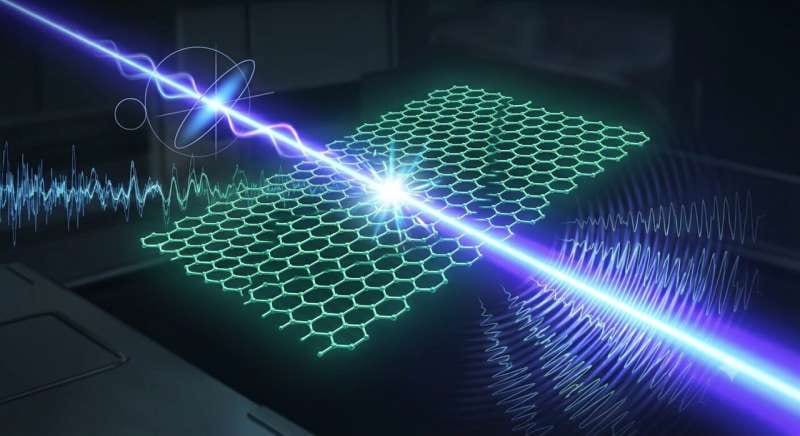
Kartik Prabhu and professor Gopal Dixit of IIT Bombay's Physics Department have proposed a new way to detect quantum fluctuations in light using the quantum material graphene as a sensor.
Their study, published in Physical Review B, shows that when specially prepared quantum light is shone on graphene, its interaction with graphene can reveal information about the quantum nature of the incident light. It also shows that by carefully engineering the quantum fluctuations in the incident light, we can generate tailored high-frequency emission.
"Our study brings together, for the first time, quantum light, a quantum material and high-harmonic generation in the extreme ultraviolet frequency range," says Dixit. High-harmonic generation is an emerging technique for imaging electron dynamics and makes it possible to track complex chemical reactions in real time.
The method involves shining short, intense laser pulses on noble gases or specific solids to obtain a very short pulse of attosecond duration (a billionth of a billionth of a second) with a frequency that is an exact integer multiple of the original laser's frequency.
Quantum fluctuations in light
In classical physics, light is treated as a wave and described by its intensity (amplitude) and the initial shift of the wave's peaks (phase). As we scale down to minute levels in time, space and intensity, we enter the realm of quantum physics. Here, light is described in terms of intensity and phase values, with a range of uncertainty for both.
Even in a complete vacuum or total darkness, there are temporary random changes in the amount of energy at a point. Heisenberg's uncertainty principle states that two quantities with specific mathematical relationships cannot be known with absolute precision. For example, we can precisely determine either a particle's position or its momentum, but not both at the same time.
The uncertainty is present in light too. These disturbances due to the uncertainty are termed quantum fluctuations. This uncertainty limits highly sensitive measurements, such as those made by atomic clocks (which keep time by measuring atomic vibrations) or gravitational-wave measurements at LIGO (Laser Interferometer Gravitational-Wave Observatory).
For laser light, quantum fluctuations, or uncertainty, are spread equally between intensity and phase. In a diagram where the x-axis represents intensity and the y-axis represents phase, the equally distributed quantum fluctuations form an uncertainty circle.
You can reduce the uncertainty of one parameter at the cost of increasing the uncertainty of the other by passing laser light through specific materials called nonlinear crystals. In the phase-intensity graph, the perfect circle would get squished in one direction and elongated in the other. Such light is called squeezed light.
Sensing quantum fluctuations
The IIT Bombay study considers graphene illuminated by light with two circularly polarized frequency components rotating in opposite directions, with one component's frequency twice the other's. The light interacts with graphene to generate high-frequency light, with frequencies several times higher than those of the incident light (high-harmonic generation).
For light with no enhanced quantum fluctuations, some high-harmonic frequencies can be produced, and some (specifically multiples of three times the fundamental frequency of the incident light) are forbidden.
When the researchers consider that the driving light is in a squeezed quantum state (it has enhanced quantum fluctuations), the results show that the quantum fluctuations activate signals that would otherwise be forbidden. Theoretical analysis revealed that the quantum fluctuations affect the polarization of the emitted light.
The researchers considered different variations and combinations of the incident-light parameters and analyzed the spectrum of the emitted light. They found that each combination produced emitted light with specific characteristics, indicating that the emitted light can be used to sense specific properties of the incident light.
While basic mathematical processing of the emitted light could reveal which frequency component of the incident light carried quantum fluctuations, it did not reveal information about the quantum component itself. To uncover information about the quantum fluctuations, the researchers further analyzed the data.
They showed that the forbidden frequency components of the emitted light carry distinct information about the intensity and polarization of the quantum fluctuations in the incident light. This information provides an experimentally observable parameter for detecting quantum fluctuations in the incident light.
"An important feature of the proposed approach is its ultrafast nature. High-harmonic generation occurs within a fraction of an optical cycle, allowing the interaction between quantum light and matter to be explored on extremely short timescales," says Dixit.
Although the present study focuses on graphene, the underlying idea may be relevant to a broader class of quantum materials and nonlinear optical systems. Going forward, Dixit plans to explore different quantum materials. Plans also include generating datasets to train a machine learning model and applying AI to generalize the concept.
Publication details
Kartik Prabhu et al., Sensing quantum fluctuations via forbidden harmonics in quantum materials, Physical Review B (2026). DOI: 10.1103/v886-ypf7
Provided by IIT Bombay
Who's behind this story?

Swati Mestri
Swati Mestri holds a bachelor's degree in Electronics Engineering and has worked as a content editor since 2019. She has experience editing research documents across technology, health care, and materials science, and has a particular interest in technology and space. Full profile →

Robert Egan
Bachelor's in mathematical biology, Master's in creative writing. Well-traveled with unique perspectives on science and language. Full profile →
Citation: Normally forbidden emissions from graphene could expose quantum fluctuations in incoming light (2026, October 19) retrieved 19 October 2026 from https://phys.org/news/2026-10-forbidden-emissions-graphene-expose-quantum.html
This document is subject to copyright. Apart from any fair dealing for the purpose of private study or research, no part may be reproduced without the written permission. The content is provided for information purposes only.
来源:Phys.org 光学与光子学 · phys.org