国际团队用极紫外光实现氦电子的量子相干控制
Steering electrons with extreme ultraviolet light—team achieves quantum coherent control
国际研究团队利用极紫外(XUV)脉冲,通过调节光场相位控制两条受激拉曼路径的干涉,改变氦He(2s)束缚态的激发产额。实验在意大利的FERMI自由电子激光设施完成,结果发表于Nature Photonics。团队认为,这一概念未来可能用于元素特异性成像与光谱工具,追踪电子运动和化学转化。
通过调节极紫外场相位改变两条受激拉曼路径的干涉,展示了将可见光和红外相干控制方法扩展到更高能光谱区域的路径。
中文译文尚未生成,当前展示的是已获取的原文文本。
Light is one of the most powerful tools scientists have for probing matter. By interacting with electrons, light reveals how atoms, molecules and materials are structured and how they evolve in time. Highly energetic ultraviolet and X-ray photons are particularly attractive because they can access electrons located close to atomic nuclei, where each chemical element carries its own distinctive electronic fingerprint.
While researchers can control electrons with visible and infrared lasers, extending these techniques to the XUV and X-ray domains has proven far more challenging. The international research team has now brought a new tool to that demanding region of the spectrum.
Making an electron go both ways... or not.
One of the strangest features of quantum mechanics is that a process can happen in more than one way at the same time. An electron can reach the same final state through different routes, and these routes can either add up or cancel each other, much like overlapping ripples on the surface of water.
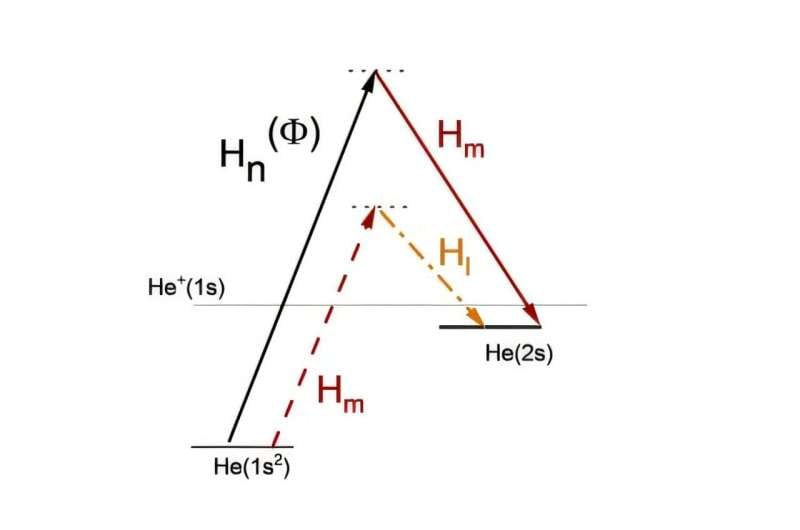
The researchers exploited this phenomenon by creating two competing quantum routes to excite a bound state in He. For these quantum routes, they used so-called stimulated Raman excitation with XUV pulses.
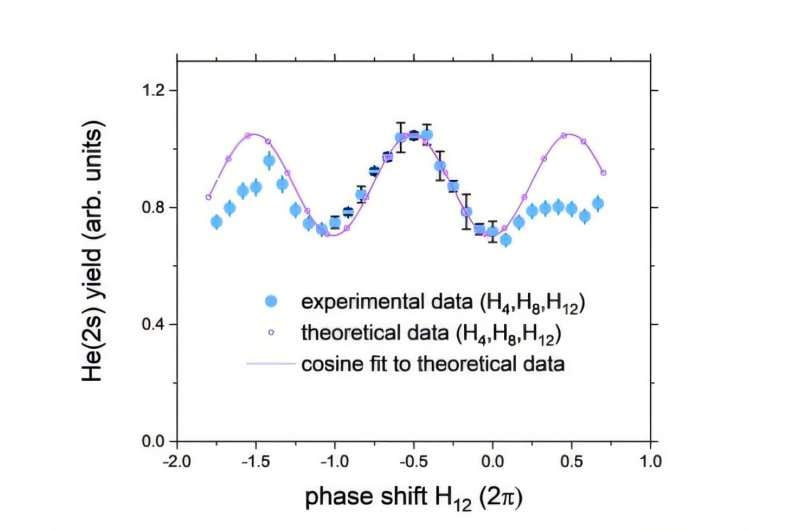
"With the stimulated Raman excitation in the XUV it's a little bit as if we could eject an electron from an atom and then bring it back home with light. Remarkably, when we have two of these transition pathways we can decide whether that happens or not simply by introducing very small delays in the light we shine on it. In other words, by controlling the phase of the light pulses in one of the quantum routes, we can decide whether the two quantum pathways cooperate with each other or work against each other," says Matthieu Génévriez, one of the authors and a researcher at UCLouvain.
The outcome of the excitation varies with the phase of one of the XUV fields.
For decades, scientists have relied on stimulated Raman scattering and related techniques using visible and infrared lasers to follow chemical reactions and electronic motion. "The new experiment demonstrates that these powerful methods can now be brought into the extreme ultraviolet, overcoming a long-standing challenge and opening new possibilities for imaging and manipulating matter with unprecedented spatial resolution," says Ulli Eichmann, the lead author and a researcher at the Max Born Institute.
The experiment reported in Nature Photonics was carried out at the FERMI free-electron laser in Trieste, Italy, one of only a handful of facilities worldwide capable of producing the intense and highly controlled extreme-ultraviolet light required for this type of study.
"These facilities produce extremely bright and ultrashort flashes of XUV and X-ray light, allowing us to probe matter in ways that were previously impossible," explains Jan-Erik Rubensson, a researcher at Uppsala University. "In some sense, they provide a snapshot of the motion of electrons and atomic nuclei, much like an X-ray image captures structures inside the human body," adds Eichmann.
The international team believes that the concepts demonstrated in this work could eventually enable a new generation of element-specific imaging and spectroscopy tools, capable of tracking electronic motion and chemical transformations at the smallest scales.
Publication details
Ulli Eichmann et al., Phase control of interfering stimulated Raman pathways in the XUV regime, Nature Photonics (2026). DOI: 10.1038/s41566-026-02024-9
Provided by Max Born Institute Berlin
Who's behind this story?

Gaby Clark
MA in English, copy editor since 2021 with experience in higher education and health content. Dedicated to trustworthy science news. Full profile →

Robert Egan
Bachelor's in mathematical biology, Master's in creative writing. Well-traveled with unique perspectives on science and language. Full profile →
Citation: Steering electrons with extreme ultraviolet light—team achieves quantum coherent control (2026, October 20) retrieved 20 October 2026 from https://phys.org/news/2026-10-electrons-extreme-ultraviolet-team-quantum.html
This document is subject to copyright. Apart from any fair dealing for the purpose of private study or research, no part may be reproduced without the written permission. The content is provided for information purposes only.
来源:Phys.org 光学与光子学 · phys.org