韩国KRISS借助光子光栅芯片重测锶原子461 nm跃迁频率,不确定度降低50倍以上
Scientists redetermine a key strontium frequency with 50 times better precision for quantum technologies
韩国标准科学研究院(KRISS)利用光子光栅芯片重新测量锶原子461 nm光学跃迁的绝对频率,测量不确定度降至约5 MHz,比1938年的旧值改善50倍以上,成果发表于Metrologia。
中文译文尚未生成,当前展示的是已获取的原文文本。
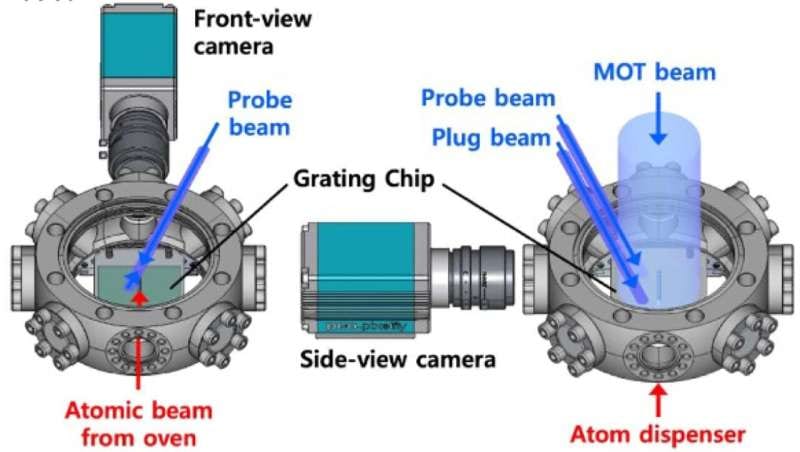
The Korea Research Institute of Standards and Science (KRISS) has remeasured a key transition frequency of the strontium (Sr) atom for the first time in 88 years, since 1938, using a photonic grating chip. It has established a new absolute frequency value with a measurement uncertainty reduced by more than 50 times. By providing an accurate reference value for next-generation quantum technologies, this achievement is expected to contribute to the precise control and miniaturization of quantum devices, including atomic clocks and neutral-atom quantum computers. The work is published in the journal Metrologia.
Strontium is an atom widely used in precision quantum technologies such as optical lattice clocks and quantum sensors. To use strontium in these technologies, fast-moving atoms must be slowed down and trapped with precisely tuned lasers. This requires knowing the exact resonant frequency of the laser light for the atomic transition.
However, the previous frequency value was obtained in 1938 by comparing the solar spectrum with the arc light of strontium, and its uncertainty was too large for today's precise laser frequency settings. As a result, researchers have had to observe the atoms' response directly and adjust the laser frequency as needed, much like turning the dial of an analog radio to tune in to a station.
As frequency control and measurement technology for light has advanced and the miniaturization of quantum devices has been pursued, the need for an accurate absolute frequency value has grown. In response, the research team measured the absolute frequency of the 461-nanometer (nm) optical transition of strontium atoms. After a yearlong campaign of precision measurements, the uncertainty was reduced to about 5 megahertz (MHz), an improvement of more than 50 times over the previous value.
This measurement established traceability to the national time and frequency standard of Korea Standard Time, which KRISS establishes and maintains. Because this standard is linked to the International System of Units (SI), measurements can be reliably compared against the same reference anywhere in the world, regardless of differences in laboratory or equipment environments.
The key device that enhanced measurement stability is the "photonic grating chip," jointly developed by KRISS with the Korea Advanced Institute of Science and Technology and the National NanoFab Center. The fine grating structure on the surface of the chip, installed inside a vacuum, diffracts and reflects light in set directions, reducing measurement errors caused by mechanical vibrations compared with conventional methods that require aligning multiple external mirrors. In addition, a single chip can generate laser beams in multiple directions, simplifying the optical setup.
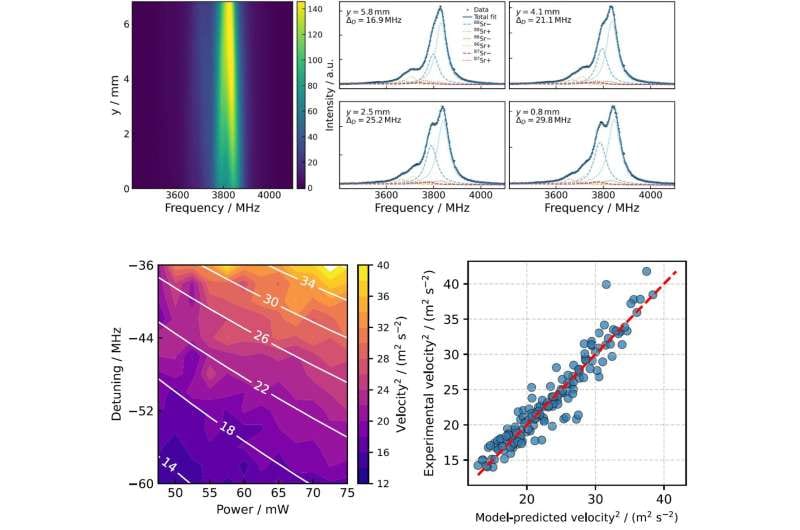
Having reduced equipment-related measurement errors, the researchers then determined the transition frequency independently using two methods based on different principles, verifying the reliability of the results. One method analyzes how the atoms respond to light depending on the laser frequency, while the other deduces the transition frequency from the velocity distribution of an atomic beam slowed by lasers.
The values obtained from the two methods agreed within their margins of error, and the final value was calculated by accounting for the uncertainty of each result in accordance with international guidelines.
The newly established absolute frequency value can be used as a reference for precisely cooling, trapping and controlling atoms in strontium-based optical lattice clocks, quantum sensors and neutral-atom quantum computers. Combined with optical frequency synthesis technology that is currently being developed, it frees next-generation quantum devices from being tethered to bulky, external atomic frequency references. These technologies are expected to accelerate the miniaturization and commercialization of cold-atom-based quantum devices.
Dr. Jae Hoon Lee, principal research scientist in the Atomic Quantum Sensing Group at KRISS, said, "I believe the main significance of this research is not simply that we remeasured a single frequency value, but that we proactively delivered an accurate measurement reference point for next-generation quantum technologies.
"As a national metrology institute (NMI), KRISS will continue to pioneer standards for the new areas of measurement needed in quantum science and technology."
Publication details
Jaewhan Lee et al., Strontium 1S0 → 1P1 transition frequency measurements assisted by a photonic grating chip, Metrologia (2026). DOI: 10.1088/1681-7575/ae8bb5
Who's behind this story?

Lisa Lock
BA art history, MA material culture. Former museum editor, paramedic, and transplant coordinator. Editing for Science X since 2021. Full profile →

Andrew Zinin
Master's in physics with research experience. Long-time science news enthusiast. Plays key role in Science X's editorial success. Full profile →
Citation: Scientists redetermine a key strontium frequency with 50 times better precision for quantum technologies (2026, October 19) retrieved 19 October 2026 from https://phys.org/news/2026-10-scientists-redetermine-key-strontium-frequency.html
This document is subject to copyright. Apart from any fair dealing for the purpose of private study or research, no part may be reproduced without the written permission. The content is provided for information purposes only.
来源:Phys.org 光学与光子学 · phys.org