计算模型指导照明设计以改善老年人色彩分辨
Computational model guides lighting design to improve color discrimination in aging eyes
研究人员开发了考虑眼睛随年龄变化的计算模型,可指导白光光谱设计,在保持常规白光特性的同时帮助老年人更好地分辨颜色。
中文译文尚未生成,当前展示的是已获取的原文文本。
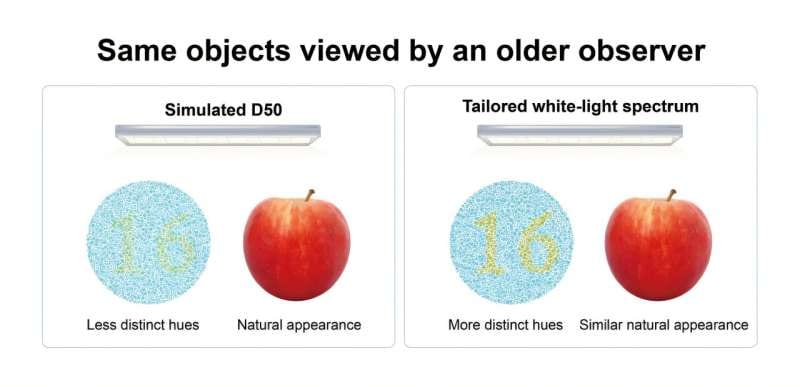
Researchers have developed a new computational model that accounts for the effects of aging on our eyes' ability to discriminate color. It could help guide lighting designs that make it easier for older adults to perceive colors while preserving the expected appearance for people with typical color vision.
"As people age, the lens inside the eye gradually yellows and absorbs more short-wavelength light, which can make similar colors harder to discriminate," said research team leader Qi Dai from Fudan University in China. "We incorporated these age-related changes into a model that can be used to guide the spectrum, or mixture of wavelengths, used for white lighting to make it easier for older adults to perceive colors."
In the journal Optics Express, researchers from Fudan University and OPPLE Lighting report results from a study that used the new model to design lighting spectra that account for how aging eyes perceive color. In a group of adult volunteers ages 70 and older, the resulting lighting improved color discrimination compared with an LED-simulated D50 daylight reference at nearly the same color temperature, while familiar colors still looked natural.
"Lighting that accounts for age-related changes in color vision could help older adults remain confident and independent in performing tasks such as reading labels, sorting medications, judging food or choosing clothing," said Dai. "In a family home or care facility, lighting designed with aging eyes in mind could support older users while retaining the characteristics needed for general use."
Modeling age-related color vision changes
Conventional ways to measure color quality generally use a mathematical representation of human color vision. However, this doesn't account for how the eye's sensitivity to different wavelengths changes with age due to lens yellowing.
"We wanted to find out if we could use new knowledge about how vision changes with age to guide the design of white light that measurably helps older adults distinguish colors while retaining conventional lighting color-quality requirements," said Dai. "Our work provides a practical link between describing aging vision and designing lighting to support it."
The researchers developed a model that estimates how easily a person would be able to distinguish similar colors based on the illumination light's spectrum, the wavelengths reflected by colored objects and age-adjusted sensitivities of the eye's three cone types.
The researchers used their model to evaluate 11,541 possible light spectra that met standard requirements for white light and color rendering near 5000 K, which is a neutral, daylight-like white. They found that spectra that otherwise appeared similar could differ substantially in how they were predicted to affect the ability of older adults to distinguish between similar colors.
Based on this analysis, the researchers selected two lighting spectra: P1, which was optimized to improve color discrimination, and P2, which was designed to balance color discrimination with natural-looking colors. For a modeled 85-year-old observer, P1 was predicted to recover about 49% of the age-related loss in color discrimination while P2 recovered about 36%.
From research to lighting solutions
To see if these optimized spectra helped with color discrimination in people, the researchers asked 34 adult volunteers, ages 70 and above, to perform a color-sorting test under lighting with both the P1 and P2 spectra and an LED-simulated daylight reference. For all three conditions, the illuminance and color temperature were nearly identical.
Both optimized spectra significantly improved performance on the color-sorting test compared with the simulated daylight reference. At the individual level, 26 of 34 participants (76.5%) improved color discrimination when the P1 spectrum was used, and 22 of 34 (64.7%) improved with P2.
"The findings suggest that the model could be used to design everyday lighting that makes it easier for older adults to see colors while keeping familiar object colors looking natural," said Dai. "Since the spectra also met conventional criteria for white-light chromaticity and color rendering, they could be used for lighting spaces shared by people of different ages."
Dai adds that their approach could be expanded to capture how displays appear to older viewers or to other groups with known differences in spectral sensitivity. However, this would require dedicated modeling and human testing.
OPPLE Lighting is now working toward translating the findings into practical lighting products. The researchers note that before wider adoption, additional studies should evaluate the approach in everyday settings and at other commonly used illuminances and color temperatures. Testing lighting solutions with people of a wider range of ages, including younger users, would also provide valuable information for lighting that is used in shared spaces.
Publication details
Chengya Lu et al., Enhancing Color Discrimination in Older Adults through Age-Adaptive Spectral Optimization of Lighting, Optics Express (2026). DOI: 10.1364/oe.609942
Who's behind this story?

Gaby Clark
MA in English, copy editor since 2021 with experience in higher education and health content. Dedicated to trustworthy science news. Full profile →

Robert Egan
Bachelor's in mathematical biology, Master's in creative writing. Well-traveled with unique perspectives on science and language. Full profile →
Citation: Computational model guides lighting design to improve color discrimination in aging eyes (2026, October 13) retrieved 17 October 2026 from https://phys.org/news/2026-10-discrimination-aging-eyes.html
This document is subject to copyright. Apart from any fair dealing for the purpose of private study or research, no part may be reproduced without the written permission. The content is provided for information purposes only.
来源:Phys.org 光学与光子学 · phys.org