光纤中首次实现光与行波声波强耦合
A highway instead of a racetrack: Strong coupling of light and sound in an optical fiber
研究人员首次在光纤中观测到光波与行进声波的强耦合,为光声信号处理提供新平台。
中文译文尚未生成,当前展示的是已获取的原文文本。
For the first time, scientists have achieved strong coupling between light and long-lived acoustic vibrations in an optical fiber. Optical fibers are used in both classical telecommunications and quantum communication and could serve not only as connections between computing nodes but also as quantum processors themselves in the future. The results, published in Nature Physics, pave the way for new technologies in quantum signal processing.
Mechanical and acoustic vibrations can be used to convert signals across various frequency ranges, from optical frequencies (terahertz) to microwaves (gigahertz) and even lower frequencies (megahertz or kilohertz). For instance, this capability is essential to connect multiple quantum computers operating at gigahertz frequencies via optical links. Furthermore, acoustic waves propagate at speeds significantly lower than the speed of light. So, they provide a medium capable of transporting slowly moving information—which is of great interest for data storage and the temporary buffering of information.
However, to utilize one of these processing capabilities for quantum information via mechanical vibrations, one prerequisite is needed: the strong coupling regime. This regime ensures that quantum information is exchanged before it is lost due to losses and decoherence. Decoherence describes the state in which the waves no longer oscillate in unison. In the strong coupling regime, quantum information can be processed more quickly—faster than the rate at which noise enters the system—without losing quantum properties.
Until now, the strong coupling regime has been achieved in so-called optomechanical cavities, which can be understood as racetracks for light. Light speeds around these optical cavity "racetracks" up to a million times, giving it the opportunity to strongly couple with vibrations along the cavity path. However, when light travels through an optical fiber, it is akin to driving on a highway. The optical signals speed in one direction along the "fiber highway" and pass vibrations or other obstacles only once, instead of a million times on a racetrack. Consequently, achieving strong coupling between optical information and an acoustic vibration during a single pass is extremely difficult.
Strong coupling between light and sound achieved for the first time without an optical or mechanical resonator
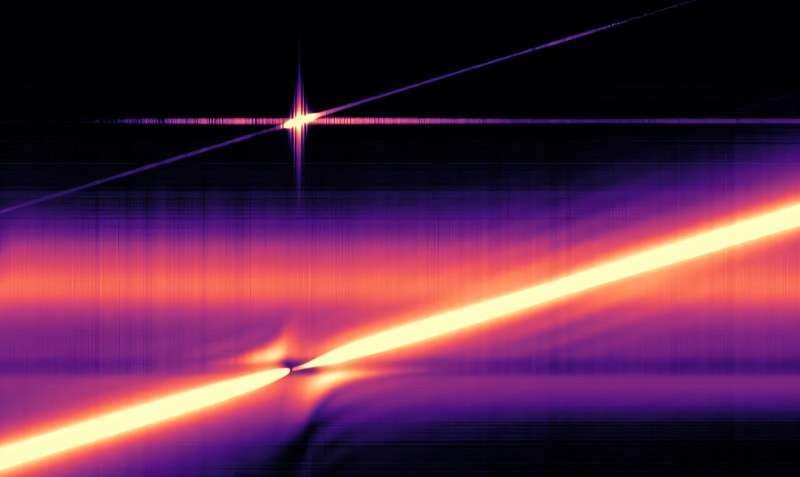
Scientists at the Max Planck Institute for the Science of Light (MPL) and Leibniz University Hannover (LUH) for the first time have achieved strong coupling within a cooled optical fiber via light-sound interactions—specifically through the effect of stimulated Brillouin scattering. This state of strong coupling between light and sound is realized without an optical resonator or a mechanical resonator. In a single pass of the light through an optical fiber at moderate cryogenic temperatures of 4 K, the team led by Birgit Stiller succeeded in generating light-sound interactions much stronger than the losses caused by both optical and acoustic noise sources.
A gap appears in the spectral signal measurement—which the researchers interpret as evidence of strong coupling. "We have introduced a new measurement technique that allows us to observe the clearest sign of strong coupling: precisely this gap in the spectral response, which is otherwise only visible in resonators," says Laura Blázquez Martínez, first author of the study. The phenomenon of avoided crossing is normally observable in resonator configurations (racetrack), but not in inline operation (highway). Consequently, the new experimental technique represents an important proof of concept of in-fiber strong coupling.
"This result is a crucial step toward utilizing optical fibers as a powerful platform for quantum interactions," says Stiller, head of the Quantum Optoacoustics research group at MPL and professor at the LUH. "The demonstration that this state can be achieved in optical fibers paves the way for performing quantum measurements on the platform that already underpins the bulk of our telecommunications system."
Furthermore, this result has implications for research into the transition between classical and quantum physics. Optical fibers are far more massive objects than the micro-optomechanical resonators typically used to study the interactions between light and mechanical waves. The ability to study the quantum properties of this interaction opens a means of studying the quantum properties of massive objects.
Publication details
Laura Blázquez Martínez et al., Cavity-less Brillouin strong coupling in a solid-state continuous system, Nature Physics (2026). DOI: 10.1038/s41567-026-03458-2
Who's behind this story?

Lisa Lock
BA art history, MA material culture. Former museum editor, paramedic, and transplant coordinator. Editing for Science X since 2021. Full profile →
Alexander Pol
PhD nano-engineering from Delft University. Published researcher and journal reviewer. Brings scientific insight to content standards. Full profile →
Citation: A highway instead of a racetrack: Strong coupling of light and sound in an optical fiber (2026, October 16) retrieved 17 October 2026 from https://phys.org/news/2026-10-highway-racetrack-strong-coupling-optical.html
This document is subject to copyright. Apart from any fair dealing for the purpose of private study or research, no part may be reproduced without the written permission. The content is provided for information purposes only.
来源:Phys.org 光学与光子学 · phys.org