东京大学定制帧间隔,捕捉跨五个时间数量级的超快过程
Custom frame timing captures ultrafast events across five orders of magnitude in time
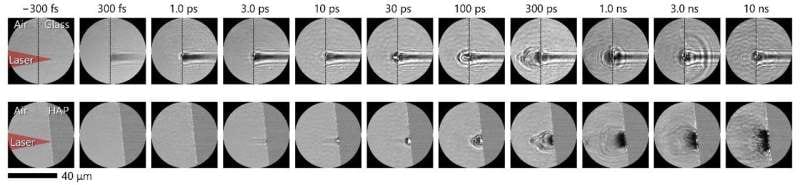
东京大学团队开发对数超快摄影方法,用11帧在单次拍摄中连接约100飞秒至10纳秒、跨五个数量级的动态过程。该方法在STAMP中引入分波段独立延迟生成(BRIDGE),独立调节各波段时序,将帧安排为早期密集、后期稀疏。发表于Optica的研究展示了玻璃和羟基磷灰石受到超短激光脉冲照射后的早期变化、后续冲击波与材料喷射。
将有限帧数按早密晚疏的时间间隔分配,可在同一次难以重复的事件中连接早期变化与后续冲击波及材料喷射。
中文译文尚未生成,当前展示的是已获取的原文文本。
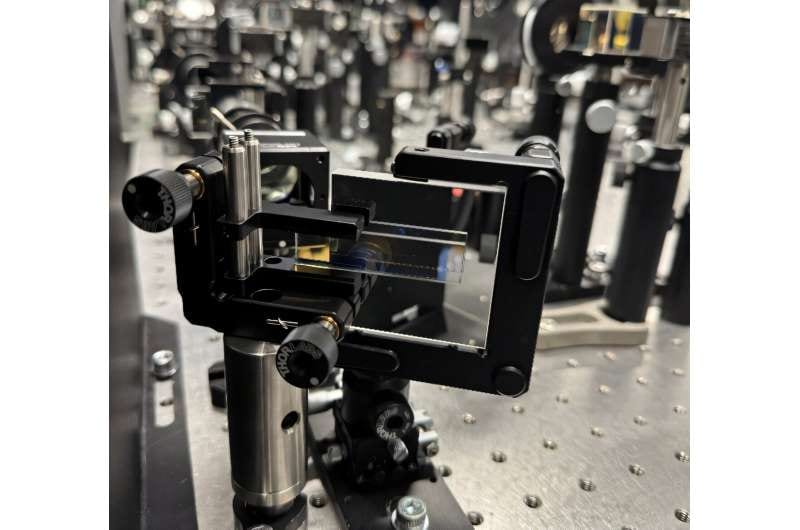
Most conventional methods of ultrafast photography use evenly spaced intervals in which images are taken, but new developments have shown how much can be left out of the story, especially when multiple timescales are involved.
Ultrafast events, such as a laser pulse or shock-wave emission, can be captured using ultrafast imaging. Conventional methods of imaging operate on microsecond (millionths of a second) or millisecond (thousandths of a second) timescales and usually have a set, evenly spaced—or mostly evenly spaced—interval in which images are taken. While this can work to capture some characteristics of the ultrafast event, not every important and observable dynamic happens at neatly spaced intervals.
Targeting moments of rapid change
To address this, a team led by associate professor Keiichi Nakagawa of the Department of Bioengineering at the University of Tokyo developed a method to capture these unseen instances by focusing their limited image captures on the times during which dynamic changes take place, using logarithmic ultrafast photography and band-resolved individual delay generation (BRIDGE). The work is published in the journal Optica.
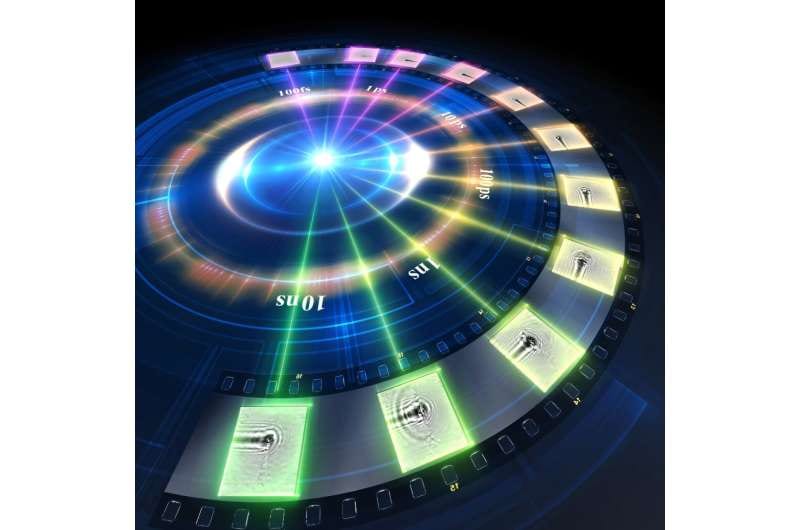
Logarithmic ultrafast photography is a process that distributes a set number of single-shot frames across a period of time, timed to correspond to moments of characteristic importance in the target occurrence. The team developed this technique to better capture instances otherwise unseen due to their speed of reaction and the shortcomings of conventional techniques.
Bridging femtoseconds and nanoseconds
The concept of logarithmic ultrafast photography is implemented in sequentially timed all-optical mapping photography, or STAMP, which offers high image quality and ultrafast operation, using BRIDGE. BRIDGE extracts wavelength bands sequentially and allows for the independent adjustment of these bands while maintaining the ability to map them to specific instants during the dynamic process. Within this process, a finite number of frames can be placed across femtosecond (quadrillionths of a second) to nanosecond (billionths of a second) timescales.
With BRIDGE, timing control is accessible across timescales and can enhance observation of what normally occurs too quickly to be seen.
"We wanted to find a way to connect these very different timescales in a single measurement. In other words, we wanted to see both the first instance and what follows, without having to choose one or the other," said Keitaro Shimada, a postdoctoral researcher in the Nakagawa Group and lead author of the study.
By customizing the intervals between frames when taking ultrafast images, researchers are able to slow down key moments that might otherwise be missed with regular intervals, allowing the beginning of an ultrafast event to be captured in addition to what follows immediately afterward, in one shot. This technique allows for 11 frames to capture the key instances across five orders of magnitude in time—from around 100 femtoseconds to 10 nanoseconds.
Capturing hard-to-repeat events
Conventional single-shot ultrafast imaging most often involves imaging at a uniform interval within a selected window of time, emphasizing a single moment captured during the process instead of the entire journey.
"We are particularly interested in phenomena that are difficult to reproduce exactly. In those cases, recording the early and later stages of the same event can reveal relationships that might be lost when a sequence is reconstructed from separate experiments," said Nakagawa, a co-author and principal investigator of the study.
The researchers continue to focus on learning more about the unknown: short-lived phenomena whose peak moments are elusive, or connections between different phases of the same physical process that have yet to be seen due to differences in timescales. The technique has many potential uses, though researchers propose using it primarily in laser processing, material dynamics, plasma and shock-wave research, and biomedical applications.
Publication details
Keitaro Shimada et al., Logarithmic ultrafast photography with band-resolved individual delay generation, Optica (2026). DOI: 10.1364/optica.610944
Journal information: Optica
Who's behind this story?

Gaby Clark
MA in English, copy editor since 2021 with experience in higher education and health content. Dedicated to trustworthy science news. Full profile →
Robert Egan
Bachelor's in mathematical biology, Master's in creative writing. Well-traveled with unique perspectives on science and language. Full profile →
Citation: Custom frame timing captures ultrafast events across five orders of magnitude in time (2026, October 20) retrieved 20 October 2026 from https://phys.org/news/2026-10-custom-captures-ultrafast-events-magnitude.html
This document is subject to copyright. Apart from any fair dealing for the purpose of private study or research, no part may be reproduced without the written permission. The content is provided for information purposes only.
来源:Phys.org 光学与光子学 · phys.org