China's Top Three LiDAR Players Reposition Their Business Focuses as Growth Logic Diverges
深度丨国内激光雷达三强重排业务重心,增长逻辑开始分化
Topics and contents
Topic
On this page
Hesai, Seyond and RoboSense released their financial reports in succession in August. Comparing the three, the article notes that as production vehicle models, robotics and embodied AI generate real demand, the growth logic of leading LiDAR companies is beginning to diverge.
Introduction:
LiDAR once carried high hopes from the capital markets, like a spark waiting to be lit, connecting autonomous driving with the intelligent world.
Today, as production vehicles, robots and embodied intelligence gradually become real demand, leading domestic players are heading down different tracks.
Author | Fang Wensan
Image source | Internet
LiDAR Leaders 'Take the Same Test'
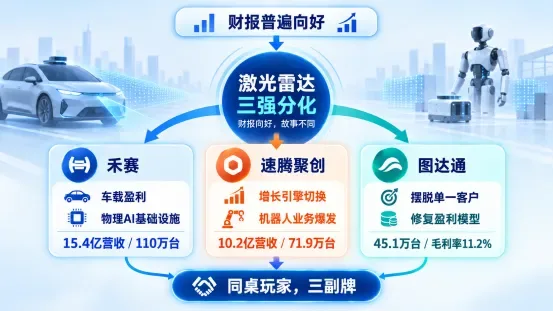
Hesai Technology released its second-quarter results on August 18, Seyond delivered its first half-year report since listing on August 20, and RoboSense disclosed its interim results on August 26.
The three earnings reports came out within a week of each other. Read together, they surface a fact previously obscured by the “shipment volume race”: China's top three LiDAR makers are no longer telling the same story.
Hesai posted net revenue of RMB 1.541 billion in the first half, up 25.1% year on year, with net profit of RMB 88.9 million, up 234.9%, and combined ADAS and robotics LiDAR shipments of 1.1 million units.
RoboSense reported first-half revenue of RMB 1.020 billion, up 30.2% year on year, with total LiDAR sales of 719,200 units, of which 282,600 units came from its robotics business, soaring 510.4% year on year.
Seyond shipped about 450,900 LiDAR units in the first half, up 364.8% year on year, exceeding its full-year 2025 total in just six months, with revenue of US$138.7 million and gross margin rising to 11.2%.
All three earnings reports look impressive, but the logic behind the results is entirely different.
Hesai is using profits from its automotive business to incubate a new identity as a「physical AI infrastructure」player, RoboSense has substantially switched its growth engine to robotics, while Seyond is busy shaking off reliance on a single major customer and repairing its profit model.
The players at the same table are starting to play three different hands.
Automotive core business: from growth story to cash cow
To understand why the big three are collectively「reshaping their lineups」, it helps to first take a clear look at the state of the automotive LiDAR market,which on the surface is still expanding rapidly.
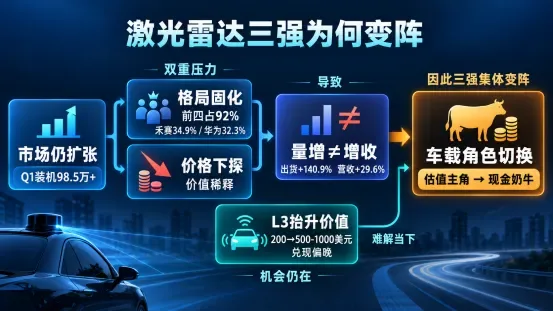
In the first quarter of 2026, total LiDAR installations in passenger vehicles in China exceeded 985,000 units, with leading vendors holding the lion's share.
But the landscape has become highly entrenched: Hesai ranked first with 328,000 units installed and a 34.9% share, Huawei followed closely with 304,000 units and 32.3%, and Seyond and RoboSense took third and fourth place. The top four together captured 92% of the market. Little room remains for smaller vendors, and the game has entered a stalemate among giants.
Alongside the solidification of market share came value dilution. When RoboSense released the MX in 2024, its initial mass-production price had already been pushed down to around US$200; two years on, LiDAR prices have kept falling with thousand-yuan-class products like the ATX, and the sensors are now fitted in vehicles priced between 80,000 and 100,000 yuan.
Price is the precondition for penetration, but the cost shows up in the financial statements: Hesai shipped 471,700 units in the first quarter of 2026, up 140.9% year on year, yet revenue grew only 29.6%, leaving a gap of more than 100% between the two growth rates. The more it sells, the cheaper each unit becomes, and the gulf between revenue and volume keeps widening.
The automotive business still has a chance for another step up in value,L3 vehicles typically use「one main LiDAR plus multiple blind-spot LiDARs」, a configuration that could lift the value per vehicle from about US$200 to US$500–1,000.
But that revenue will most likely materialize only between late 2026 and 2027 — distant water cannot quench an immediate thirst.
As a result, the automotive business has collectively changed roles in the strategic maps of the top three players,no longer the protagonist of the valuation story, but a cash cow.
Hesai posted second-quarter revenue of 860 million yuan and GAAP net profit of 70.55 million yuan, up 60% year on year, marking its fifth consecutive quarter of GAAP profitability. In June, its share of China's automotive main LiDAR market reached 44%, twice that of the second-ranked player, holding first place for 17 consecutive months.
When a company has built its core business to this point, the most natural question becomes: where should the money it earns be invested?
Robotics' second curve: delivery speeds are already diverging
Robotics is the answer shared by almost every player,and RoboSense is the earliest starter on this curve.
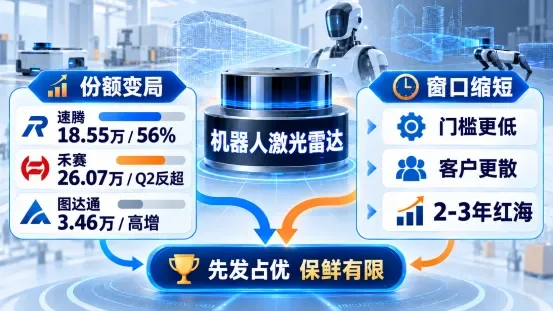
In the first quarter of 2026, its robotics LiDAR sales reached 185,500 units, soaring 1458.8% year on year, and their share of total sales rose from about 11% in the same period last year to 56%, surpassing the ADAS business for the first time in history.
By the first half of the year, the robotics business already accounted for nearly half of its product revenue and was the main source of product gross profit.
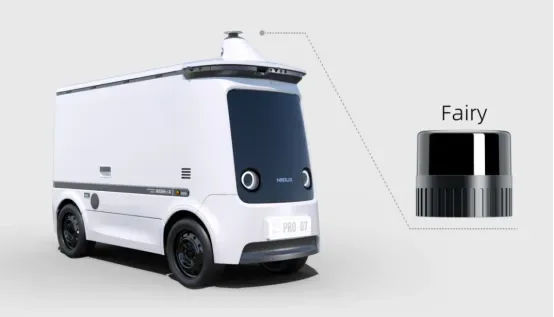
What is driving this growth is not the humanoid robots in the spotlight, but a set of「unsexy but genuinely lucrative」scenarios: in the robotic lawn mower market, RoboSense holds an absolute share among leading customers and expects to ship 450,000 to 600,000 units in 2026; in unmanned delivery, its coverage of leading customers exceeds 90%, with Neolix, JD.com and Meituan all on its customer list.
By comparison, the humanoid robot market is only in the tens of thousands of units this year. Even if it climbs to 100,000-200,000 units next year, that remains a sideshow against the millions of units shipped annually in the automotive market, contributing valuation upside rather than current revenue.
Hesai is catching up faster than most expected, shipping 260,700 robot LiDAR units in the first half and narrowing the gap with RoboSense to about 20,000 units. In the second quarter alone, Hesai overtook RoboSense with 142,400 units versus 97,100.
Seyond's robot business shipped about 34,600 units in the first half, up 842.9% year on year — impressive growth, but from a small base.
One easily overlooked variable lurks here: the window for robot LiDAR may be far shorter than for the automotive market. This track has lower technical barriers and more fragmented customers.
The competition is not just among the top three, either. 3D vision leader Orbbec's revenue from vision solutions for the global robot market has reached more than twice the year-earlier level, with a cumulative base of over 1,000 robot customers.
What took the automotive market five years — the shift from blue ocean to red ocean — may well repeat in the robot market in two or three years. First-mover advantage is real, but it may not stay fresh for long.
The Third Curve Divide: Some Offer a Ruler, Others Tell a Story
More than the second curve, what reveals the strategic divergence among the top three is their vision beyond LiDAR.
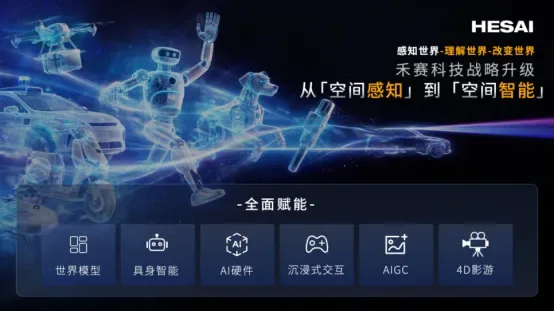
Hesai has made the most decisive moves,In April 2026, the company announced that its strategy had been upgraded from「Spatial Perception」to「Spatial Intelligence」, and its financial reporting structure was accordingly split into two major segments: the LiDAR business and the Strategic Growth Initiatives (SGI) business.
SGI generated revenue of RMB 44.943 million for the first time in the second quarter. Its robot power module production line is now fully operational, with more than 10,000 units delivered cumulatively. The Kosmo spatial intelligence platform completed delivery of its first batch of prototypes in July and has won orders from several leading humanoid robot companies, including Galbot.
Power modules mean Hesai's reach has extended from the robot's「eyes」into its「joints and muscles」, while Kosmo aims to scan the real world into 3D data assets for physical AI training.
More unusually, Hesai has turned its new businesses into verifiable KPIs: full-year 2026 SGI revenue guidance has been raised to RMB 200-300 million, with revenue expected to reach about RMB 700 million in 2027 and break-even achieved.
RoboSense is also pointing toward physical AI, building a product matrix around embodied robots that covers three core incremental categories — “eyes,” “skin,” and “muscles”: spatial cameras, tactile sensors, and joint modules, with commercial deliveries starting to roll out in the third quarter of this year.
The direction is similar; the difference lies in granularity. RoboSense has yet to disclose the revenue scale of its third growth curve or its break-even timeline. The market can only track events such as product launches and customer partnerships, lacking a financial yardstick to gauge how well the strategy is being delivered.
Seyond's situation is far more grounded, the company, which sought a Hong Kong listing via a De-SPAC deal in February 2025 at a valuation of HK$11.7 billion, still has catching up to do on its second growth curve as its core task.
On one hand, it is diversifying its customer base, cutting NIO's share of total deliveries from 97.3% in 2024 to 86.2% in 2025;
on the other, it is repairing its profitability model, with its gross margin turning positive from minus 8.7% to 7.9% in 2025, its first positive annual gross margin.
The first two have already placed their bets on the third growth curve, while Seyond is still thickening its second curve — objectively one step behind.
Behind the Divergence Lies an Underestimated Variable
Shipments are the noisiest metric in this industry — and the most misleading. To judge the substance of the Big Three's divergence this round, three sets of numbers are worth watching more closely than shipments.
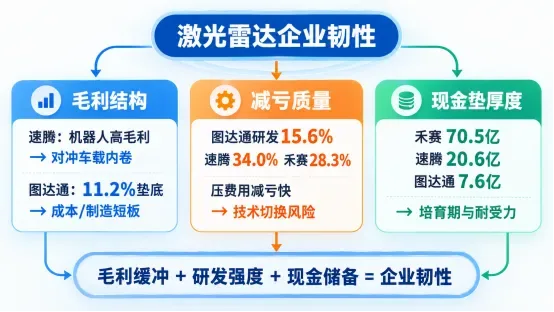
①Gross margin structure:RoboSense's confidence in absorbing a net loss of RMB 160 million in the first half stems from its robotics business, where both unit price and gross margin outperform automotive, creating a profit cushion that offsets the automotive price war.
Seyond is the opposite: its overall gross margin of 11.2% in the first half ranked last among peers. Its products sell at high prices, yet the money is not being made, exposing weaknesses in cost control and manufacturing efficiency.
②Quality of loss reduction:Seyond's R&D expense ratio was just 15.6% in the first half, versus 34.0% for RoboSense and 28.3% for Hesai over the same period.
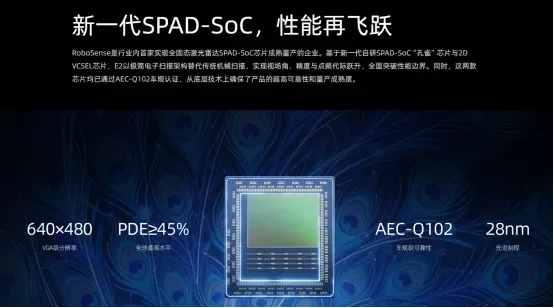
Loss reduction bought by cutting expenses delivers immediate results, but the bill may come due later.The technological shift to SPAD-SoC digital chips and all-solid-state architectures is under way, and the intensity of R&D investment directly determines a ticket to the next generation of products.
③Depth of cash reserves:As of mid-2026, Hesai held cash reserves of about RMB 7.05 billion, RoboSense about RMB 2.06 billion, and Seyond only RMB 760 million in renminbi terms.
New businesses typically take years to move from investment to breakeven. Cash reserves determine how long a company can nurture a new business, and how well it can withstand another escalation in the automotive price war.
Conclusion:
The big three are reshuffling their business priorities, seemingly competing for the same new continent called “Physical AI”, but the real contest is a far simpler proposition: whose cash cow is strong enough to keep funding a new business all the way to breakeven.
Hesai buys time with money, RoboSense trades first-mover advantage for room to grow, and Seyond trades focus for survival.
The 2026 interim reports mark only the beginning of the divergence. The strategic differences of today will truly translate into rankings when each company's new businesses report results in 2027.
Some information referenced from Gaogong Intelligent Vehicle: "LiDAR Enters the Scale Competition Stage, Leading Players Seek New Growth Curves",
Gasgoo Auto: "The LiDAR Market Enters a Period of Divergence, with Hesai, RoboSense and Innovusion Taking Distinct Paths",Zhuosi Automotive Research: "2025 Automotive LiDAR Industry Research Report",Yole Group: "Automotive LiDAR 2025",Frost & Sullivan: "Global and China LiDAR Industry Market Research Report"
Original title : In-depth | China's Top Three LiDAR Players Reorder Business Priorities as Growth Logic Diverges
Source: OFweek Laser Network · News · laser.ofweek.com