Optical Interconnect Watch: Why OCS Is the Focus at CIOE
【光互连观察04】一文读懂OCS,为啥成为CIOE最靓的仔?
Topics and contents
C114 explains the principles and industry landscape of optical circuit switches (OCS) and why they have become a highlight at CIOE.
C114 News, September 10 (Yan Yi) — Earlier this month, NVIDIA announced an investment in European silicon photonics company iPronics to support the development of second-generation OCS technology, once again igniting market enthusiasm for OCS. That enthusiasm was on full display at this year's CIOE.
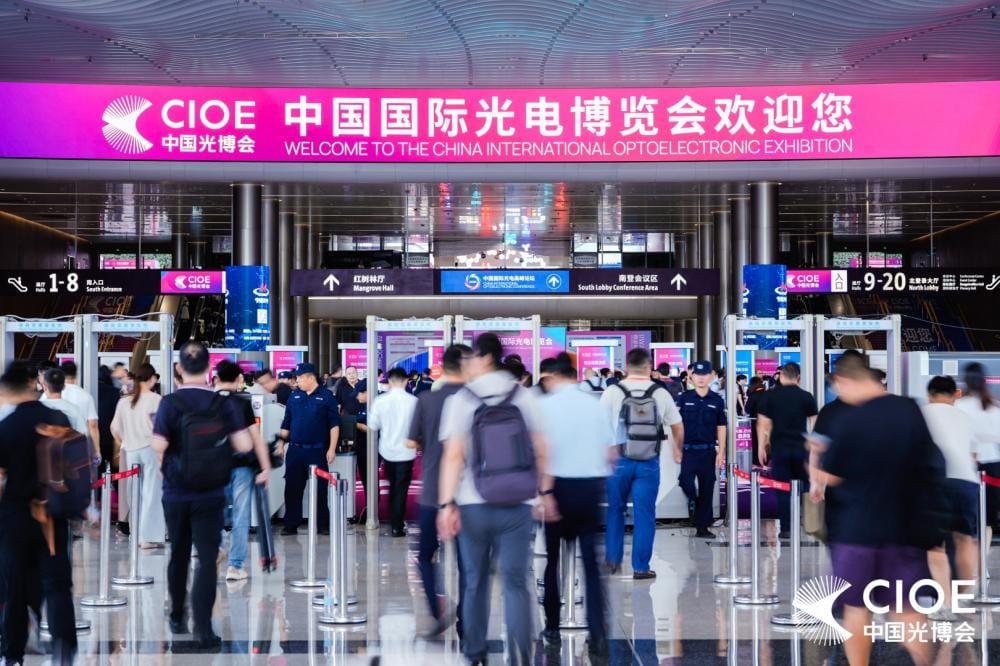
According to incomplete statistics from "Optical Interconnect," during this CIOE, multiple companies — including Accelink Technologies, Dekeli, Luster LightTech, Bopu Semiconductor, Guanglong Technology, Zhihe Technology, and Guangdong Sanshiyuan Technology — unveiled complete OCS system solutions based on different technology approaches. Beyond complete-system vendors, a host of core optical component makers — including T&S Communications, G&O Photonics, Focuslight Technologies, Advanced Fiber Resources, and Sai Microelectronics — showcased passive components such as MEMS collimator arrays, microlens arrays, and optical circulators. Slightly disappointingly, North American giants Lumentum and Coherent did not exhibit complete OCS systems at their booths this time.
What is OCS, why is it needed, what technology approaches does it offer, how is industrial deployment progressing, and where will it evolve next? This article gives you an overview of the OCS industry.
Four Major OCS Technology Routes
As 10,000-card-scale AI training clusters and ultra-large-scale intelligent computing centers rapidly come online, supernode product form factors are becoming mainstream. However, traditional electrical switching architectures are hampered by high power consumption, high latency, poor rate adaptation, and difficult scaling, and can no longer meet the computing interconnect demands for ultra-high bandwidth, dynamic scheduling, and ultra-low latency.
OCS (Optical Circuit Switch, optical circuit switch, also known as all-optical switch) is a new product form factor. With its low latency, protocol transparency, ultra-low power consumption, and reconfigurability, it is seen as the key path to breaking through this bottleneck. As a device that routes signals directly in the optical domain, OCS enables end-to-end all-optical transmission of signals, fundamentally resolving the triple barriers of power consumption, latency, and cabling complexity associated with electrical switching.
The industry currently groups OCS into four main technology routes: micro-mirror arrays (MEMS), digital liquid crystal (DLC), piezoelectric ceramics (DBS), and silicon photonic waveguides (SiPh), each with its own strengths and weaknesses.
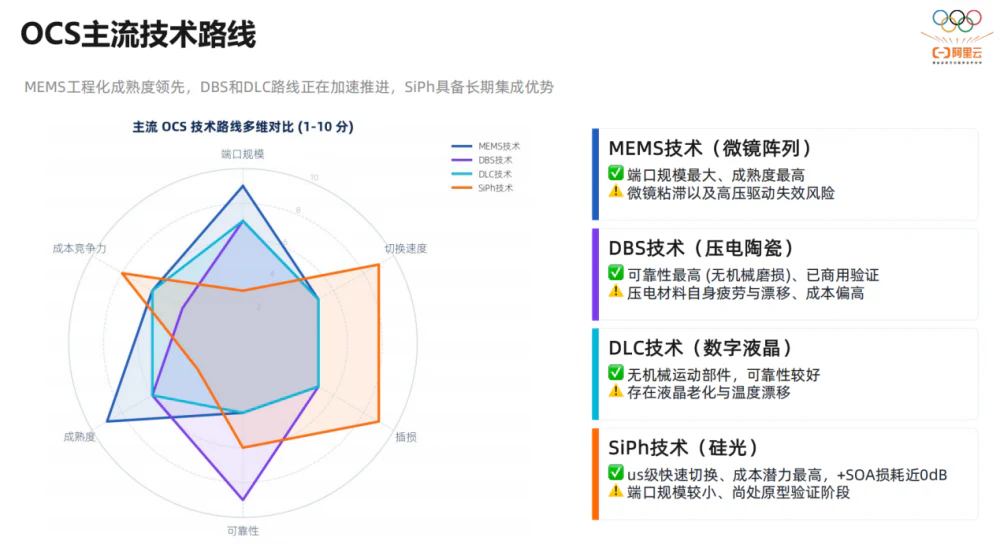
MEMS is currently the mainstream option. Its advantages include the strongest port scalability, the highest maturity, millisecond-level switching, relatively controllable mass-production costs, and low insertion loss, making it the closest to large-scale deployment. However, it carries risks of micro-mirror stiction and high-voltage driver failure, and its switching speed is limited to the millisecond range.
DBS (piezoelectric ceramics) has the lowest insertion loss of the four routes and extremely high reliability, but it is costly, and the core technology is held by a handful of overseas vendors, with no domestic players yet possessing core capabilities.
DLC (digital liquid crystal) has no moving mechanical parts and requires low drive voltage. Its drawbacks are aging and temperature drift, requiring periodic calibration, making it better suited to relatively static topologies.
SiPh (silicon photonics) is a much-hyped route. Its advantages include compatibility with CMOS processes, microsecond-level switching, and the greatest long-term cost potential. Although its native insertion loss is relatively high (about 6dB), it can approach 0 when combined with SOAs. It is currently limited by port scale (32-128) and remains at the prototype validation stage.
Wang Peng, an optical network architect at Alibaba Cloud, notes that from a system cost structure perspective, the four routes share some common features: core components and precision packaging alignment together account for about 60%-70% of BOM cost across all four, making them the main battleground for cost reduction in mass production. The MEMS and DBS routes also bear 15%-18% in high-voltage driver-related costs. In addition, software and testing together account for about 18%-24%; constrained by efficiency and a lack of standards, these remain a hidden cost hotspot.
On a per-port cost basis, using a 300×300-port configuration as an example, MEMS costs about $350-500 per port, SiPh about $200-500, DLC about $500-800, and DBS as much as $1,500-2,000.
OCS Applications
Large-scale OCS deployment began with Google. Since OCS was first introduced in TPU v4, this approach has evolved through several generations. In April 2026, Google's eighth-generation TPU was the first to separate the design of training and inference chips, marking OCS's formal entry into inference scenarios. Given that inference servers will far outnumber those in training scenarios, the OCS market opportunity can be recalculated.

Google remains OCS's most mature user. Omdia data shows that Google's AI server fleet will reach 929,000 units in 2026, forming the base of current OCS market growth. The industry forecasts that Google's demand for 300-port OCS switches will be about 15,000 units in 2026, potentially rising to 50,000 units in 2027.
According to Omdia Senior Principal Analyst Lü Mingyang, of OCS's four major application scenarios, Google's TPU-based node configuration optimization is the largest volume market; Spine-layer applications are still largely at the exploration stage, with volumes not yet comparable to the former; usage in automated testing scenarios is also very limited; and in the scale-out/across market, OCS is an effective solution. That market will begin to emerge after 2028, growing gradually from tens of millions of dollars toward the hundreds of millions.
Spurred by Google's example, hyperscale players such as Microsoft and Meta have also begun testing and adopting OCS technology in their new-generation AI clusters. OpenAI recently worked with Broadcom to launch its first in-house inference ASIC, Jalapeño, which uses OCS technology, making it the first such case among mainstream vendors other than Google.
Counterpoint Research expects global data center AI ASIC shipments to exceed 15 million units in 2028, surpassing data center GPU shipments for the first time in history. This wave of in-house ASIC development will also further boost demand for OCS. NVIDIA's entry is the biggest variable in this market.
In March 2026, at OFC 2026, NVIDIA presented a "GW-scale AI factory" network solution integrating the Feynman architecture with OCS, which brokerages interpreted as "NVIDIA plans to achieve chip-level OCS integration by 2028." At the Deutsche Bank 2026 Technology Conference, Lumentum's CEO publicly confirmed that the company had already engaged a major hyperscale customer significantly larger than Google at the early stage of OCS product shipments. The industry widely believes the customer is NVIDIA.
Among domestic players, Huawei's Ascend 950 supernode already uses OCS all-optical switches for inter-rack interconnection; China Telecom has completed the world's first new data center networking experiment combining optical and electrical coordination, with results showing a 14% reduction in GPU point-to-point latency, a 19% reduction in cluster DCN power consumption, and a 17% improvement in reliability; China Mobile has also included OCS in its intelligent computing network upgrade roadmap, viewing it as key to shifting from an "electricity-first, optics-assisted" paradigm to an "all-optical native" one.
OCS Industry Development
Market demand has rippled upstream. Industry leader Coherent says the capacity bottleneck for key OCS internal components was "dramatically" resolved over the past two months, and the market opportunity will double to more than $4 billion. Another industry leader, Lumentum, says OCS shipments doubled from the third to the fourth quarter of fiscal 2026; OCS revenue in the first quarter of fiscal 2027 will exceed $100 million in a single quarter.
According to Cignal AI estimates, the global OCS market was worth about $400 million in 2025 and, driven by AI demand, is expected to exceed $2.5 billion in 2029, representing a compound annual growth rate of 58% over four years.
Lü Mingyang said that the current complete-system solution already has more than five established suppliers, including Accelink Technologies, Coherent and Lumentum, making it extremely difficult for new players to enter Google's supply chain. He advised newcomers to participate first as core component suppliers.
On the four main technology routes, overseas companies hold the core components: Lumentum develops its own MEMS micromirrors; Coherent mainly promotes the liquid crystal (DLC) route; Polatis holds the DBS piezoelectric route; and in silicon photonics there are iPronics, nEye and others. The upstream materials sector also has supporting suppliers.
Looking at China's supply chain, the port counts of complete systems with in-house MEMS from Accelink Technologies, InnoLight Technology and Eoptolink are now on par with mainstream international offerings. Major upstream core component suppliers also include Union Optic, T&S Communications, Advanced Fiber Resources and Silex Microsystems. However, as Wang Peng of Alibaba Cloud explained, China has full control over optical components, LC connectors and system software; it has partial manufacturing capability in MEMS micromirrors, silicon photonic chips, DLC panels, precision packaging, driver ASICs, FPGAs and test and calibration equipment, but yield and consistency still need improvement; and China currently has no core capability in DBS technology.

At this year's CIOE, we saw two representative OCS vendors. One is Accelink, a long-established optical module maker, which demonstrated a 320×320 OCS all-optical switching system on site, capable of supporting complex leaf-spine architectures or super-node cluster communications. Most notably, the MEMS micromirror array chip, fiber array unit (FAU) and precision coupling and packaging processes in Accelink's OCS solution are all developed in-house across the full stack.
The other is Bopo Semiconductor. As a newcomer to the industry, Bopo Semiconductor chose the silicon photonic optical waveguide technology route and demonstrated a 32x32 OCS all-optical switch on site, with power consumption of just 10W. This significantly reduces equipment power consumption and forwarding latency, effectively addressing the high energy consumption and high latency challenges of large-scale AI cluster networking and helping computing centers save energy and cut costs. It should be noted that although silicon photonic waveguide technology has a relatively small port scale, it offers clear advantages in cost potential and +SOA loss.
Future evolution path of OCS
A consensus in the industry is that OCS will not fully replace traditional electrical switching, but will evolve alongside it, optimizing interconnect efficiency in AI clusters in specific scenarios.
NVIDIA's strategy is a combined approach: OCS handles horizontal optical switching across large-scale clusters, while CPO handles high-speed vertical interconnects within the rack. CPO is used at the Leaf layer and for Scale-up (within the rack, near the chip), while OCS is used at the Spine layer and for Scale-out/Scale-across (across racks, clusters, and data centers).
On the evolution of OCS devices, Wang Ruixue, technical manager at the Institute of Basic Network Technology of China Mobile Research Institute, noted that starting from OCS devices, the industry is focusing on three main lines: port scale evolving from "hundreds of ports" to "thousands of ports," switching performance evolving toward lower loss and higher performance, and switching architectures evolving toward silicon photonics integration and chip-level integration.
From the perspective of OCS optical-electrical hybrid networking and scheduling technology, the rapidly changing communication patterns of AI models and the continued expansion of computing power are driving OCS to evolve from static topology/slow switching toward fast, intelligent reconfiguration, extending to multi-level AI infrastructure interconnect scenarios including Scale-up, Scale-out, and Scale-across.
Wang Ruixue summarized four barriers to large-scale OCS deployment: the mainstream millisecond-level switching speed of OCS struggles to match the bursty, random traffic of data centers; technical solutions require deep adaptation to upper-layer applications and protocols, relying on customized development with a high technical barrier; hardware interfaces and management protocols lack unified standards, making interworking between different vendors' equipment difficult; and initial construction investment is relatively high, with advantages only becoming apparent in specific, predictable high-traffic scenarios. Lü Mingyang also issued a special reminder: OCS is a proven, successful product, but the entry barrier is extremely high, requiring a lengthy validation cycle, and customer adoption cycles will be even longer. 
Source: C114 Communications Network · Optical Communications · c114.com.cn