Smartphone Market Battle Royale: The Imaging War Keeps Escalating
Topics and contents
Topic
On this page
Smartphone makers have entered another intensive product launch cycle, with larger sensors, longer telephoto reach, stronger stabilization and computational photography remaining key launch highlights. The article argues that as performance and displays mature, imaging remains the core battleground for differentiation and winning premium users.

By Liu Yong
Edited by Zhang Xiao
The smartphone industry has entered another dense product launch cycle.
From camera flagships to premium all-rounders, phone makers are rolling out new-generation products. Larger sensors, longer telephoto reach, stronger stabilization, and ever-improving computational photography remain the highlights of every launch event. Even though smartphone imaging has already gone through multiple rounds of iteration, this battle over lenses shows no sign of stopping.
The reason is not hard to understand. As core experiences such as performance and displays gradually mature, imaging remains a key anchor for phone makers to differentiate themselves and compete for premium users.
But the problems follow.
As hardware specs converge, how much competitive advantage can smartphones still gain simply by stacking sensors and chasing pixel counts?
At the same time, user expectations for imaging are changing. Taking a sharp photo is no longer the whole story. Recording a concert, capturing a fleeting emotion, shooting cinematic video, and letting ordinary people create compelling work without mastering complex techniques are becoming the new questions smartphone imaging must answer.
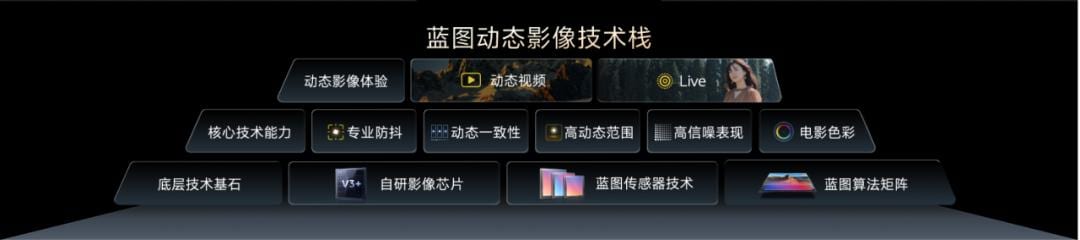
This gives the imaging race a new direction. On September 21, vivo launched the X500 series and announced motion imaging as a company-level strategy, unveiling the BlueImage Motion Imaging Technology Stack in a bid to extend the competition beyond traditional still photography into video, Live Photos and other motion imaging experiences.
With every manufacturer still working to improve imaging performance, why has vivo chosen to make motion imaging a strategic priority? Is this a proactive response to shifting user needs, or an inevitable choice as smartphone imaging competition enters a new phase? And what technical and commercial hurdles must vivo clear to bring professional creative capabilities into everyday use for the mass market?
01 Motion Imaging: Hard, but the Right Call
Why are smartphone makers still competing fiercely over imaging?
One key reason is that as the basic smartphone experience matures, imaging remains one of the few core capabilities that can simultaneously influence purchase decisions, product differentiation and brand perception. Processor performance can be measured by benchmark scores, and display specs can be compared at launch events, but whether a photo is sharp enough or a video is stable enough is ultimately tested in users' real lives.
For smartphone makers collectively pushing into the high-end market, imaging is not just a hardware specification; it is a product value consumers can directly perceive.
But imaging competition is also facing new challenges. Over the past few years, smartphone makers have kept upgrading sensor size, telephoto zoom ratios, night-mode algorithms and portrait effects, and computational photography has enabled phones to take quite impressive photos in many scenarios. Yet as basic image quality keeps improving, it is getting harder to differentiate on hardware specs alone.
At the same time, the way users document their lives is changing. Dynamic content such as short videos and Live Photos is becoming more common. People want to capture not just a single frame, but the stage at a concert, a figure in motion, the voices of friends gathered together, and those fleeting emotions.

This means smartphone imaging competition is extending from "taking a good photo" to "capturing a moment well."
Still imaging certainly remains important, but video gives manufacturers a new arena in which to compete. Especially for brands seeking to build a reputation in professional imaging, video is about more than image quality; it encompasses a complete experience including shooting continuity, color performance, motion tracking autofocus, and post-production creativity. Whoever can truly connect all of these elements has a chance to build new differentiation beyond the existing imaging competition.
However, moving from still photography to motion imaging is not simply a matter of porting photo features into video mode.
The two face clearly different technical requirements.
When capturing a still photo, a phone can combine information from different exposures in a short time through multi-frame synthesis and computational photography. Video, by contrast, requires image capture and processing to be completed in real time in every consecutive frame. Exposure must not jump frequently, color must not swing between cool and warm, autofocus must keep up with the subject's movement, and stabilization must not come at the cost of a significant loss of field of view or unnatural image distortion. Even if single-frame quality is excellent, flicker, smearing or color inconsistency during continuous playback will degrade the overall viewing experience of the video.
What makes it more complex is that the phone must accomplish all of this within limited body space and power budgets.
High-specification video requires sustained use of the sensor, processor and imaging algorithms. The higher the resolution, frame rate and dynamic range, the greater the demands on real-time processing power, heat dissipation and energy management. At the same time, the phone must still balance a slim design, battery life and everyday usability.
This makes motion imaging a classic systems engineering challenge: the sensor determines how much information can be captured, the chip affects how efficiently that information is processed, the algorithms determine how the image is reconstructed, and optical image stabilization and electronic stabilization together determine stability in dynamic scenes.
vivo chose to elevate dynamic imaging to a company-level strategy at this stage because it is not facing an isolated video feature, but a technology system that requires sustained investment.
On September 21, 2026, vivo launched the X500 series and introduced the BlueImage dynamic imaging technology stack, listing high dynamic range, high signal-to-noise performance, professional stabilization, dynamic consistency and cinematic color as its five core technical capabilities. Under vivo's product plan, this system aims to improve overall performance from capture to final footage through coordination among the sensor, imaging chip and algorithms, rather than relying on a single specification to create a selling point.
Dynamic consistency is particularly worth noting. Photos can be improved locally through post-processing, but video is a continuous visual experience. When users move the camera, switch scenes or walk from indoors to outdoors during shooting, whether exposure, color and focus remain natural often determines the final impression more than the peak image quality of any single frame.
The same applies to stabilization. What users truly need is not a rating on a spec sheet, but footage that remains sufficiently stable while shooting on the move, tracking a moving subject or using telephoto.
In other words, the real test of dynamic imaging is not whether a phone can shoot a beautiful video, but whether it can deliver consistently stable results in complex, unpredictable real-world scenarios.
Of course, elevating dynamic imaging to a strategic direction does not mean the industry has formed a new competitive landscape, nor can a technology launch alone establish that a particular maker has gained a leading edge. Other brands are also continuing to invest in video capture, computational photography and professional creation capabilities. For vivo, launching a technology system is only the beginning; it must still prove through real product experience that these capabilities can be delivered reliably, and that consumers are willing to change their purchasing choices because of them.
But from an industry perspective, motion imaging has indeed opened up a new technical challenge for smartphone makers.
For vivo, the value of this path lies not only in shooting better video, but also in turning professional imaging capabilities into a product experience that ordinary users can easily use.
This raises the next question: when motion imaging requires such complex technical support, how does vivo prevent professional capabilities from remaining in the hands of a few creators? And how does it let ordinary users achieve better creative results without learning complex shooting techniques? The answer will determine whether motion imaging remains merely a high-spec feature of flagship phones, or becomes a product capability that truly expands the boundaries of mobile creation for the masses.
02 Raising the professional ceiling, lowering the barrier for everyone
If motion imaging tests a smartphone maker's systematic technical capabilities, the more practical question is: what can these technologies ultimately deliver to users?
For smartphone makers, a gap that must be bridged has always existed between professional imaging capabilities and the everyday user experience.
At one end are professional creators who care about image quality, dynamic range, color depth, codec formats and post-production headroom, and want their phones to offer greater creative freedom. At the other end are everyday users who may not understand these professional concepts and simply want to capture clear, stable, atmospheric videos with ease at concerts, on trips and at gatherings.
Raising only the professional ceiling could leave imaging capabilities confined to spec sheets and the workflows of a few. Lowering only the barrier to use could limit the product's room to expand into professional creation.
vivo is trying to answer both questions at once through its dynamic imaging strategy: on the one hand, continuing to push the boundaries of professional smartphone imaging; on the other, leaving complex technical processing to the system as much as possible so users can focus more on the content itself.
First, the professional ceiling.
In the past, smartphone video capture was largely about everyday documentation. As sensors, processing chips and algorithms have improved, phones have begun taking on more complex creative tasks. For professional creators, video quality does not just mean high resolution; it also means whether highlights and shadows are fully preserved, whether sharpness holds up during fast motion, and whether there is enough room for color grading and editing after the shoot.
That is what makes vivo's latest dynamic imaging push worth watching. With the X500 series, vivo is building high-specification video, professional Log video and the associated post-production workflow into its product capabilities.
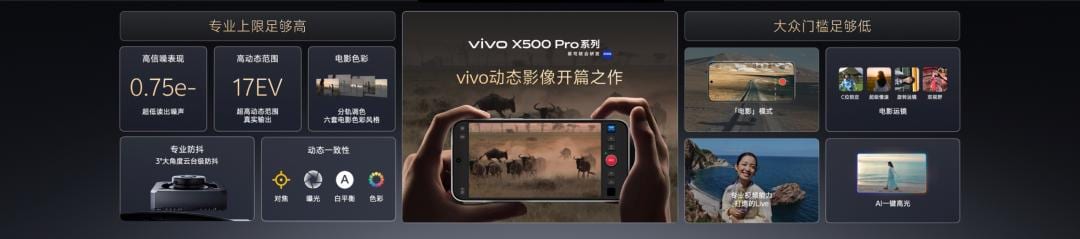
Take high-frame-rate video as an example: higher frame rates give creators more room for slow-motion work, but they also increase the burden of data capture and processing. Log video, meanwhile, preserves more latitude for color grading in post, but it also means users need a certain level of post-production knowledge. The value of professional codecs and color workflows likewise lies not in making video specs look better, but in minimizing the friction between shooting on a phone and post-production.
The competitive logic behind this is that phones are no longer content to serve as a supplement to professional gear; they are trying to become devices that can handle tasks on their own in more creative scenarios.
Of course, this does not mean phones can fully replace professional cameras. Lens systems, sensor size, thermal management, and the degree of control available in complex shooting environments still create real differences between devices. What phones truly need to prove is whether, beyond portability and ease of use, they can deliver professional creative capabilities that are reliable enough.
But improving professional capability is only half the problem. For a broader user base, the more professional features there are, the higher the operating barrier may become. Users may not know what Log is, nor necessarily understand the relationship among shutter speed, exposure compensation, and color space. If a feature requires users to first learn a complex body of knowledge before they can use it, it will struggle to become part of everyday imaging for the mass market.
Lowering the barrier, then, is not simply about cutting a few steps out of the process; it is about turning technical complexity into product usability. Whether the system can recognize shooting scenes and offer sensible suggestions, whether it can automatically apply more appropriate processing in backlit, night, and fast-moving scenes, and whether it lets users get a finished clip that matches their expectations without complex post-production all affect the real value of imaging technology.
For moving images, this capability is especially important.
Video shooting usually takes place in fast-changing scenes with little room for error. Concert lights flash by in an instant, the movements of children and pets are unpredictable, and the highlights of a trip cannot be replayed. Users have little time to adjust settings, let alone complete professional setup before every shot.
In this context, the value of a smartphone lies not just in offering more optional features, but in delivering stable, natural results even when the user has no time to think.
This is also where AI and computational photography can help. Through scene recognition, parameter optimization and intelligent processing, a phone can hand over some of the work that once required experienced judgment to the system. Automation, however, does not mean making decisions unconditionally on the user's behalf.
A good intelligent imaging experience requires a balance between automatic processing and user control: for everyday users, operation should be simple enough, while for creators with higher demands, the system should also leave room for necessary adjustments.
From this perspective, the professional ceiling and the consumer threshold are not two unrelated product paths.The former determines how far the technology can go; the latter determines how many people can ultimately use it. Professional features can validate a phone's technical potential, while an easy-to-use experience decides whether those capabilities can enter real life and create lasting user value.
For vivo, this is precisely where the challenge of its dynamic imaging strategy lies.
Upgrades to technical specifications are relatively easy to showcase at a launch event, but genuine differences in user experience often have to be tested across a large number of complex scenarios. Whether professional features are reliable enough, whether automatic processing feels natural, and whether users enjoy a coherent experience across shooting, editing and sharing all require long-term product validation.
What is truly worth pursuing in motion imaging, therefore, is not turning every user into a professional creator, but making professional capabilities no longer the exclusive tools of a select few. For users who need fine-grained control, a phone should offer a high ceiling for creation; for everyday users who simply want to record their lives, it should minimize the effort required to operate it. Only when both sets of needs are served within the same product system can motion imaging evolve from a high-spec feature into a product capability with broad practical value.
Achieving this clearly requires more than a single generation of technological breakthroughs. It demands long-term R&D accumulation, hardware-software coordination, and a continuous understanding of user needs.
This also brings the question back to vivo itself: why did vivo choose to make dynamic imaging a strategic priority? What technical foundations can it draw on, and how can it turn those technical strengths into lasting product competitiveness?
03 Why vivo?
Elevating moving-image capture to a company-level strategy means the question vivo wants to answer is no longer just how to make a flagship phone shoot better video, but how to build a differentiated capability that can keep accumulating and iterating as mobile imaging competition enters a new stage.
This path is not without its barriers.
Moving imaging requires sensors, chips, algorithms and the software experience to work in concert, along with long-term product iteration and user feedback. For vivo, what is truly worth discussing is not a breakthrough in any single technology, but why it chose to concentrate resources on moving imaging at this moment, and whether its accumulated capabilities can support this transformation.
First, there is the strategic starting point provided by long-term imaging data accumulation.
Since establishing a global imaging strategic partnership with ZEISS in 2020, vivo has steadily advanced research and development in optical technology, imaging algorithms and professional portrait experiences, forming a relatively clear technical roadmap for smartphone imaging. The collaboration extends beyond co-branding to include joint development of optical systems, coating technology, portrait styles and telephoto lenses. In 2025, vivo and ZEISS renewed and expanded their partnership, pledging to explore a broader imaging product portfolio and imaging ecosystem.
This means that vivo's push into dynamic imaging did not start from scratch. The optical, sensor, chip and algorithm expertise built up in still imaging can provide a foundation for video capabilities; yet as the focus of competition shifts from single photos to continuous footage, these capabilities must be re-integrated and validated.
What is particularly noteworthy is that vivo does not simply interpret dynamic imaging as an upgrade to video specifications. Instead, it groups it into five areas: high dynamic range, high signal-to-noise performance, professional stabilization, dynamic consistency, and cinematic color. Behind this technical roadmap lies a rethinking of the entire video capture chain: the sensor collects information, the chip provides real-time processing power, algorithms improve image performance in complex scenes, and software turns these technologies into features users can use directly.
But existing capabilities only explain why vivo is ready to enter this field; they do not fully explain why it has elevated dynamic imaging to a company-level strategy.
The more critical reason may be that the imaging competition cycle is changing.
As more manufacturers build strong static photography capabilities, differentiation from hardware upgrades alone may be hard to sustain over the long term. For vivo, continuing along its existing upgrade path would still improve the product experience, but it may not consistently build new user perceptions.
Moving imagery offers another possibility: it extends the reach of traditional imaging technology while also broadening competition into wider scenarios such as video creation, motion capture and professional workflows.
This is also the difference between a company-level strategy and a single product's selling points. The former means that the relevant investment should not revolve around just one generation of flagships, but must run through technology R&D, product planning, software experience, and user service. Sensor and chip upgrades take time, algorithm optimization in complex scenarios requires sustained accumulation, and professional creation features must also be continually adjusted based on user feedback. If this work can be carried across multiple product generations, dynamic imaging can gradually evolve from a technical highlight at launch events into a brand capability that consumers can recognize.
Another asset for vivo is the connection it has already built with imaging creators.
In September 2026, vivo announced an upgrade to its BlueImage imaging strategy at its Creator Summit, proposing a deeper integration of imaging technology and imaging culture, while continuing to promote mobile imaging creation through photography competitions and creator exchanges. The value of such efforts should not be understood solely from a brand communications perspective. For smartphone makers, professional creators bring more complex shooting requirements and more specific product feedback, while real-world creative cases help manufacturers test how their technology performs in demanding environments.
More importantly, imaging has both a technical and an expressive dimension. What users ultimately care about is rarely what technology the sensor uses, but whether it can capture important moments and convey the emotions they want to express. If manufacturers talk only about hardware specifications, it becomes difficult to fully explain what imaging capability means to users. But if technology, products and creative scenarios can be connected, there is an opportunity to build more lasting brand recognition.
Of course, an imaging ecosystem cannot be built simply by holding a few events or launching several creative features. It requires creators to keep using the products, continuous iteration of software and hardware, and these investments to genuinely improve the user experience. Whether the ecosystem becomes a competitive advantage ultimately depends on whether it can feed back into product development and foster long-term, sustainable user engagement.
This brings the question back to the business level: what exactly can vivo gain by choosing motion imaging?
From a product perspective, dynamic imaging can give flagship smartphones a new dimension of differentiation. For high-end users and professional creators, professional video capabilities could become a plus in the purchase decision; for everyday users, simpler shooting and more consistent results could raise the product's value in daily use. Only by working together can the two turn technical investment into broader market competitiveness.
But this path also has practical constraints. Professional video capabilities require stronger hardware and computing power, forcing trade-offs among R&D costs, product costs and power management; whether high-specification features see broad use cannot be judged by technical specifications alone. Even if a product can capture high-specification video, whether users will pay a premium for these capabilities, and whether they will choose vivo over other brands as a result, still needs to be validated by market performance.
The real test of motion imaging for vivo is not whether it can achieve a few industry-leading specifications on a single generation of products, but whether it can keep improving the experience in subsequent products and make that improvement perceptible, usable and recognized by consumers.If professional creative capabilities can continue to filter down and ordinary users can genuinely feel the convenience that motion imaging brings, then this strategy has a chance to turn technical investment into a product advantage and, further, into brand competitiveness.
The next stage of smartphone imaging may not be decided by any single specification. The real competition is likely to take place at the intersection of technological accumulation, product experience and user needs.
By elevating motion imaging to a company-level strategy, vivo is signaling that it is seeking a new breakthrough in this competition. But strategic direction is only the starting point. What ultimately determines how far this path goes is still whether the technology can continue to deliver as an experience, and whether that experience can further be converted into commercial value.
Original title : Smartphone Market Free-for-All: Who Is Redefining the Imaging War?
Source: OFweek Optics Network · News · optics.ofweek.com