Configurational Entropy Engineering Enables Ultra-Broadband Emission in Bismuth-Doped Glass Fiber
上海光机所提出构型熵工程策略助力铋掺杂玻璃光纤实现超宽带发光
Topics and contents
The Shanghai Institute of Optics and Fine Mechanics has proposed a configurational entropy engineering strategy that enables ultra-broadband emission in bismuth-doped glass fiber.
The original article provides specific data and details that help assess the actual progress in this direction
Excellence Innovation Brief on Ultra-Intense Laser Science
(Issue 806)
July 31, 2026
SIOM Proposes Configurational Entropy Engineering Strategy for Ultrabroadband Emission in Bismuth-Doped Glass Fiber
Recently, a team led by researcher Hu Lili in the Department of Advanced Laser and Optoelectronic Functional Materials at the Shanghai Institute of Optics and Fine Mechanics, Chinese Academy of Sciences, proposed a configurational entropy engineering strategy for bismuth-doped glass and fiber. By tuning glass-forming kinetics, the team froze the glass network in a high-energy, highly disordered configurational state, effectively suppressingGe/Bielement clustering and the resulting non-radiative energy dissipation. They fabricated bismuth-doped silica fiber with significantly reduced background loss and unsaturable loss, and demonstrated1680-1750 nmbroadband amplification, laser output at1650 nmand1720 nm, and proof-of-principle methane sensing. The results, titled “Configurational Entropy Engineering of Bi-Doped Glass Fiber Enabling Ultrabroadband Emission”, were published inAdvanced Functional Materials.
Near-infrared broadband amplifiers and lasers are important light sources for next-generation high-capacity optical communications, molecular spectroscopy detection and fiber sensing. Conventional erbium-doped fiber amplifiers (EDFA) have a relatively limited effective gain window and cannot readily meet the continuously growing demand for transmission bandwidth. Bismuth-doped silica fiber can generate broadband near-infrared emission across the 1000–1800 nm range and is compatible with mature silica fiber fabrication technology, making it a promising candidate material for extending communication bands.
The core difficulty lies in the "gain-loss" contradiction. The optical properties of bismuth active centers (BAC) are extremely sensitive to the local coordination structure; while raising the bismuth content helps increase gain, it also drives excess Bi ions to aggregate in Ge-rich regions, forming non-luminescent atomic clusters and quenching centers that raise background loss and unsaturable loss. Suppressing elemental aggregation while maintaining a high doping concentration is the key challenge for bismuth-doped fiber to reach high-performance devices.
Unlike high-entropy alloys that rely on the mixing entropy of multiple components, the configurational entropy strategy treats the glass-forming pathway as a design variable: ultrafast cooling freezes the disordered topology of the high-temperature melt into a high-energy, high-configurational-entropy metastable state. In Ge/Bi co-doped silica, the Si–O network freezes first, while still-mobile Ge–O units readily form Ge aggregation domains, into which Bi also tends to enter. Conventional cooling leaves time for Ge migration and Bi aggregation, producing Ge and Bi aggregation domains; ultrafast quenching instead imposes kinetic arrest before the domains grow. Phase diagrams and molecular dynamics simulations show that although the system has a driving force for phase separation, increasing the cooling rate still compresses diffusion and relaxation times, thereby suppressing aggregation.
Spherical-aberration-corrected TEM shows that the average size of Ge aggregation domains dropped from 5.42 nm with slow cooling to 1.66 nm with quenching. Synchrotron X-ray total scattering and PDF/rPDF analysis show that the slow-cooled sample has stronger Bi-related atomic pair peaks and medium-range oscillations, indicating more pronounced Ge/Bi aggregation; the quenched sample has a more dispersed local structure, higher transmittance and stronger near-infrared luminescence. DSC, in situ PDF and in situ transmittance spectroscopy further confirm that the high-configurational-entropy state is a kinetically frozen metastable state: heating induces sequential relaxation of Bi-related structures and Ge aggregation domains; after prolonged annealing at 500 °C, the optical performance degrades irreversibly to near that of the slow-cooled sample.
The team used the same preform and simply raised the drawing speed from 30 m/min to 100 m/min, subjecting the fiber core to stronger ultrafast cooling. With the Ge/Bi content essentially unchanged, background loss fell from 400 dB/km to 210 dB/km, and unsaturable loss from 33.5% to 25.8%. The fiber achieved over 20 dB net gain in the 1680–1750 nm range, with average net gain about 5 dB higher than the reference fiber, and produced laser output at 1720 nm and 1650 nm. Combined with a hollow-core fiber gas cell, the 1650 nm laser output power decreased regularly as methane pressure rose, completing the gas-sensing validation.
The value of this work lies not only in obtaining a higher-performance bismuth-doped fiber, but also in proposing a structural control paradigm for amorphous functional materials. Conventional design focuses on "what to add" and "how much to add" in material composition; configurational entropy engineering further addresses "how it forms": by controlling cooling rate and relaxation pathway, the non-equilibrium structure is locked in before harmful aggregation occurs. This approach offers a new route to combining high doping, high luminescence activity and low energy dissipation, and can be extended to other rare-earth/main-group-element-doped glasses.
This study establishes a configurational entropy engineering method for bismuth-doped glass fiber: ultrafast cooling locks the glass network into a highly disordered, high-energy metastable configuration, imposing kinetic arrest before Ge/Bi aggregation domains grow, thereby suppressing bismuth agglomeration, non-radiative energy transfer and optical loss. The resulting fiber's background loss fell from 400 dB/km to 210 dB/km, and unsaturable loss from 33.5% to 25.8%, with over 20 dB net gain in the 1680–1750 nm range and 1650/1720 nm laser output.
Configurational entropy engineering elevates "cooling history" from a processing parameter to a designable structural variable, providing a unified thermodynamic–kinetic framework for tuning local coordination, elemental distribution, and energy migration in amorphous materials. In the future, this strategy is expected to extend to rare-earth-doped glasses, amorphous luminescent materials, and other functional glass systems, and to be combined with multiscale simulation, in situ characterization, and advanced forming processes to further establish quantitative links among "formation path – local structure – device performance".
The related research was supported by the Strategic Priority Research Program of the Chinese Academy of Sciences, the National Key R&D Program of China, projects of the Shanghai Science and Technology Commission, and the Advanced Glass R&D Platform, among others.
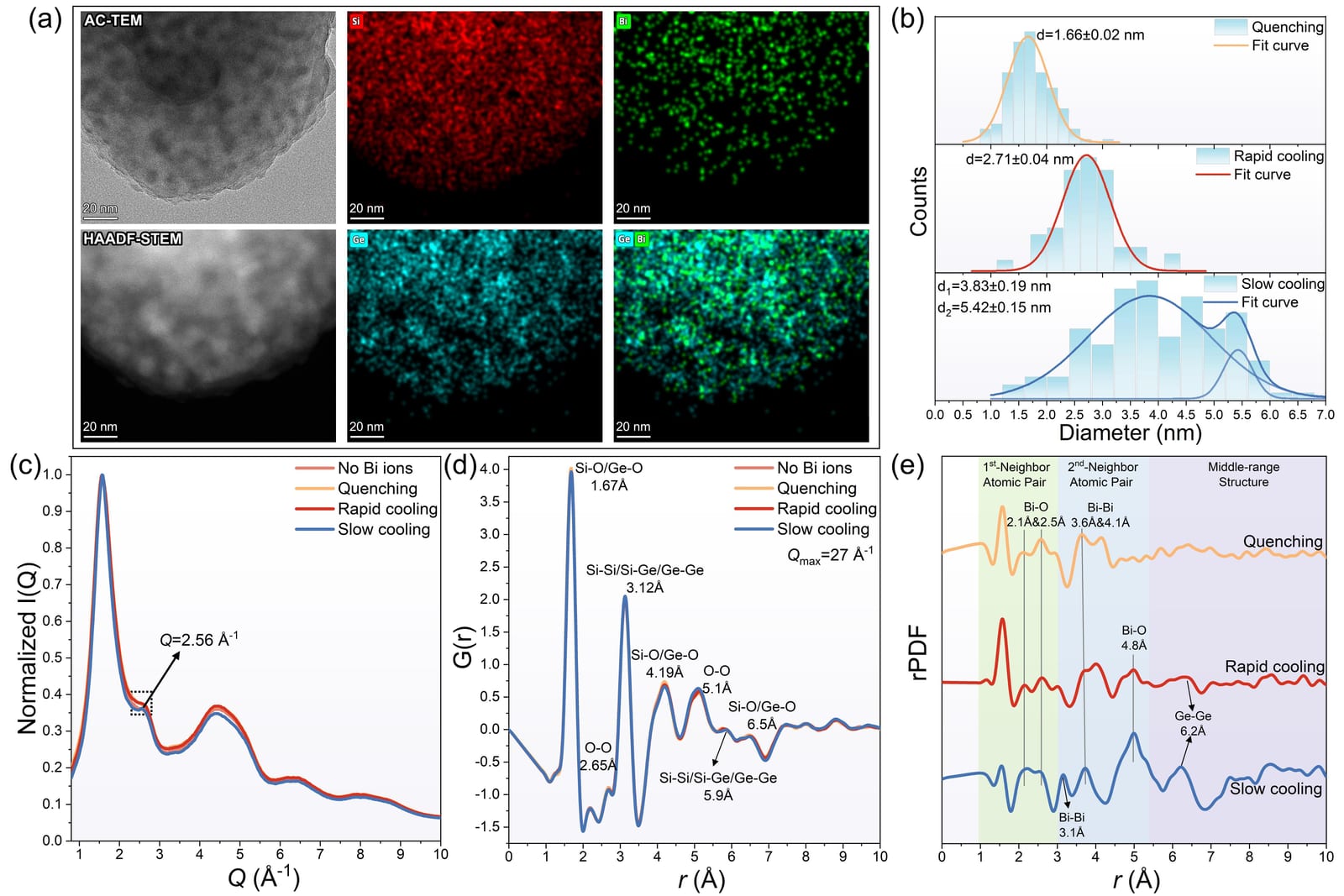
Figure 1. Multiscale structural evidence: aberration-corrected TEM elemental mapping, synchrotron X-ray total scattering, and the reduced pair distribution function (rPDF) jointly show that rapid quenching shrinks Ge aggregation domains and suppresses Bi-related structural clustering.
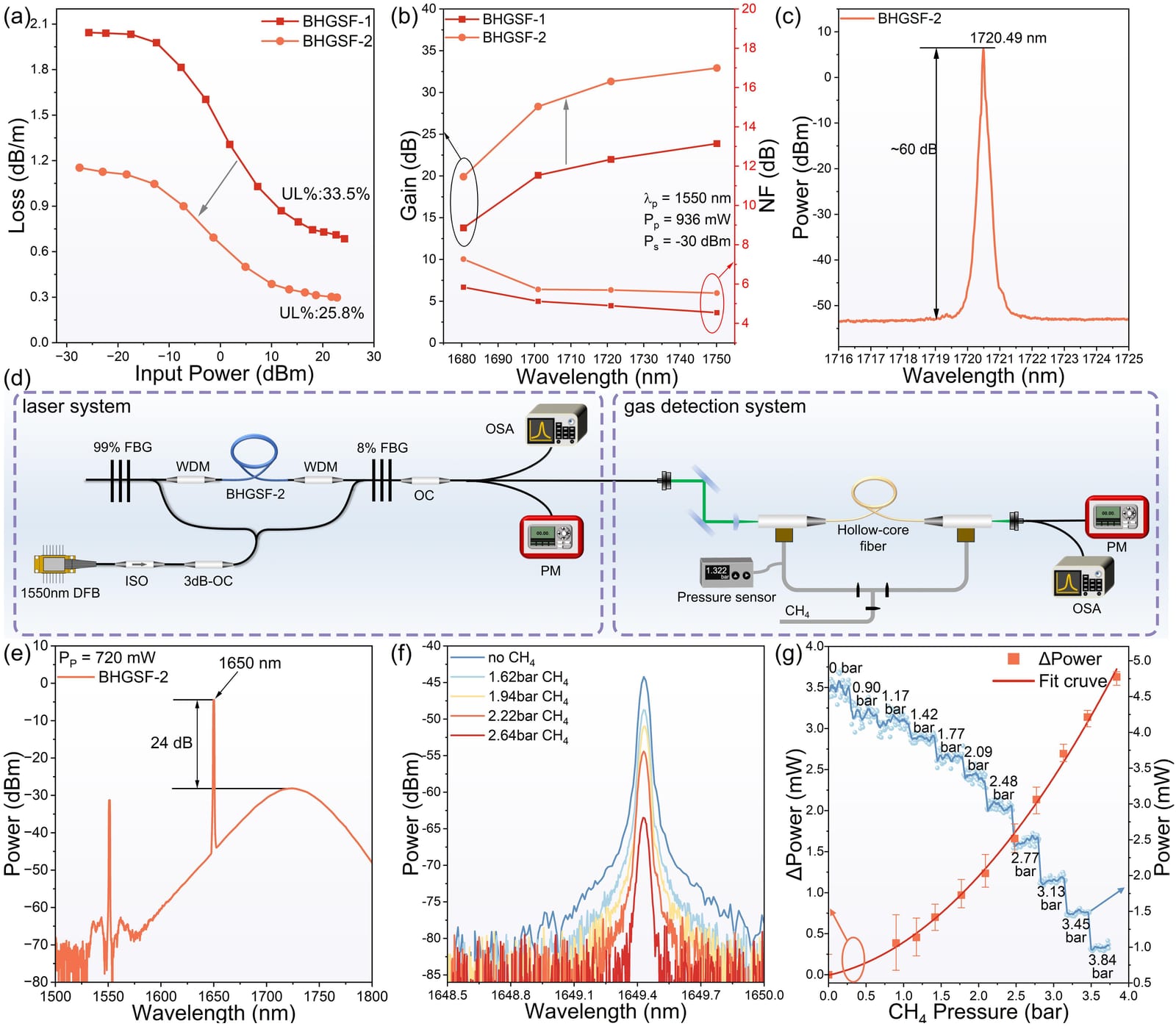
Figure 2. Device performance validation: the configurational entropy-engineered fiber achieves lower unsaturated loss, broadband amplification across 1680–1750 nm, 1650/1720 nm laser output, and methane sensing with hollow-core fiber.
Source: Shanghai Institute of Optics and Fine Mechanics (SIOM) · Research Updates · siom.cas.cn