SF-PULSE Lensless Imaging Enables Stain-Free Long-Term Monitoring of Living Cells
Lensless imaging method enables long-term monitoring of living cells without staining
Topics and contents
Topic
On this page
Researchers proposed the SF-PULSE lensless imaging method, which can monitor living cells over long periods without staining, and successfully imaged and reconstructed glioblastoma cells.
The source demonstrates an imaging route that replaces lenses with computational reconstruction, offering insights for low-cost microscopy
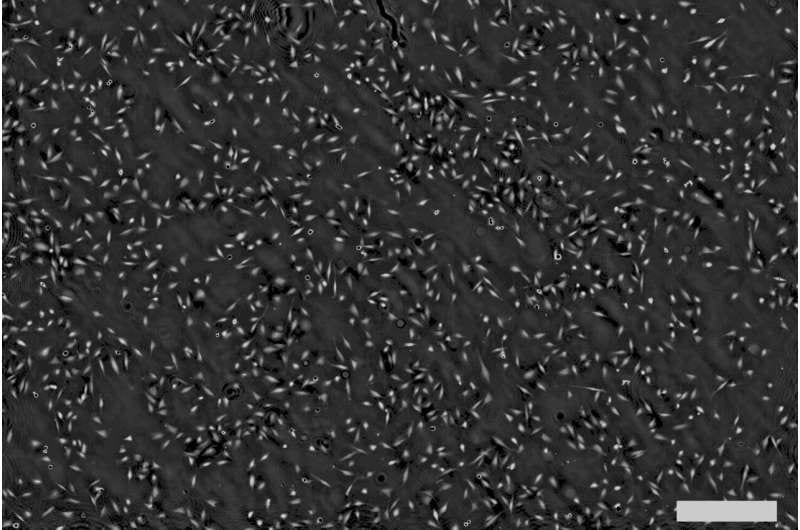
In a study led by Tampere University, researchers have developed a new lensless imaging method that produces precise quantitative data on living cells from a single image. The compact system can be placed inside a standard cell-culture incubator, allowing living cells to be monitored continuously for hours or even days without staining or other labels. The research is published in the journal Applied Physics Letters.
Researchers have developed a new lensless quantitative phase imaging method, called SF-PULSE, which combines an AI-based neural network with physics-informed image reconstruction.
The method is designed for use in a compact imaging system that can operate directly inside a standard cell-culture incubator. This allows cells to be monitored continuously for hours or even days without the need for staining or repeated removal from the incubator for imaging.
Quantitative phase imaging is a technique that enables the observation of living, transparent cells without staining. In addition to producing images of cells, it provides quantitative information about features such as cell growth, size and changes in biomass.
The researchers set out to address two major limitations of quantitative phase imaging. Conventional quantitative phase imaging methods typically rely on large and complex microscope systems that are not well suited for long-term monitoring inside a cell-culture incubator. In addition, recovering phase information in lensless systems is a challenging computational problem that has traditionally required multiple images or additional optical components.
"Our SF-PULSE method can reconstruct quantitative phase information from a single measurement image without the need for complex optical hardware. The method reduced computational errors, improved reconstruction stability and enabled accurate long-term tracking of individual cells," says Igor Shevkunov, the study's first author from the Faculty of Information Technology and Communication Sciences at Tampere University.
The result is important because it enables long-term, uninterrupted and label-free monitoring of large numbers of cells. The method produces quantitative information about the behavior of individual cells, which is often far more informative than analyzing only the average behavior of a cell population.
"Importantly, researchers can follow not only how a cell population changes, but also how individual cells grow, move, divide and gain or lose biomass over time. This is often more informative than examining the average behavior of a cell population alone," says Meenakshisundaram Kandhavelu, university lecturer in the Faculty of Medicine and Health Technology at Tampere University and head of the Molecular Signaling research group.
Rather than simply providing another imaging modality, SF-PULSE has the potential to enable entirely new types of biological experiments. The method could support applications such as drug-response studies, toxicity screening and investigations of cell-death mechanisms.
Because the system is compact, lensless and capable of monitoring hundreds or even thousands of cells simultaneously across a wide field of view, it could also be used for automated biological analytics and the development of new biomedical instrumentation in the future.
Publication details
Igor Shevkunov et al, Single-frame lensless phase retrieval using learned sensor plane initialization, Applied Physics Letters (2026). DOI: 10.1063/5.0353436
Who's behind this story?

Gaby Clark
MA in English, copy editor since 2021 with experience in higher education and health content. Dedicated to trustworthy science news. Full profile →

Robert Egan
Bachelor's in mathematical biology, Master's in creative writing. Well-traveled with unique perspectives on science and language. Full profile →
Citation: Lensless imaging method enables long-term monitoring of living cells without staining (2026, October 8) retrieved 17 October 2026 from https://phys.org/news/2026-10-lensless-imaging-method-enables-term.html
This document is subject to copyright. Apart from any fair dealing for the purpose of private study or research, no part may be reproduced without the written permission. The content is provided for information purposes only.
Source: Phys.org Optics & Photonics · phys.org