LightCounting: Ethernet optical module market forecast to grow 120% in 2026
Topics and contents
LightCounting's latest report says the Ethernet optical module market had been expected to slow in 2026, but data from the first nine months defied expectations: cloud providers' capital spending accelerated sharply from late January to early February and remained strong over the following six months. The full-year Ethernet optical module market is now forecast to grow 120%.
The original article explains that the upward revision was driven by cloud providers' capital expenditures, helping to gauge the scale of AI-driven demand for optical modules
C114 News, October 8 (Shuiyi) — Market research firm LightCounting for the optical communications industry has released its latest market report. The firm said it had originally expected growth in the Ethernet optical module market to slow in 2026, but data from the first nine months of this year has completely overturned that outlook. Cloud providers' capital expenditures began accelerating sharply in late January and early February, and have remained at high levels over the following six months.
LightCounting said the current situation is almost surreal. Oracle, for example, spent nearly $30 billion on capital expenditures in its most recent quarter, up 235% year over year, while its revenue was under $20 billion, up 30%. The veteran giant is reinventing itself around AI like a startup. Alibaba and Tencent also increased capital expenditures by 150%-200% year over year in the latest quarter, while revenue grew just 15%-20%.
This trend must have a limit. Even the most optimistic forecasters, including Nvidia, expect capital expenditure growth to hold at around 70% in 2027, roughly in line with 2026. LightCounting's forecast model assumes capital expenditures grow "only" 50% in 2027, because supply chains tend to overreact to changes in capital spending. The supply chain has clearly overreacted already: Innolight reported that its optical transceiver sales rose nearly 200% year over year in the first half of 2026.
As shown in the chart below, LightCounting now expects the Ethernet optical transceiver market to grow 120% in 2026. Its detailed forecast for 2027-2031 is based on a "soft landing" scenario.
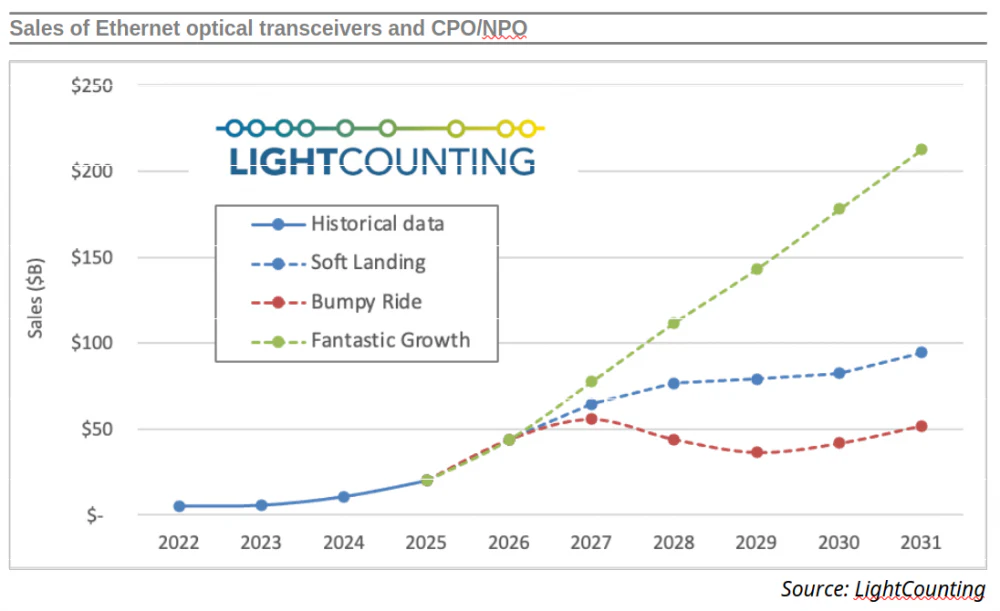
Compared with six months ago, uncertainty around market growth from 2027 to 2031 has increased substantially. The "explosive growth" could continue from 2027 onward. But even in that scenario, market growth is assumed to slow from 120% in 2026 to 76% in 2027, and to 20% by 2031. In terms of growth rate, the market is clearly at the peak of this supercycle.
A look back at historical optical transceiver sales data from 2004 to 2025 reveals a clear cyclical pattern: two to three years of growth are often followed by a year of flat or negative growth. Most cycles have been driven by supply chain rebalancing, and a similar pattern is expected in 2027-2030. LightCounting's forecast is set to a "soft landing," but supply chain balance is often restored through a market correction — the "Bumpy Ride" scenario.
The "soft landing" scenario also factors in improved optical interconnect efficiency in AI clusters, enabled by new network architectures and improved XPU designs. For example, TPU-based clusters and multi-plane networks require fewer optical modules per XPU. New switches will also help make network architectures flatter and more efficient.
The latest report also covers forecasts for more than 100 product categories, including 100G, 200G, 400G, 800G, 1.6T, 2.4T and 3.2T optical modules, as well as LPO/LRO and CPO/NPO products broken down by transmission distance and application. The market is also segmented by end customer into cloud, telecom and enterprise. Within the cloud segment, it is further divided by end customer (top five US, top five China, other cloud providers) and application (non-AI, Scale-out and Scale-up networks). 
Source: C114 Communications Network · Optical Communications · c114.com.cn