INMO AIR3 recalled in US and Canada over overheating temples, putting smart glasses thermal design to the test
影目Air3被召回,智能眼镜迎来散热大考
Topics and contents
Topic
On this page
The US CPSC and Health Canada issued a recall on September 24 after the left temple of INMO AIR3 smart glasses could overheat during prolonged use. INMO has received 10 overheating reports, including burning sensations on the face and left ear. The recall covers about 1,643 pairs in the US and about 120 in Canada, with free repairs and system updates offered as the remedy.
The source provides recall figures and incident reports that help illustrate the engineering constraints on heat dissipation in lightweight AI glasses

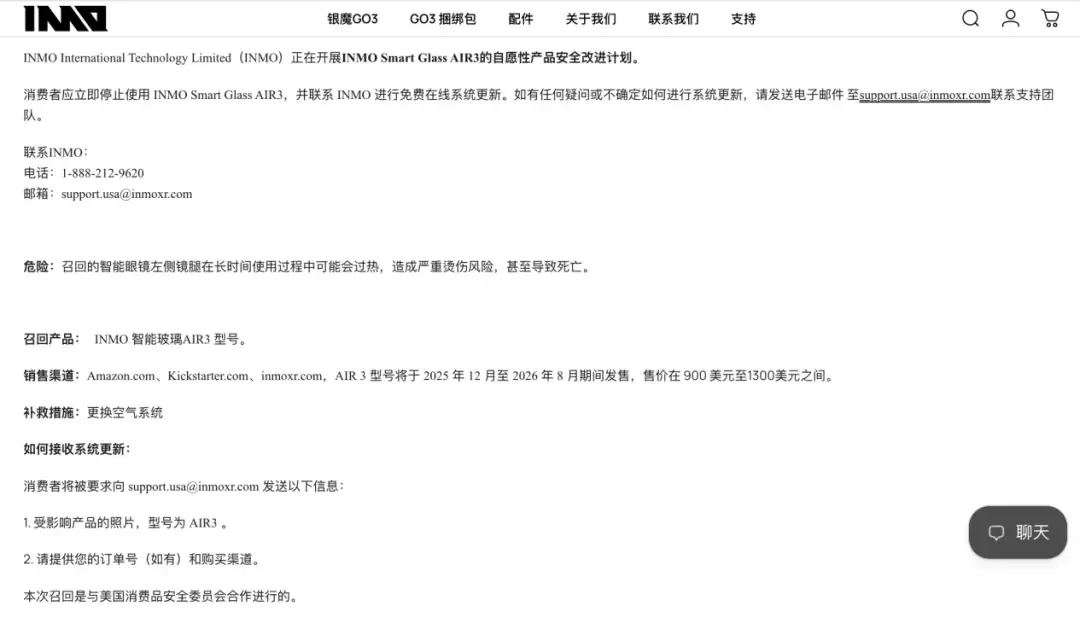
On September 24, the U.S. Consumer Product Safety Commission (CPSC) and Health Canada issued simultaneous recall notices for INMO's AIR3 smart glasses, which may overheat at the left temple during prolonged use. Users have been told to stop using them.
According to the CPSC, INMO has received 10 reports of AIR3 overheating, including cases in which consumers felt a burning sensation on their face and left ear. The recall covers about 1,643 pairs in the U.S. and about 120 pairs in Canada.
The official remedy is not a direct return, but free repair through INMO, which will help users update the system to version V3.16. The recall notice and the company's official response are available on INMO's overseas website.
This is not the first time the AIR3 has drawn users' attention over heating issues.
In September 2025, an overseas AIR3 user posted on Reddit that the left temple of the glasses became noticeably hot after about five minutes of use, and prolonged wear even left the ear feeling "unbearably hot." Users on Xiaohongshu have also repeatedly discussed heating problems with the AIR3 during charging and use.
Within INMO's product lineup, the AIR3 is not a niche offering. Priced at around RMB 4,000-5,000 in China, the AIR3 is described by the company as a key part of its bet on next-generation AR glasses. It emphasizes an "all-in-one" design, with the processor, storage, display, camera and AI capabilities built directly into the glasses, allowing standalone operation without a phone connection.
INMO has even described AIR3 as a "wearable computer" in an official article, and sees the balance between lightweight design, high performance and heat dissipation as the core problem that standalone AR glasses must solve.
The product also became a key part of INMO's overseas push. From October to December 2025, AIR3 raised about HK$10.296 million from 1,394 backers on Kickstarter. It was subsequently sold through Amazon, Kickstarter and INMO's overseas website, priced at $900 to $1,300.
From its positioning to overseas sales, AIR3 clearly carried much of INMO's vision for "all-in-one AR glasses." Yet less than a year later, the much-hyped AIR3 became the first INMO product to be singled out for recall by regulators in the United States and Canada.

The Disappearing AIR3
Judging by the timeline, AIR3 appears to have begun disappearing from sales channels even before the formal overseas recall.
Today, when 「市象」 asks about AIR3 at INMO's official Taobao store, customer service says the product has been out of stock for about 10 days, and what remains available for purchase are mainly AIR3 accessories. JD.com also says the product is currently out of stock, with customer service offering no further explanation. When 「市象」 pressed on whether this was related to the recall, customer service said it had received no such notice.
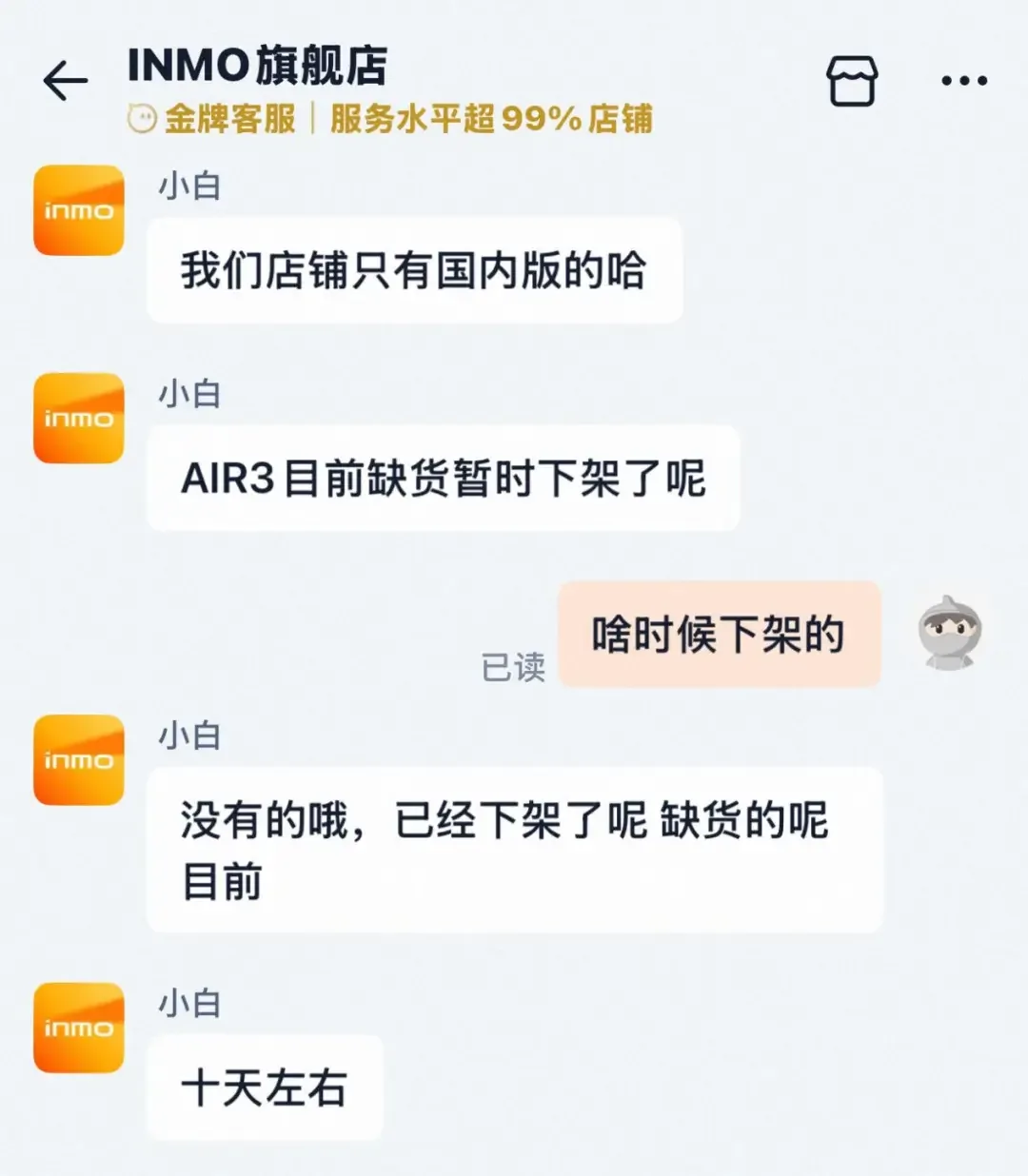
Meanwhile, AIR3's regular sales page is no longer visible on INMO's international website. Third-party tracking of INMO's overseas web pages also shows that the AIR3 international product page still existed earlier but became inaccessible by late August; on August 29, members of an overseas user community also noticed that AIR3 had disappeared from INMO's official website. All of this happened before the recall.
AIR3 currently comes in a version for the Chinese market and a version for overseas markets. The two differ in cooling, body materials and ecosystem. INMO added cooling and material improvements for the overseas version, including superconducting copper cooling on top of graphene cooling, upgraded body materials, and GMS and Google Play support in the software ecosystem.
INMO has in fact recognized that cooling is a problem that standalone AR glasses must solve.
When introducing AIR3, INMO described "performance, weight and cooling" as challenges a standalone all-in-one device must tackle simultaneously, and said the product uses a multi-layer cooling solution to ensure wearing comfort under heavy loads.The overseas version of AIR3 did receive further cooling upgrades over the domestic version, adding superconducting copper cooling on top of graphene cooling.
Yet the AIR3 units recalled by U.S. and Canadian regulators were precisely the overseas model.One detail is particularly intriguing: foreign media reports noted that AIR3 shipped with a protective cover to prevent high temperatures from directly touching the face. The reports also said that as early as about seven months ago, online product reviews had already mentioned overheating on the left temple arm and a burning sensation during use.
This means INMO was not unaware of AIR3's heat issues. But if the overseas version had already been specifically optimized for cooling, why did localized overheating severe enough to trigger a recall still occur? And do domestic AIR3 users face risks? These are the questions INMO most needs to answer right now.
What is clear is that overseas regulators have classified the problem explicitly as a "burn risk." The U.S. CPSC stated directly in its recall notice that the left temple of the AIR3 can overheat during prolonged use, posing a risk of serious burns or even death; Health Canada, meanwhile, urged consumers to stop using the product immediately and upgrade its firmware to version 3.16 before resuming use.
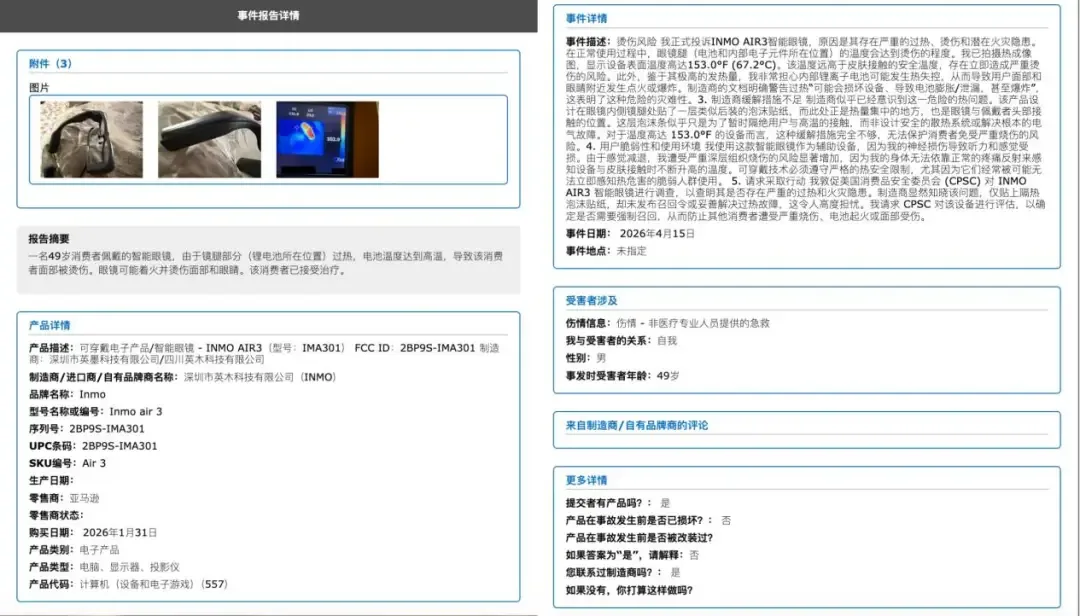
For ordinary consumer electronics, heat usually signals performance, battery life or user-experience issues first. Smart glasses are different: the heat source sits very close to the body, and the device must rest against the ear and face for long periods. Once heating reaches the point of causing a burning sensation or even burns, it is far more than a poor experience.

INMO wants to pack more into its glasses, but that path is not easy
In INMO's product roadmap, the AIR3 is actually a highly representative product.
Founded in 2021, INMO is young but has a clear goal, and it has steadily pushed an all-in-one approach in AR glasses since its inception. The company's website positions the AIR series for light office work and audiovisual entertainment, the GO series for translation scenarios, and the X series for imaging, while consistently emphasizing wireless connectivity, integration and lightweight design. The AIR series has always been the flagship line.
The AIR3 represents a clear doubling down on this approach. On its Kickstarter page, INMO defines the AIR3 as "1080P All-in-One Full-Color Waveguide AR Glasses," with core selling points including 1080P full-color optical waveguides, standalone operation, a 16MP wide-angle camera, 3DoF interaction, a rich app ecosystem, and open APIs and SDKs.
In fact, INMO is not content to make display glasses that simply connect to a phone; it wants the glasses themselves to handle more computing tasks. That means AIR3 faces a set of demands that are hard to satisfy at once: more processing power, better display quality, longer battery life, lighter weight and lower heat output.
INMO has been working on this problem for some time. Its AIR3 product line itself emphasizes standalone computing and integration, while the overseas version further adapts the product and system for the global market. But this recall shows that, at least when it comes to thermal management during extended use, this complex product mix still had issues that required a firmware update to resolve.
Notably, INMO has not stopped expanding into overseas markets because of the AIR3 roadmap.
From October to December 2025, AIR3 ran a global crowdfunding campaign on Kickstarter, ultimately drawing 1,394 backers and more than HK$10 million in funding. INMO has since continued to expand its overseas product lineup. In September this year, the company's international website launched MAGIC AI Glasses J, a product clearly positioned around everyday wear, an AI assistant, first-person shooting, translation, voice navigation and open-ear audio.
This also means INMO is not simply iterating again and again on a single AIR3 product, but is trying to find the next form factor for smart glasses.
AIR3 represents a more aggressive direction: packing as much computing and AR capability as possible into the glasses so they become a standalone wearable terminal. GO3 and the newly launched MAGIC AI Glasses J, by contrast, are closer to everyday AI glasses, using lighter hardware and clearer use cases to make the glasses a device users are willing to wear for long periods.
Neither approach is inherently right or wrong, but the AIR3 experience shows that the real challenge for smart glasses may not simply be "how many more features can be packed into a pair of glasses."
As computing power grows and AI capabilities multiply, glasses must also stay light, thin, cool-running and long-lasting. For a consumer device worn on the face every day, performance and features ultimately take a back seat to one fundamental condition: whether users are willing to wear it for long periods.
Original title : INMO Air3 recalled as smart glasses face a heat dissipation test
Source: OFweek Optics Network · News · optics.ofweek.com