Huawei Mate 90 Pro Max Review: Strong Imaging, HarmonyOS Ecosystem the Highlight
华为Mate 90 Pro Max体验:影像超能打,鸿蒙生态是一大亮点
Topics and contents
Topic
On this page
Lei Tech reviewed the Huawei Mate 90 Pro Max, which features a new Kirin processor, a brighter display and the Ruiying Z10 10x zoom module camera H1, with a starting price of RMB 9,499. The review found its imaging performance outstanding and the HarmonyOS ecosystem a key highlight.
As Huawei's true flagship of the year, the Huawei Mate90 Pro Max is undoubtedly packed with诚意: a brand-new Kirin processor, a brighter and clearer display, simpler and more capable imaging, and the Ruiying Z10 10x zoom module camera H1, which arrives with a killer feature right out of the gate.
Its price also starts at ¥9,499.A starting price close to ¥10,000 has raised Leikeji's expectations for it, given that it is positioned as the market's top-tier flagship phone.So the question is: does the Mate90 Pro Max truly deserve the "Pro Max" name? Here is Leikeji's hands-on review.
Design "stays true to its roots," but plenty of details have changed
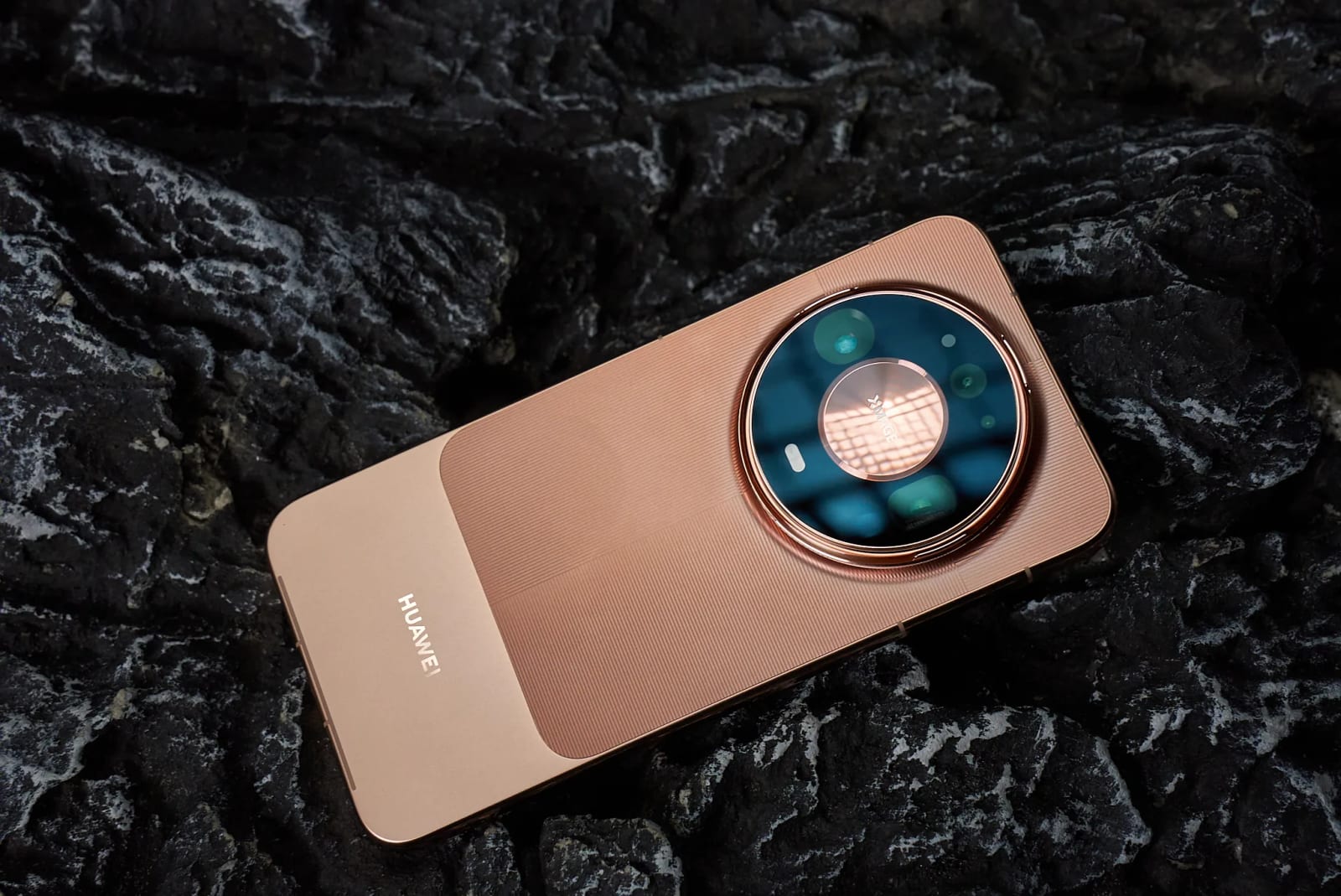
Huawei is arguably the only domestic phone maker that has stayed true to its original design philosophy. This ring-style "Oreo" camera deco has carried over from the Mate40 series to this day, so the first time you see the Mate90 Pro Max, you barely need to look at the logo to know it's a Huawei Mate.Some readers may see this as the designer being lazy, but for a top-tier flagship phone, a distinctive look matters more.
(Image source: Leikeji)
Although the camera module is noticeably larger again, the center of gravity is handled well. The oversized lens assembly doesn't make the phone feel particularly top-heavy, and the smooth transition along the edges helps too, so the actual grip is fairly comfortable — at least it doesn't feel as intimidating as its 234g weight suggests.
That said, for an imaging flagship, the camera bump on the Huawei Mate90 Pro Max is still fairly pronounced — place it on a table and it can double as a "seesaw," though whether that bothers you is a matter of personal taste.
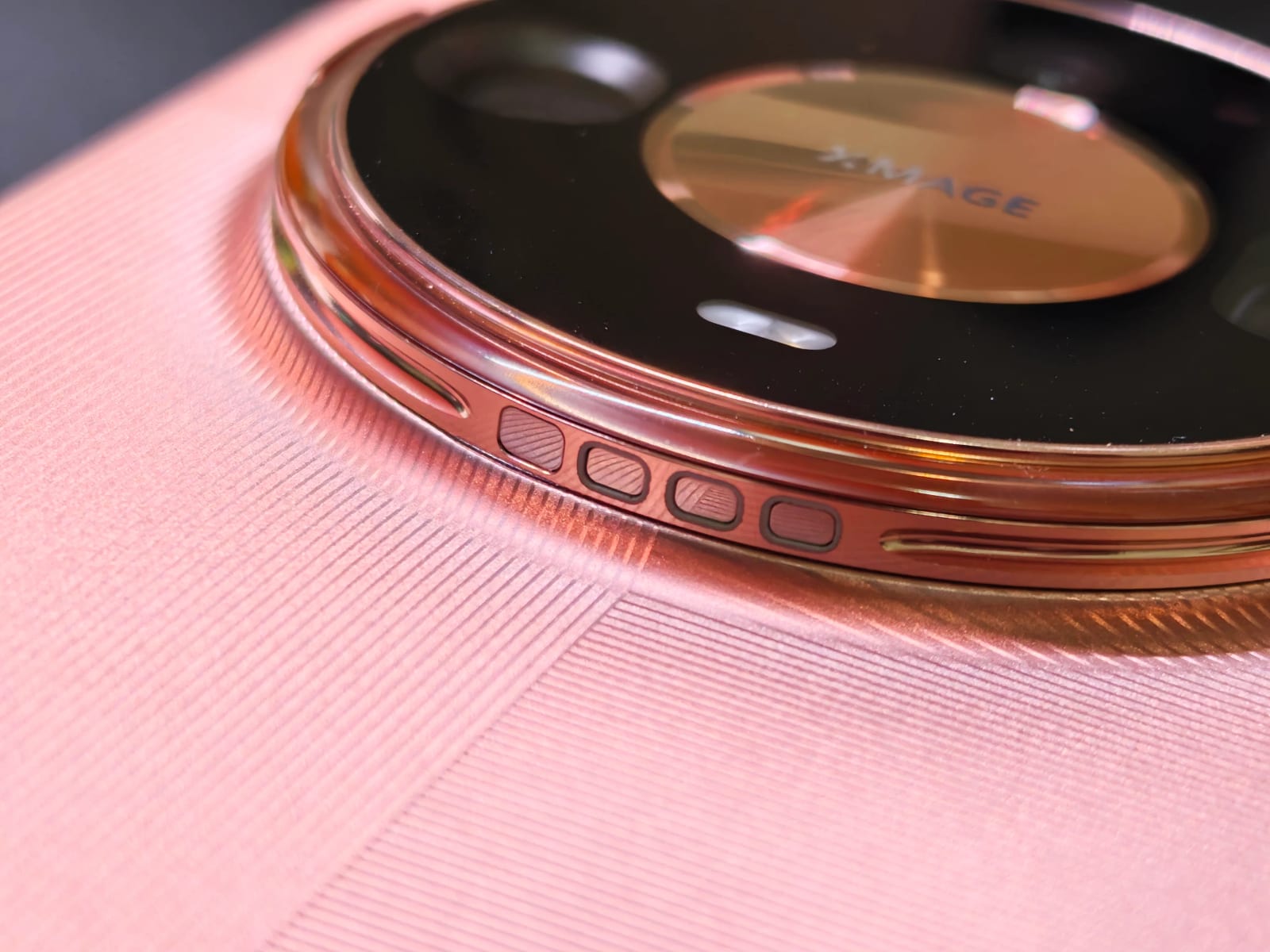
What's interesting is that this time Xiao Lei got the Mate90 Pro Max Collector's Edition, which has dedicated external contacts below the camera module for attaching the Huawei Ruiying Z10 modular camera.
(Image source: Leikeji)
When I first saw the name "module camera," I assumed it was similar to the detachable telephoto extenders that have become popular on Chinese imaging flagships over the past two years. It turns out to be an entirely different thing. A traditional telephoto extender essentially adds a set of optics lenses in front of the phone's existing telephoto lens, with the phone's CMOS still doing the imaging. The Z10, by contrast, integrates its own sensor, lens, and motorized zoom mechanism, covering focal lengths from 24mm to 240mm with 10x continuous optical zoom and a maximum aperture of F2.0-F4.5. Mounted on the back of the Mate 90 Pro Max Collector's Edition, it feels more like attaching a complete zoom camera to the phone.
Unfortunately, we were not able to get our hands on the Ruiying Z10. If readers are interested, we can try to get one in for a separate round of testing.
Having covered the back, let's turn to the front. The Mate90 Pro Max features a 6.9-inch second-generation Linglong display with a dual-layer OLED architecture. It supports an adaptive LTPO refresh rate of 1–120Hz, 1.07 billion colors and the BT.2020 ultra-wide color gamut, with local peak brightness reaching 12,000 nits.

(Image source: Leikeji)
At this point, it is hard to find fault with the display on a 10,000-yuan flagship, but the Mate 90 Pro Max's real advantage is outdoor visibility. In our hands-on testing under strong sunlight, opening Maps, WeChat, or the camera still showed on-screen content clearly, without having to move the phone into the shade.

(Image source: Leikeji)
Xiao Lei also compared his iPhone Air side by side. Indoors at the same ambient brightness, with both phones manually set to maximum brightness, the Huawei was clearly a notch brighter than the iPhone.
Overall, the Mate 90 Pro Max's design changes are mostly in the details, especially the Collector's Edition's floating star ring and external module structure, which give the circular Deco a new purpose. It does not chase extreme thinness and lightness, nor does it overhaul the Mate's look just for novelty. It remains the familiar business flagship, except that it has begun to offer some new approaches on the imaging side.
200 MP Telephoto Adds Muscle: Mate Imaging Has a Mind of Its Own
Imaging is one of the most important upgrades on the Mate90 Pro Max, and Huawei has put considerable effort into it this time. For a long time, the P series has consistently held a slight edge over the Mate line in camera capability, but this time the Mate90 Pro Max can be said to pack in every relevant technology it should have.
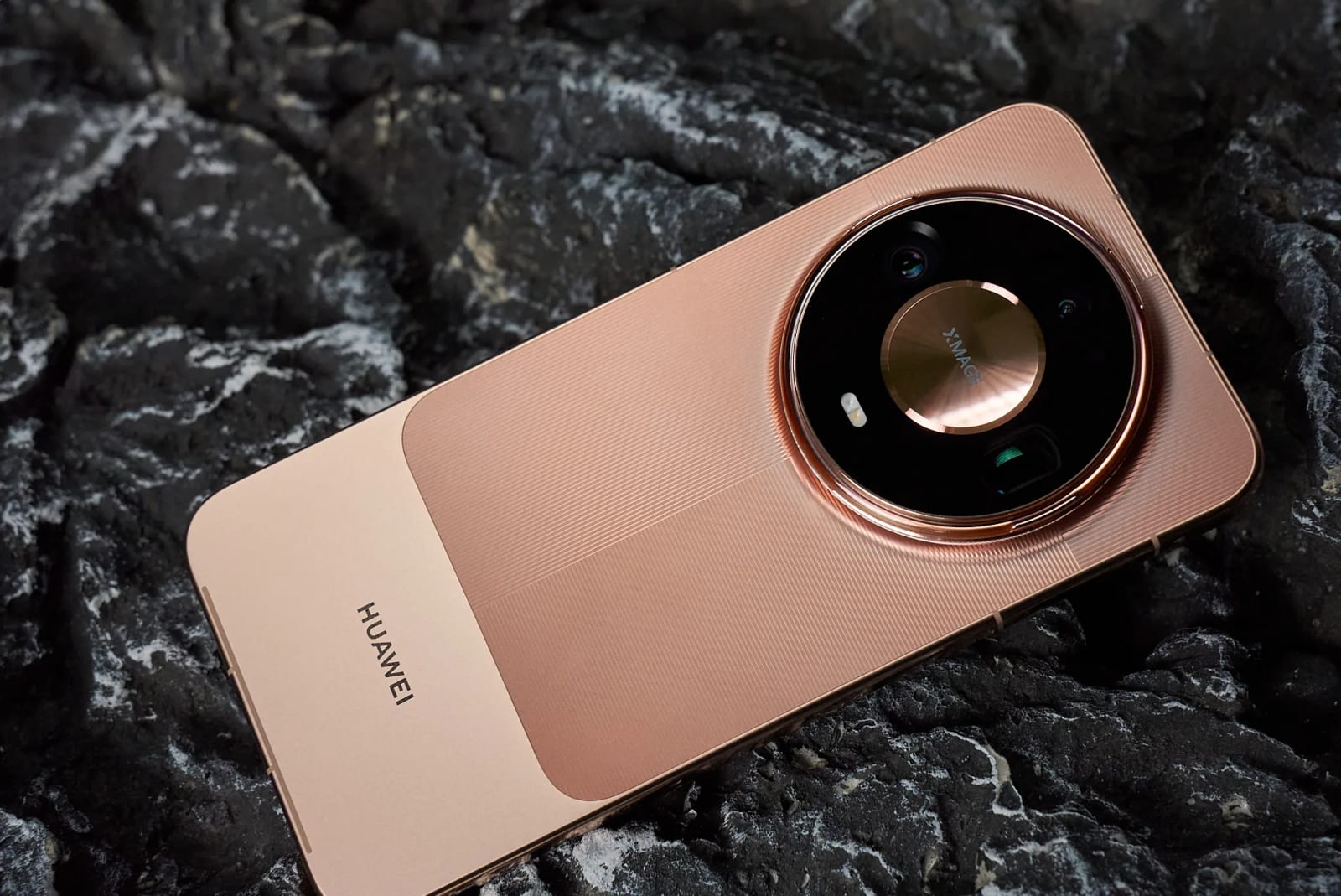
Starting with the specs, the main camera uses a 50-megapixel RYYB sensor with a 24mm equivalent focal length, supporting a variable F1.4-F4.0 aperture and OIS optical image stabilization; Huawei highlights an 18EV dynamic range. The ultra-wide is a 40-megapixel RYYB sensor with a 13mm equivalent focal length and an F2.2 aperture. The telephoto has been upgraded to a 200-megapixel RYYB periscope telephoto with an 89mm equivalent focal length and an F2.6 aperture, also with OIS optical image stabilization. Huawei has also added a third-generation Hongfeng True Color camera to further improve color performance in complex lighting conditions.
(Image source: Leikeji)
But after reviewing so many flagship camera phones over the years, everyone knows that specs only set a phone's floor; whether the photos look good comes down to how well the manufacturer tunes them. Today's domestic flagships are all competing on large sensors, high-resolution telephoto lenses and computational photography, with launch events routinely touting dynamic ranges of more than ten EV, hundreds of megapixels or multi-fold zoom. The numbers sound more and more extravagant, yet the final photos may not differ that much.

(Image source: Leikeji)
In good daylight, virtually every flagship phone can capture sharp, attractive photos. What really tests a manufacturer's capabilities is complex lighting, indoor low light, and performance across different focal lengths. So this time, Xiao Lei didn't go looking for extreme test scenarios either, but mainly used the Mate 90 Pro Max to shoot some everyday scenes.
 (Image source: Leikeji)
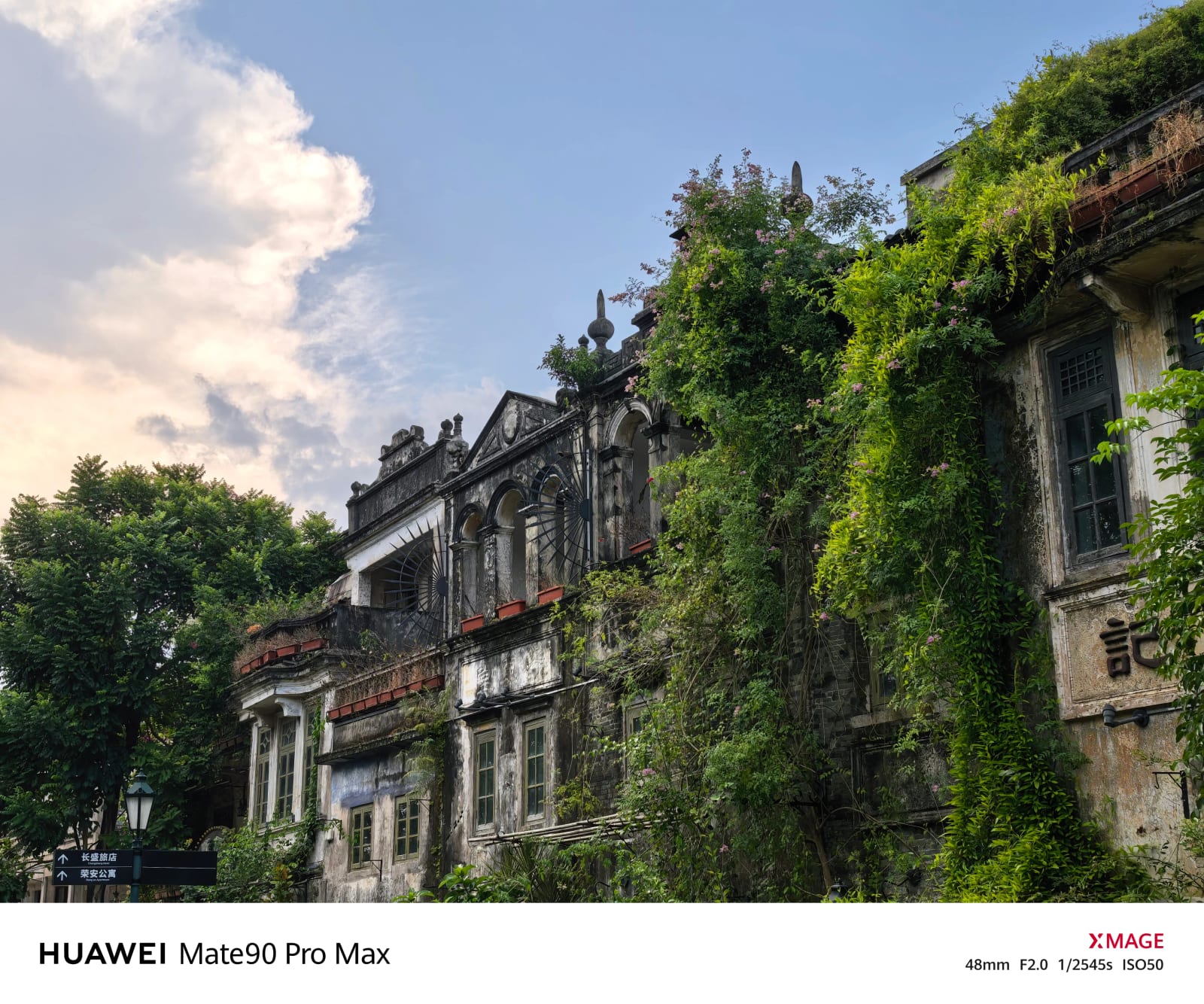
First, this set of architectural samples. The lighting on the day of the shoot was actually quite complex: the left side of the frame features a very bright sky and clouds, while the right side shows an old building and plants in shadow, creating a pronounced contrast between light and dark.If a phone's dynamic range is insufficient, the sky is easily overexposed and much of the detail in the building's shadows is lost.
The photos ultimately captured by the Mate 90 Pro Max are fairly consistent with Huawei's usual style: the sky shows no large areas of overexposure, the clouds retain visible light and shadow variation, and the mottled texture of building surfaces, window frames and plant details are preserved reasonably well.Especially the green plants in shadow on the right, where the layering between leaves remains clear, showing that Huawei's HDR processing in high-contrast scenes is indeed quite mature.
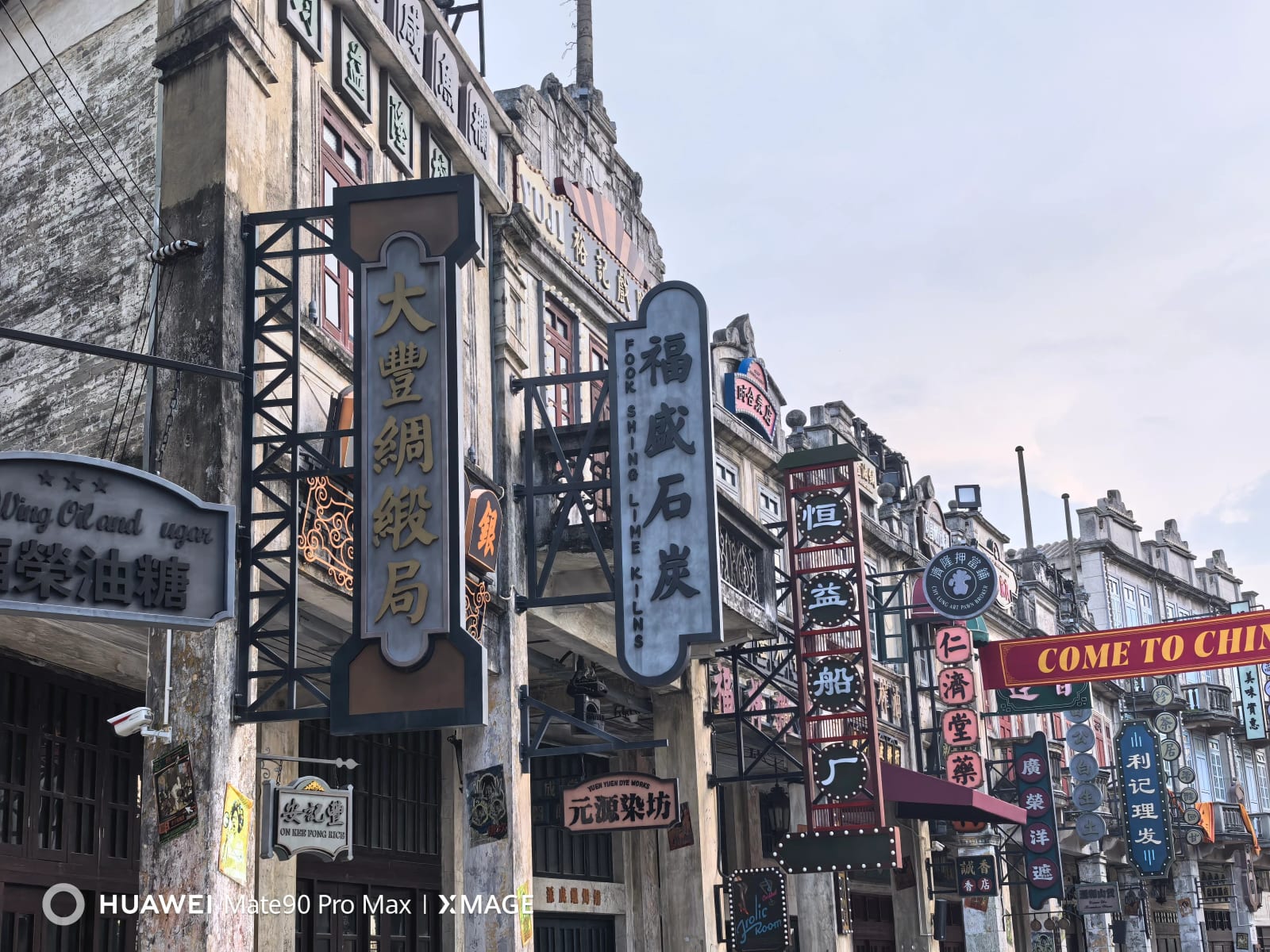
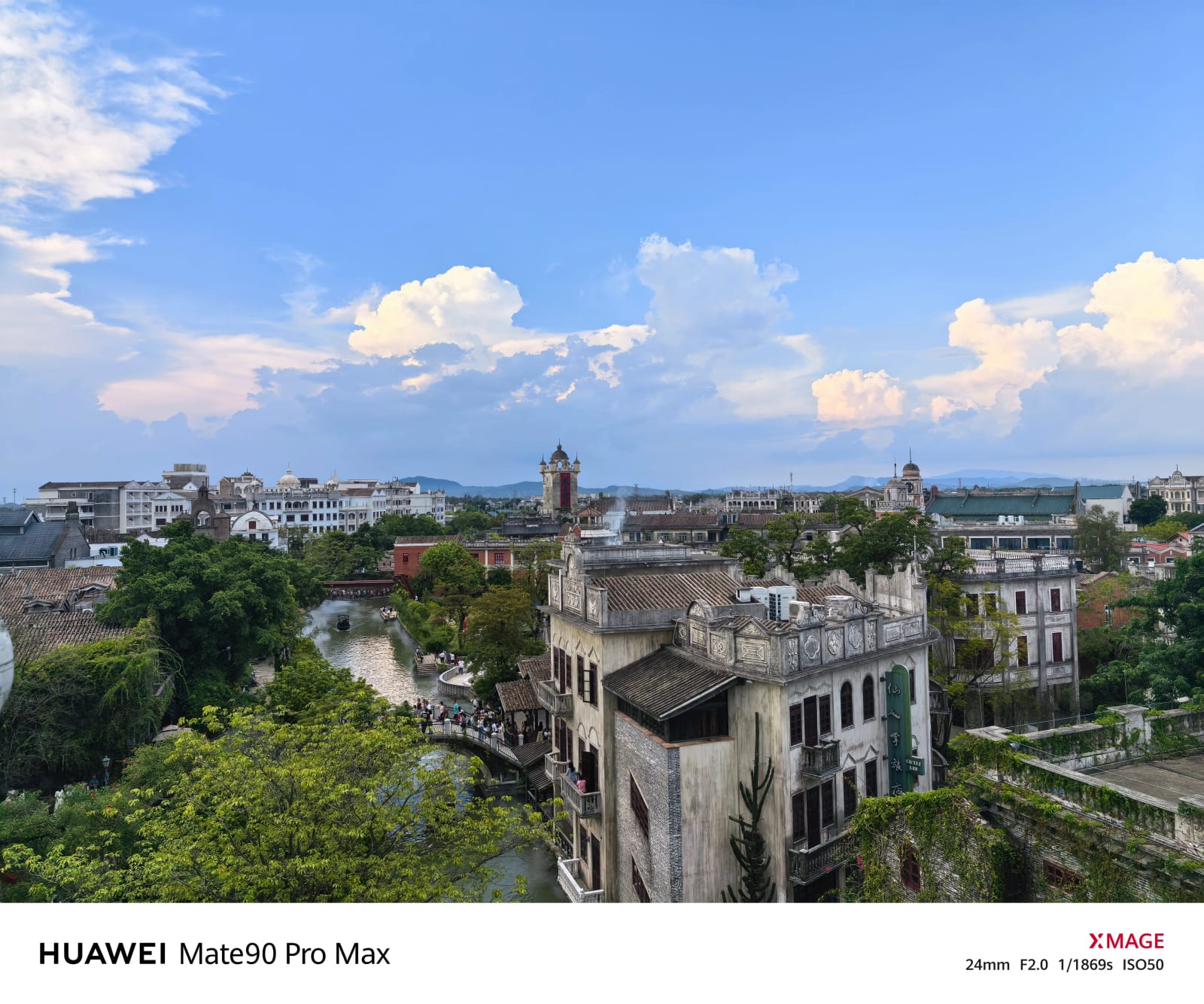
(Image source: Leikeji)
Compared with the wide-angle view that is the default on a phone's main camera, I actually prefer shooting buildings and casual everyday shots at focal lengths close to 50mm, because the perspective feels more natural and it is easier to make the subject stand out. The Mate 90 Pro Max still retains plenty of detail at this focal length; the textures on building surfaces do not become soft or mushy after cropping, and the overall look is good.Look closely, though, and Huawei's color processing is still fairly aggressive: the images have strong visual impact, but the colors differ to some extent from what the eye actually sees on site.
This color tendency becomes even more apparent when shooting food. Xiao Lei used the Mate 90 Pro Max to photograph a batch of hairy crabs. The shooting conditions for the raw crabs were actually quite challenging: the shells were covered with water droplets, a stainless steel steamer rack sat underneath, and fairly strong lighting shone from the side, filling the frame with all kinds of specular reflections. In such an environment, phones tend to run into two problems: darkening the entire image to suppress reflections, or over-sharpening so much that the texture on the crab shells looks unnaturally harsh.
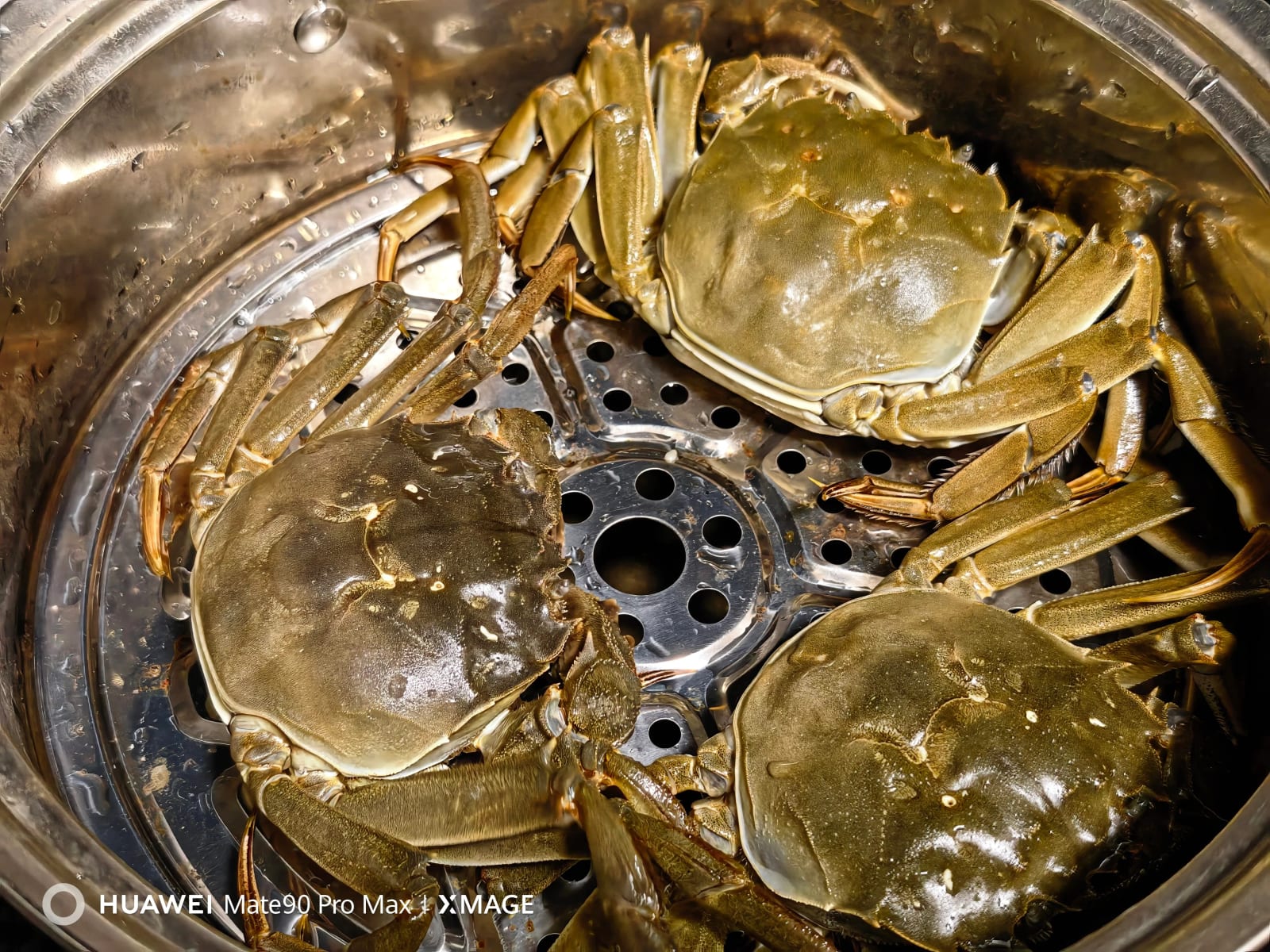
The Mate 90 Pro Max puts in a decent showing. The grains on the crab shell, the water droplets and the edge textures are all preserved fairly well, and the details on the metal steamer rack are not completely smoothed away, so the overall image looks fairly natural. Huawei has not forced down every highlight, however, and some obvious white specular spots remain visible on the crab shell and metal surfaces. Lei thinks this approach is actually more natural, since strong reflections in the real world cannot retain full detail anyway; crush every highlight in pursuit of so-called ultra-high dynamic range and the photo easily loses its true lighting relationships.
The Mate 90 Pro Max preserves fairly clear light-and-dark gradation in this set of sample shots, keeping the subject clearly visible without making the photos look particularly flat.

(Image source: Leikeji)
Once the hairy crabs were cooked, the Mate 90 Pro Max's color style became even more pronounced. The oranges, reds and yellows in the photos are all vivid, especially the red of the crab shells, which looks quite glossy and rich.
However, from a color accuracy standpoint, Huawei has once again pushed things a bit too far. Some reds and yellows are noticeably oversaturated, deviating from what the eye sees on site. The addition of the third-generation Hongfeng True Color camera clearly does not mean Huawei is abandoning its past color style entirely. Judging from these samples at least, the Mate 90 Pro Max still leans toward producing a pleasing photo.
Shoots far enough and clear enough — perfect for concerts and sweeping landscapes
Compared with the main camera, what really caught Lei's interest this time is the 200-megapixel RYYB periscope telephoto. Over the past few years, domestic flagship phones have gradually shifted from simply chasing larger main-camera sensors toward improving telephoto resolution and versatility. Especially since 200-megapixel telephoto cameras began to spread, phones can use high-resolution cropping to cover more focal lengths, turning them into a "photography powerhouse" for more users.
The shoot covered a fairly varied set of scenes: fish lanterns hung outdoors, indoor stage performances, and boats along the river, with quite different shooting distances and lighting conditions. What pleased Lei was that the Mate 90 Pro Max showed no particularly obvious drop in final image quality across these scenes; when light was plentiful, the telephoto's resolution advantage was especially clear.

(Image source: Leikeji)
For an object like a fish lantern, whose surface is covered in scales, stitching and fabric folds, the texture remains clearly visible even at a focal length of 240mm, and the outline of the fins stays fairly intact rather than turning into a mushy blob from the high-magnification crop.More importantly, this photo shows no excessive sharpening artifacts.
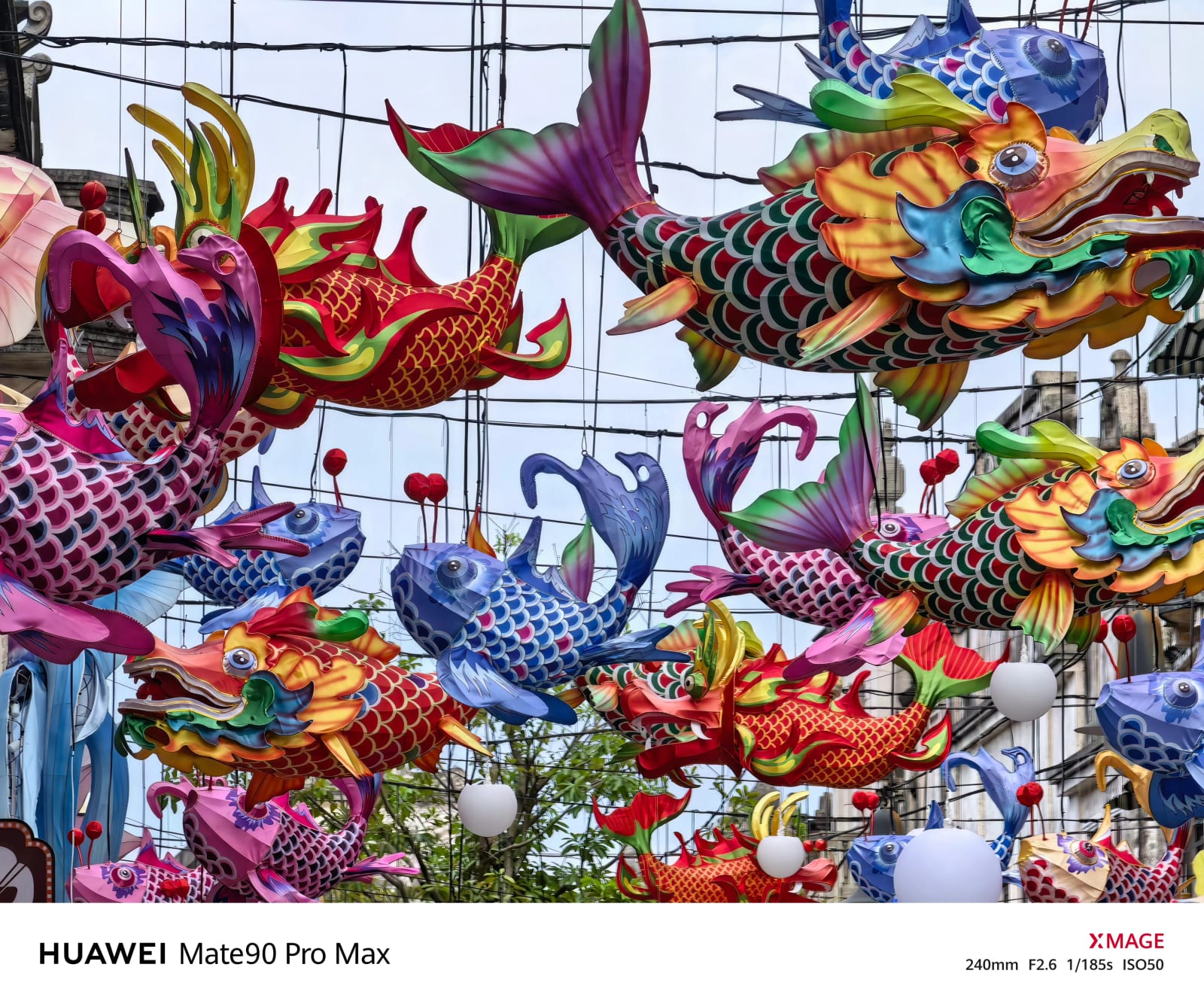
(Image source: Leikeji)
Of course, Huawei's color signature is still unmistakable. The fish lanterns themselves use plenty of red, green and yellow, and after processing by the Mate 90 Pro Max the colors look even more vivid — especially the red fish lanterns, which grab your attention almost immediately. Some of the reds have become a bit oversaturated, however, which also compresses the gradation in the highlights. If you prefer colors closer to what the eye sees, Huawei's "original color" profile may not be for you.
Another advantage of a telephoto lens is that it lets you achieve a better composition without changing your shooting position. For example, when shooting a stage performance from a seat near the back, a phone's main camera often captures the entire stage, leaving the performers occupying little of the frame, and cropping later rarely preserves sharpness.
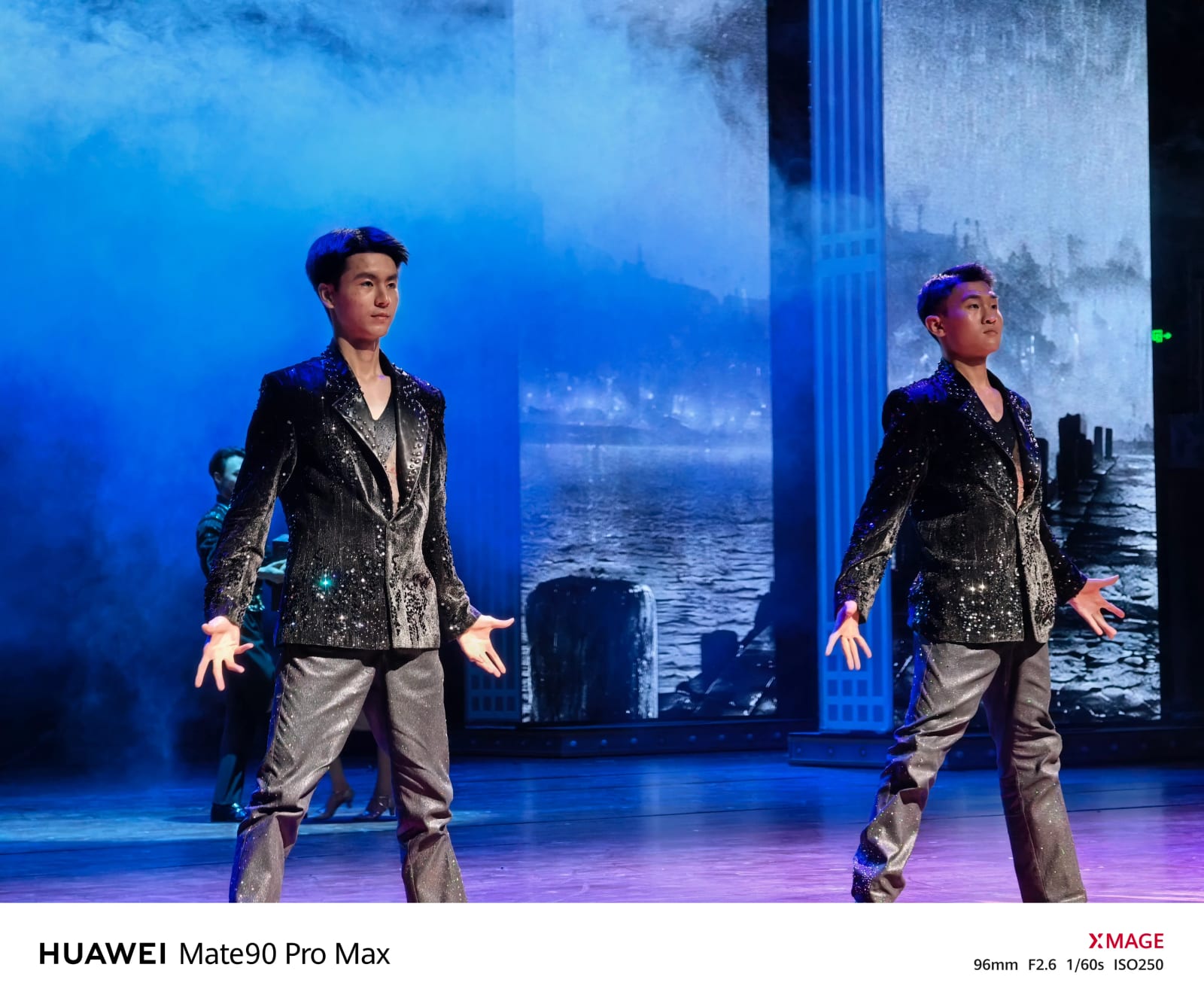
(Image source: Leikeji)
With the telephoto lens, we can make the performer the main subject of the frame, preserving even the sequins on the black suit and the reflective texture of the trousers. Given that the scene was lit mainly in blue and purple, with the subject's face in a relatively dim area, Huawei's performance here is quite satisfying — at least the face isn't smoothed into oblivion and the clothing doesn't turn into a solid black mass.
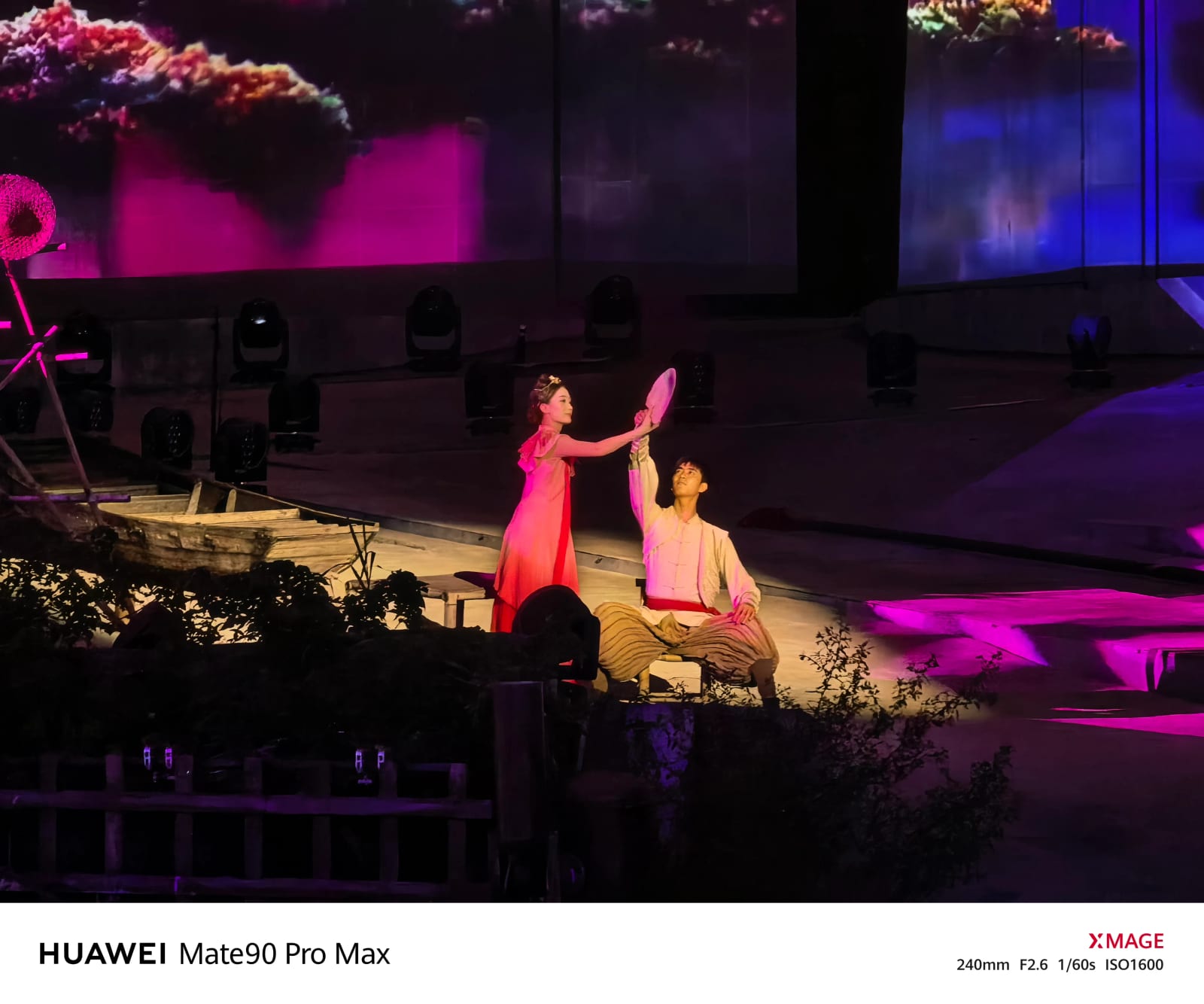
(Image source: Leikeji)
Still, the stage scenario exposes a few minor issues with the telephoto lens. The subject looks fairly sharp, but a close look at areas such as the hands reveals slight motion blur. After all, the shutter speed for this shot was only 1/60s, which is a bit of a stretch for freezing the motion of a performer in action. The phone's optical image stabilization can minimize the effects of hand shake, but it cannot stop a moving person, so faster shutter speeds are still needed for performances with large movements. On the other hand, the slower shutter speed was chosen to boost overall image brightness — you simply cannot have it both ways.
(Image source: Leikeji)
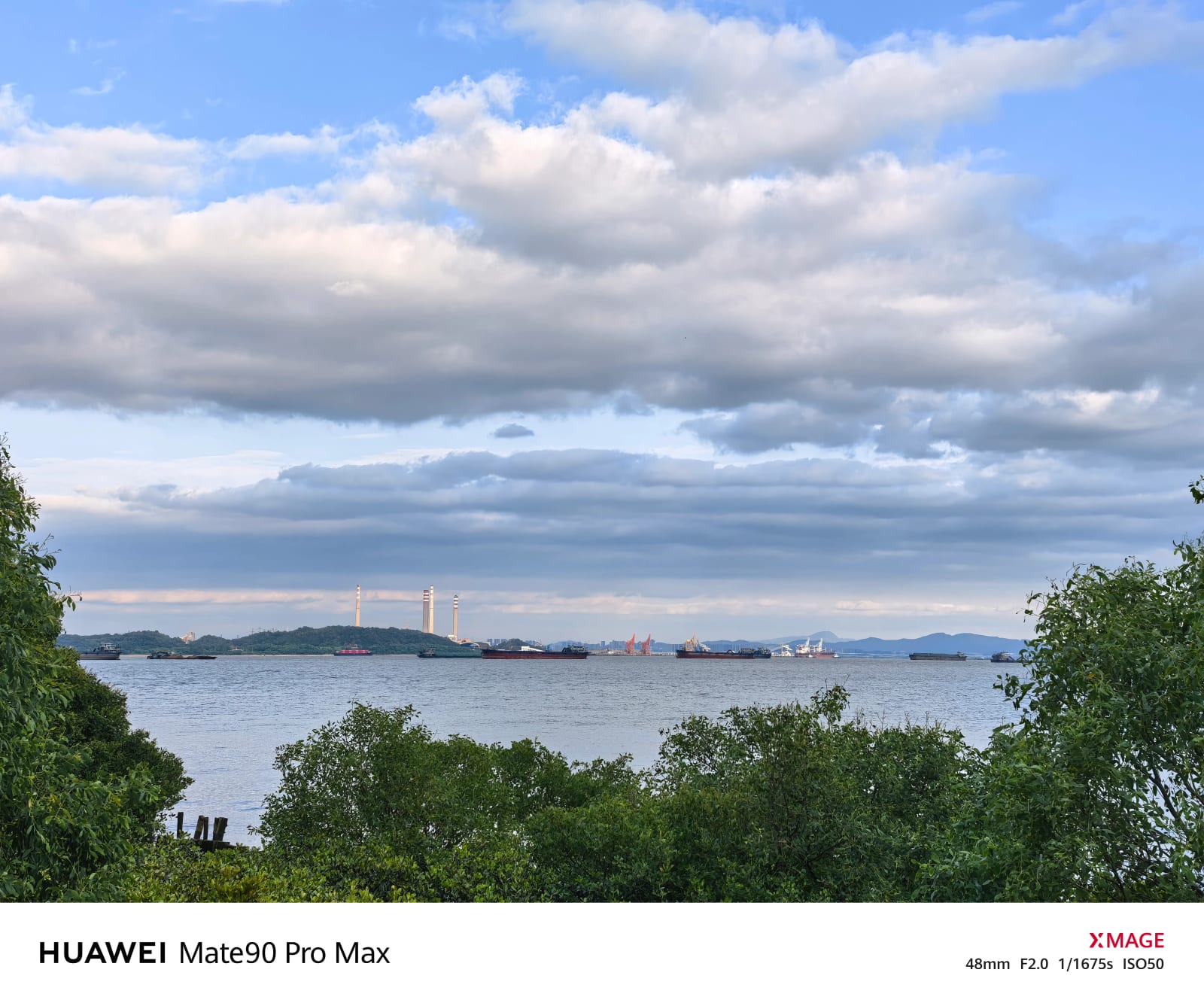
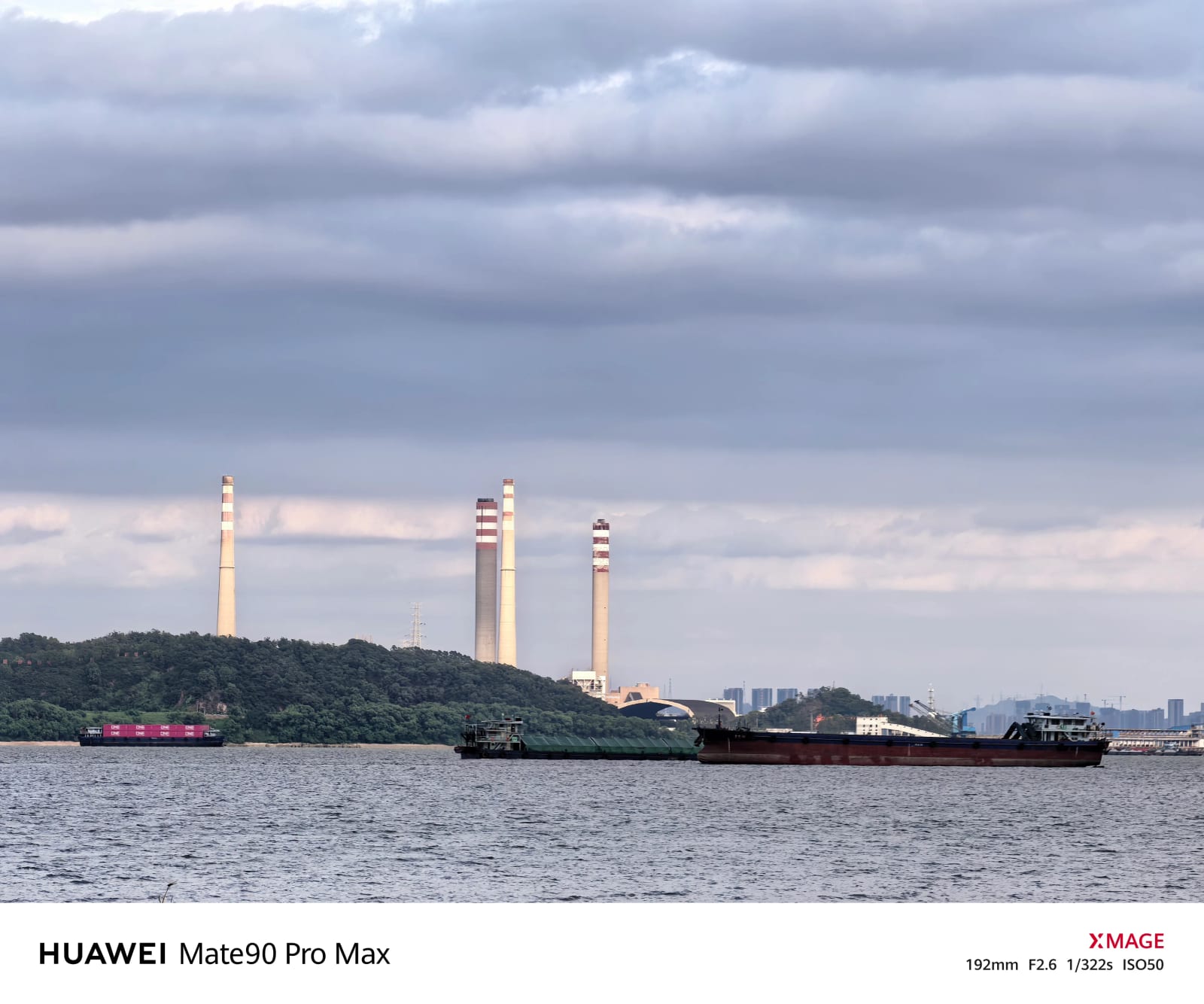
The Mate 90 Pro Max also delivered satisfying results when shooting distant buildings and the river. Even at a focal length of 192mm, the red-and-white stripes on the distant chimney, the boats on the river and the buildings along the shore remain reasonably sharp, with some details visible when zoomed in.
Of course, at around 8x zoom, some sharpening artifacts are still visible along the edges of certain buildings, and the detail is not as rich as at the native focal length. However, comparing with photos taken at 48mm reveals some color differences between the two shots, especially in the sky: the telephoto images are noticeably grayer and cooler, and the clouds, which originally had some warm tones, look flatter. White balance consistency still has room for improvement. Fortunately, these differences are mainly in color cast and have little impact on sharpness or detail, so the overall look remains good.
After shooting these sets of photos, Xiao Lei is fairly satisfied with the telephoto camera on the Mate 90 Pro Max. The 200-megapixel sensor in particular enables heavy cropping at high zoom factors, letting it capture reasonably sharp images even at 8x or 10x zoom — handy for shooting performances, architecture, or distant scenery. The telephoto is not without its flaws, though. Beyond slightly oversaturated colors in some scenes, white balance can occasionally differ between focal lengths, which is more noticeable in overcast conditions where colors are relatively flat.
But given its overall performance, these issues did not significantly affect Xiao Lei's assessment of the telephoto camera. After all, what matters most in smartphone photography is whether you can capture the shot and capture it clearly, and the Mate 90 Pro Max does a genuinely good job on that front.
HarmonyOS ecosystem matures: what changes in everyday experience?
Having covered imaging, let's turn to HarmonyOS 7.
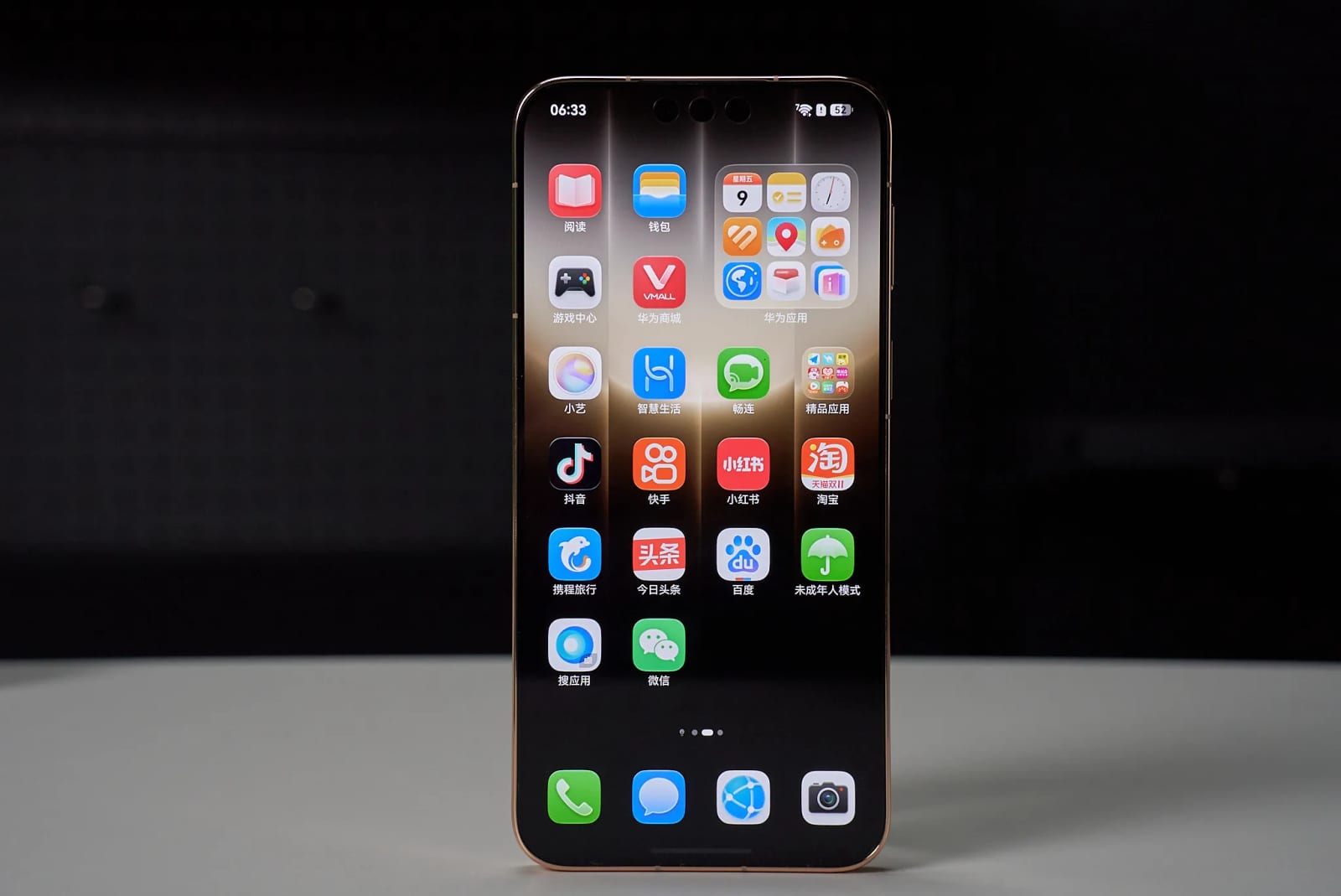
As the most important component of Huawei's flagship offerings, HarmonyOS has changed quite visibly over the years. Starting with HarmonyOS NEXT in particular, Huawei has gradually built an independent app ecosystem. After several generations of updates, mainstream apps such as WeChat, Alipay, Douyin and Taobao now work essentially without issues in daily use.
(Image source: Leikeji)
The app ecosystem issue is not fully resolved yet. While adaptation for mainstream domestic apps is fairly mature, some rarely used software, overseas apps and certain professional tools may still have incomplete features or cannot be installed directly. If you mainly use common domestic apps, HarmonyOS 7 should largely meet your needs; but if you often rely on overseas software or niche tools at work, it is best to check compatibility before switching phones.
 (Image source: Leitech graphic)
As for system smoothness, the Mate 90 Pro Max is largely worry-free. As one of the few self-developed operating systems, it delivers responsive performance whether you are swiping through daily tasks, switching apps, or multitasking, with fluid animations throughout. Given that the Kirin 9050 Pro offers a clear performance leap over previous generations, combined with HarmonyOS optimizations, overall smoothness ranks firmly in the first tier among smartphones.
AI remains a major focus of the HarmonyOS 7 update, with Celia gaining an increasingly rich feature set. The assistant can now understand parts of what is on screen, help users look up information, organize documents, and even call different apps to carry out everyday tasks. For example, when you come across a long article, you can simply ask Celia to pull out the key points; when you need to sort through information, there is no need to copy and paste repeatedly — just hand it off to Celia.
As Celia handles more and more tasks, many operations that once required manual steps can now be done simply by speaking. Once you get used to it, it is quite convenient.

(Image source: Leikeji)
Judged by everyday use, HarmonyOS 7 is already a fairly mature mobile operating system, with mainstream app compatibility and system smoothness requiring little concern.
Verdict: Mate90 Pro Max is worth the price
Finally, following Leikeji's usual review format, here is a quick look at the pros and cons of the Mate90 Pro Max:
Advantages:
1. It has strong recognition — people know at a glance that it's a Huawei Mate;
2. The camera's imaging style is very consistent and generally pleasing;
3. System smoothness remains in the top tier;
4. Build quality and overall fit and finish are impeccable.
Cons:
1. The application ecosystem is not yet particularly well developed;
2. It still falls a little short in some extremely heavy-load scenarios;
3. Battery life is average.
Starting at ¥9,499, the Mate 90 Pro Max was never going to be a phone for everyone. But after using it for a while, Xiao Lei thinks Huawei has delivered a genuinely competitive product this time, with the camera and display performance leaving a particularly strong impression. That said, there is still room for improvement in areas such as body weight, camera color rendition and peak performance.
As for whether it is worth buying, Xiao Lei believes the key comes down to individual needs. If you already use a Huawei phone and value camera performance and the HarmonyOS ecosystem, the Mate 90 Pro Max is indeed worth considering. But if gaming performance matters more to you, or you frequently rely on overseas apps, there are other options worth considering at the same price.
At the 10,000-yuan price point, users no longer need a phone that does everything. What they want is a device that excels in the areas they care about most and feels effortless to use.
Source: OFweek Optics Network · News · optics.ofweek.com