China Passenger Vehicle LiDAR Installations Reach 525,500 Units in August, with Hesai Just 65 Units Behind Huawei
Topics and contents
Data from NE Times shows that LiDAR installations in Chinese passenger vehicles reached 525,500 units in August 2026. Hesai installed 182,436 units, just 65 fewer than Huawei, and the two together accounted for 69.4%. The growth logic is extending beyond simply adding vehicle models to multiple LiDARs per vehicle, robot perception and 3D spatial mapping.
The original paper provides monthly installation and market share data, useful for assessing the automotive LiDAR market landscape
In August 2026, domestic passenger vehicle LiDAR installations reached 525,500 units. Hesai and Huawei were separated by just 65 units, together accounting for 69.4% of the market. It looks like a dual-leader tie, but the growth logic has extended beyond simply adding models to multiple LiDARs per vehicle, robot perception, and 3D spatial modeling.
In August 2026, domestic passenger vehicle LiDAR installations exceeded 520,000 units.
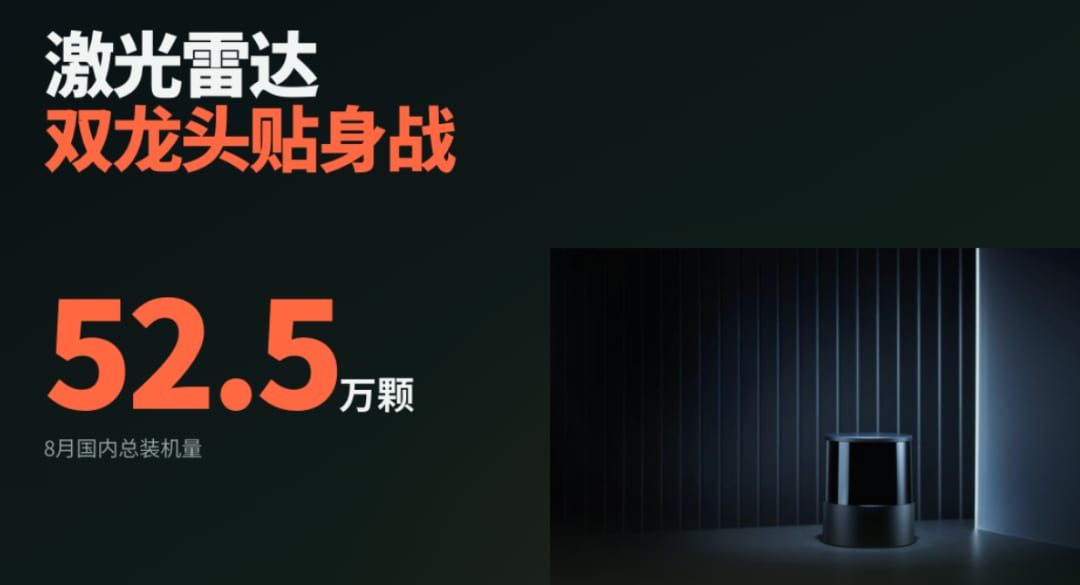
According to NE Times data compiled from domestic vehicle end-sales, the top five suppliers installed a combined 525,477 units. Of these, Hesai Technology installed 182,436 units and Huawei installed 182,371 units, a difference of just 65 units between the two companies, with each holding a market share of about 34.7%.
Compared with 271,000 units in August 2025 on the same basis, installations in August this year grew about 94% year over year, nearly doubling. The LiDAR market remains in a phase of rapid expansion.
More important than the overall growth is the shift in its sources: the automotive market is entering a stage of "how many units to install and where to install them," while leading suppliers are also extending their automotive-grade expertise into robotics, surveying and mapping, and spatial intelligence.
01
August market:
Hesai and Huawei virtually tied
The clearest feature of the August market was the continued consolidation of the leaders.
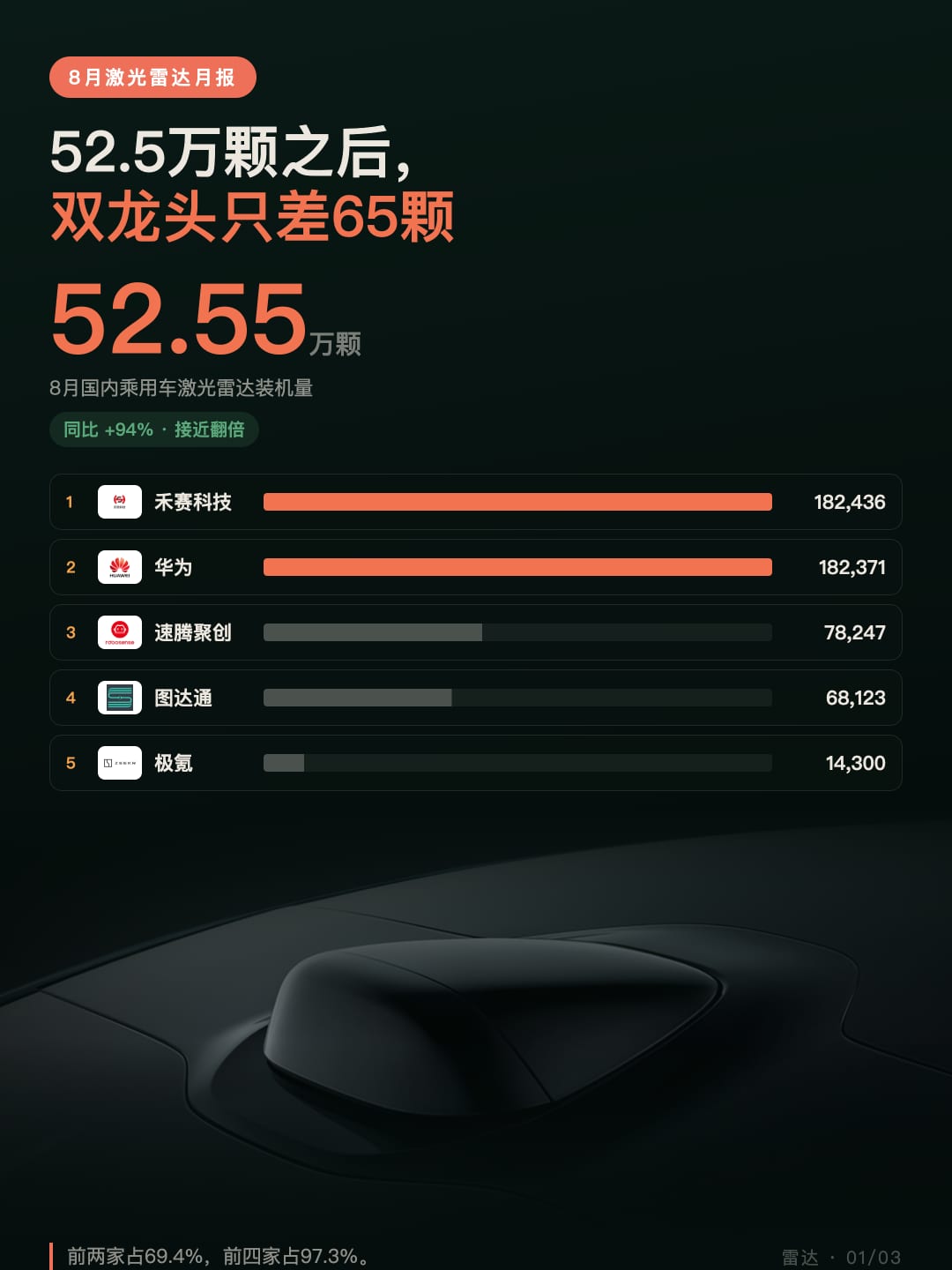
According to NE Times data, the top five companies installed a combined 525,477 units, distributed as follows:
◎ Hesai Technology 182,436 units, 34.7% share, including 170,035 forward-facing main LiDARs and 12,401 blind-spot units;
◎ Huawei 182,371 units, 34.7% share, including 77,984 forward-facing units and 104,387 blind-spot units;
◎ RoboSense: 78,247 units, 14.9%, including 77,369 forward-facing and 878 blind-spot units;
◎ Seyond: 68,123 units, 13.0%, including 33,119 forward-facing and 35,004 blind-spot units;
◎ Zeekr: 14,300 units, 2.7%, all blind-spot LiDAR.
Hesai and Huawei together account for 69.4%. Adding RoboSense and Seyond, the top four hold a 97.3% share.
The number of OEM customers, mass-production delivery capability, in-house chip development and product cost are all fiercely competitive.
Hesai and Huawei are similar in scale, but their product mixes are completely different.
◎ Hesai's 170,000 forward-facing main LiDAR units account for 93.2% of its own installations, with its advantage still coming from roof-mounted or front-compartment main LiDAR.
◎ Huawei's 104,400 blind-spot LiDAR units account for 57.2% of its own installations, already surpassing its main LiDAR.
The two companies differ by only 65 units in volume, yet follow two different routes:
◎ Hesai relies on open supply and the scale expansion of main LiDAR,
◎ Huawei leverages its intelligent driving system to bring both main LiDAR and blind-spot LiDAR onto vehicles, while also raising the number of sensors per vehicle.
02
Second growth driver:
From one LiDAR per vehicle to multiple units
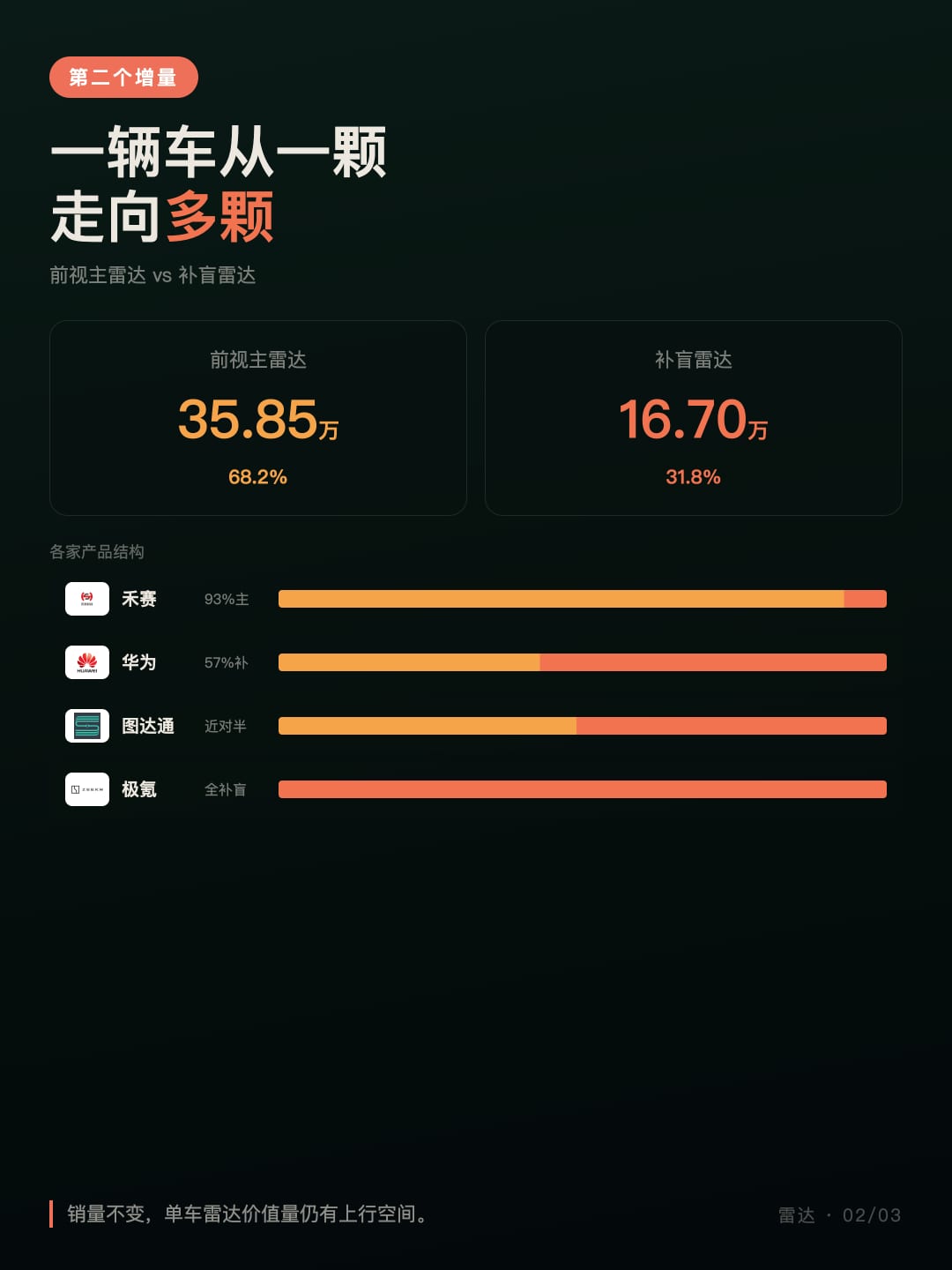
In August, forward-facing main LiDAR installations reached 358,500 units, accounting for 68.2%, while blind-spot LiDAR installations totaled 167,000 units, or 31.8%. The ratio of forward-facing to blind-spot units was about 2.15:1.
Blind-spot LiDARs accounting for 30% shows that the industry has moved beyond the basic configuration of a single forward-facing unit.
In the past, a single forward-facing main LiDAR mainly handled long-range detection and front-space modeling. Demand is rising for urban driver assistance, narrow-road navigation, parking, and side and rear perception, and a single forward-facing LiDAR can hardly cover all blind spots around the vehicle. Multi-LiDAR configurations are beginning to spread from flagship models to more price segments.
Huawei's August structure was the most representative. In 2026, it introduced an 896-beam dual-optical-path image-grade LiDAR that combines telephoto and wide-angle receiving optical paths to cover both long range and a wide field of view. Officially disclosed figures show it can identify a 14 cm target at 120 meters.
Blind-spot LiDAR covers the near field and side areas, combining with the main LiDAR to deliver "see far, see clearly" plus "see everything."
In August, Seyond's front-facing and blind-spot LiDAR installations were nearly evenly split. All 14,300 units from Zeekr on this list came from blind-spot LiDAR.
For the industry, the significance of multiple LiDARs per vehicle is that even if overall vehicle sales stay flat, LiDAR value per vehicle still has room to grow.
Multi-LiDAR setups must prove they deliver better safety redundancy and functional experience. Vision-only systems, millimeter-wave radar and end-to-end algorithms continue to improve, and automakers will reassess sensor counts.
Hesai: Defending the main LiDAR while moving toward spatial intelligence
Hesai ranked first in August with 182,436 units installed, of which front-facing main LiDAR accounted for more than 90 percent. Hesai's scale advantage in the automotive main LiDAR market remains solid.
The story Hesai is telling now goes well beyond automotive.
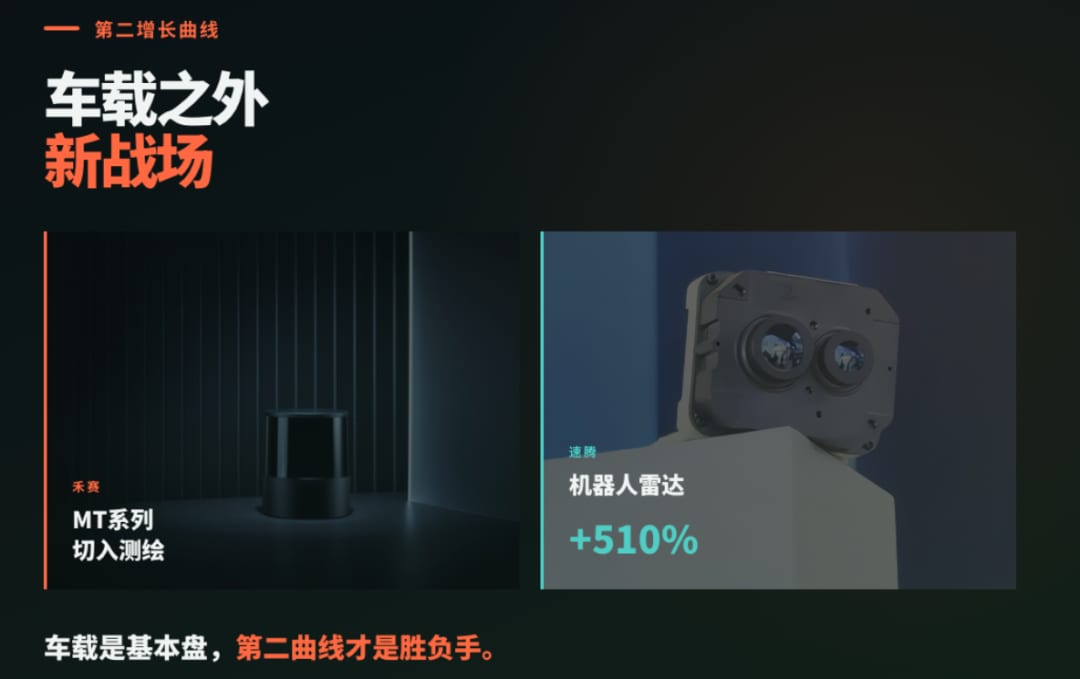
The company's MT series targets high-precision modeling, with ranging accuracy of 3.5 mm, a body weight of about 300 g, and a maximum field of view of 320°×60°. Use cases include handheld surveying, vehicle-mounted surveying, tripod-based surveying, and stockpile volume scanning. The products have already been integrated into NavVis's next-generation mobile scanning system.
Automotive demands high volumes, low cost, and long-term automotive-grade reliability. High-precision modeling places more weight on measurement accuracy, point cloud quality, device weight, and software ecosystem. By extending its optoelectronic systems, chips, and mass-production expertise into surveying, robotics, and spatial intelligence, Hesai is seeking markets that are less fragmented by automotive price competition and place greater value on performance.
Huawei: LiDAR is just one part of the intelligent driving system
Huawei's August installations were only 65 units behind Hesai, but more than 100,000 of those were blind-spot LiDAR units.
The biggest difference between Huawei and independent LiDAR makers is that Huawei sells a complete system solution. LiDAR, cameras, millimeter-wave radar, computing platforms and intelligent driving algorithms are bundled together, with each individual sensor just one part of the package.
The 896-channel dual-optical-path image-grade LiDAR improves perception of distant, small and low-reflectivity obstacles. The blind-spot LiDAR extends the vehicle's near-field coverage.
As more vehicle models adopt Qiankun intelligent driving, Huawei can use its system solution to drive installations of both the main LiDAR and the blind-spot LiDAR at the same time.
The advantage of Huawei's model is that sensor specifications, mounting positions and algorithm requirements can be defined in coordination. The limitation is that the market size is highly tied to the sales of partner automakers and the penetration rate of the Qiankun intelligent driving solution.
RoboSense: The robotics business is no longer just a concept
RoboSense shipped 78,247 units in August, including 77,369 forward-facing main LiDAR units, with its automotive business still dominated by main LiDAR.
In the first half of 2026, RoboSense's total LiDAR sales reached 719,200 units, up 169.6% year on year. Of these, sales in robotics and other fields totaled 282,600 units, up 510.4% year on year, making it the company's fastest-growing business.
RoboSense is also extending its capabilities from LiDAR to spatial cameras, tactile sensors and robot joint modules, shifting from selling a few more LiDAR units to robots to becoming a core component platform for robotics.
Seyond and Zeekr: Blind-spot LiDAR is reshaping the second-tier rankings
Seyond installed 68,123 units in August, including 33,119 forward-facing LiDAR units and 35,004 blind-spot LiDAR units, with blind-spot installations slightly exceeding main LiDAR units.
In the first half of the year, Seyond added automaker customers including GAC, and a cumulative total of seven new vehicle models have entered mass production, so it no longer relies solely on NIO. The combination of main and blind-spot LiDAR is helping it raise per-vehicle value and reduce dependence on a single customer.
Zeekr entered the ranking with 14,300 units, all of them blind-spot LiDAR. This figure at least shows that automakers are extending their sensor capabilities to a more fundamental level.
For independent LiDAR makers, the blind-spot market offers new incremental demand but could also bring new competitors.
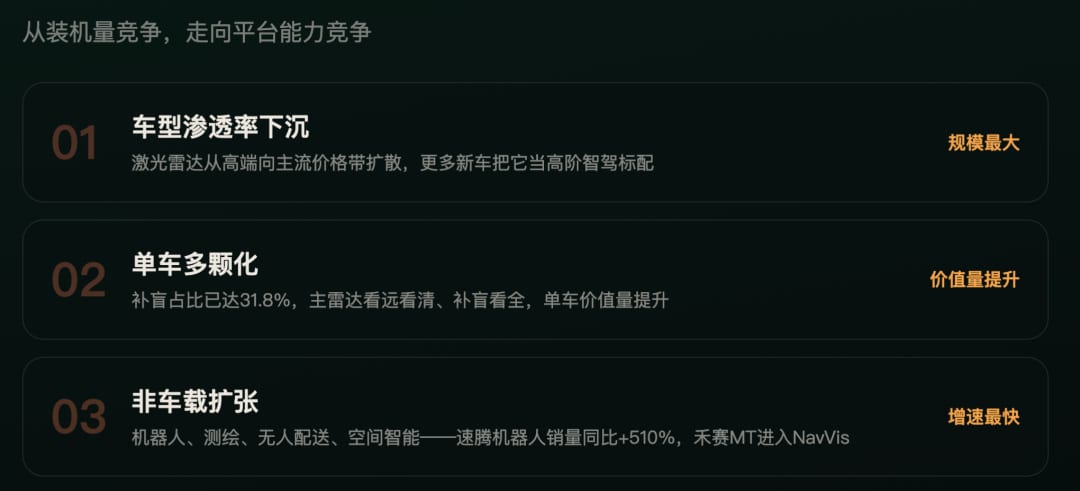
LiDAR continues to move down from premium vehicles into mainstream price bands, with more new models adopting it as key hardware for advanced driver assistance. Blind-spot LiDAR accounted for 31.8%, and the product mixes of Hesai, Seyond and Zeekr show that incremental growth no longer relies solely on selling one more vehicle.
Robotics, surveying and mapping, unmanned delivery, lawn mowers and spatial intelligence are absorbing the chips, optoelectronics and mass-production capabilities accumulated by the automotive supply chain.
The automotive market is the largest, but annual price cuts, customer concentration and model cycles will continue to push down unit prices.
Multi-LiDAR configurations can raise per-vehicle value, but they need to be supported by functional experience. Robotics and surveying and mapping are growing fastest, yet remain at a stage of fragmented customers and rapid product iteration.
Summary
In August 2026, 525,500 units installed confirmed that automotive LiDAR remains in a high-boom range. Hesai and Huawei together accounted for nearly 70%, and the leading landscape is already highly concentrated. The two leaders are separated by just 65 units, and the entire industry is searching for a second growth curve beyond automotive main LiDAR.
Whoever can connect automotive-grade mass production, in-house chip development and the commercialization of new scenarios will secure a ticket to the next round of growth.
Data basis
NE Times, LiDAR installations in August 2025
Huawei Qiankun, the world's highest-specification 896-line dual-optical-path image-grade LiDAR in mass production
Hesai Technology, MT ultra-high spatial resolution LiDAR
RoboSense, interim results for 2026 and robot LiDAR sales volume
RoboSense, E2 all-solid-state digital LiDAR
Original title : August LiDAR | Hesai and Huawei separated by just 65 units; a second growth curve emerges after 525,000 automotive LiDAR units
Source: OFweek Laser Network · News · laser.ofweek.com