Optical Waveguide Technologies: Five Routes and Five Physical Logics
光波导技术分类: 五条路线,五种物理逻辑
Topics and contents
Topic
On this page
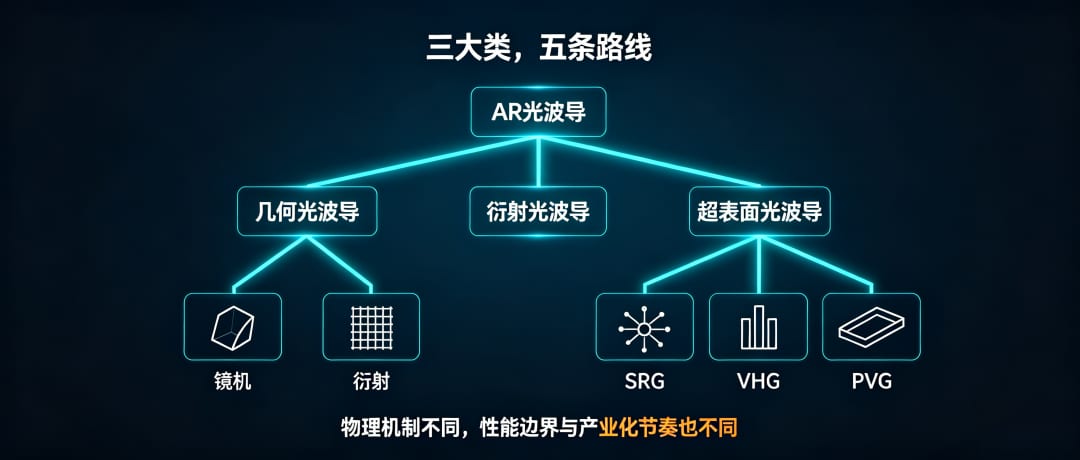
The article groups AR optical waveguides into three major categories and five technical routes: geometric, diffractive (including SRG, VHG and PVG) and metasurface. Each relies on different optical principles, performance limits and industrialization timelines, and the author argues that no single solution fits all.
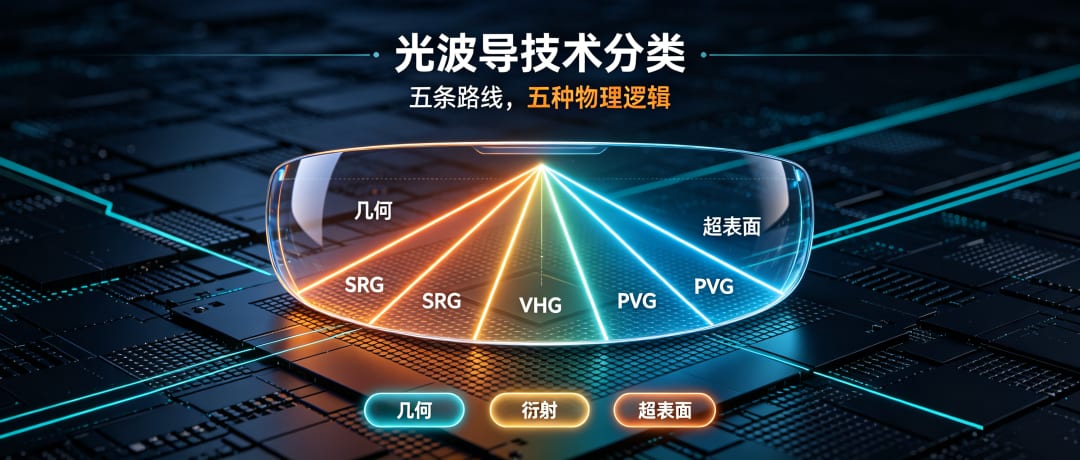
Abstract: AR optical waveguides fall into three major categories and five technology routes: geometric, diffractive (including SRG/VHG/PVG), and metasurface. Each route relies on entirely different optical principles, with its own performance boundaries and industrialization pace. There is no one-size-fits-all solution; only by understanding the underlying physics can you see the real landscape of the AR optics arena.
The term "optical waveguide" is used far too loosely in the industry. Some say "geometric waveguides are better than diffractive waveguides," some say "SRG and VHG are both diffraction," and some say "metasurfaces are the next-generation route" — all of these statements are correct, but none is complete. Optical waveguide is not a single technology; it is a technology family. Based on fundamental optical principles, it can be divided into three major categories and five routes. This article explains the physical mechanisms and industrialization status of each category.
01 Category 1 — Geometric optical waveguides: Guiding light by "reflection" — geometric optical waveguides are based on Snell's law of refraction and reflection, using arrays of semi-reflective, semi-transparent mirrors to propagate light and expand the pupil.
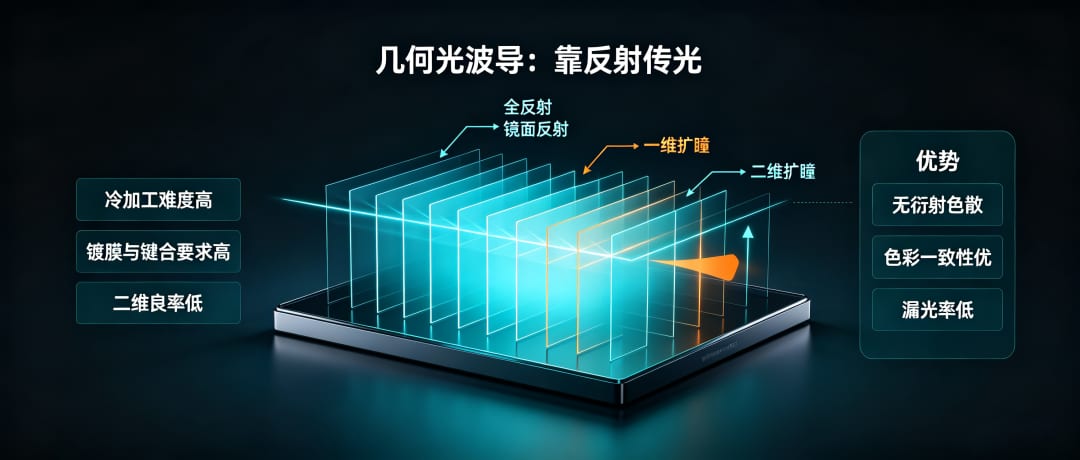
Its core logic is this: light propagates inside the glass via total internal reflection and is coupled out step by step when it encounters the mirror array. One-dimensional array waveguides expand the pupil in only one direction, giving a narrow, elongated eyebox; two-dimensional array waveguides use two sets of parallel beam-splitting surface arrays to expand light in the horizontal and vertical directions respectively, forming a larger rectangular eyebox.
The physical mechanism of geometric waveguides brings inherent advantages: they do not rely on nano-gratings, fundamentally eliminating diffraction dispersion and rainbow artifacts, and their full-color display and color consistency are the best among the five routes. Light leakage is below 5%, and one-dimensional array waveguides achieve 5%-10% optical efficiency utilization.
The cost is that mass production relies mainly on cold processing — coating, bonding, and cutting/grinding — with extremely demanding requirements for nanometer-level coating precision and molecular bonding processes, resulting in relatively low mass-production yields. Representative companies: Lumus, 理湃光晶 (Lipi Photonics), 灵犀微光 (Lochn Optics), and 水晶光电 (Crystal Optech).
02 Category 2 — Diffractive Optical Waveguides: Light Guided by "Grating Diffraction"
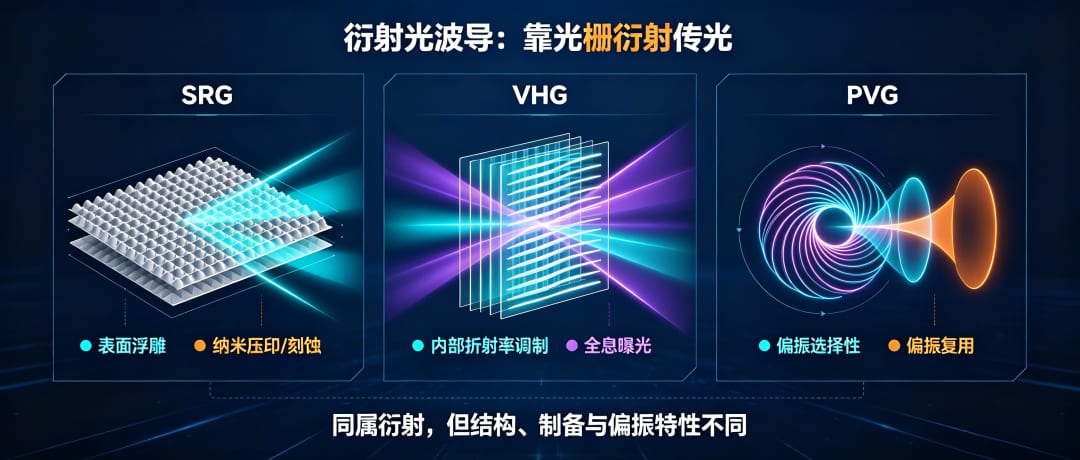
Diffractive optical waveguides use gratings for light coupling-in, pupil expansion, and coupling-out, and mainly fall into three branches: surface relief gratings (SRG), volume holographic gratings (VHG), and polarization volume gratings (PVG).
All three are based on the grating diffraction principle, but their fabrication methods, physical structures, and polarization characteristics are completely different. SRG — Surface Relief Grating: nanostructures etched into the surface. The defining feature of an SRG is the periodic relief structure fabricated on the waveguide surface.
Light diffracts as it passes through these nanoscale gratings and is coupled into or out of the waveguide. Two fabrication routes are used: nanoimprint and etching. Nanoimprint enables high-volume production but relies on high-refractive-index imprint resist; etching offers higher reliability, can operate for 240 hours at -40℃~85℃, delivers a larger FOV (determined by the refractive index of the glass wafer), and achieves higher manufacturing yield.
Goertek Optics has built China's first 12-inch wafer DUV lithography and etching mass-production line, while AAC Technologies' SRG production line maintains a stable mass-production yield above 80%, outperforming the industry average of 50%.
SRG's advantages are its thin and light form factor, high design freedom, and relatively mature manufacturing ecosystem, making it the most widely used optical waveguide solution in consumer AR devices. The trade-off is inherent rainbow artifacts and chromatic dispersion — even after grating optimization, dispersion and rainbow artifacts cannot be fundamentally eliminated.
Among the waveguide AR glasses launched in 2026, SRG designs account for more than half. Representative companies: Zhige Technology, AAC Technologies, Goertek Optics, and Guangna Siwei. VHG — Volume Holographic Grating: refractive index variations written inside the material. The biggest difference between VHG and SRG is that the grating is not "etched on the surface" but "written inside." Through two-beam laser interference exposure, a periodic refractive index distribution is formed inside the photosensitive material, and light diffracts as it passes through these internal gratings.
This physical mechanism brings several inherent advantages: no lithographic etching of nanostructures is required, so mass-production investment is low and yield is high; confidentiality is strong because the grating structure lies inside the material and cannot be replicated externally; and transparency is high, with a flat surface free of relief structures.
However, VHG material barriers are extremely high. Core holographic material formulations have long been locked away by overseas giants, high-stability mass-production equipment remains an industry gap, and China's industry has long lacked systematic mass-production capability.
Lightweighting of full-color volume holographic waveguides still needs to be overcome. In June 2026, according to official disclosures by Nika Optics, it has built a million-unit-scale automated VHG production line. Starting from raw materials and formulation design at the base level, it overcame the production and industrialization of holographic photoresist, achieving full-stack independent control. Crystal Optech's VHG production line has achieved mass production and shipments, with front-side light leakage precisely controlled below 2%, and the company plans to exhibit red-green dual-color display modules.
Representative companies: Nika Optics, Crystal Optech, and DigiLens. PVG — Polarization Volume Grating: polarization-selective diffraction. PVG is a special branch of diffractive optical waveguides based on the principle of polarization-selective diffraction. Using holographic interference, it forms a periodic distribution of refractive index variation within the substrate from liquid crystal material. The core feature of PVG is polarization selectivity — it responds only to circularly polarized light of a specific handedness, while the orthogonal component is transmitted.
Based on this property, the industry has developed polarization multiplexing schemes: PVG waveguide systems that multiplex left- and right-handed circularly polarized light can significantly improve system uniformity and optical efficiency. Using an anomalous polarization conversion effect, Gudong Intelligence increased coupling-in light efficiency by more than 50% and improved field-of-view brightness uniformity by about 20%.
In manufacturing, PVG requires only wet coating and holographic exposure processes, with no need for complex micro- and nanofabrication techniques such as lithography, electron-beam etching, or nanoimprint, significantly reducing production costs. On the industrialization front, in December 2025, Parallel Vision's world-first PVG optical waveguide pilot production line was officially completed, with an annual capacity of 50,000 waveguide wafers.
Gudong Intelligence expects to add annual PVG optical waveguide capacity of 3 million wafers by the end of 2026, expanding the field of view of a single substrate to 45° through a double-sided coating polarization multiplexing scheme. Representative companies: Gudong Intelligence, Parallel Vision.
03 Third category — metasurface optical waveguides: controlling phase with "subwavelength structures" Metasurface optical waveguides are a third, independent technology route, based on the principle of optical field phase control.
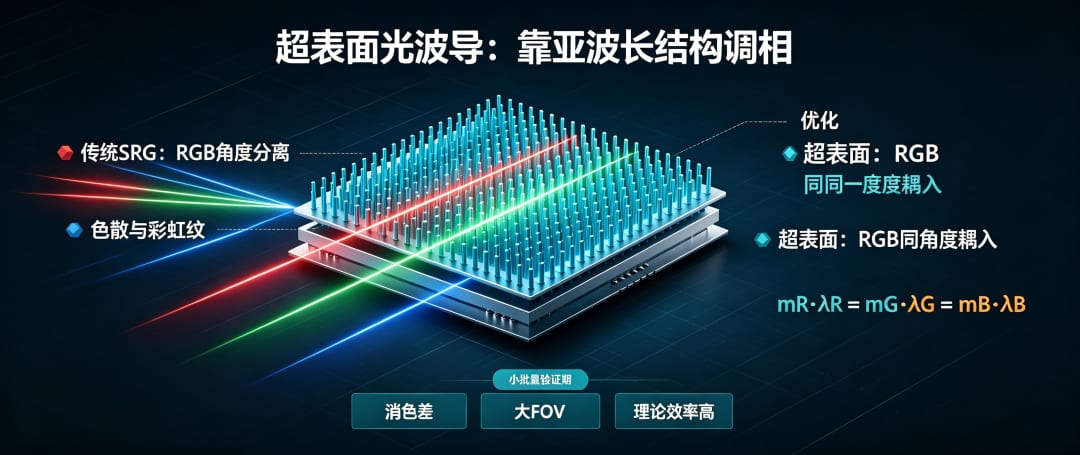
Its core feature is the use of nanoscale structures (nanopillars, nanofins) at subwavelength scales to modulate the phase and amplitude of light point by point. Conventional diffractive optical waveguides use first-order diffraction, and the diffraction angles for red, green, and blue differ, causing chromatic dispersion.
Metasurfaces assign different diffraction orders to different colors — +4 for red, +5 for green, and +6 for blue — so that m_R·λ_R = m_G·λ_G = m_B·λ_B, coupling all three colors in at exactly the same angle and eliminating chromatic aberration at its root.
In terms of performance, according to publicly available information from Alpha Long, its MGW metasurface solution can achieve an optical efficiency more than three times that of SRG, a field of view above 50°, and a field of view above 70° with a single layer of material, while fundamentally improving dispersion and rainbow artifact issues.
After mass production, costs are expected to be about 60% lower than mainstream SRG solutions. Metasurfaces are currently in small-batch validation and have not yet entered large-scale commercial use. Alpha Aurora (阿法龙) has completed a Series B round of over 100 million yuan and is building an 8-inch silicon carbide metasurface optical waveguide chip production line, closing the full-process loop from chip design and master fabrication to mass-production processing. Representative players: Alpha Aurora (阿法龙) and Prof. Sun Xiaowei's team at Southern University of Science and Technology.
04 Five routes, one table to see the differences. Putting the five routes side by side:
Route | Physical mechanism | Core advantage | Main drawback Geometric waveguide | Mirror reflection for light guidance | No rainbow artifacts, best color uniformity, 5%-10% optical efficiency | Difficult cold processing, low yield for 2D pupil expansion SRG (surface relief grating) | Diffraction | Best manufacturability, high design freedom | Inherent rainbow artifacts and dispersion that cannot be eliminated VHG (volume holographic grating) | Diffraction | No etching required, high cost-reduction potential, high transparency | High material barriers, difficult environmental stability control Metasurface | Subwavelength structures for point-by-point phase modulation | Achromatic, large FOV, high theoretical optical efficiency | Small-batch validation stage, not yet commercially scaled PVG (polarization volume grating) | Polarization-selective diffraction | Simple process, high optical efficiency, flexible polarization multiplexing | Capacity just getting started, material system still evolving The five routes differ in physical mechanism, performance limits and industrialization stage. No single route can cover every scenario, and no route can "replace" the others.
Final thoughts
The technical classification of optical waveguides is essentially a matter of "physical mechanisms determining performance limits, and manufacturing processes determining the pace of industrialization." The geometric route offers "the best image quality but is the hardest to manufacture"; SRG offers "the best manufacturability but with image-quality compromises"; VHG offers "the greatest cost-reduction potential but is bottlenecked by materials"; and metasurfaces and PVG offer "a high performance ceiling but are still early-stage." Only by understanding the physical logic and industrial stage of these five routes can one grasp why the industry is advancing multiple routes simultaneously rather than betting on just one.
Discussion topic: Of the five routes, which do you think will become the mainstream solution for consumer AR glasses within 3-5 years? Share your take in the comments.
— AR Andy | Focused on optical waveguides and AR microdisplays, with in-depth analysis of the underlying logic of the optics industry
[Risk Notice] This article is compiled from publicly disclosed company materials and publicly available industry data. It is intended solely for industry commentary and technical education. Processes and specifications vary among vendors and do not constitute technical selection or investment advice.
Original title: Optical Waveguide Technology Classifications: Five Paths, Five Physical Logics
Source: OFweek Optics Network · News · optics.ofweek.com