XGIMI and Dangbei Enter AI Glasses: Which Optical Capabilities Can Projector Makers Transfer?
Topics and contents
XGIMI and Dangbei have entered the AI glasses arena, and the article frames this as a business exploration under pressure in their core projector operations, drawing on their accumulated optical engine and microdisplay expertise. XGIMI MemoMind One began domestic pre-sales on October 15 at 2,294 yuan after the national subsidy; the AI note-taking glasses co-developed by Dangbei and DingTalk launched on October 13, priced from 1,299 yuan. Runto Technology notes that experience in optical engine miniaturization and image quality tuning can be reused, but near-eye imaging, wearable design, software ecosystems and eyewear retail channels remain real challenges.
Comparing market shifts and imaging constraints in projectors and smart glasses clarifies where optical engine capabilities can be transferred, and the gaps created by wearable design and software ecosystems.
Early this year, smart projector leader XGimi unveiled three AI glasses products and introduced its new sub-brand MemoMind. On June 28, MemoMind One launched an overseas crowdfunding campaign on Kickstarter. On October 15, XGimi's AI display glasses MemoMind One began presales on domestic e-commerce platforms at a price of RMB 2,294 after the national subsidy.
Around the same time, Orimag, a leading company specializing in 1LCD projectors, launched on October 13 an AI note-taking smart glasses co-developed with DingTalk. Designed for office note-taking scenarios, the product focuses on audio transcription and meets the needs of all-day everyday wear, with prices starting at 1299 yuan.
Next, XGimi will continue to launch products without displays, while RUNTO expects Dayan Cheng may also introduce versions with displays.
From this perspective, leading companies under both the DLP and 1LCD technology routes in the smart projector market have formally begun building smart glasses as a "second growth curve."
From large-screen projection devices to wearable hardware designed for the human eye, the domestic projection industry has moved its battleground from living rooms and bedrooms to people's faces. This is no coincidence. RUNTO believes two main factors are driving projection makers to transform and upgrade, and to converge on the same direction: first, as their core business, the projection market has been sluggish for a long time, price wars have squeezed profits, prospects are limited, and it cannot sustain corporate value; second, projectors and AR glasses with displays are essentially imaging systems built around micro optical engines and microdisplay chips, sharing the same technological origins, with much of the underlying capability and supply chain in common.
Projection market remains sluggish; leading players seek incremental breakthroughs
According to RUNTO data, China's smart projector market (excluding laser TVs) sold 2.056 million units in the first half of 2026, down 26.0% year on year, while sales revenue reached 3.34 billion yuan, down 27.0% year on year. The decline remained above 20% in the third quarter.
Multiple factors are weighing on industry growth. On the one hand, amid weak overall consumer spending, demand for discretionary goods is the first to soften, reducing households' willingness to upgrade large-screen hardware. On the other hand, the industry is caught in a dilemma of losing money on price cuts while holding prices hurts volume. Rigid increases in memory component costs in particular are further squeezing profit margins. Meanwhile, prices for large-screen LCD TVs continue to fall, putting direct pressure on projectors in terms of contrast and peak brightness and diverting significant large-screen home demand. In addition, potential growth scenarios such as automotive and commercial projection are being explored, but their market size is limited and they are unlikely to offset the decline in the home market in the short term.
2020-2026 China Smart Projector Market Retail Sales Volume
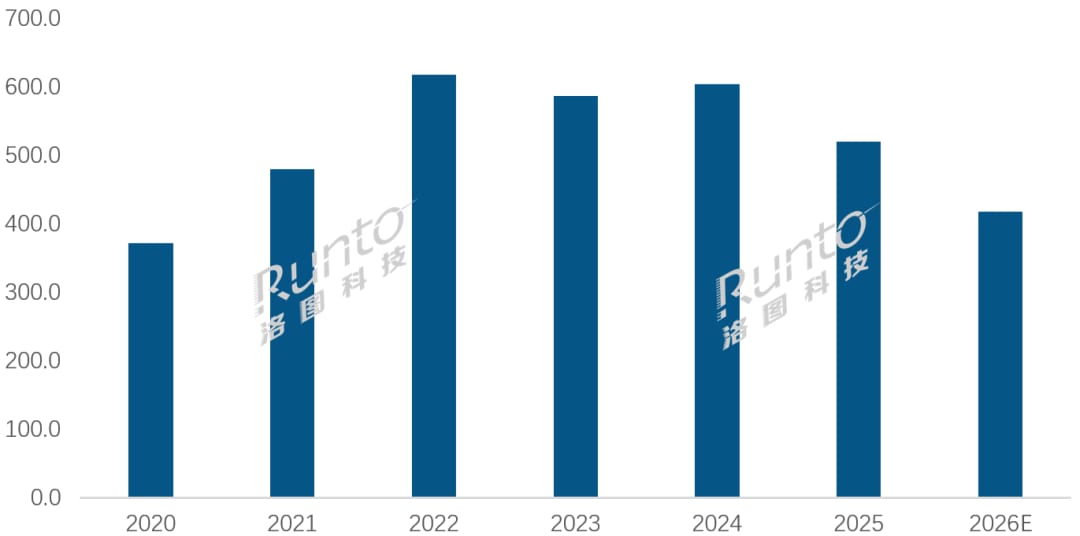
Source: RUNTO, unit: 10,000 units
In the projector industry, most companies rely heavily on projectors as their sole revenue driver, with a narrow product line. In this market environment, the ceiling on business growth is becoming apparent and risk resilience is clearly insufficient. Over the long term, the business can neither sustain continued internal investment in people and resources, nor ensure sales productivity per square meter of offline stores, let alone deliver the value companies have promised in the capital markets.
As a leader in China's smart projector market, XGIMI's financial report reflects the contraction pressure in the large-screen market. Its 2026 interim report shows that XGIMI posted total revenue of 1.606 billion yuan in the first half, down slightly by 1.22% year on year. Domestic market revenue declined notably year on year, and although overseas business grew rapidly, it is still difficult to fully offset the pressure from the downturn in the domestic market.
As a leader in the 1LCD segment, Dangbei is one of the few brands in the industry to buck the trend and keep growing during a market downturn. Thanks to competitive shakeout in the 1LCD segment, a stronger leading-player effect, and upgrades to its own product mix, the brand has maintained positive growth in both revenue and market share.
Even as growth diverges across their core businesses, leading companies all hope to move beyond the limits of large home screens and explore more applications for display technology. In fact, besides XGIMI and Dangbei, Vidda has already brought audio smart glasses to market. On the supply chain side, Appotronics earlier released an AR glasses optical engine based on the LCoS route, while Goertek Optics is developing miniaturized LCoS optical engines and waveguide devices in-house, while building up capabilities for smart glasses system integration and mass production.
Smart glasses grow rapidly as segment divergence matches projector makers' cross-over ambitions
By contrast, the smart glasses market is expanding rapidly both globally and in China. In particular, in 2026 smart glasses were included in China's national subsidy catalog as the only newly added category.
According to RUNTO data, China's smart glasses market sold 909,000 units in the first half of 2026, up 85.5% year on year, with sales revenue of 1.88 billion yuan, up 98.7% year on year. This made it one of the few high-growth segments in consumer electronics, in sharp contrast to the continued contraction of the smart projector market.
2024-2026H1 Quarterly Smart Glasses Sales Volume in China
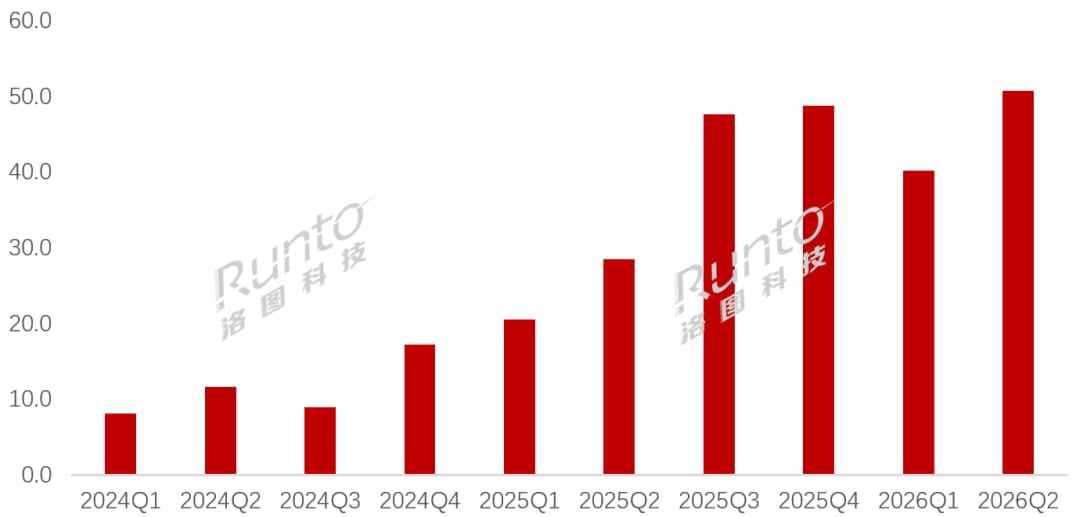
Source: RUNTO, unit: 10,000 units
Moreover, in the near term, as lightweight AI is deployed, products priced around 1,000 yuan are beginning to carry offline large models, and the target audience is rapidly expanding from geeks to ordinary consumers.
RUNTO divides the smart glasses market into three major segments by function: AR glasses, camera glasses, and audio glasses; it also notes the view in "Lightweight Breakthroughs in Smart Glasses: The Era of Subtraction Begins in Full in 2026": the market will gradually split into lightweight everyday glasses and heavyweight giant-screen viewing/spatial computing glasses.
Requirements for capabilities vary significantly across sub-segments, which has also shaped differentiated market-entry strategies for projector makers. Audio glasses center on voice interaction and lightweight use cases, have a lower barrier to optical implementation, and suit rapid product rollout and market validation, making them the primary exploration direction for Vidda and Big Eye Orange; AR display glasses demand high capabilities in micro-optical engines, optical coupling, and image quality tuning, matching the long-standing optical engineering strengths of XGIMI and Appotronics, and have become the core battleground for technology-leading companies; camera glasses focus on imaging algorithms, have weaker ties to projector technology systems, and thus attract relatively low interest from the projector industry as a whole.
Technical Foundations and Practical Challenges Facing Projector Makers Entering Smart Glasses
Projector makers have long specialized in core technologies such as microdisplay chip selection, light source control, color tuning, and speckle suppression, building mature optical tuning and image quality optimization systems that can directly support AR display glasses.
At the same time, projector makers' years of accumulated experience in miniaturizing optical engines, stacking whole-device structures, lightweight design and thermal management can be reused in smart glasses hardware development. Their long-standing engineering expertise in audio and video tuning also fits the acoustic tuning and overall optimization needs of audio glasses well.
Although projector companies entering smart glasses have a clear technological kinship and hardware engineering depth that ordinary cross-industry entrants lack, RUNTO believes that far-field projection and near-eye display still differ, and some capabilities cannot be directly transferred or reused. A series of hard-to-avoid practical challenges also arise in the crossover.
Traditional projection is far-field real-image projection, using lenses to cast images onto an external screen; smart glasses rely on optical waveguides, Birdbath and other components to generate near-eye virtual images, with completely different optical path logic and imaging constraints. 1. Projection optical engines cannot simply be shrunk and used directly in glasses products; a series of optical challenges must be tackled anew to meet the stringent requirements for lightweight design, low power consumption and high light transmittance in wearable devices.
2. The second is the entirely new challenge of wearable products. Traditional projection equipment has no constraint of prolonged wear on the face, whereas smart glasses are worn close to the body. Weight balance, long-term wearing comfort, thermal control, myopia lens adaptation and industrial design are all areas projector companies have rarely dealt with before, requiring a brand-new R&D and validation system.
3. Software ecosystems and channel development are also shortcomings. Projector companies' core strengths lie in hardware, and they lack software ecosystem experience in AI large-model adaptation, intelligent interaction and scenario-based application development, as well as offline channels and user operation systems suited to the eyewear category. At this stage, most can only integrate third-party AI capabilities to make up for their software gaps. Fortunately, leading projector makers have shifted their business focus overseas, and the channels already built will help expand their overseas smart glasses business.
RUNTO Viewpoint Summary
Overall, leading projector companies moving into smart glasses is not a cross-industry pivot, nor simply chasing a trend. It is a pragmatic strategic exploration under pressure in their core business, transferring their core capabilities in optical engines and large-screen imaging from living room and bedroom screens and walls to the lenses in front of users' eyes.
Projectors and glasses are complementary in use scenarios, with highly overlapping user profiles: both appeal to people who enjoy immersive large-screen audio and visual experiences. Brand recognition can carry over, creating an all-scenario large-screen ecosystem of "fixed projectors plus wearable glasses." At the same time, the advantage of shared underlying technology can help capture the next generation of wearable displays and the next-generation human-machine interface.
However, this cannot yet be seen as a guaranteed win. The strengths of projector companies cannot offset the core barriers posed by wearable design, software ecosystems, and imaging principles. In addition, the pain points of smart glasses in consumer use and long-term wearing habits still need to be absorbed by the industry, while the long-term market size and effective business growth remain to be verified.
Original title : Observation | XGIMI and Dangbei push into AI glasses, as projector makers' battleground extends from living rooms and bedrooms to the face
Source: OFweek Optics Network · News · optics.ofweek.com