Vision-Only vs. LiDAR Fusion: Which Demands More Compute?
纯视觉和激光雷达融合, 谁更吃算力?
Topics and contents
Topic
On this page
The article analyzes the computing demands of the vision-only and LiDAR fusion approaches in autonomous driving, arguing that compute requirements are not simply determined by the number of sensors, but by how the perception scheme processes data and its algorithm architecture.
In autonomous driving technology roadmaps, the debate between pure vision and LiDAR fusion has long been contentious, with differing views even at the algorithm level.
Many believe that LiDAR adds a perception dimension, reducing algorithmic difficulty and therefore demanding less computing power.
Others argue that LiDAR generates large volumes of 3D data, which in turn requires greater computing power from the system.
In fact, both views hold some merit, but neither gets to the heart of the matter.
The computing power required by an autonomous driving system is not simply determined by the number of sensors; it depends on how the perception scheme processes data, algorithm complexity, model size, and the depth of the system's environmental understanding.
Looking at current technology trends, the pure vision route relies more on large models and intensive computation, while LiDAR-based fusion schemes, although they increase data volume, can ease some of the algorithmic burden at the perception stage.
The difference in computing power requirements between the two future routes may come down not to who has more data, but to who needs more sophisticated intelligence.
01 LiDAR generates more data but the processing logic is more direct
LiDAR's biggest advantage is its ability to capture spatial information directly.
Conventional cameras capture only two-dimensional images, so vehicles must use deep learning algorithms to infer object positions, distances and 3D structures from pixels.
This is essentially a process of reasoning about the 3D world from 2D information.
LiDAR works differently: by emitting laser pulses and receiving the reflected signals, it directly generates point cloud data, with each point carrying spatial coordinate information.
As a result, when identifying vehicles, pedestrians and obstacle boundaries, LiDAR provides information that more closely matches the physical-world description an autonomous driving system actually needs.
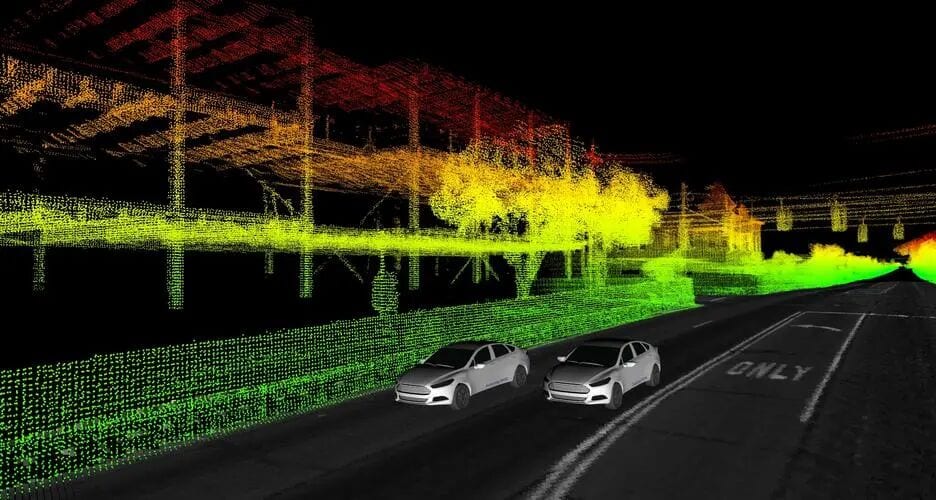
Image source: Internet
But that does not mean LiDAR-based systems do not require high computing power. LiDAR generates large volumes of discrete point cloud data; a high-performance LiDAR can output hundreds of thousands of points per second or more.
The system must filter, cluster, detect and track these point clouds, and fuse them with data from cameras, millimeter-wave radar and other sensors. In multi-sensor fusion schemes in particular, the computing platform must handle different types of data simultaneously.
Cameras output high-resolution images, LiDAR outputs 3D point clouds, and millimeter-wave radar outputs velocity and range information. Time synchronization, spatial calibration and feature fusion of these data all require additional computing resources.
So the LiDAR route is not simply a matter of adding one more sensor; it adds an entire complex data-processing pipeline.
However, in terms of algorithmic difficulty, LiDAR does relieve some of the burden.
For example, when judging an oddly shaped roadside obstacle, a vision-only system must learn what the object is from large amounts of training data, then predict the space it may occupy.
LiDAR, by contrast, can directly sense the object's spatial outline; even if it cannot accurately identify what the object is, it still knows there is an impassable area ahead.
This is also a key reason why LiDAR-based solutions have an advantage in complex environments.
02 Why does vision-only increasingly rely on massive computing power?
In the past, autonomous driving relied mainly on modular architectures: cameras captured images, and environmental understanding was completed through multiple modules such as object detection, lane line recognition, and obstacle prediction.
The problem with this approach is that each module requires its own handcrafted rules and trained model.
In complex road environments, the system easily runs into edge cases.
In recent years, new architectures led by end-to-end large models have begun to change this paradigm.
End-to-end autonomous driving no longer tackles tasks such as detecting vehicles, judging lanes, and planning routes separately. Instead, a large-scale neural network lets the system output driving decisions directly from the input visual data.
This approach more closely mirrors human driving, but at the cost of a much larger model.
Because cameras do not provide direct 3D information, the system must be trained on massive amounts of data so the model learns to understand spatial relationships, traffic rules, and vehicle motion patterns.
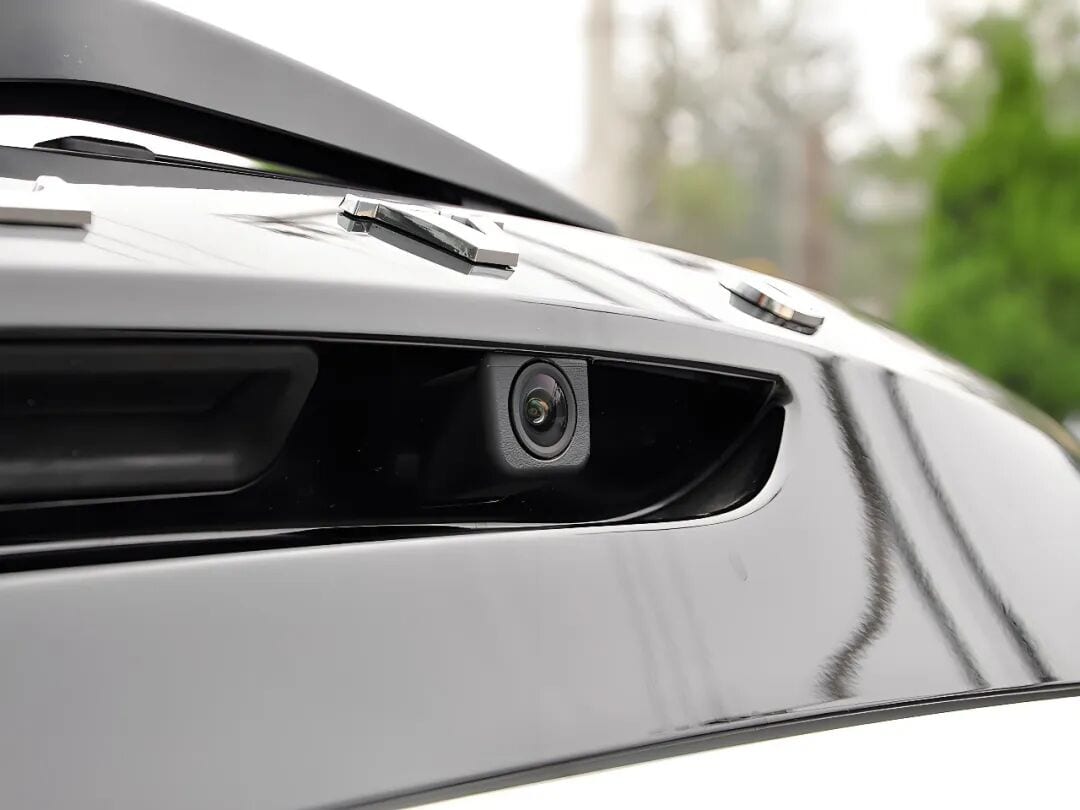
Image source: Internet
Faced with the same plastic bag on the roadside, a LiDAR-based system might first identify a low obstacle and then use vision to decide whether avoidance is needed.
A vision-only system, by contrast, must infer the object's shape, material and motion from the image and determine whether it will affect the vehicle's driving, requiring much stronger semantic understanding.
As a result, the vision-only approach places higher demands on AI models.
That is why, in recent years, some vision-only autonomous driving systems have begun adopting larger neural networks, longer video inputs and more complex training pipelines.
The goal is not simply to improve image recognition, but to give the vehicle something akin to an understanding of the world.
From this perspective, the advantage of a vision-only approach is not lower cost, but the shift of some tasks originally handled by sensors to algorithms and computing power.
03 The core of the computing power competition is shifting from data processing to intelligent understanding
If we look only at the perception stage, a LiDAR fusion solution may not require more computing power than a vision-only approach.
Because LiDAR provides explicit spatial information, it can eliminate a large amount of visual reasoning work.
But when it comes to the future direction of autonomous driving, the situation may be different.
Vehicles of the future will need to process not just what they see, but to understand what is happening.
A pedestrian stands at the roadside — will they suddenly step into the road the next second? A car is stopped at an intersection — is it a temporary stop or preparing to change lanes? An anomaly appears on the road ahead — what strategy should the vehicle adopt? These are all situations that autonomous vehicles must handle flexibly.
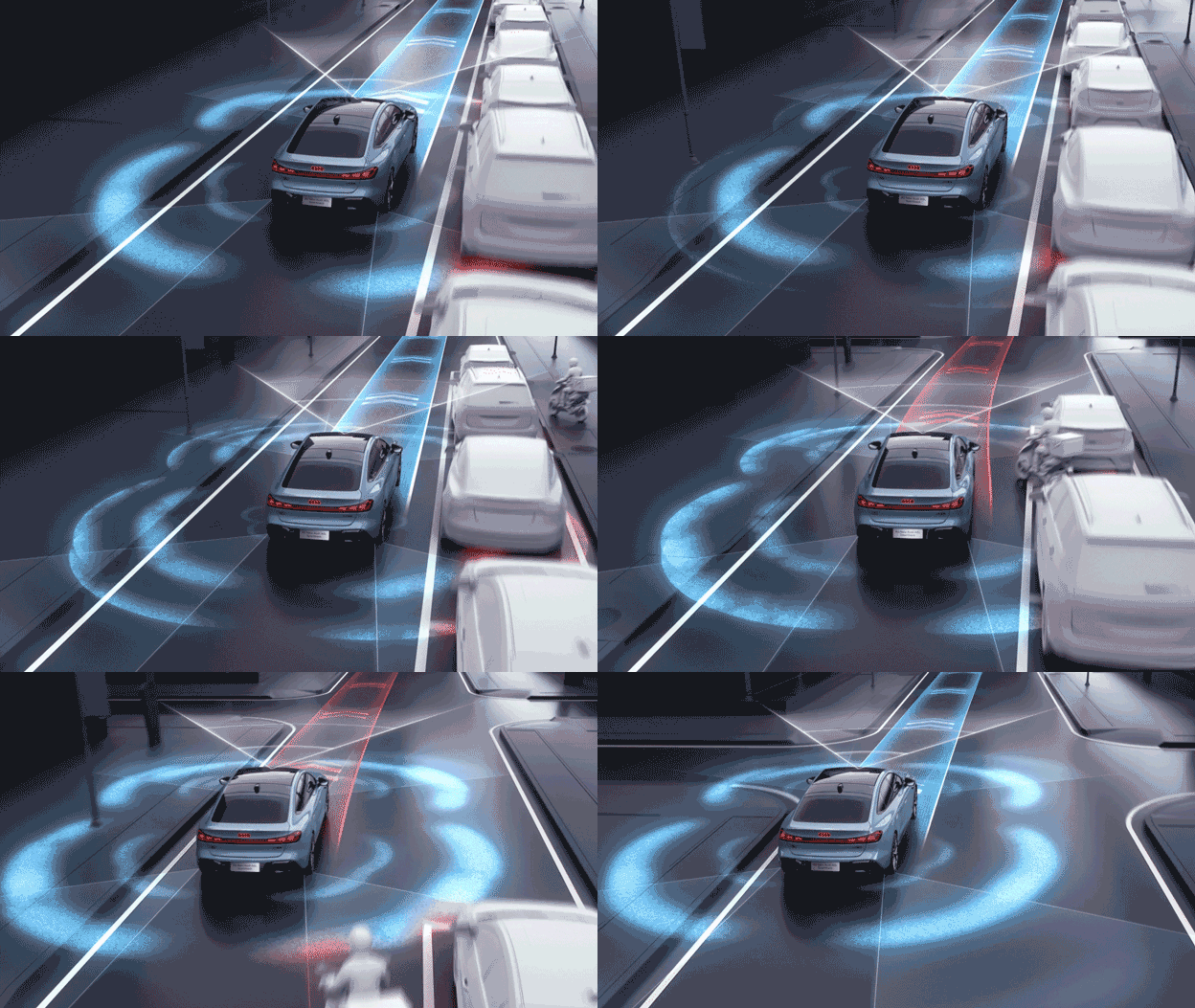
Image source: Internet
These issues have moved beyond simple perception into the realms of prediction and decision-making.
At this stage, the system needs to understand causal relationships in its environment and requires training on larger-scale data.
This is also why the industry continues to explore vision large models, world models, and VLA (vision-language-action models).
Whether or not LiDAR is fitted, autonomous driving systems will increasingly rely on large model capabilities. LiDAR can improve perception reliability, but it cannot replace intelligent reasoning.
Vision-only systems can cut hardware costs, but they demand stronger data and algorithm capabilities.
The real point of competition between the two is no longer just the number of sensors, but who can understand complex road environments more efficiently.
04 Final Thoughts
From a technology development standpoint, neither vision-only nor LiDAR fusion has an absolute advantage.
The vision-only approach excels in that data scale is easier to expand, the cost structure is simpler, and it better aligns with the direction of AI model development.
But it places higher demands on training data, model capability, and computing platforms.
The advantage of LiDAR fusion is stronger physical perception, which can reduce some of the difficulty of environmental understanding.
But it must address sensor cost, data fusion complexity, and systems engineering issues. In fact, as algorithms improve, vehicles will gradually rely less on rule-based perception, turning sensors into information inputs, while the real determinant of autonomous driving capability is the underlying computing architecture and intelligent models.
From this perspective, the vision-only approach is more like trading compute for sensors, while the LiDAR approach is more like using sensors to relieve some of the compute burden.
#AutonomousDriving #VisionOnly #LiDAR #ComputePower
Original title : Vision-only vs. LiDAR fusion: which demands more compute?
Source: OFweek Laser Network · News · laser.ofweek.com