SIOM Achieves Ultrafast Nonlinear Optical Control in CdO Nanograting Films
Topics and contents
SIOM has made progress in geometry-induced quantum interference and ultrafast nonlinear optical control in CdO nanograting films.
The source provides specific data and details that help assess actual progress in this direction
Excellent Innovation Center for Ultra-Intense Laser Science Briefing
(Issue 810)
August 3, 2026
SIOM Reports New Progress in Geometry-Induced Quantum Interference and Ultrafast Nonlinear Optical Control of CdO Nanograting Thin Films
Recently, the team of Zhao Yuan'an in the High-Power Laser Component Technology and Engineering Department at the Shanghai Institute of Optics and Fine Mechanics, Chinese Academy of Sciences, in collaboration with the team of Yao Jianke at South China Normal University, made important progress in controlling the mid-infrared nonlinear optical properties of cadmium oxide (CdO) nanograting thin films through geometry-induced quantum interference effects. The related results, titled "Mid-Infrared Nonlinear Optical Modulation of CdO Nanogratings Enabled by Geometric Quantum Interference Enhancement", were published in Optics Express.
epsilon-near-zero (ENZ) materials such as cadmium oxide (CdO) exhibit strong nonlinear optical responses in the mid-infrared band and are a research focus for frontier photonic devices worldwide. However, these materials generally suffer from limited tunability and weak nonlinear responses. To overcome these limitations, the research team designed and fabricated a CdO-based nanograting structure (CdO-NG). In this structure, geometry-induced quantum interference effects (GQIE) can effectively tune the material's Fermi level (EF) and carrier concentration, enabling active control of mid-infrared nonlinear optical properties.
Experiments show that as the grating etch depth increases from10 nmto30 nm, the carrier concentration of theCdOnanograting film rises significantly from8.18×10²⁰ cm⁻³to43.76×10²⁰ cm⁻³, and the Fermi level shifts upward from2.074 eVto3.831 eV, enabling geometrically controllable modulation of the electronic band structure over a wide range. At a wavelength of2 μm(theENZregion), the nonlinear absorption coefficientβincreases markedly with etch depth and incident angle, showing clear polarization anisotropy. Under60° TMpolarized excitation, theCdO-NG30sample reaches a nonlinear absorption coefficientβof-8.63 cm/MW, about1.5times higher than that of the unstructuredCdOfilm (-5.74 cm/MW). Tests at a wavelength of3 μm(outside theENZregion) further confirm that this anisotropy originates from the intrinsic geometric properties of the grating structure. In addition, carrier dynamics measurements show that the structure offers excellent ultrafast performance, with a transient response time below220 fsand a modulation bandwidth exceeding1.6 THz.
This work introduces geometrically induced quantum interference effects into the nonlinear control ofENZmaterials for the first time, achieving wide-range, structurally controllable modulation of the Fermi level and carrier concentration. TheCdOnanograting film not only significantly enhances nonlinear absorption in the mid-infrared band, but also delivers ultrafast temporal response and broadband modulation capability, offering a new design approach for next-generation ultrafast all-optical switches, high-power mid-infrared photonic devices, and tunable nonlinear optical platforms.
This research was supported by the Chinese Academy of Sciences Special Exchange Program, a key international cooperation project of the CAS Bureau of International Cooperation, and the Shanghai “Explorer” program, among others.
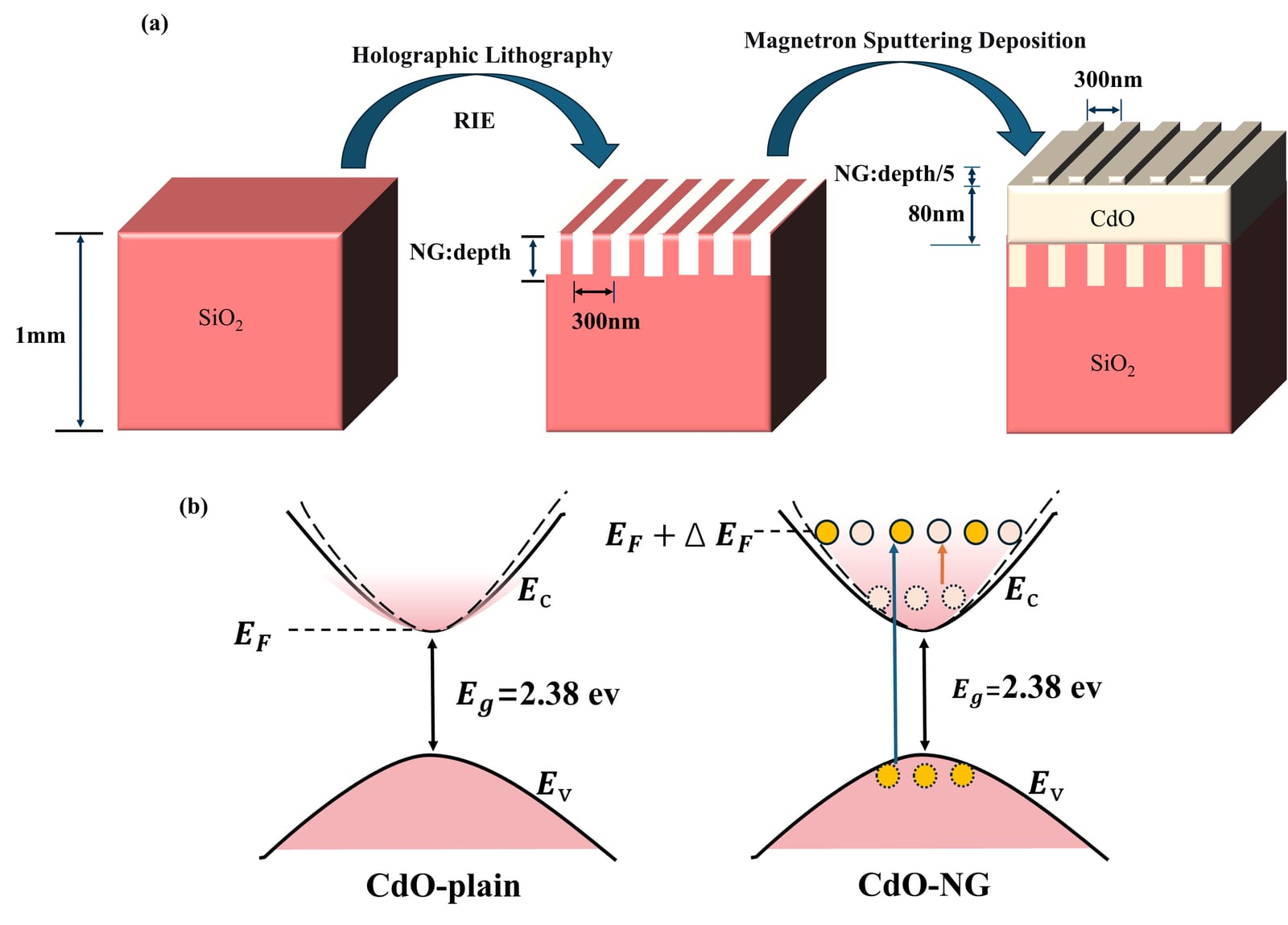
Fig.1. CdO-plainandCdO-NGs: fabrication process and band structure.(a) CdO-NGsfabrication process;(b) Schematic band structures ofCdO-plainandCdO-NGs.
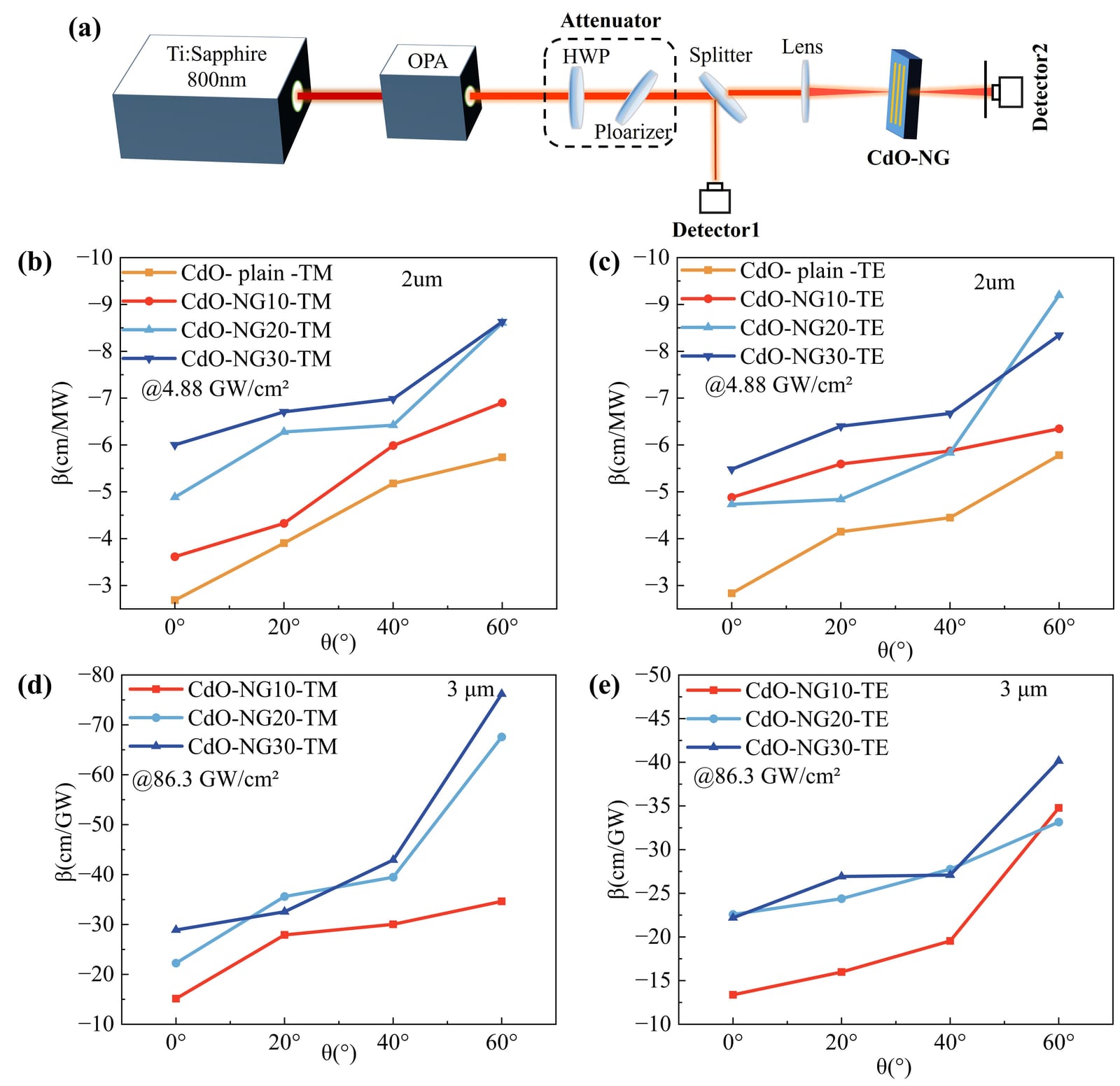
Fig.2. CdO-plainandCdO-NGs: nonlinear optical characterization.(a) Schematic of the open-apertureZ-scan setup. At a wavelength of2 μm, variation of the nonlinear absorption coefficientβofCdO-NGswith incident angle and etch depth:(b) TMpolarization;(c) TEpolarization. Corresponding variations of the nonlinear absorption coefficient at3 μm:(d) TMpolarization;(e) TEpolarization.
Source: Shanghai Institute of Optics and Fine Mechanics (SIOM) · Research Updates · siom.cas.cn