TDK Shows Meta-Optic Reflector for Retinal Projection Smart Glasses at CEATEC
绕过光波导?TDK首创视网膜直投光学技术
Topics and contents
TDK showcased at CEATEC an ultra-thin meta-optic reflector designed for retinal projection smart glasses. The prototype is monochrome green with 750p resolution and a 45-degree diagonal field of view. The reflector is just 150 nanometers thick and achieves 80% visible-light transmittance. TDK plans to launch a green version by the end of 2026, a full-color version in May 2027, and to begin mass production within a few years.
The original article gives thickness, transmittance, field of view and a mass-production timeline, useful for comparing the retinal projection approach with waveguide routes.
The Japan Electronics Show (CEATEC) is currently underway in Tokyo, Japan. At the event, TDK is showcasing an ultra-thin metaoptics mirror designed specifically for smart glasses with direct retinal projection. The technology is said to be a world first.
The prototype on display is a green monochrome system with 750p resolution and a 45-degree diagonal field of view. TDK plans to launch this green monochrome version by the end of 2026, followed by a full-color version in May 2027, with mass production targeted within a few years. Going forward, the company aims to raise the resolution to 4K.
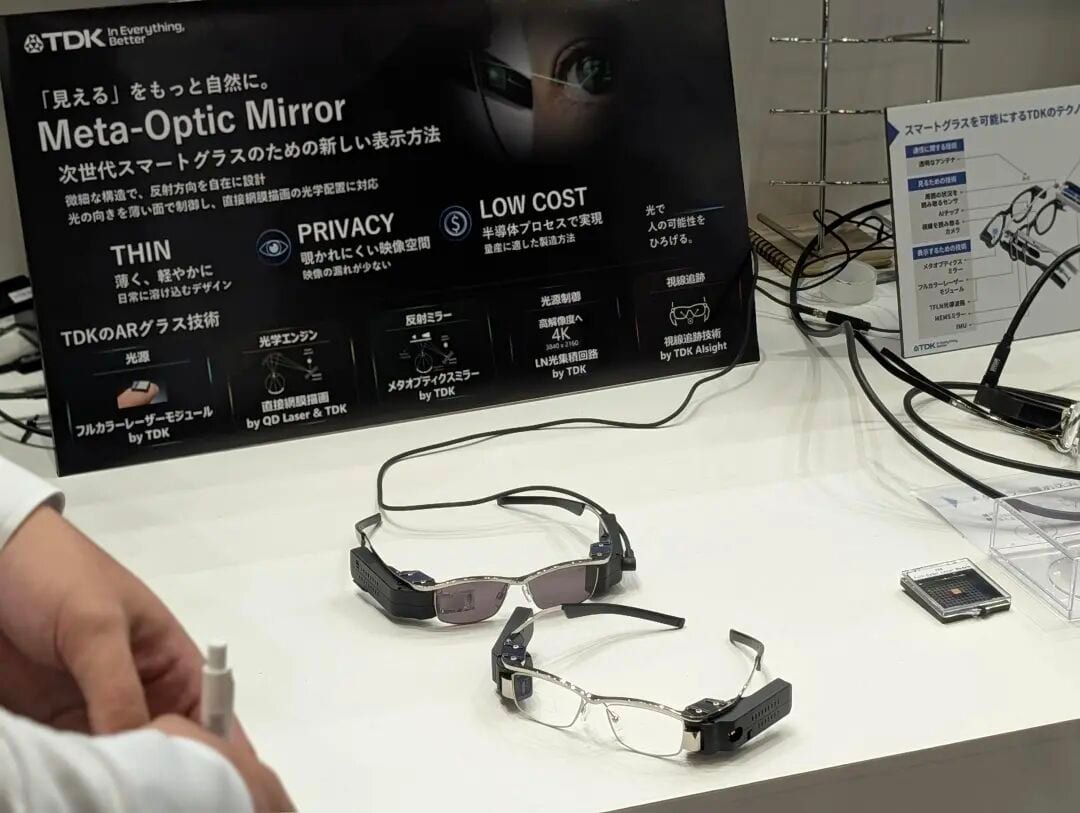
The meta-optics mirror is just 150 nanometers thick, roughly one five-hundredth the diameter of a human hair. It offers a visible light transmittance of up to 80% and looks just like a pair of ordinary glasses.
Drawing on thin-film and microfabrication technologies from its hard disk drive business, TDK etched microscopic trapezoidal structures onto the mirror surface. The trapezoids have base widths of 160 nanometers and 380 nanometers respectively and lengths ranging from 200 nanometers to 1500 nanometers, producing a rare "negative reflection angle." This structure allows laser light from the MEMS scanning mirror at the temple side to be reflected directly into the pupil at an ultra-low power consumption of just 1 microwatt.
The significance of the technology is that it replaces the bulky curved mirrors used in earlier retinal projection devices. Because the light is scanned directly onto the retina, the image requires no focusing at all, remaining sharp whether the wearer is nearsighted, farsighted, astigmatic or presbyopic. However, some testers noted that this infinite depth of field also means it lacks natural accommodation depth cues.
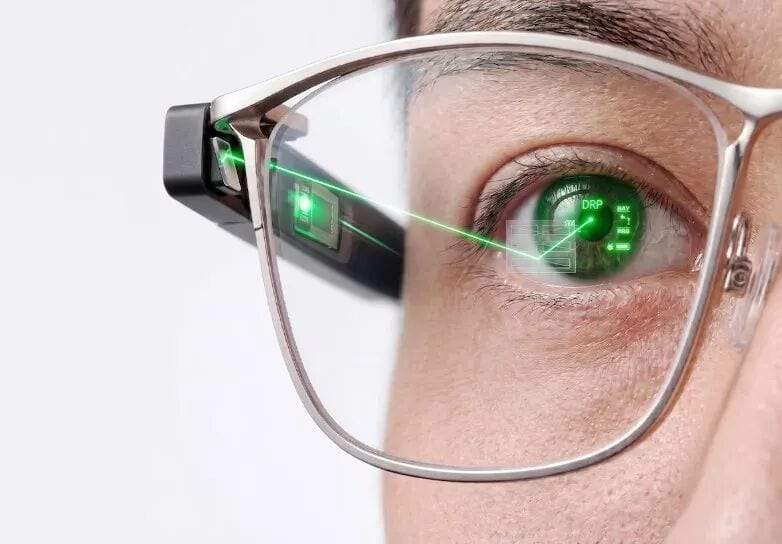
In addition, the design addresses two common shortcomings of waveguide technology: it eliminates rainbow-like interference fringes and ensures complete visual privacy by preventing light leakage to the front.
More importantly, because the mirror is fabricated using standard semiconductor wafer processes, it dramatically reduces the number of components and lowers production costs compared with waveguide assemblies. TDK also demonstrated working prototypes mounted in clear prescription lenses and tinted sunglass frames.
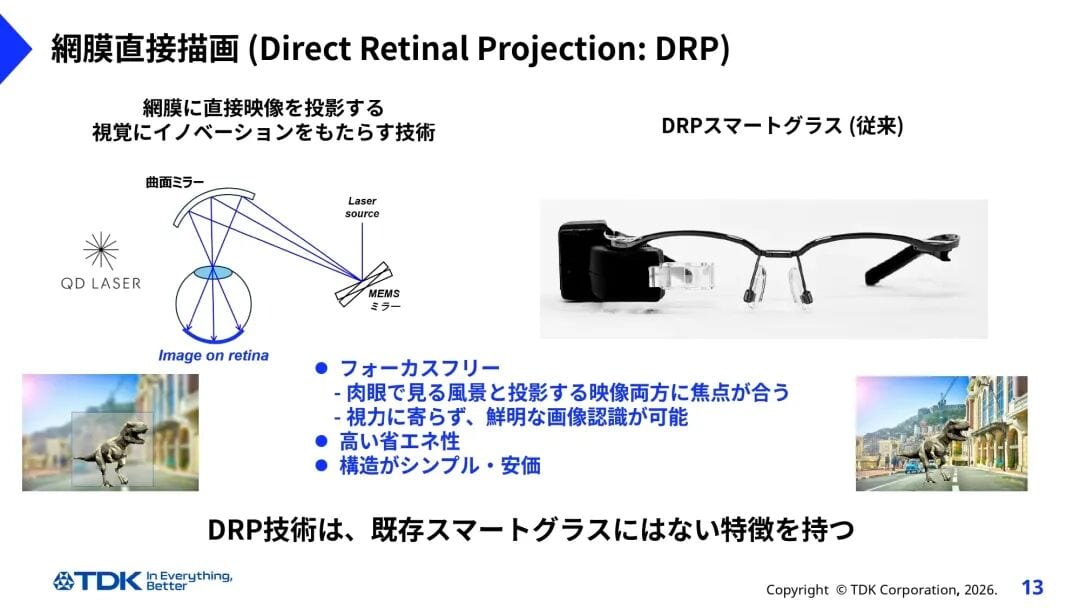
As a B2B supplier to smart glasses manufacturers, TDK is working with key partners and acquired companies to build a complete hardware and sensor ecosystem for the display. The retinal optical engine was co-developed by TDK and QD Laser, while TDK has also acquired German MEMS laser beam scanning developer OQmented and is leveraging eye-tracking technology from its TDK Aisight subsidiary.
To raise display performance from 750p to a maximum of 4K (3840 x 2160) resolution, TDK is developing thin-film lithium niobate (LN) photonic integrated circuits to pair with its ultra-compact full-color laser module (FCLM) chip.
Beyond the optics, TDK also presented a full suite of miniaturized hardware. This includes a 4.6 x 4.6 mm low-power edge-side SoftEye AI chip, a 2.2 x 2.2 mm eye-tracking camera, a 5.1 x 5.0 mm scene context sensor, a battery with a built-in wireless charging coil, an inertial measurement unit (IMU), transparent antennas, and haptic feedback actuators (including a temple touch slider and behind-the-ear mastoid haptic feedback).
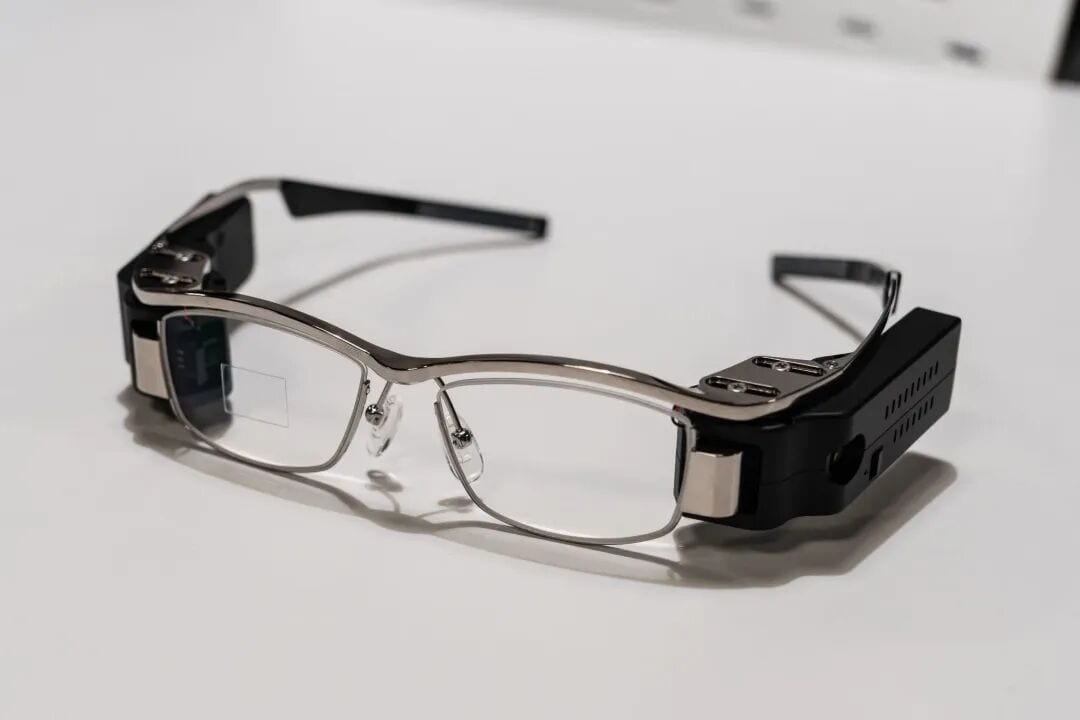
These components enable low-power, proactive AI features such as gaze-point camera capture (taking high-resolution photos only at the center of the user's gaze), automatic food and calorie logging, visual shopping assistance, and a memory recall function that can confirm daily tasks such as whether medication was taken in the morning.
TDK's smart glasses platform received the METI Minister's Award at CEATEC 2026 and is a core pillar of its broader AI hardware portfolio. In the long term, TDK plans to apply this metaoptics technology to high-speed optoelectronic convergence devices in AI data centers.
Text by Watchdog (all images in this article are from the internet)
Original title : Bypassing Waveguides? TDK Pioneers Direct Retinal Projection Optics
Source: OFweek Optics Network · News · optics.ofweek.com