Photon Bridge CCO: Tackling the Mass-Production Bottleneck for External Light Sources in AI Optical Interconnect
Photon Bridge CCO:打破“不可能三角”,破解AI光互连ELS量产瓶颈
Topics and contents
C114 interviews Photon Bridge's chief commercial officer about the interconnect bandwidth pressure from expanding AI compute clusters, the role of integrated photonics in breaking through optical module power and density limits, the mass-production challenges of external light sources (ELS), and the Dutch integrated photonics ecosystem.
C114, September 25 (Yue Ming) — From thousands to tens of thousands and now hundreds of thousands of accelerators, and from single racks to supernodes and supernode clusters, the continued expansion of AI computing infrastructure is placing enormous pressure on interconnect bandwidth. Integrated photonics is the core technology for breaking through the power consumption and density limits of traditional optical modules, and has become a key foundation for next-generation AI compute clusters.
The Netherlands has a highly collaborative integrated photonics ecosystem spanning research, chip design, wafer fabrication, packaging and testing, and commercial deployment. Building on this industrial base, PhotonDelta organized a Dutch integrated photonics delegation to China to attend the 27th China International Optoelectronic Exposition (CIOE 2026) in Shenzhen. Led by PhotonDelta and supported by the Netherlands Innovation Network and the Shenzhen representative office of the Netherlands Business Support Office, Dutch photonics companies and industry organizations will engage in in-depth exchanges with domestic supply chain peers at the exhibition, exploring opportunities for collaboration in technology R&D and commercialization.
Photon Bridge is one of the core companies in the PhotonDelta pavilion, focusing on developing light source products for expanding AI infrastructure. At this year's CIOE, Photon Bridge is showcasing its third-generation photonic platform. The platform targets a key bottleneck in scaling AI compute clusters — the mass production of external laser sources (ELS) — and also serves as the underlying technology base for its multi-wavelength digital light engine.
In an interview with C114, Photon Bridge CCO John said, "Compute clusters continue to grow in scale, and next-generation high-density optical interconnect solutions such as CPO and NPO impose stringent requirements on high-power multi-wavelength external light sources. Conventional discrete lasers can hardly meet the combined constraints of wavelength count, optical power, cost, and mass-production yield at the same time. That is exactly the problem our third-generation photonic platform is designed to solve."
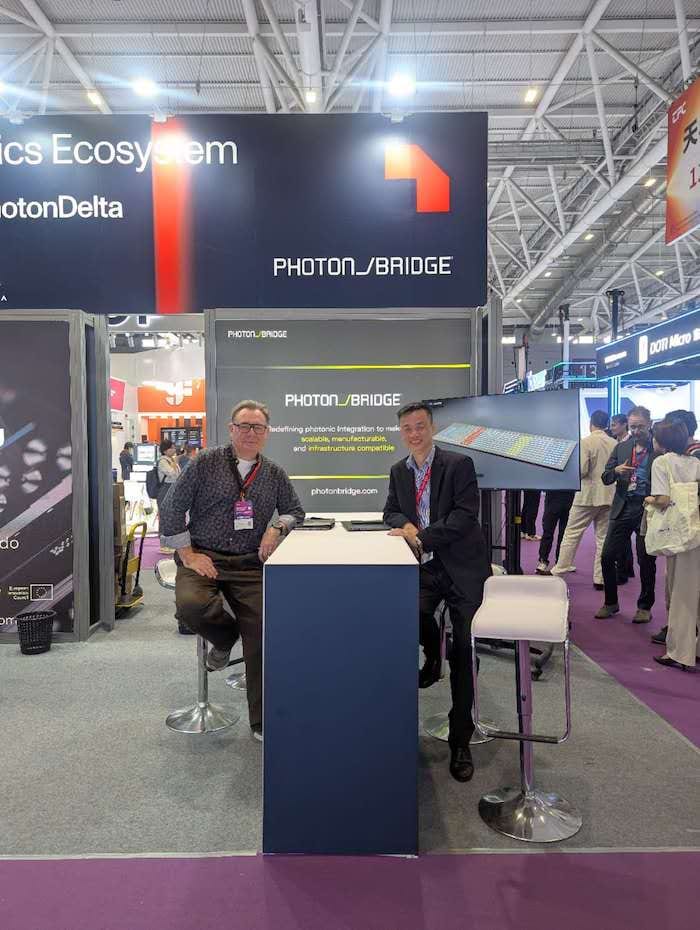
According to John, Photon Bridge's third-generation photonic platform uses a proprietary heterogeneous-integrated cantilever waveguide solution, integrating III-V lasers with silicon photonic circuits at the wafer level. It eliminates the need for complex high-precision active alignment and is compatible with passive-alignment packaging. The technology can speed up laser integration by up to 100 times, works with mature OSAT assembly and test lines, and significantly reduces assembly costs.
In terms of performance, Photon Bridge's third-generation photonic platform delivers high-power multi-wavelength output, with per-channel continuous-wave output power exceeding 30mW. A single fiber can carry 8/16/32 wavelengths, meeting the light source requirements of 1.6T and 3.2T CPO co-packaged optics modules, reducing fiber deployment in data centers and improving overall rack energy efficiency.
Meanwhile, Photon Bridge's third-generation photonic platform uses a thick silicon waveguide design that can withstand optical power greater than 1 W. Wafer-level test data show that more than 92% of interconnect channels meet specifications, highlighting strong volume-production potential. Backed by a parallel supply chain across multiple foundries, the product offers greater supply flexibility and can support high-volume delivery beyond the laboratory prototype stage. "Seven of the world's top ten optical module OEMs are from China. We are very optimistic about the deployment prospects of the third-generation photonic platform in the domestic market and hope to work with more Chinese companies to improve end-product delivery capabilities," said John.
C114 believes that AI compute clusters have entered the era of 100,000 accelerators, and optical interconnects are evolving from traditional solutions toward co-packaged and near-packaged optics, with the light source a key bottleneck. Conventional discrete lasers have long faced an "impossible triangle" of wavelength, optical power, and cost, and Photon Bridge's third-generation photonic platform solution is undoubtedly a promising exploration. 
Source: C114 Communications Network · Optical Communications · c114.com.cn