Philippine Ambassador to China Jaime: Connecting More Than 7,600 Islands with Light, Looking to Deepen China-Philippines Digital Infrastructure Cooperation
Topics and contents
Topic
On this page
Jaime FlorCruz, the Philippine Ambassador to China, said in his opening remarks at the 2026 Global Optical Fiber and Cable Conference that he looks forward to deepening cooperation with Chinese companies in submarine cables, resilient networks and skills development. The Philippines is made up of more than 7,600 islands, making cross-sea connectivity, disaster-resilient communications and affordable broadband access especially important for economic and social development. He specifically noted that FiberHome Telecommunication Technologies has worked with local telecom operators to build and maintain fiber broadband networks, creating local jobs and transferring knowledge.
C114 News, October 19 midday report (by Jiang Junmu): The 2026 Global Optical Fiber and Cable Conference opened today in Wuhan, China Optics Valley. Philippine Ambassador to China Jaime A. FlorCruz said in his opening remarks that optical fiber networks are becoming critical infrastructure in the artificial intelligence era. The Philippines is made up of more than 7,600 islands, making cross-sea connectivity, disaster-resilient communications and affordable broadband access especially important for economic and social development. He looks forward to deeper cooperation with Chinese companies in submarine optical cables, resilient networks and skills development.
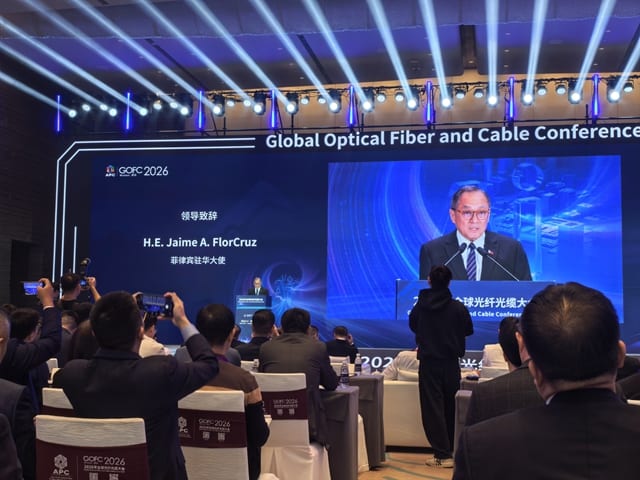
"Light is the carrier of information, and it naturally has an illuminating effect," Jaime said. The conference theme, "Light Powers AI, Leap into the Future," offers people without an engineering background like him a simple way to understand optical fiber technology: light makes hidden things visible, helping people find their bearings and chart the path ahead. Light traveling through optical cables underpins the computing networks behind AI and also connects people; used well, it can bring understanding, prosperity and peace.
He said the leap into the future depends on the infrastructure designed, manufactured and built by the optical fiber and cable industry. As an archipelagic nation, connecting people in the Philippines means crossing waters and mountains to reach remote communities, and it means networks must withstand frequent natural disasters such as typhoons, floods and earthquakes. Submarine optical cables, terrestrial optical fiber and reliable connections to homes and businesses are essential to bringing Philippine communities closer together.
The country's geography makes network deployment more challenging and underscores the need and urgency of technical cooperation and investment. Reliable connectivity can give students access to teachers and peers, give patients access to doctors, and give small businesses access to larger markets. AI is opening up new possibilities in education, healthcare and commerce, and reliable, affordable connectivity will largely determine who benefits.
"For Filipinos, 'leap to the future' means bringing prosperity to more people, and China has done this remarkably well over the past few decades," Jimmy said. The Philippines welcomes cooperation in submarine cable systems, resilient networks, skills development, and expanding access to technology to help more people realize their potential. He specifically cited FiberHome Telecommunication Technologies's collaboration in the Philippines, including working with local telecom operators to build and maintain fiber broadband networks. He said these partnerships not only improve connectivity but also create local jobs and transfer knowledge to the younger generation, giving international technology cooperation real meaning.
In Jaime's view, optical fiber connectivity also serves a broader human purpose. When people can communicate, they exchange ideas and discover opportunities for collaboration; through sustained contact, they learn about each other's lives, aspirations and concerns, deepening understanding and building trust. This trust and friendship are vital to China and the Philippines. The two sides should continue to develop cooperation that delivers tangible benefits to both peoples and fosters friendly relations.
"You transmit light, and you also transmit knowledge, opportunity and dialogue," Jimmy told the optical communications professionals at the event. It is these connections, he said, that enable people to understand one another and add value to each other's lives. The Philippines welcomes the "light" generated by the industry to connect more islands and people, bringing them closer together.
This conference coincided with the 50th anniversary of China's first optical fiber, drawing industry organizations, operators, equipment makers and supply chain representatives from more than 30 countries. Attendees generally agreed that AI computing power and data centers are becoming a new engine of demand for optical fiber and cable, while the construction of resilient submarine and cross-regional networks is opening up new room for cooperation across the global optical communications industry. 
Source: C114 Communications Network · Optical Communications · c114.com.cn