Leqi Gen-2 AI Glasses Preview: Four Optical Challenges for Diffractive Waveguides
乐奇第二代 AI 眼镜前瞻: 想伪装成普通眼镜,四道光学绕不过去的坎!
Topics and contents
Topic
On this page
The article argues that AI capabilities can be upgraded over the air, but the optical experience of a diffractive waveguide is hard to fix once finalized. The development of Leqi's second-generation AI glasses focuses on four engineering challenges: making the grating invisible, suppressing rainbow artifacts, thinning the lens, and reducing reflections while preserving brightness. These are also the issues that must be solved for consumer AI glasses to look like ordinary eyewear.

Abstract: AI capabilities can be updated over the air, but once the optics experience of a diffractive waveguide is finalized, it is hard to fix. The development focus of Leqi's second-generation AI glasses falls on four engineering challenges: hiding the grating, suppressing rainbow artifacts, thinning the lenses, and reducing reflections without losing brightness — the hurdles consumer-grade AI glasses must clear to "look like ordinary glasses." Today, piling AI capabilities onto AI glasses is no longer the hard part.
Translation, teleprompting, meeting minutes and photo recognition can all be continuously upgraded at the software level. But making the glasses look no different from ordinary prescription eyewear tests the hard optical fundamentals of the waveguide hidden inside the lenses.
Leqi's first generation has already proven the practical deployment of consumer-grade binocular diffractive waveguide AI glasses.
The upcoming second-generation Leqi AI glasses no longer chase FOV specs alone. Instead, the R&D focus turns inward to the four optical experience problems that hurt most in daily wear: the visibly imprinted grating area, rainbow artifacts in sunlight, lens thickness and weight, and display brightness loss after anti-reflection treatment.
Software can iterate indefinitely; once the optics are finalized, there is almost no room for later fixes. Whether the second generation can truly approach the form of "everyday glasses" depends largely on how it answers these four challenges.
Challenge 1: Can the imprinted grating area be made "nearly imperceptible" to the naked eye?
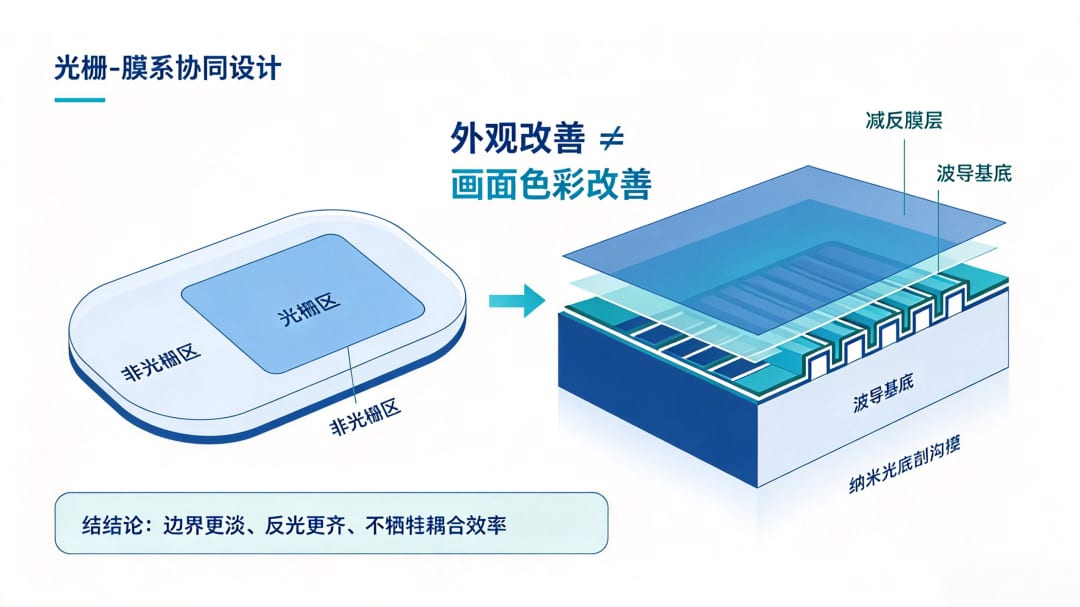
The surface of a diffractive waveguide lens has a light-extraction grating area formed by nanoimprint. Its microscopic groove structure is completely different from the surrounding ordinary lens.
Under certain angles of lamp or sunlight, distinct color patches and reflective spots appear. In face-to-face conversation, others can instantly spot the display area on the lens, and the "disguise as ordinary glasses" fails on the spot.
Many people assume that simply applying an ordinary anti-reflection coating will solve it. In practice, it does not work.
The grating performs the entire diffractive task of coupling in, guiding and coupling out light. The thickness and materials of a conventional anti-reflection coating alter the grating's effective refractive index and directly damage its coupling efficiency.
For a consumer-grade second-generation product to achieve an invisible grating, the mainstream industry route is a joint, coordinated design of the grating and coating stack: the anti-reflection coating is no longer applied only to the blank areas without gratings, but must conform to the nano-groove topography so that the reflection characteristics of the entire lens are uniform.
Here is a critical piece of engineering common sense for diffractive waveguides: improving the appearance color patches ≠ improving the color error of the displayed image.
Newcomers often confuse two things: how the lens looks to others, and the image quality of the virtual image seen by the wearer's eyes. These are two completely independent evaluation systems.
When a coating covers the nano-grating grooves, it not only changes the light coupling efficiency but also alters the grating's effective refractive index, further perturbing the diffraction angles of different wavelengths. After passing through the grating, the deflection and output ratios of red, green and blue light shift.
The end result is a paradox: from the outside, the grating boundary on the lens fades and the reflections are clean, like ordinary glasses; but the wearer sees color casts and color imbalance in the internal virtual image.
In other words, making the external appearance look good is only the first step. Additional joint simulation and parameter tuning of the grating and coating stack across the RGB bands is needed to ensure the color accuracy of the virtual image.
If this coordinated design is realized, the other person can see the wearer's eyes more easily in face-to-face conversation, the external appearance moves closer to ordinary consumer eyewear, and the display color performance for the wearer is not sacrificed.
Challenge 2: Rainbow artifacts can only be suppressed, not fully eliminated
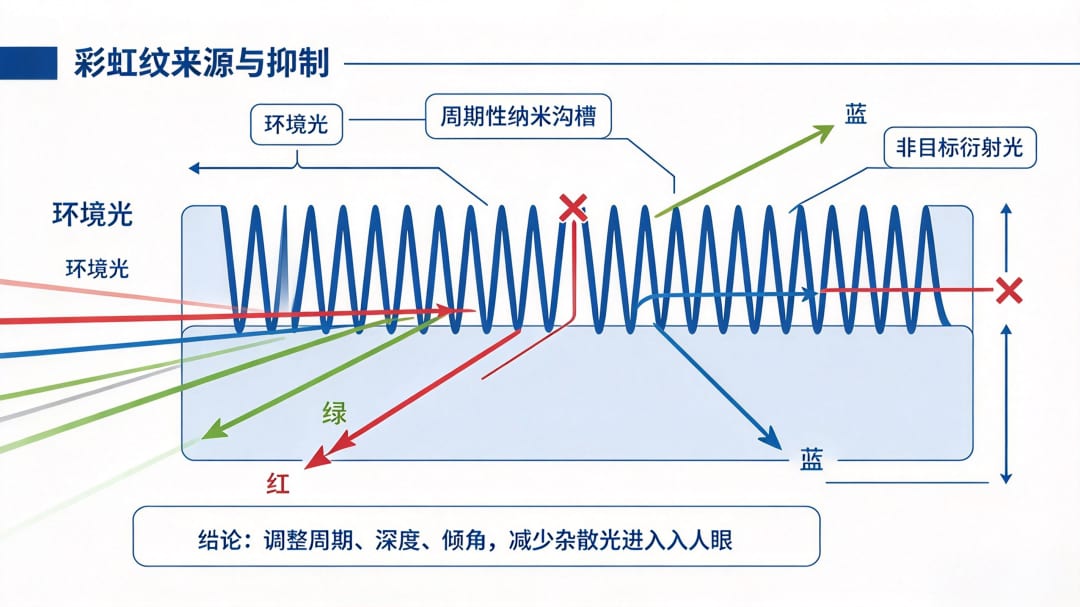
Many users of diffractive waveguide glasses have experienced this: walking under spotlights or sunlight, colored stripes drift into the field of view, and the stripes move as the head turns or tilts.
The source must be identified correctly: rainbow artifacts do not come from the image projected by the glasses, but from ambient light striking the periodic nano-grating and being split into stray light of different wavelengths that enters the eye. It is a dispersion side effect inherent to diffractive waveguides.
To suppress rainbow artifacts, a consumer-grade second-generation solution usually needs to readjust the grating period, groove depth and sidewall angle, or even adopt a composite grating structure, steering useless non-target diffracted light away from angles that reach the eye.
But grating parameters are interlinked: suppressing rainbow artifacts must not sacrifice field of view, image brightness or real-world transmittance.
The objective reality: engineering methods can minimize the intensity and probability of rainbow artifacts, but it is very difficult to eliminate them completely at the physical level.
Quality cannot be judged only under laboratory light sources; it must be validated through multi-scenario, multi-angle field tests under sunlight, car headlights and indoor spotlights.
Challenge 3: Thinner lenses do not automatically mean comfortable wear
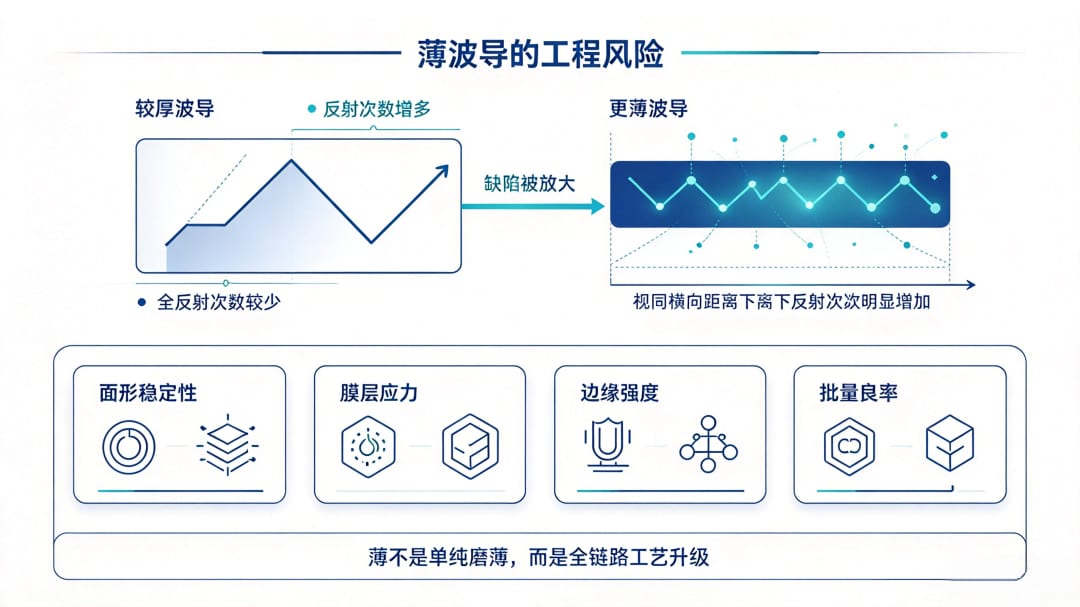
The whole industry is chasing lens thinning. Thinner lenses mean less weight, and more room inside the frame for batteries and sensors.
But simply grinding the glass substrate thinner does not improve the experience; the engineering difficulty of thin waveguides rises exponentially.
Judging from Leqi's disclosed technical roadmap and publicly available industry patents, bringing thin lenses into consumer-grade products requires a complete, coordinated process upgrade:
Over the same lateral propagation distance, the thinner the lens, the significantly more times light undergoes total internal reflection inside the waveguide.
Any tiny defect inside the waveguide is repeatedly accumulated and amplified along the reflection paths, turning into ghosting, image distortion and uneven local brightness.
Thin substrates themselves are extremely sensitive to all kinds of stress, and the risk sources run through the entire process chain:
Coating stress: internal stress from depositing the grating and anti-reflection coatings can "pull" the lens out of shape;
Adhesive shrinkage: curing shrinkage of the bonding adhesive in multilayer composite waveguides causes persistent deformation;
Mounting pressure: clamping and assembly of the frame exert mechanical compression, causing slight warping of the lens;
Thermal cycling: switching between hot and cold environments, differences in thermal expansion among materials further worsen surface-shape changes.
The consequences of deformation go beyond visible bending; they directly change the propagation angles of light inside the waveguide.
To make thin lenses truly usable, the entire process must be upgraded in step: strictly control coating internal stress with low-stress deposition processes, monitor substrate flatness and surface-shape stability across the full flow, optimize the precision nanoimprint process to ensure nanostructure consistency, reinforce the structural strength of the lens edges, use the mounting structure to avoid clamping stress, and finally control batch yield to reduce unit-to-unit lens variation.
Thickness is just a number. Whether thinness truly translates into wearing comfort depends on the total device weight and structural strength, and must be verified through drop and long-term thermal-reliability tests. This is the complete engineering validation that a consumer-grade second-generation product must complete along the thinning path.
Challenge 4: A better-looking exterior must not "erase" display brightness
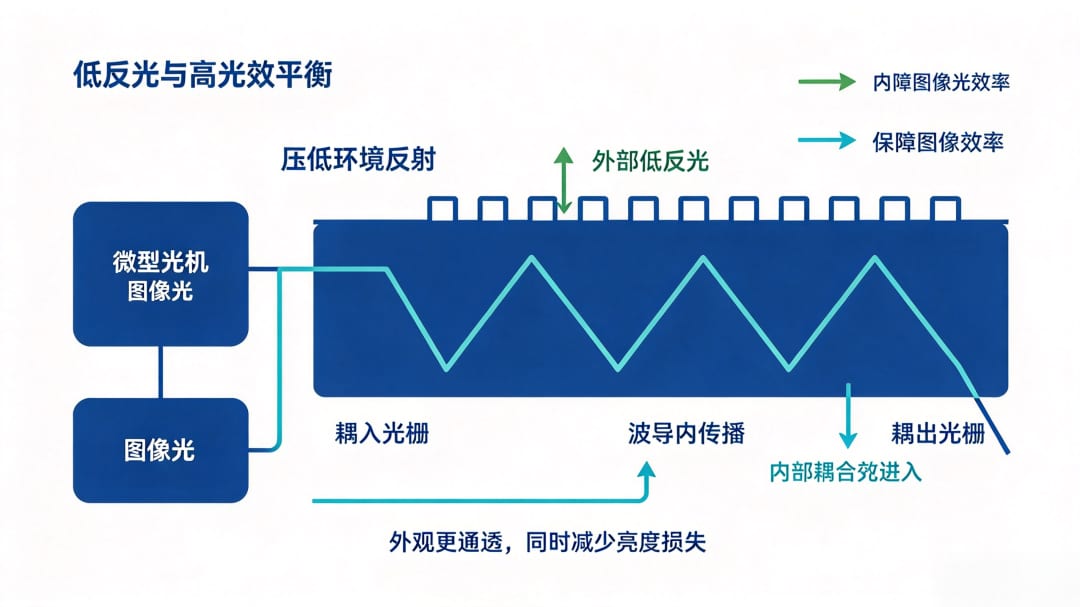
This is the most agonizing trade-off in the whole waveguide system: adding anti-reflection to improve the external appearance can easily eat into the coupling efficiency of the internal image light.
Image light is coupled from the optical engine into the waveguide, undergoes multiple total internal reflections inside the lens, and is then coupled out to the eye; the chain has inherent losses.
If the anti-reflection design in the grating area is crude, external reflections are suppressed but the coupling-in and coupling-out efficiency drops in step. The image becomes dim with uneven edge brightness, forcing higher optical engine power, which brings greater power consumption and heat.
Finding the balance between anti-reflection and brightness, a dedicated coating design for the input grating is a common solution for the second generation.
While suppressing external ambient light reflection, it strives to preserve the coupling efficiency of image light into the waveguide, taking into account the image center, corners and the different RGB bands.
The goal is not to max out any single parameter, but the overall experience: the lens looks clear and natural from outside, the wearer can read navigation and subtitles clearly, and optical engine power does not have to be cranked up.
Final thoughts: The second-generation Leqi is worth looking forward to and carries market expectations, but its limits should be viewed rationally.
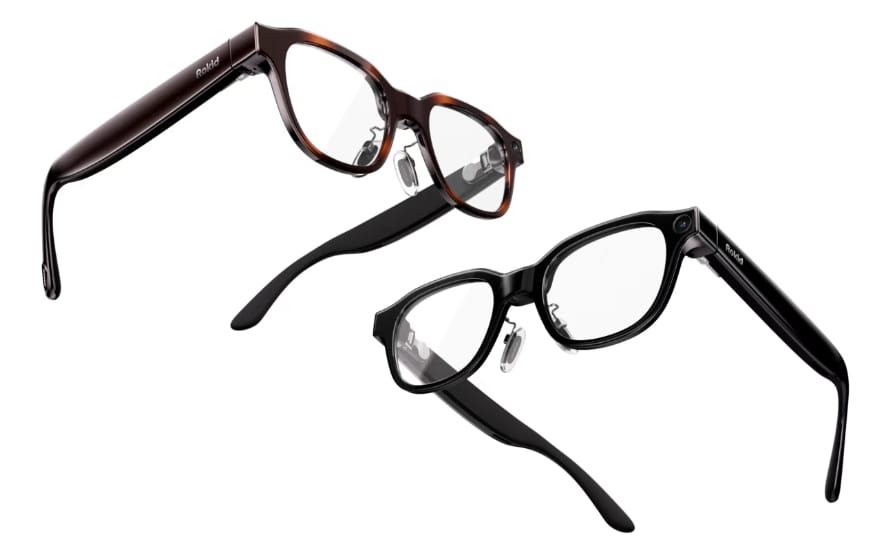
Stringing these four points together makes it clear: hiding the grating, suppressing rainbow artifacts, thin lenses and a bright image pull against each other. Maxing out one metric easily sacrifices the others; there is no black technology that solves every pain point at once.
From the first generation proving consumer-grade binocular diffractive waveguides to the second generation going back to fix the most visible issues of appearance, stray light and the thinness-weight balance for daily social wear, Leqi's product cadence shows pragmatic engineering judgment.
As AI glasses gradually enter the mass consumer market, this product carries high hopes — if this optical experience can be brought to mass production, it has the chance to rewrite the public's fixed impression of diffractive waveguide AI glasses and open up a broader consumer market.
Of course, rationality is also needed: the above analysis is based on technology trends in the diffractive waveguide industry and public information; prototype simulation does not equal a mass-produced product.
Some inherent optical defects of diffractive waveguides can only be suppressed at this stage, not completely eliminated. The actual experience and market performance must be judged by post-launch field tests and market feedback.
Discussion topic: If grating invisibility, rainbow artifact suppression, display brightness and lightweight comfort cannot all be satisfied at once, how would you rank your priorities? And what product performance do you think would truly convince ordinary consumers to buy AI glasses? Feel free to leave a comment and share your expectations.
[Risk note] This article is a forward-looking industry technology analysis. The R&D directions discussed are compiled from publicly available industry materials and patent information and do not represent Leqi's official finalized parameters; diffractive waveguide optical characteristics have physical limits, and the actual experience is subject to the mass-produced product at launch.
— AR Andy | Focused on waveguides and AR microdisplays, with in-depth analysis of the underlying logic of the optics industry.
Original title : Preview of Leqi's second-generation AI glasses: to disguise as ordinary glasses, four optical hurdles cannot be bypassed!
Source: OFweek Optics Network · News · optics.ofweek.com