SIOM Achieves Dynamic Quantitative Phase Imaging with Coherent-Detection Ghost Imaging Lidar
上海光机所在基于相干探测鬼成像雷达的动态定量相位成像研究取得进展
Topics and contents
The Shanghai Institute of Optics and Mechanics (SIOM) has achieved dynamic quantitative phase imaging using coherent-detection ghost imaging lidar.
The source article provides specific data and details that help assess actual progress in this direction
Excellent Innovation Center for Ultra-Intense Laser Science Briefing
(Issue 816)
August 25, 2026
SIOM Advances Dynamic Quantitative Phase Imaging Based on Coherent Detection Ghost Imaging Radar
Recently, a research team from the Aerospace Laser Technology and Systems Department of the Shanghai Institute of Optics and Fine Mechanics, Chinese Academy of Sciences, achieved a breakthrough in dynamic quantitative phase imaging. The team proposed and validated a novel dynamic phase imaging scheme based on single-arm field-correlation ghost imaging, enabling continuous quantitative phase mapping of dynamic transparent media without phase retrieval algorithms. The related work, titled “Quantitative dynamic phase mapping via single-arm field-correlation ghost imaging,” was published inAPL Photonics.
In electromagnetic wave measurement, phase is a more sensitive physical parameter than amplitude and carries critical information in measurement bands ranging from microwave and terahertz to X-rays. Conventional optical interferometric techniques offer high sensitivity but impose stringent requirements on environmental stability, including mechanical vibration and optical path drift. In recent years, non-interferometric single-arm techniques such as coherent diffraction imaging have been proposed, but they typically rely on iterative phase retrieval algorithms, which are computationally complex and struggle with dynamic scenes.
To address these challenges, the team modeled the continuous transparent medium under test as a dynamic pure-phase object and used field-correlation ghost imaging to spatially encode and compress its two-dimensional complex transmittance, with all information captured by a single bucket detector. This architecture maps spatial information into the time domain, using high-speed digitization to continuously resolve two-dimensional phase dynamics and bypass the frame-rate bottleneck of conventional area-array sensors. Combined with mid-frequency spectral analysis, the method establishes a direct linear mapping from the recorded signal to the physical phase; the complex amplitude can be extracted deterministically via field correlation, and a pseudoinverse algorithm enables spatial reconstruction of the two-dimensional acoustic pressure distribution.
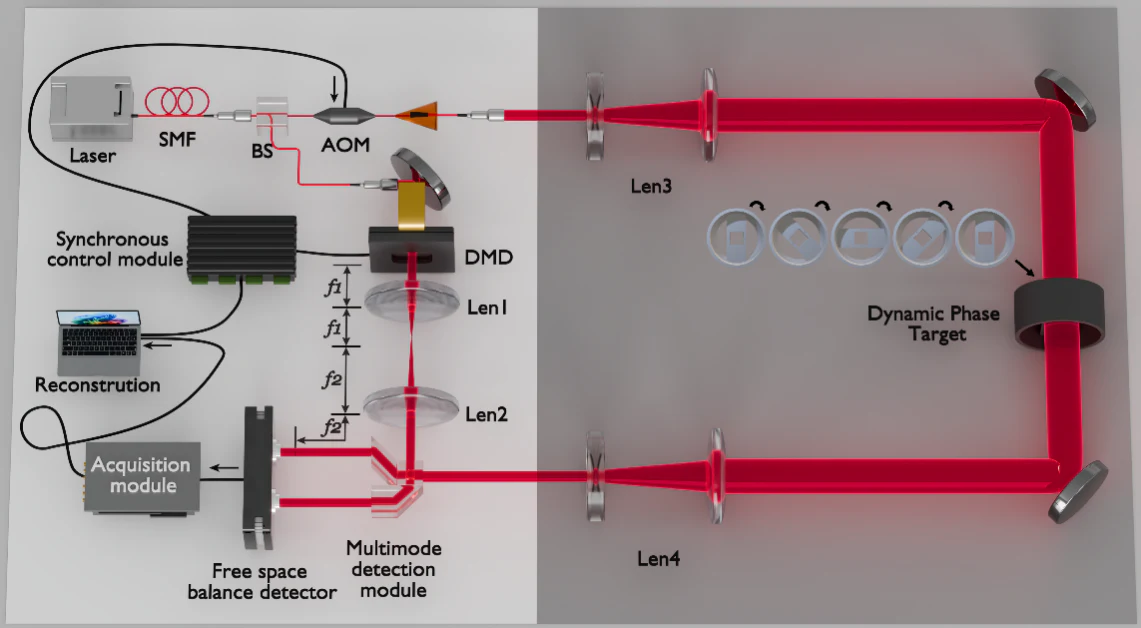
Figure1 Schematic of the novel dynamic phase imaging experimental setup based on single-arm field-correlation ghost imaging
The team validated the approach experimentally in an acoustic levitator, as shown in Figure1. The results show that the optically extracted acoustic wavelength matches the theoretical dispersion model, and the extracted phase shift is linearly correlated with the local acoustic pressure level. The spatial phase distributions at different frequencies are shown in Figure2. This deterministic method provides a metrology tool with real-time capability for characterizing rapidly evolving phenomena, with broad applicability to transient aeroacoustic flow fields, shock waves, and microfluidic biodynamics. The study offers a route to dynamic phase imaging that requires no phase retrieval, no two-arm interferometry, and no area-array detector, with important application prospects in high-speed aero-optical diagnostics, quantitative ultrasonic field characterization, and real-time microfluidic monitoring.
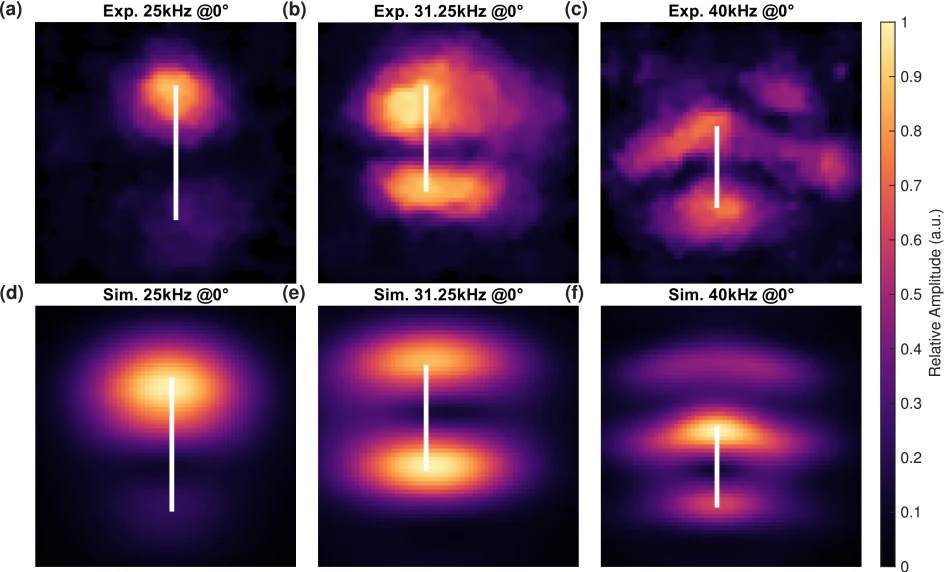
Figure2 Experimental-simulation comparison of the phase space of dynamic phase at different temporal frequencies
The work was supported by the National Key R&D Program of China, the Strategic Priority Research Program of the Chinese Academy of Sciences, and projects of the Space Application System of China Manned Space Program.
Source: Shanghai Institute of Optics and Fine Mechanics (SIOM) · Research Updates · siom.cas.cn