2026 Nobel Prize in Physiology or Medicine Goes to Optogenetics, Giving Brain-Computer Interfaces a Precision Write Tool
热点丨2026诺奖落定光遗传学, 脑机接口补上“精准写入”拼图
Topics and contents
Topic
On this page
The Karolinska Institute has announced that the 2026 Nobel Prize in Physiology or Medicine goes to Karl Deisseroth, Peter Hegemann and Georg Nagel for the discovery of light-gated ion channels and optogenetics. The article explains how the channelrhodopsin ChR2 is activated by blue light and discusses how optogenetics adds precision write capability to brain-computer interfaces.
Introduction:
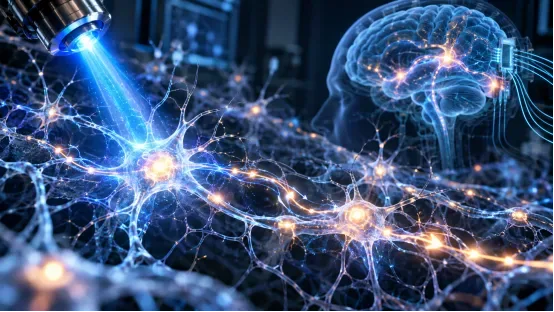
A beam of blue light can make neurons fire on command. This sci-fi-sounding experiment took center stage at the 2026 Nobel Prize in Physiology or Medicine.
Optogenetics offers an exciting path — and a new benchmark for the next phase of competition in neural interfaces.
A medal for the brain's「write key」
Recently, the Karolinska Institute in Sweden announced that the year's Nobel Prize in Physiology or Medicine would go to Karl Deisseroth, Peter Hegemann and Georg Nagel, for the discovery of light-gated ion channels and optogenetics.

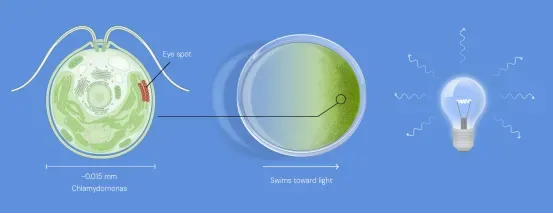
The first clue to this research lay in a single-celled alga called Chlamydomonas, which can sense light and change its swimming direction.
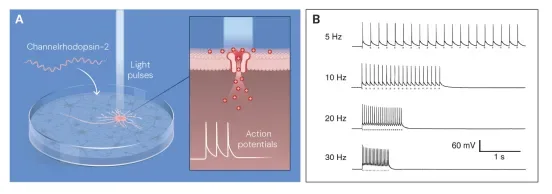
In their work, Hegemann and Nagel discovered channelrhodopsins with light-responsive capability. When the ChR2 protein is illuminated with blue light of a specific wavelength, it opens ion channels in the cell membrane, allowing charged ions to flow and altering the cell's electrical activity.
A door to the microscopic world swung open.
In 2005, Deisseroth's team applied these light-sensitive proteins to mammalian neurons, proving that light could be used to precisely control the firing of nerve cells. The work then moved into the brains of living animals, letting scientists use light to intervene in specific neural circuits.
For a long time, studying the brain has largely depended on observation.
One region becomes active while processing fear; a group of neurons fires frequently as an animal forms a memory. Researchers can capture these phenomena, but it is hard to confirm whether they actually drive behavior or merely accompany it.
Optogenetics brought a new experimental capability: actively activating or suppressing specific nerve cells, then observing how behavior, emotion and physiological activity change.
Neuroscience thus gained a key for verifying causality. By controlling the activity of different neural circuits, researchers can analyze in greater depth the neural mechanisms underlying movement, reward, memory, sleep and mental illness.
There is one easily overlooked technical detail: the precision of optogenetics does not simply come from a sufficiently narrow beam of light.
Target cells must first be made to express a specific light-sensitive protein, after which light of the corresponding wavelength is used to alter cell activity. With genetic tools, researchers can select intervention targets based on cell type or neural circuit characteristics.
This ability to select cells adds an important dimension to neuromodulation.
Electrical stimulation excels at applying current to local tissue; optogenetics gives researchers the chance to decide which cells, with which biological identity, respond to stimulation.
The prize citation contains a weighty judgment: this technology makes it possible to show how nerve cells shape memory, emotion and behavior in the living brain.
Deisseroth put it plainly after the award: in science, light has always been a tool for gathering information; optogenetics is the exact opposite — we use light to make things happen. The human brain has about 90 billion neurons, and for the first time there is a tool that can name a small group of cells and order them to switch on or off, then watch how behavior changes.
Brain-computer interfaces sprinted for a decade, but only built the road out of town
Shift the gaze from the lab to industry and a glaring gap appears. Nearly every highlight of brain-computer interfaces over the past decade has been in the outbound direction: reading signals out of the brain and sending them to machines.
Neuralink is the fastest company on this road. As of September 2025, 12 severely paralyzed patients worldwide had received its implants; by February 2026 that number exceeded 20.
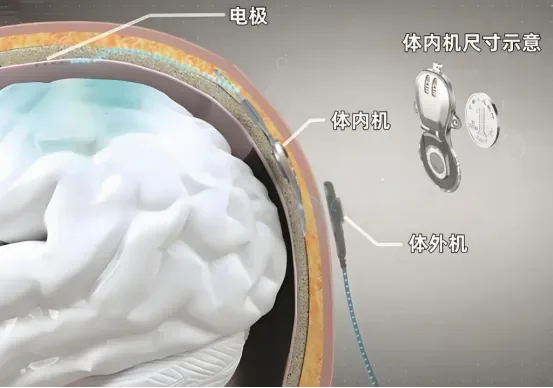
Shanghai's BrainCo? No — 脑虎科技 (Naohu Technology) completed China's first fully implanted, fully wireless system clinical implantation in December 2025, and in April 2026 enabled a 29-year-old art teacher with high-level quadriplegia to paint again, with end-to-end latency cut to 50 milliseconds.
The NEO system, developed by a Tsinghua team with 博睿康 (Borui Kang), completed 32 implantations in cervical spinal cord injury patients at 11 hospitals in 2025; subjects used brain-controlled pneumatic gloves to grasp, with 92% accuracy. In March 2026, NEO received a Class III medical device certificate from the National Medical Products Administration, becoming the world's first approved implantable brain-computer interface product.
The track record is impressive, but the direction is singular. All of this is reading — one-way output from the brain. A paralyzed patient can move a cursor but cannot feel it. A robotic arm can lift a cup, but its owner cannot sense the temperature of the cup's wall. The road into town — writing information back into the nervous system — has remained full of potholes.
The obstacle lies in physics. Electrical stimulation writing is like a searchlight: current spreads through tissue, indiscriminately lighting up thousands of mixed neurons around the electrode. A cochlear implant uses twenty-odd electrodes to mimic the work of tens of thousands of hair cells, so the sound is inevitably crude.
On the reading side, the clinical, regulatory and payment loop has gradually come together — hard to imagine five years ago. The problem is that reading solves "output": extracting motor intent from the brain.
The far larger clinical market for neurological disease is almost entirely an "input" problem: blindness requires writing images into the visual cortex, deafness requires writing sound into the auditory nerve, and Parkinson's, epilepsy and depression require writing regulatory signals into specific circuits.
It is precisely on the writing side that the physical limits of electrode approaches have become apparent. Current spreads in brain tissue; the stimulation sites of the Utah array are about 0.4 millimeters apart, while precise control of the primate cortex requires hundreds of sites per square millimeter.
Deep brain stimulation (DBS) cannot distinguish excitatory from inhibitory neurons and can only apply current indiscriminately to an entire region. Some describe it as shouting through a megaphone at a room full of people, hoping the right listener responds.
Neuralink's Blindsight visual prosthesis received FDA Breakthrough Device designation in September 2024, with human trials planned for 2026; Musk himself admits the early image quality will look like early Nintendo graphics.
The ceiling for electrode writing is set jointly by the physical properties of current and the anatomical density of neurons — piling on more channels will not break through it.
This is exactly where optogenetics shows its value: light ignites only the cells that have been genetically engineered and tagged. The searchlight is swapped for a laser pointer.
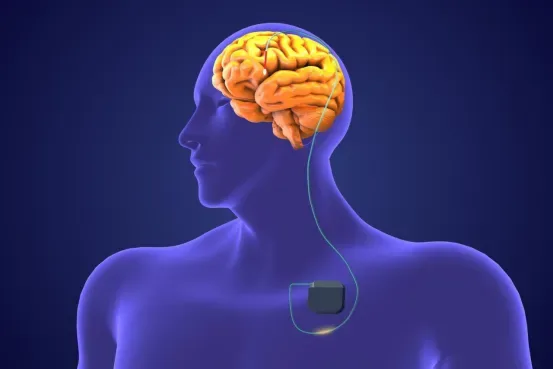
Light offers a different way to solve the problem
The value of optogenetics can be summarized in three properties:
① Cell-type specificity: through genetic targeting, only a particular class of neurons expresses the light-sensitive protein.
② Millisecond precision: matching the timescale of neural firing.
③ Bidirectional control: it can both excite and inhibit.
These three properties precisely fill the three gaps in electrode writing.
The mesoscale optogenetic system published in Neuron this February achieved megapixel-scale light stimulation within centimeter-scale regions of the primate cortex, with a single pixel able to evoke visual responses stably for more than a year.
Northwestern University's hair-thin wireless LED array and KAIST's sugar-cube-sized implant in Korea point in the same direction: light-delivery hardware is rapidly shrinking.
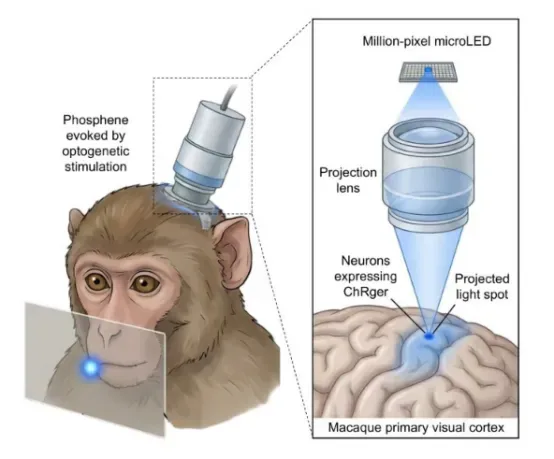
For theoretical elegance to become a business, it needs a beachhead to land on. Nature has prepared one: the eye.
The retina is part of the central nervous system and is naturally transparent to light. The biggest challenge of light writing in the brain — delivering the light — dissolves automatically inside the eyeball.
In 2026, this beachhead saw heavy fire: in July, Science Corporation's PRIMA retinal implant system received EU CE marking, approved for sale in about 30 European countries. This photovoltaic chip, 2 millimeters square and 30 micrometers thick, is implanted under the retina and paired with glasses that project near-infrared light onto the chip, replacing the dead photoreceptor cells to generate power.
Nanoscope's MCO-010 therapy produced significant improvement in visually guided movement or object recognition in 88.9% of subjects in its Phase 2 trial — 16 of 18 people — with no external glasses needed; ambient light alone activates it.
Interim Phase 1/2 data released by Restore Vision in 2026 is even more intriguing: among six patients with advanced retinitis pigmentosa who had no light perception at baseline, all three in the high-dose group recovered light perception or better within a month of treatment, and some can already read letters on an eye chart.
Reading decodes intent; writing provides feedback. Together they make a complete brain-computer interface: sensory feedback for prosthetics, visual prostheses, real-time intervention before an epileptic seizure, circuit regulation for depression — each requires two-way read-write capability.
On the timeline, ophthalmic optogenetic therapies are due to land in 2027–2028; for brain diseases, the more likely first form is a hybrid closed-loop device combining "electrode reading + optogenetic writing," while purely optogenetic deep-brain applications must wait for light-delivery and long-term safety data to catch up.
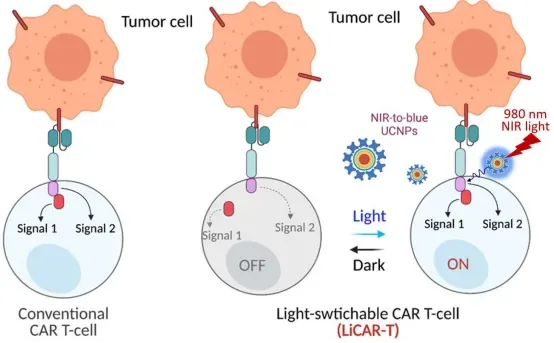
The peripheral battlefield is also opening up: optogenetic cochlear implants could theoretically expand independent channels from twenty-odd to over a hundred, with a team in Göttingen, Germany planning to launch multicenter clinical trials in 2031; light-controlled analgesia already has companies planning human trials before 2027; and in cell therapy, light-controlled switch CAR-T (LiCAR-T) has caged cytokine storm — the biggest pain point — in animal models.
Conclusion:
Return to the medal itself: it crowns a scientific discovery from 20 years ago, but endorses an industry now taking shape.
The keyword of the first half of brain-computer interfaces was bandwidth; the keyword of the second half will be the precision of writing. This belated Nobel Prize for optogenetics is less a laurel wreath than an industry entry permit: from now on, the business of "writing into the brain" has textbook-level legitimacy.
Sources: Explainer: "Why 2026 Nobel Prize in Physiology or Medicine awards optogenetics"; 医药魔方 (Yiyao Mofang): "The Optimistic Prospects of Optogenetics"; 生物谷 (Bioon): "2026 Brain-Computer Interface Frontier Technology and Industrial Translation Conference — China's First Full-Chain Dialogue on the First Year of BCI Commercialization"; 投中网 (ChinaVenture): "2026: How High Can Brain-Computer Interfaces Fly on the Wind?"
Original title : Hot Topic | 2026 Nobel Prize Goes to Optogenetics, Brain-Computer Interfaces Get the "Precise Writing" Puzzle Piece
Source: OFweek Optics Network · News · optics.ofweek.com