Jinding Optics Files for ChiNext IPO Amid Frequent Equity Changes and Customer Concentration
金鼎光学股权变动频多,客户集中,与宇瞳光学采销不一
Topics and contents
Topic
On this page
Guangdong Jinding Optics plans to list on the ChiNext board, issuing up to 19.1706 million shares to raise CNY758 million for projects including a precision optical equipment and optical products smart manufacturing base. The article notes frequent equity changes, customer concentration, and inconsistencies between its purchase and sales data and those of Yutong Optics.
By: Quan Heng Cai Jing iqhcj researcher Li Li
Edited by: Xu Hui
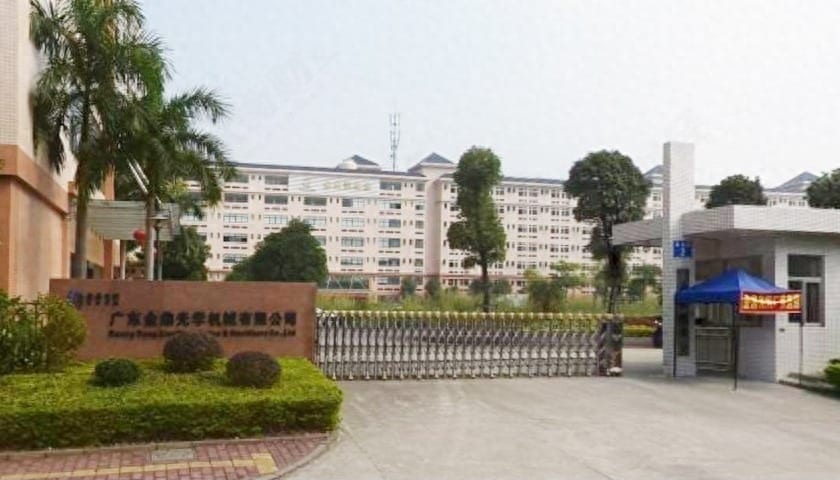
Guangdong Jinding Optical Technology Co., Ltd. (Jinding Optics) plans to list on the ChiNext board, with SDIC Securities as its sponsor. It will issue no more than 19,170,600 shares, representing at least 25.00% of the company's total share capital after the offering. The company plans to use 758 million yuan of the proceeds for a precision optical equipment and optical products intelligent manufacturing base project, an R&D center construction project, an IT system project and working capital replenishment (130 million yuan).
On September 11, the People's Bank of China published document No. 71 of 2026 on its website. The notice shows that SDIC Securities was given a warning and fined 818,000 yuan for three violations. The penalty decision was made by the central bank on June 22, 2026, with a three-year publication period. According to the details, SDIC Securities' violations included: 1. failure to conduct customer due diligence as required; 2. failure to report suspicious transactions as required; 3. failure to conduct money laundering risk assessments or establish sound corresponding risk management systems as required.
The actual controller and persons acting in concert hold relatively low stakes, with frequent equity changes; gross margins for precision optical equipment are slightly above the peer average, while those for optical components and lenses fall below the peer average; R&D spending as a share of revenue is below the comparable peer average, and the capacity expansion funded by the offering far exceeds current production and sales; customer concentration is high, gross profit depends on the top two customers, and purchase and sales figures conflict with those of Yutong Optics in the disclosure.
The actual controller and persons acting in concert hold relatively low stakes, with frequent equity changes
In August 2011, Jinding Limited was established. Jinding Property, Yushi Management and Caijing Optoelectronics contributed 7.05 million yuan, 6.75 million yuan and 1.20 million yuan respectively in cash, for a total paid-in capital of 15.00 million yuan, representing 47.00%, 45.00% and 8.00% of the registered capital respectively. In February 2016, Jinding Limited was converted in its entirety into a joint-stock company.
The company's controlling shareholder and actual controller is Zhang Shengfeng. As of the date of signing of the prospectus, Zhang Shengfeng directly held 9,862,893 shares, or 17.15%, making him the company's largest shareholder. Zhang Shengfeng, Luo Shuijin, Dingsheng Partnership and Dili Partnership entered into a Concert Party Agreement on November 20, 2025, under which the parties agreed to act in concert at the company's operational and management level. Luo Shuijin, Dingsheng Partnership and Dili Partnership are concert parties of the company's actual controller and, to maintain operational stability, are willing to act in concert with the actual controller unconditionally.
As of the date of signing of the prospectus, Luo Shuijin directly held 4,319,693 shares, or 7.51%; Dingsheng Partnership directly held 6,354,000 shares, or 11.05%; Dili Partnership directly held 599,000 shares, or 1.04%. Through direct shareholding, indirect control and the concert party arrangement, Zhang Shengfeng controls voting rights over 36.75% of the company's shares in total and is the company's actual controller.
Quan Heng Cai Jing iqhcj notes that if the concert parties sell down their shares after the lock-up period expires, or if the Concert Party Agreement is not renewed upon expiry, causing the proportion of voting rights actually controlled by Zhang Shengfeng to fall, the stability of the company's control may be at risk, which could have a certain impact on the company's production and operations.
On May 7, 2025, Jinding Optics issued 2,325,399 new shares: Dengling Tianshu subscribed for 852,273 shares for a total of 19.50 million yuan, Junyi Digital subscribed for 874,126 shares for a total of 20.00 million yuan, and Dili Partnership subscribed for 599,000 shares for a total of 6,852,560 yuan. Dengling Tianshu and Junyi Digital subscribed at 22.88 yuan per share; Dili Partnership, an employee shareholding platform, subscribed at 11.44 yuan per share. For each period under review, the company's share-based payment expenses were 4,200 yuan, 255,800 yuan and 1,731,400 yuan respectively.
On August 27, 2025, Jinding Optics appointed Liu Xiangmao as the new board secretary and chief financial officer, with Liu Xiangmao subscribing for 500,000 new shares for a total of 5.72 million yuan at 11.44 yuan per share. From July 2008 to June 2019, he held successive positions at Essence Securities as an analyst, project manager, business vice president and business director in the investment banking division; from July 2019 to July 2025, he served as business director and executive director in the investment banking division of Guotai Haitong Securities.
On November 4, 2025, the company's former shareholder Zhai Pingxian signed Share Transfer Agreements with Zeng Lijun, Du Xiaofeng, Zhang Zhirui, Yang Daiqun, Wan Jun, Chen Wenmo, Xu Wanlin, Zhang Jiejie, Yu Xiaoping and Wance Partnership respectively, transferring 2 million shares of Jinding Optics held by her to the above parties at 22.88 yuan per share for a total consideration of 45,759,997 yuan; Zhai Pingxian opted for a full exit on the eve of the company's IPO.
Gross margins for precision optical equipment are slightly above the peer average, while those for optical components and lenses fall below the peer average
Jinding Optics is mainly engaged in the R&D, production and sales of high-end precision optical equipment, optical lenses and precision optical components, generating revenue and profit by supplying equipment, optical lenses and components to downstream customers. From 2023 to 2025, the company's operating revenue was 144.1 million yuan, 201.1 million yuan and 340.9 million yuan respectively, with growth of 39.56% and 69.51%; net profit was 27.9418 million yuan, 42.0095 million yuan and 83.2064 million yuan respectively, with growth of 50.34% and 98.06%, indicating relatively rapid performance growth.
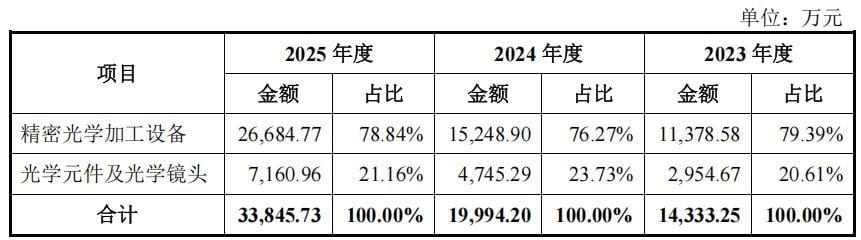
For each period under review, the company's precision optical processing equipment generated revenue of 113.8 million yuan, 152.5 million yuan and 266.8 million yuan respectively, accounting for 79.39%, 76.27% and 78.84% of revenue from principal operations, making it the company's main source of revenue, with the overall revenue scale showing a sustained upward trend. As downstream optical market demand continues to expand and end-product application scenarios keep broadening, the company's customer base has grown steadily. Supported by a continuously improving product model system and an increasingly rich product range, revenue from glass aspheric precision molding presses and related equipment has grown steadily, while also driving revenue growth in precision cold-processing equipment and other optical equipment, and ultra-precision processing equipment.
For each period under review, the company's optical components and optical lenses business generated revenue of 29.5467 million yuan, 47.4529 million yuan and 71.6096 million yuan respectively, accounting for 20.61%, 23.73% and 21.16% of revenue from principal operations, with the overall revenue scale showing a steady upward trend.
During the reporting period, Jinding Optics' overall gross margin was 36.27%, 39.32% and 42.28%, showing an overall upward trend, mainly due to rising gross margins in its principal business.
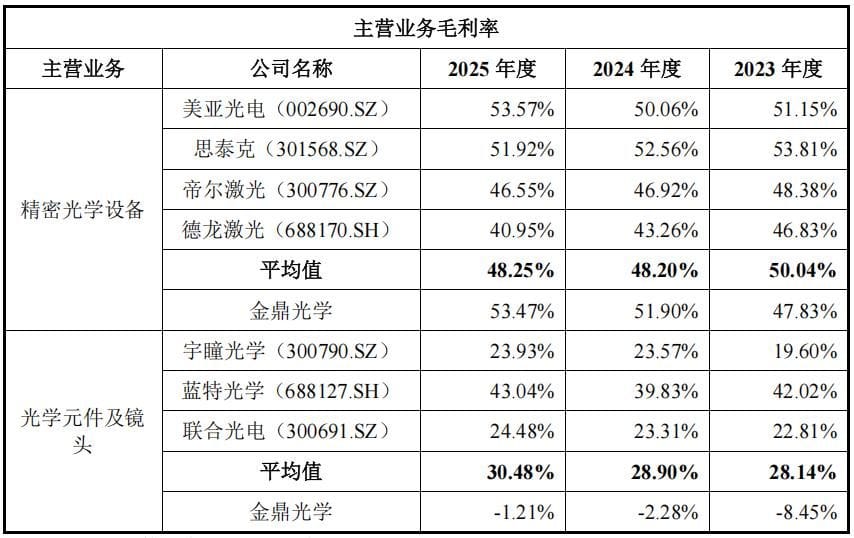
During the reporting period, the average overall gross margins for precision optical equipment of listed industry peers Meiya Optics, SITAC, DR Laser and Delong Laser were 50.04%, 48.20% and 48.25% respectively, remaining stable overall in the high range of 48%-51%, reflecting the industry characteristics of high-end optical equipment: relatively high technical barriers, prominent product value-add and ample profit margins.
During the reporting period, the company's gross margin for optical components and lenses was -8.45%, -2.28% and -1.21% respectively, below the average of listed industry peers. The main reasons are that the company's business scale and production process capabilities for optical components and optical lenses still lag behind listed industry peers, and product yields are lower than those of listed industry peers; as a result, the gross margin for the company's optical components and optical lenses business is negative and below that of listed industry peers.
R&D spending as a share of revenue is below the comparable peer average, and capacity expansion funded by the offering far exceeds current production and sales
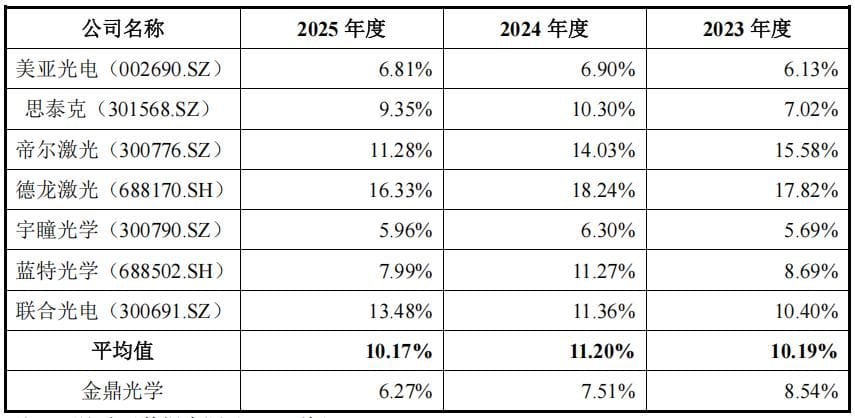
At the end of each period under review, Jinding Optics had 183, 283 and 420 employees respectively. Of the company's 420 employees at the end of 2025, 250 had education below junior college level. For each period under review, Jinding Optics' R&D expense ratio was 8.54%, 7.51% and 6.27% respectively, while the average R&D expense ratio of listed industry peers was 10.19%, 11.20% and 10.17% respectively; the company's R&D expense ratio is below that of listed industry peers.
Jinding Optics outsources certain lower value-added processes for some products, such as milling and grinding, fine grinding and polishing. The company strictly controls the quality of outsourced processing to ensure it meets product design requirements and customer needs. During the reporting period, the company's outsourced processing costs were 8.1964 million yuan, 9.2314 million yuan and 11.3274 million yuan respectively, with the overall scale of outsourced processing remaining relatively small.
The company's precision optical equipment products are produced in-house, while its optical components and optical lenses are produced mainly under OEM, with a small amount under ODM. The company's lens and optical component products are produced mainly under OEM/ODM models. Under these models, the company has formed long-term cooperative relationships with certain mainstream domestic lens manufacturers; upon receiving customer orders, the company produces optical lenses and optical components based on the customer's design plans or product requirements.
The concept of designed capacity does not apply to the company's products. During the reporting period, the production and sales volumes of the company's main equipment products and of its optical lenses and optical lens products are shown in the figures respectively:
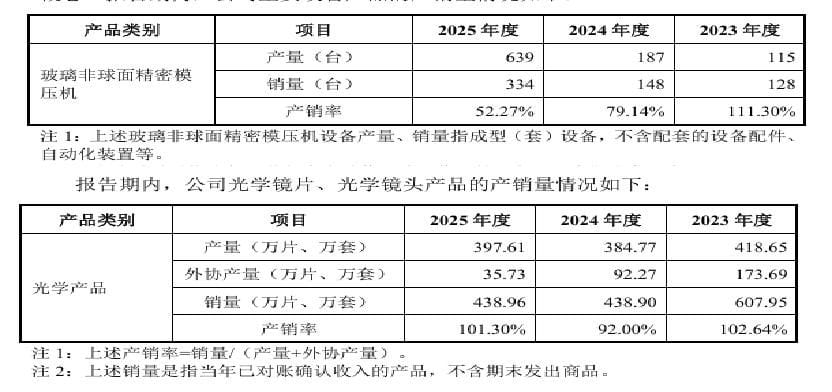
According to the environmental impact assessment report for the investment projects, the expected capacity from this expansion funded by the offering is 15.8 million sets of precision lenses, lens elements and AR products per year and 1,440 units (sets) of intelligent precision equipment per year. These capacities far exceed current corresponding output and sales volumes, raising significant questions about how the additional capacity will be absorbed.
Customer concentration is high, gross profit depends on the top two customers, and purchase and sales figures conflict with those of Yutong Optics in the disclosure
End applications of Jinding Optics' products include emerging vision-intelligent fields such as intelligent driving, consumer electronics, smart cities, robotics, machine vision and optical communications. Due to multiple factors — including the high industry concentration of downstream optical camera manufacturers, the cyclical nature of customers' fixed-asset investment, and the company's priority in meeting large customers' order needs — the company's customer concentration has remained at a relatively high level.
For each period under review, sales revenue from the company's top five customers accounted for 82.71%, 83.76% and 85.50% of operating revenue respectively. Of these, revenue from Yutong Optics was 48.3599 million yuan, 91.1825 million yuan and 189.2 million yuan respectively, representing 33.56%, 45.33% and 55.51% of the company's revenue. During the reporting period, major customers Yutong Optics and Lianchuang Electronics contributed more than 70% of gross profit.
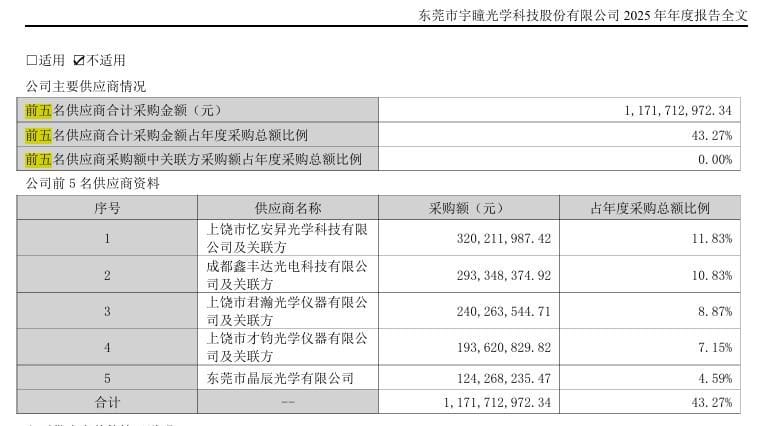
A review of Yutong Optics' 2025 annual report data shows that among its disclosed top five suppliers, the fourth-largest supplier was Shangrao Caijun Optical Instrument Co., Ltd. and its affiliates, with purchases of 193.62 million yuan, accounting for 7.15%; the fourth-largest supplier was Dongguan Jingchen Optical Co., Ltd., with purchases of 124.3 million yuan, accounting for 4.59%. There is no 189.2 million yuan from Jinding Optics. The two sets of figures constitute a mismatch between purchases and sales and a disclosure conflict, leaving it unclear which should be relied upon.
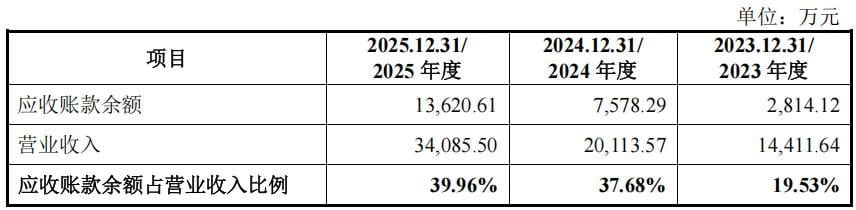
At the end of each period under review, the company's accounts receivable balances were 28.1412 million yuan, 75.7829 million yuan and 136.2 million yuan respectively, representing 19.53%, 37.68% and 39.96% of operating revenue for the respective periods.
At the end of each period under review, the carrying value of the company's inventories was 43.7993 million yuan, 82.7365 million yuan and 194.4 million yuan respectively, representing 26.81%, 26.88% and 29.20% of total assets, a relatively high proportion; at the end of each period under review, the company's inventory write-down provisions were 5.7894 million yuan, 6.8211 million yuan and 6.8498 million yuan respectively.
Under the registration-based IPO system, IPO applicants should pay even greater attention to disclosure quality. Whether their operating metrics meet listing requirements and their subsequent sustainable operations cannot all be addressed here due to space limitations. Everything in this article comes from source materials and is intended only by Quan Heng Cai Jing iqhcj to alert investors and other stakeholders to corporate risks they should focus on; it is not a comprehensive reference. Investors are advised to review the IPO applicant's complete prospectus when making decisions.
Original title : Jinding Optics sees frequent equity changes and high customer concentration, with purchase and sales figures conflicting with those of Yutong Optics
Source: OFweek Optics Network · News · optics.ofweek.com