Wen Ku: AI Drives Fiber Optic Cable Demand, Calls for Price Negotiation and Rational Capacity Expansion
Topics and contents
Topic
On this page
Speaking at the Global Optical Fiber and Cable Conference, Wen Ku said AI, computing power and data centers are reshaping fiber optic cable demand, and urged upstream and downstream players to establish long-term price negotiation mechanisms and expand capacity rationally. He noted that global fiber demand grew 4.1% in 2025, with data communications and data center-related demand up 76%, while expanding optical fiber preform capacity takes two years. Wen Ku warned that high prices could trigger a concentrated release of new capacity, recommending more long-term contracts and navigating price cycles through low-latency, low-loss, high-density technologies and diversified applications.
Links AI-driven changes in fiber demand to the preform capacity expansion cycle and price mismatches, providing industry context for why the current boom carries risks of overcapacity.
C114 News, October 19 midday report (by Jiang Junmu): The 2026 Global Optical Fiber and Cable Conference opened today in Wuhan, China Optics Valley. In his opening remarks, Wen Ku, chairman of the China Communications Standards Association, said the growth logic of the optical fiber and cable industry is shifting. For decades, growth was driven by telecom networks, from long-haul backbones to fiber-to-the-home and then 5G. Today, artificial intelligence, computing power and data centers are pushing the industry into the spotlight. Demand is changing, specifications are changing and the pace is changing. The industry must capture the current upswing while also leaving room to maneuver three years from now.
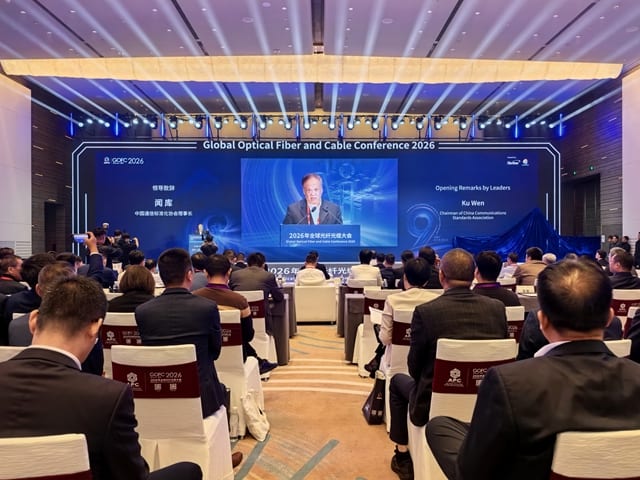
"This is a special year, marking the 50th anniversary of China's first optical fiber," Wen Ku said. He noted that recent conversations with many business leaders yielded a shared impression: business has been exceptionally good this year, but the winds driving it have changed. Global optical fiber demand grew 4.1% in 2025, with data communications and data center-related demand up 76%. Some institutions forecast that data center internal and interconnect applications will account for more than 30% of optical fiber demand by 2027, up from 5%, as data centers gradually replace carriers as the most important buyers of optical fiber.
Specifications are changing too. He summarized the shift with three "the more, the better" phrases: in the past, good enough was fine; now faster is better, thinner is better and more efficient is better. Tens of thousands of cards train collaboratively, with card-to-card and rack-to-rack connections relying entirely on optics, driving demand for multimode fiber, ultra-low-loss G.654.1 and bend-insensitive G.657.A2. The pace is also changing. Previously, orders followed carriers' predictable annual centralized procurement. Now cloud providers come directly to sign contracts. Internationally, one company has signed a five-year contract worth US$6.5 billion, and another plans to deploy 15,000 km of hollow-core fiber within two years. Many domestic companies have orders booked through 2028. "In short, the market has shifted from following carriers to following computing power."
Domestic demand is shifting from "fiber to the village" to "fiber to computing power." Wen Ku acknowledged that the traditional domestic communications market has indeed entered a mature stage. As of the end of August this year, the country had nearly 1.2 billion fiber access ports, accounting for 96.7% of broadband access ports, with fiber reaching virtually every village - a remarkable achievement. However, there is little room left for growth into villages and homes. New growth mainly comes from three areas. First, AI and data centers are the biggest source of incremental demand. East Data West Computing has entered full-scale construction, and the national integrated computing power network has been included in major national projects; of the six networks, the communications network and the computing power network are the main battlegrounds for growth. Second, the shift from copper to optical inside data centers has become unprecedentedly urgent in the AI era. As cluster bandwidth and density rise, copper cables struggle to meet the demands of the 1.6T era in speed, power consumption, heat dissipation and cabling density. Optical modules, active optical cables, high-density connectors and in-rack cabling "may all have to be redone." Third, cars are becoming "data centers on wheels." In-vehicle data volumes are multiplying, while traditional cable constraints are becoming more expensive and taking up more space. Fiber is light, resistant to electromagnetic interference and offers high bandwidth, making it naturally suited to vehicles. Although the current volume is still small, it could be the most promising growth market of the next decade.
The challenges are equally clear. Three issues stand out. First, supply cannot keep up: as a critical link in the industry chain, optical fiber preform capacity expansion takes two years. Second, upstream and downstream prices are misaligned: spot prices have surged while centralized procurement price caps have struggled to keep pace, and one major centralized procurement project failed at its first tender this year before closing only after prices were raised. Third, the trade environment remains uncertain, with anti-dumping actions, export controls and supply chain de-risking measures continuing. Three risks warrant vigilance over the long term. First, will a new round of overcapacity emerge? When prices are high, capital rushes in from all sides, and capacity comes online en masse two or three years later, sending prices into a cliff-edge drop. "We have been through more than one such cycle. We must capture today's upswing while leaving ourselves an out three years from now." Second, can the high end be defended? China ranks first worldwide in conventional optical fiber capacity, but gaps remain in hollow-core fiber, high-end optical components, specialty materials and core equipment. Third, can the industry hold its ground on the international stage? Standards, patents and industry rules are the real moat.
Where should breakthroughs come from? Wen Ku argues that the technology must move toward "three more's": lower latency, lower loss and higher density. Hollow-core fiber is the most promising bet right now, cutting latency by more than 30 percent and pushing loss beyond the physical limits of conventional fiber. This year, the lowest attenuation achieved domestically reached 0.04dB per kilometer, with cumulative deliveries exceeding 10,000 kilometers. Procurement of fiber and cable for the Guangdong hub has been completed, and the cross-border commercial link from Dongguan to Hong Kong achieves 0.93 milliseconds, as the technology moves from pilots toward large-scale commercial deployment. The next step is to address cost, splicing processes, reliability and standards. On the application side, the industry must look beyond telecom operators and data centers. Individual segments such as smart grids, rail transit, offshore wind power, deep-sea observation, fiber-optic sensing, healthcare, lasers and automotive are each small, but together they add up to a sizable market. "Putting all your eggs in one basket is the biggest risk for this industry." On the ecosystem and external environment, coordination and resilience are essential. Wen Ku calls for longer-term price negotiation mechanisms across the upstream and downstream supply chain, rational capacity expansion, greater responsibility from leading companies and standards that lead the way. Externally, exports are growing rapidly and these markets should be valued; the path of openness and cooperation must not change. At the same time, backup supplies are needed for critical raw materials and key equipment, and overseas markets should be diversified.
The hottest word this year is price increases. Mainstream single-mode fiber has risen several-fold in a year, and bend-insensitive specialty fiber has climbed even more. In the first half, fiber industry profit grew more than fourfold year on year. Wen Ku said this round of increases has a real foundation: it is the spark produced by the explosion of AI computing demand colliding with supply constraints. It is not speculation, but a correction of the excessive involution and low-price competition of recent years. But increases that are too fast and too steep will inevitably have side effects. Higher network construction costs downstream will in turn suppress demand. More troubling, high prices will strongly stimulate new capacity, planting the seeds of the next glut. "What we want is sustainable, reasonable returns, not one-off windfall profits."
What should be done? He offered four words: rationality, meaning no price wars, no chasing rallies and selling into declines, and no blind capacity expansion; coordination, with upstream and downstream players establishing a transparent price communication mechanism; the long term, signing more long-term contracts and doing more capacity planning to smooth out volatility; and innovation, the most fundamental point of all. "What truly enables a company to ride through price cycles is not price increases, but products that others cannot make."
Fifty years ago, a single optical fiber opened the curtain on a new era. Today, artificial intelligence is pushing the industry to a new starting point. At the close of his speech, Wen Ku said this industry has never lacked cycles; what it lacks is the ability to get through them. Only by sticking to innovation-driven development, open cooperation, and a rational, pragmatic approach can the industry become more stable, stronger, and longer-lasting. For the optical fiber and cable industry, now caught between prosperity and hidden concerns, this may be worth deeper reflection than any short-term price increase.

Source: C114 Communications Network · Optical Communications · c114.com.cn