Hesai Launches Kosmo, Extending from LiDAR to Robot Joints and Physical AI Infrastructure
从激光雷达到机器人关节:禾赛为什么要做物理 AI 的基础设施?
Topics and contents
Topic
On this page
Hesai held the global launch of Kosmo at its Maxwell super factory in Shanghai on October 14, unveiling a 3D world data engine and disclosing that it has entered robotic motion modules and begun commercial deliveries. Li Yifan said that LiDAR units that once sold for more than RMB 300,000 can now be produced for around USD 200, with one unit rolling off the line every five to six seconds.
On October 14, Hesai held the Kosmo global launch event at its Maxwell super factory in Shanghai. Beyond the newly unveiled 3D world data engine, Li Yifan said in his speech that Hesai has entered the robotics motion module market and has begun commercial deliveries.
The company that grew up on automotive LiDAR is now cutting into robotics perception, spatial data and actuation systems at the same time.
1) From a LiDAR system with a 10-minute lifespan to the underlying hardware for robots
The launch event opened with a joke Li Yifan told from ten years ago.
In October 2016, Hesai attended the China International Industry Fair for the first time, where the automation of its super factory had already reached a very high level. Li Yifan said that a LiDAR unit that sold for more than RMB 300,000 back then can now be produced for around $200; the production takt time has gone from hand assembly to one unit rolling off the line every five or six seconds.
This experience underscores the very precondition that allows Hesai to enter the robotics industry with confidence today: taking complex hardware from the lab to million-unit-scale manufacturing.
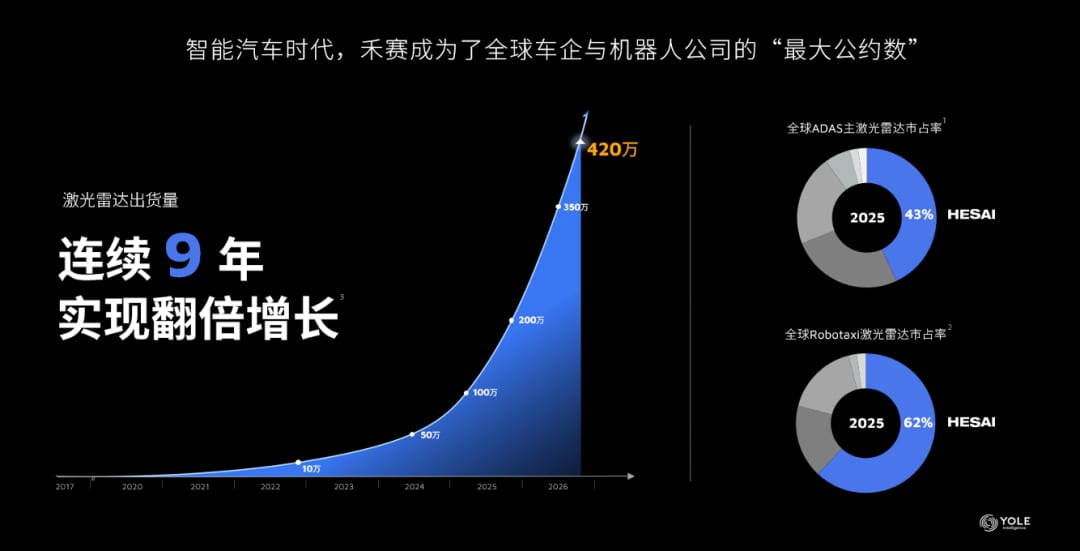
In 2025, Hesai reported revenue of RMB 3.028 billion, net profit of RMB 436 million, and a gross margin of 41.8%. Full-year LiDAR shipments totaled 1.6204 million units, of which 239,300 were robotics LiDAR. By the first half of 2026, robotics LiDAR shipments climbed further to 260,700 units, surpassing the full-year total of the previous year in just six months.
The automotive business continues to supply the main revenue and manufacturing scale.
Hesai's JT series LiDAR for robots has entered the embodied AI supply chains of Unitree, X Square Robot and Galbot. According to the company's Q2 2026 disclosure, the JT128 has been adopted by more than 50 embodied AI companies worldwide.
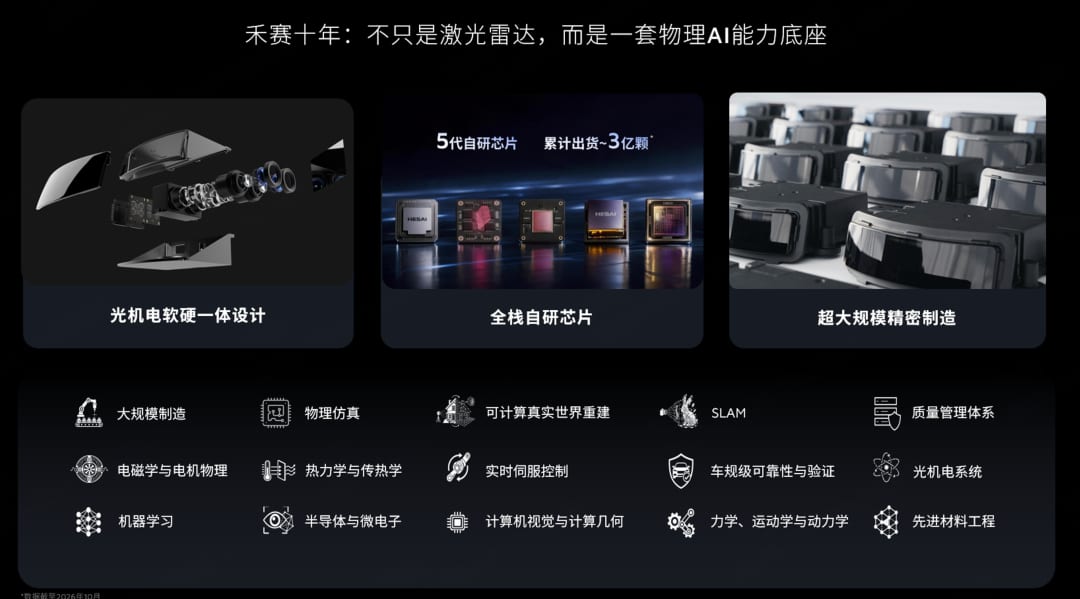
These are still Hesai's core business: sensors. At the event, Yifan Li posed a bigger question: do the capabilities Hesai has built up over the years belong to LiDAR, or to that complex opto-mechanical, electrical and semiconductor system?
This question will determine where Hesai heads over the next decade.
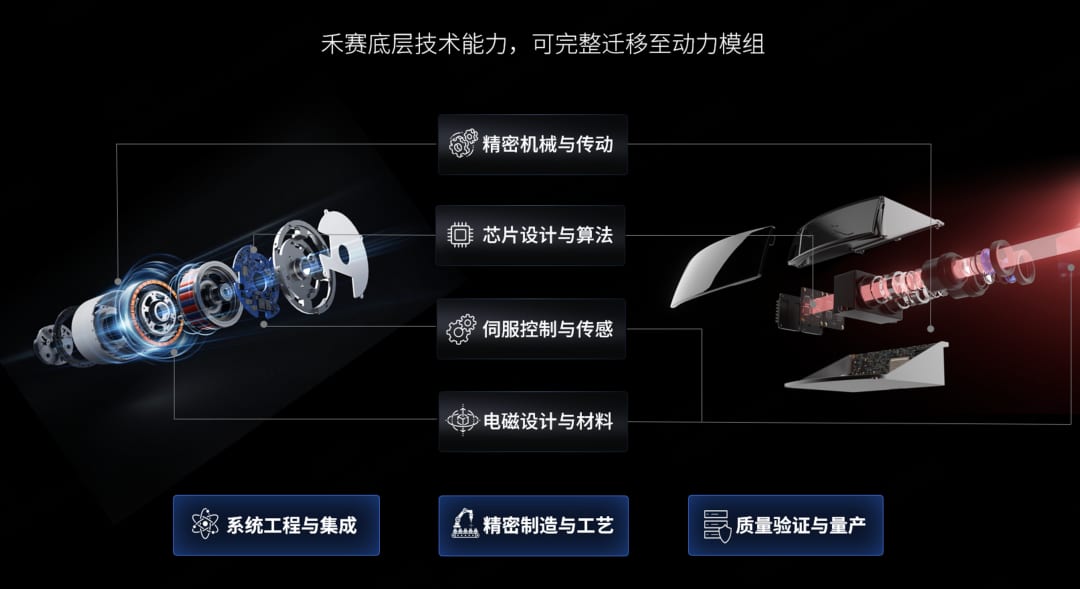
At its core, LiDAR competitiveness comes down to precision mechanics, motor drives, optical systems, application-specific chips, reliability testing and automated manufacturing. Automotive-grade products also require suppliers to hold consistency over the long term, keeping cost, yield, failure rates and delivery capability within reasonable bounds.
What robot joints need is this same set of capabilities, just with a different mix of technologies. Hesai's view is that this engineering expertise can be transferred to robot motion modules.

2) Why are robot joints worth Hesai's investment?
Li Yifan said in his speech that robotic motion systems could become one of the highest-value components in future complete hardware systems.
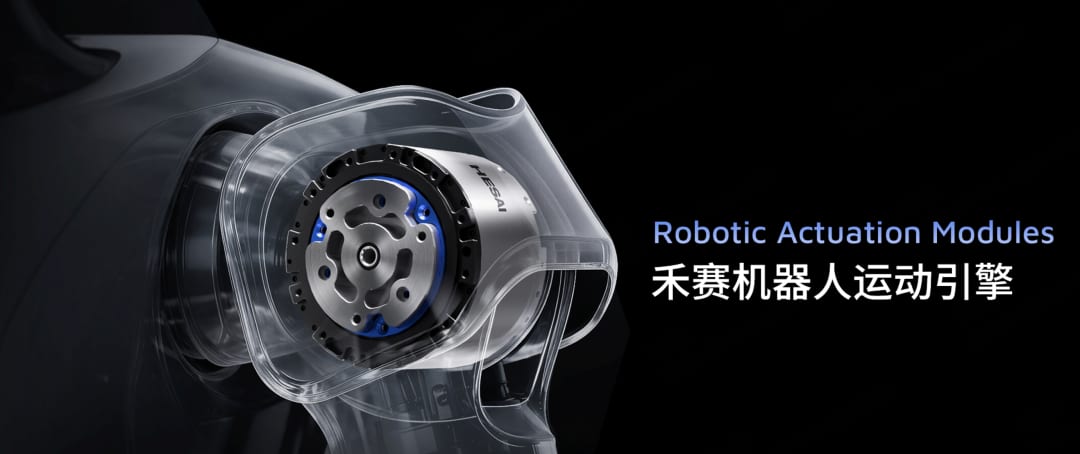
In a complex humanoid robot, roughly half the bill of materials is tied up in the joints. So why does Hesai think it can pull this off? For humanoids that combine agile locomotion with dexterous manipulation, joints are the biggest cost driver. Every joint must deliver drive force, speed, position control, transmission efficiency, compact size and low weight. High-end dexterous hands must also pack a large number of drive units into a limited space.
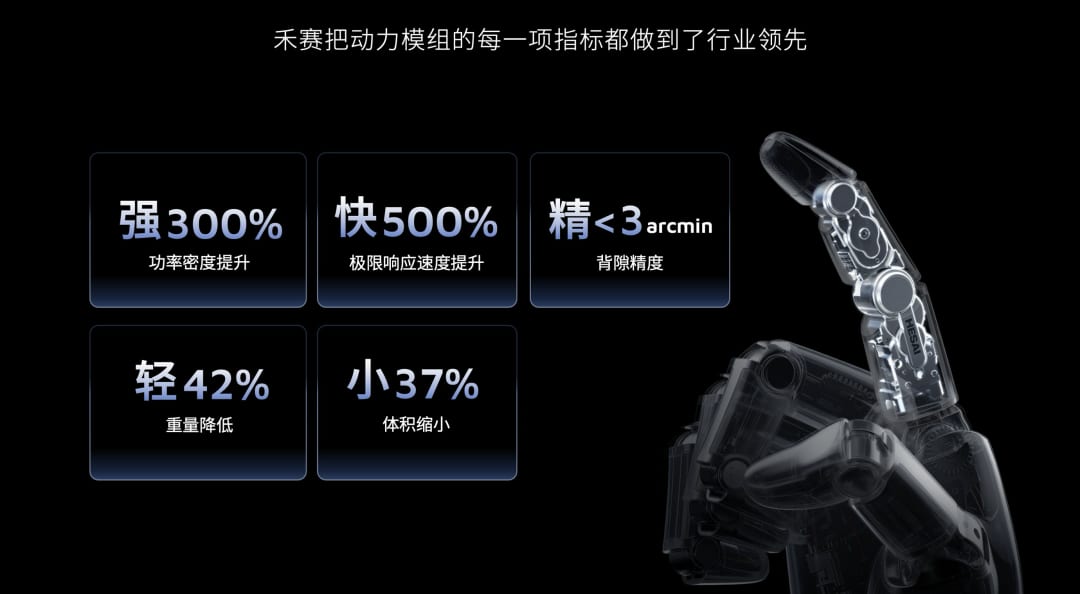
Hesai's new-generation motion module delivers roughly three times the torque density and power density of the industry benchmark it selected, with a 37% reduction in volume and transmission efficiency above 95%. On-site figures also highlighted a 42% weight reduction and angular control accuracy better than 3 arcminutes.
A heavier robotic arm means the shoulder joint needs more torque; a heavier shoulder joint in turn adds load to the torso and legs. Weight propagates up the kinematic chain, ultimately burdening the battery, chassis, stability and runtime.
Lighter weight can take the load off the entire motion system. Smaller joints also free up space for sensors, cabling, heat dissipation and the internal mechanisms of dexterous hands.
Joints must handle continuous output torque, frequent reversals, impact loads, gear wear, thermal management and long-term control stability. Dexterous hands also need to be back-drivable, so external forces can be transmitted back to the drive system without making the mechanics overly stiff. For joints, look beyond peak power and static accuracy to sustained torque, efficiency curves, temperature rise, backlash, service life and fail-safe behavior.
Hesai can bring its automotive-grade manufacturing expertise to the table. But long-term engineering validation of robotic execution systems will take more time.
Judging by its progress, Hesai has moved beyond the pure R&D stage.
By the end of Q2 2026, the company had delivered more than 10,000 robot motion modules cumulatively. Dedicated production lines are now running, and applications are expanding from dexterous hands to full-body joints. The company expects motion module shipments to reach the 100,000 level in 2027.
Another player at this launch event cannot be overlooked: Sharpa. Hesai's three founders are also Sharpa's founders. The two companies have formed a tightly coupled feedback loop in technology R&D.
Sharpa focuses on the robot body, manipulation models and application scenarios, and can spot joint problems from whole-machine use; Hesai optimizes around power, size, precision and manufacturing processes.

This speeds up the feedback loop in product development.
In the typical model, a robotics company sets requirements for multiple suppliers, and the suppliers develop to the spec sheet. But in the early days of embodied AI, many requirements are still being explored. Mechanical design affects the control algorithms, which in turn force changes to the mechanical design.
If the joint team and the robotics team could frequently exchange experimental results, many problems could be identified early.
The Sharpa Wave dexterous hand is one example of collaboration between the two sides.
Hesai supplies motion components through dedicated drives, precision transmission and modular manufacturing; Sharpa develops control and learning systems around operating tasks. This approach reflects the value of hardware and AI models iterating together.
At the DQ store on Wujiang Road in Shanghai, Sharpa carried out commercial validation of the ice cream preparation task. According to the launch event, the robot operates more than 12 hours a day, completing a continuous process of over 50 steps and executing the designated workflow autonomously without teleoperation.
Making ice cream requires identifying containers, gathering ingredients, operating equipment, and completing preparation and delivery. The actions form a long chain of dependencies, and if any link breaks, the entire task fails.
According to documents Hesai filed with regulators, transactions between the two sides totaled about 42 million yuan from March 25 to June 30, 2026. In late July, Hesai raised the annual cap on related-party transactions from 100 million yuan to 300 million yuan, covering LiDAR, robotic motion modules and manufacturing support services.
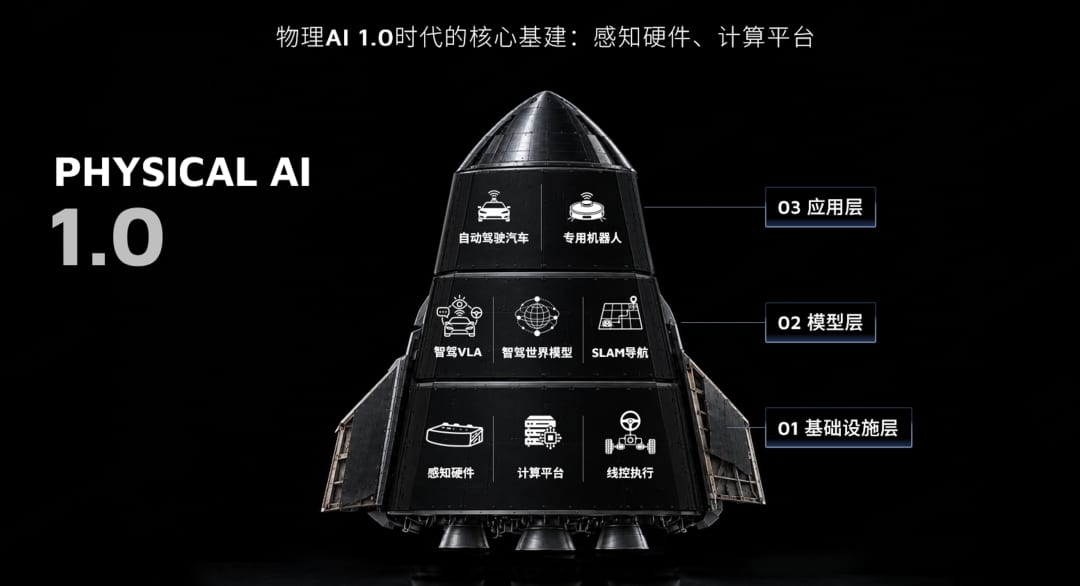
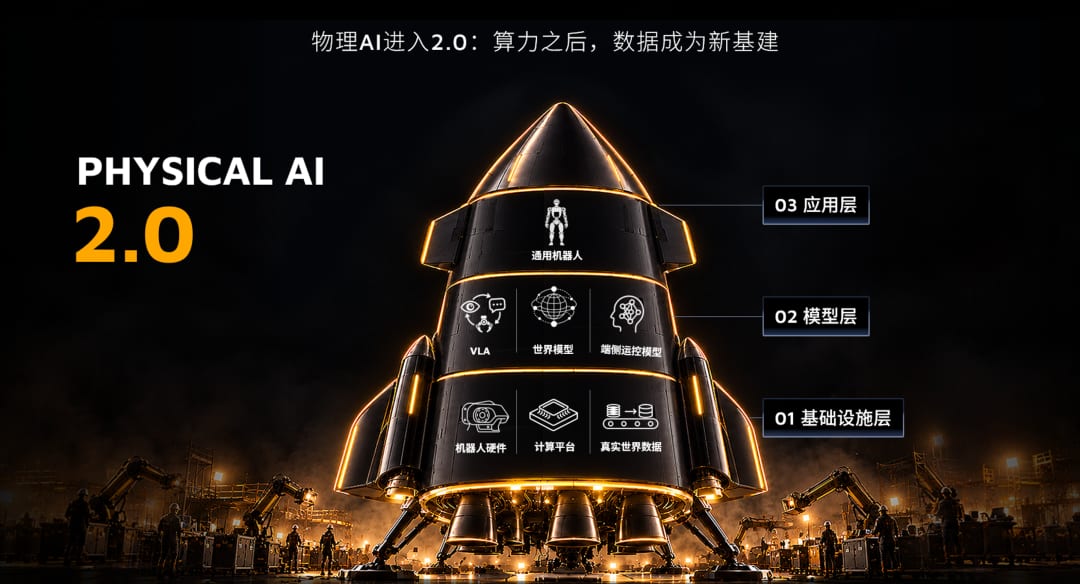
This time, Li Yifan has positioned Hesai as a physical AI infrastructure provider.
Who builds the complete robot, who develops the control models — multiple technology routes may emerge. Hesai has chosen to prioritize investing in the underlying systems broadly needed across the industry.
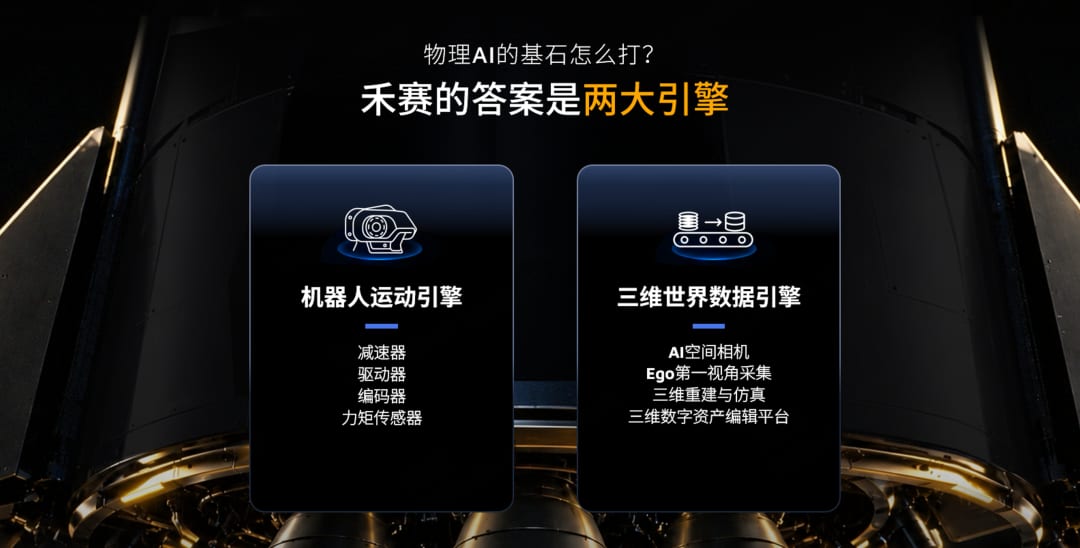
Three business lines have taken shape: LiDAR handles 3D perception, Kosmo handles real-world scene capture and spatial data processing, and the robot motion module handles motion execution.
LiDAR is a mature business built on hardware procurement and volume production design wins; motion modules likewise rely on hardware delivery, but joint specifications, reliability and cost structures must be established step by step. Kosmo has the opportunity to grow data processing, software services and scenario asset revenue on top of its space cameras.
Hesai has already written the commercial targets for its new business into its financial guidance.
In its Q2 2026 earnings report, the company raised its full-year revenue guidance for its strategic growth business to RMB 200 million to RMB 300 million, and expects revenue from the business to reach about US$100 million in 2027 while achieving break-even.
Hesai's existing LiDAR business is already profitable and generating cash flow. A gross margin above 40% in 2025 leaves room for R&D investment in new businesses.
Conclusion
In 2016, Hesai kept repairing a LiDAR unit that could only run continuously for 10 minutes.
A decade later, it could organize manufacturing at a scale of millions of units shipped per year.
The bottleneck in robotics today resembles the early days of LiDAR: the products can be built, but making them light, compact, reliable, mass-producible and reasonably priced is another matter.
Hesai is entering this industry by starting with robot joints and 3D world data!
Original title: From LiDAR to Robot Joints: Why Is Hesai Building Infrastructure for Physical AI?
Source: OFweek Laser Network · News · laser.ofweek.com