Eoptolink's Zhang Jinshuang: Pluggable Optical Modules Remain the Absolute Mainstay
新易盛张金双:高速光互连多种技术路径共存 可插拔光模块仍是绝对主力
Topics and contents
Eoptolink's Zhang Jinshuang told the CIOE forum that multiple high-speed optical interconnect technology paths will coexist, with pluggable optical modules remaining the absolute mainstay.
C114 News, September 17 — The 27th China International Optoelectronic Exposition (CIOE) was successfully held at the Shenzhen World Exhibition & Convention Center last week. At the concurrent "AI Computing Cluster Optical Interconnect Technology Development Forum," Zhang Jinshuang, Director of Business Development and Deputy General Manager of Commercial Affairs at Eoptolink Technology, delivered a keynote titled "Traveling with Light: Unlocking the Potential of AI Computing Power."
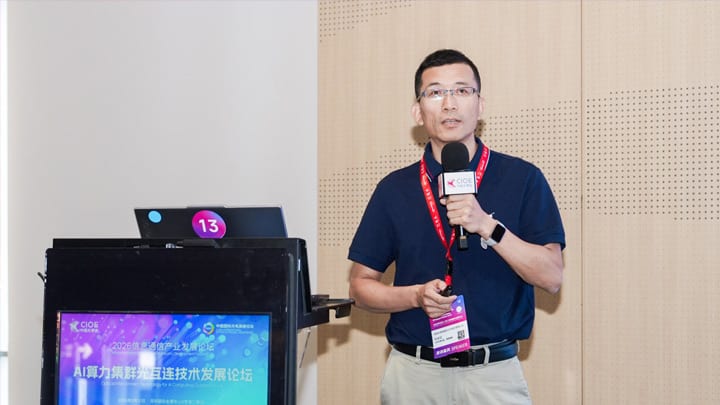
Zhang noted that AI technology has evolved rapidly since 2022, moving quickly from traditional chatbots to AI agents. This year has even been dubbed the "Year of the Agent" by the industry, with AI increasingly being deployed deeply in physical world models, steadily expanding the depth and breadth of real-world adoption. Large AI models are iterating at an accelerating pace, with vendors frequently releasing new product versions that continuously improve operating efficiency and user experience. Their core value lies in empowering industries across the board and boosting social productivity.
He cited a biopharmaceutical case as evidence: Moderna, in collaboration with Merck, leveraged advanced AI algorithms to screen neoantigens with high immune-killing potency in just a few hours, dramatically compressing a drug development cycle that once took decades and achieving a breakthrough in customized vaccine development. This demonstrates the core value of AI in empowering real-world industries and lays the industrial foundation for continued upgrades to computing infrastructure.
Large-scale AI adoption is directly fueling a global investment boom in computing infrastructure. Reviewing AI industry investment data for China and the United States, Zhang noted that leading companies in both countries steadily increased AI investment in 2024-2025, and industry institutions forecast continued steady growth in 2026. North America has a more mature computing infrastructure build-out and leads the world in investment volume. Meanwhile, AI clusters are trending toward gigawatt-scale development. Leading players such as Meta are expanding computing capacity at a rapid pace, planning to scale from 128-GPU clusters in 2023 to future ultra-large clusters of up to one million GPUs. These high-density, high-power, ultra-large computing clusters place stringent new demands on the bandwidth, latency, reliability and energy efficiency of underlying optical interconnects, continuously driving demand for high-speed optical modules.
On the evolution of AI computing interconnect architectures, Zhang detailed the dual expansion logic of vertical (Scale-up) and horizontal (Scale-out) scaling. GPU iteration is accelerating, breaking the previous two-year generational cycle. Vendors including Google, Amazon, Meta and AMD continue to roll out high-performance GPU/xPU chips, substantially boosting per-card computing power. However, single-chip performance can no longer meet the demands of large model training and inference, making computing interconnects a key breakthrough point. Vertical interconnects rely on protocols such as NVLink to build computing nodes from multiple GPUs/xPUs, emphasizing low-latency, highly reliable transmission. Once per-lane speeds exceeded 448G, the bottlenecks of traditional copper transmission became pronounced, rapidly releasing demand for optical interconnect substitution. Horizontal interconnects focus on cross-cluster scaling of super nodes and represent the core application scenario for pluggable optical modules, while capacity expansion across physical sites further broadens the market for high-speed optical interconnects. Whether in Scale-up, Scale-out or Scale-across scenarios, high-performance network protocols and high-quality physical-layer optical modules are essential.
Based on industry iteration trends, Zhang forecast broad growth potential for the optical module market. According to industry projections, the global Ethernet optical module market will exceed $80 billion in 2031, with AI applications accounting for more than 80% and reaching over $65 billion. The top five North American cloud providers are leading AI infrastructure build-out and remain the core driver of demand for AI optical modules.
Zhang Jinshuang focused on three high-speed optical interconnect technology iteration paths currently shaping the industry. The first is the "fast but narrow" route, which raises the per-lane rate to 400G and integrates eight lanes to deliver next-generation 3.2T optical modules. The second is the "fast but wide" route, represented by the XPO solution, which integrates 64 lanes at 200G per lane for up to 12.8T of bandwidth per module, scalable beyond 25.6T after iteration to suit ultra-high-bandwidth computing scenarios. The third is the "slow but wide" route, which integrates more lanes to achieve low-power, high-rate transmission. A typical example is the MicroLED solution, which uses 400 lanes at a 4G per-lane rate to deliver 1.6T of bandwidth, making it a hot area of innovation in the industry. At the optical component level, the industry has developed single-lane 400G modulators based on thin-film lithium niobate and indium phosphide, while novel modulation approaches such as silicon photonics and organic materials continue to make breakthroughs.
On the competitive landscape of the industry's diverse technology roadmaps, Zhang Jinshuang noted that pluggable optical modules remain the dominant market choice, with core advantages in ease of operation and maintenance and a mature ecosystem. Co-packaged solutions such as NPO and CPO, the low-power LPO solution, and the highly integrated XPO solution each have their own strengths and weaknesses and suit different computing network scenarios. Going forward, the industry will see multiple technology roadmaps coexist over the long term, with selection driven by specific needs; there is no industry trend of a single technology fully replacing the others.
Finally, Zhang Jinshuang outlined Eoptolink's technology strategy and industry achievements. As a leading domestic optical module maker, Eoptolink operates dual production bases in Chengdu and Thailand, with more than 16,000 employees and an R&D team of over 1,000, giving it strong technical and production capacity. The company was the first to complete a multi-path technology roadmap, launching the industry's first 1.6T DR4 product in module form with a single-wavelength 400G optical path, paving the way early for 3.2T pluggable optical module technology. It also achieved the industry's first release of 32-channel NPO and 12.8T XPO solutions, and launched an OCS product based on its proprietary MEMS patented technology, comprehensively empowering high-quality development of AI computing infrastructure. 
Source: C114 Communications Network · Optical Communications · c114.com.cn