SIOM Makes Progress in High-Resolution Dual-Comb Spectral Detection
上海光机所在高分辨双光梳光谱探测技术领域取得新进展
Topics and contents
The Shanghai Institute of Optics and Fine Mechanics (SIOM) has made new progress in high-resolution dual-comb spectral detection technology.
The original text provides specific data and details that help assess actual progress in this direction
Excellent Innovation Center for Ultra-Intense Laser Science Briefing
(Issue 809)
July 31, 2026
SIOM Makes New Progress inHigh-Resolution Dual-Comb Spectroscopy Detection Technology

Recently, the team led by Researcher Zhou Jiaqi at the Shanghai Institute of Optics and Fine Mechanics, Chinese Academy of Sciences, made new progress in high-resolution dual-comb spectroscopy detection technology. The related findings were published in Optics and Laser Technology under the title “Probing High-Resolution Spectra with Scanning Raman Gain Modulated Dual-Comb Spectroscopy”.
Dual-comb spectroscopy has become a highly promising precision spectroscopy measurement technique thanks to its outstanding advantages of broad spectral coverage, high spectral resolution, high sensitivity and rapid acquisition. However, the resolution of conventional dual-comb spectroscopy is directly limited by the repetition rate of the optical frequency comb. Mode-locked laser frequency combs typically have repetition rates on the order of tens to hundreds of MHz, making it difficult for their spectral resolution to meet the demands of low-pressure and cold-atom spectroscopy, isotope analysis and fine-structure resolution. Lowering the repetition rate to pursue higher resolution would severely narrow the detected spectral coverage, complicate the system architecture and degrade noise performance, making it hard to achieve both broad spectral coverage and high resolution.
To address this, the team used Raman-gain-modulated dual-comb spectroscopy based on single-frequency seed injection. Applying stepwise frequency tuning to the single-frequency laser drives all comb teeth to scan synchronously, gradually filling the spectral gaps between teeth so that spectral resolution is no longer limited by the original repetition rate. Because an optical frequency comb consists of thousands of longitudinal optical modes, the tuning of the single-frequency laser does not require precise control during scanning. The entire system uses all-polarization-maintaining fiber components, making it compact and environmentally robust. The system principle is shown in Figure 1.
The team applied the system to carbon dioxide absorption spectroscopy. Through 27 frequency scans, the system automatically retrieved and stitched the high-resolution spectral information within minutes, achieving a spectral resolution of ~3.8 MHz over a ~776 GHz bandwidth, with a signal-to-noise ratio of 36 dB. The resulting high-precision absorption lines agree closely with theoretical predictions (Figure 2). The entire measurement and retrieval process requires no post-processing correction algorithms, and the optical frequency comb needs no additional electronic locking.
This approach effectively removes the trade-off between spectral coverage and resolution in conventional dual-comb systems, raising resolution to the MHz level while maintaining broad spectral coverage, without relying on complex active stabilization or algorithmic compensation. Its simple structure, on-demand tunable resolution, and strong tolerance to external disturbances offer a new technical route for frontier applications demanding extremely high spectral resolution.This work was supported by the National Key R&D Program of China, the National Natural Science Foundation of China, the International Partnership Program of the Chinese Academy of Sciences, and the Shanghai Science and Technology Innovation Action Plan.
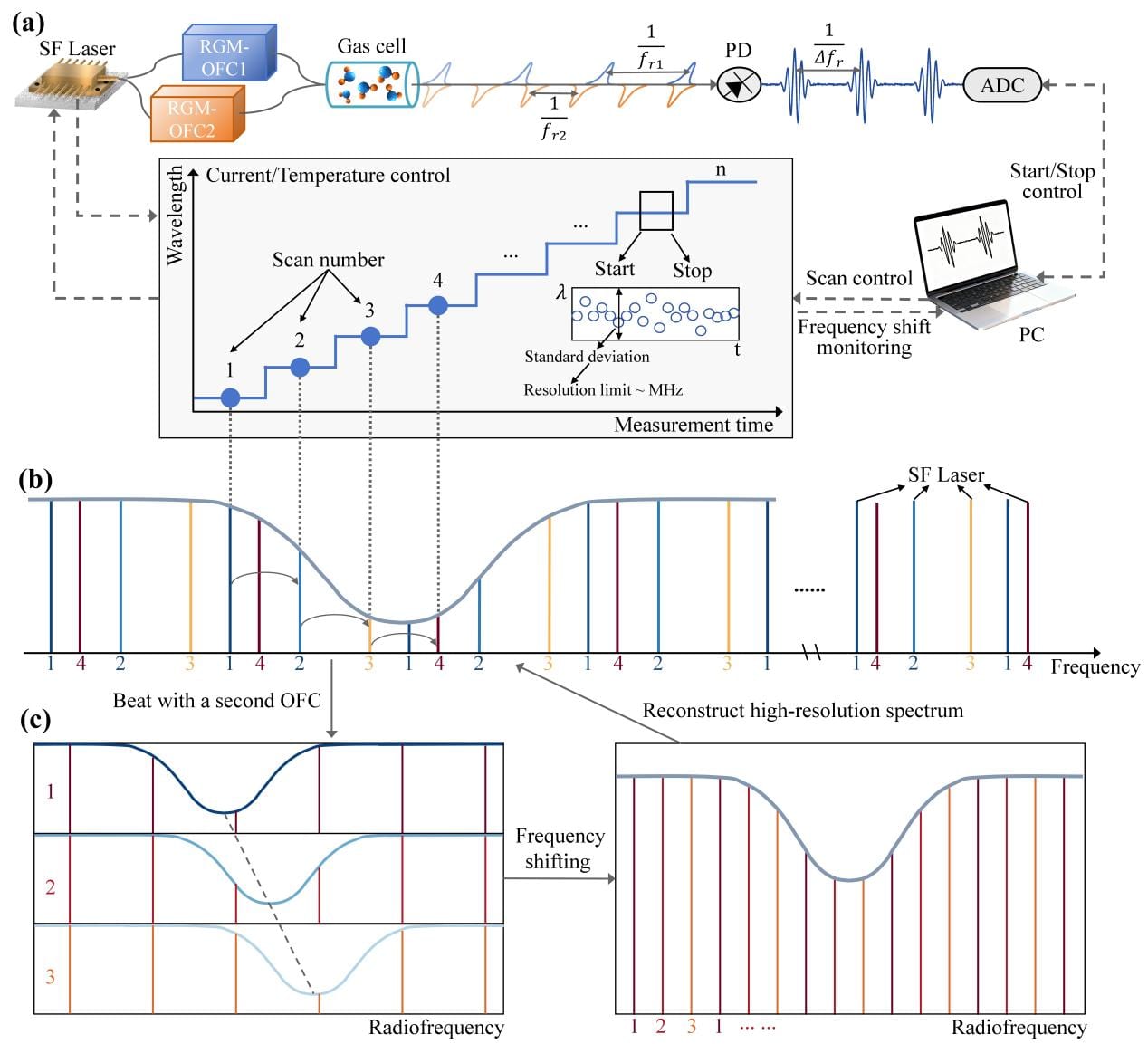
(Figure 1: Principle of swept high-resolution Raman-gain-modulated dual-comb spectroscopy.(a) Time-domain diagram of the system's scanning procedure.(b) Principle of spectral scanning detection.(c) RF spectral signal and high-resolution spectral recovery process.)
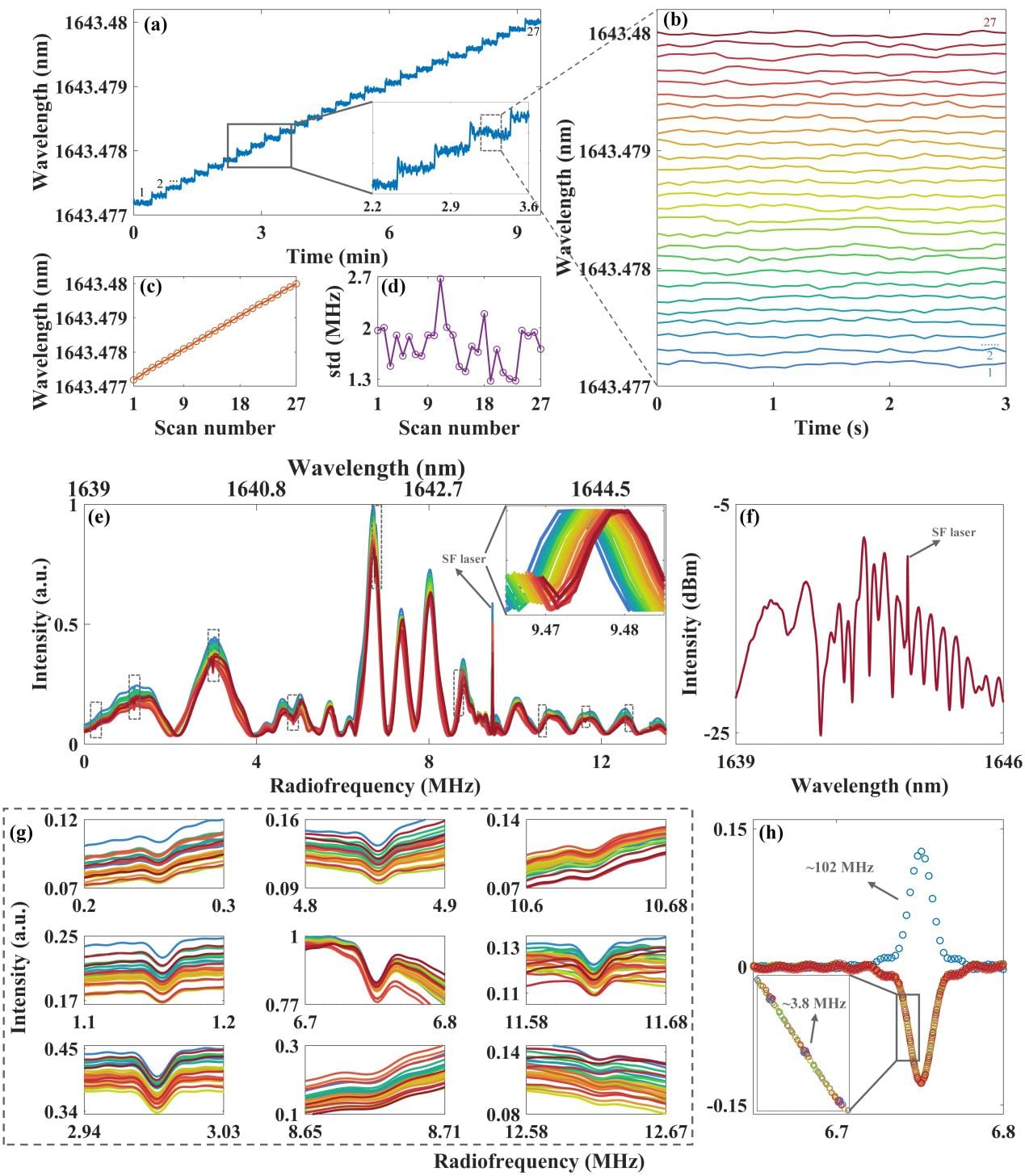
(Figure 2:27 sets of scanning detection results.(a) Stepwise scanning data recorded by the wavemeter.(b)27 Wavelength fluctuations during system data acquisition for the 27 sets.(c)27 Wavelength variations across the 27 scans.(d)27 Wavelength standard deviation of the 27 scans.(e) The 27 sets of dual-comb spectral data obtained.(f) Spectral data.(g) Multiple gas absorption lines detected.(h) Comparison of a single dual-comb spectral detection with the 27 sets of scanning detection results.)
Source: Shanghai Institute of Optics and Fine Mechanics (SIOM) · Research Updates · siom.cas.cn