Xi'an Institute of Optics and Mechanics Masters Full-Chain Technology for Mid- and Long-Wave Infrared Anti-Resonant Hollow-Core Fiber
Topics and contents
Guo Haitao's team at the Xi'an Institute of Optics and Mechanics has mastered key full-chain technologies for mid- and long-wave infrared anti-resonant hollow-core fiber.
The original text provides specific data and details that help assess actual progress in this direction.
Recently, a team led by researcher Guo Haitao and associate researchers Xu Yantao and Liu Chengzhen at the Xi'an Institute of Optics and Precision Mechanics (XIOPM), Chinese Academy of Sciences, achieved end-to-end breakthroughs in anti-resonant hollow-core fiber (AR-HCF) technology. The team developed tellurite and chalcogenide infrared anti-resonant hollow-core fibers with the lowest loss among comparable products worldwide, overcoming the key bottlenecks of high transmission loss and insufficient laser power handling in conventional fibers across the mid- to long-wave infrared bands. The advance will provide critical materials and technology support for laser power delivery, ultrafast photonics, precision medicine and other fields.
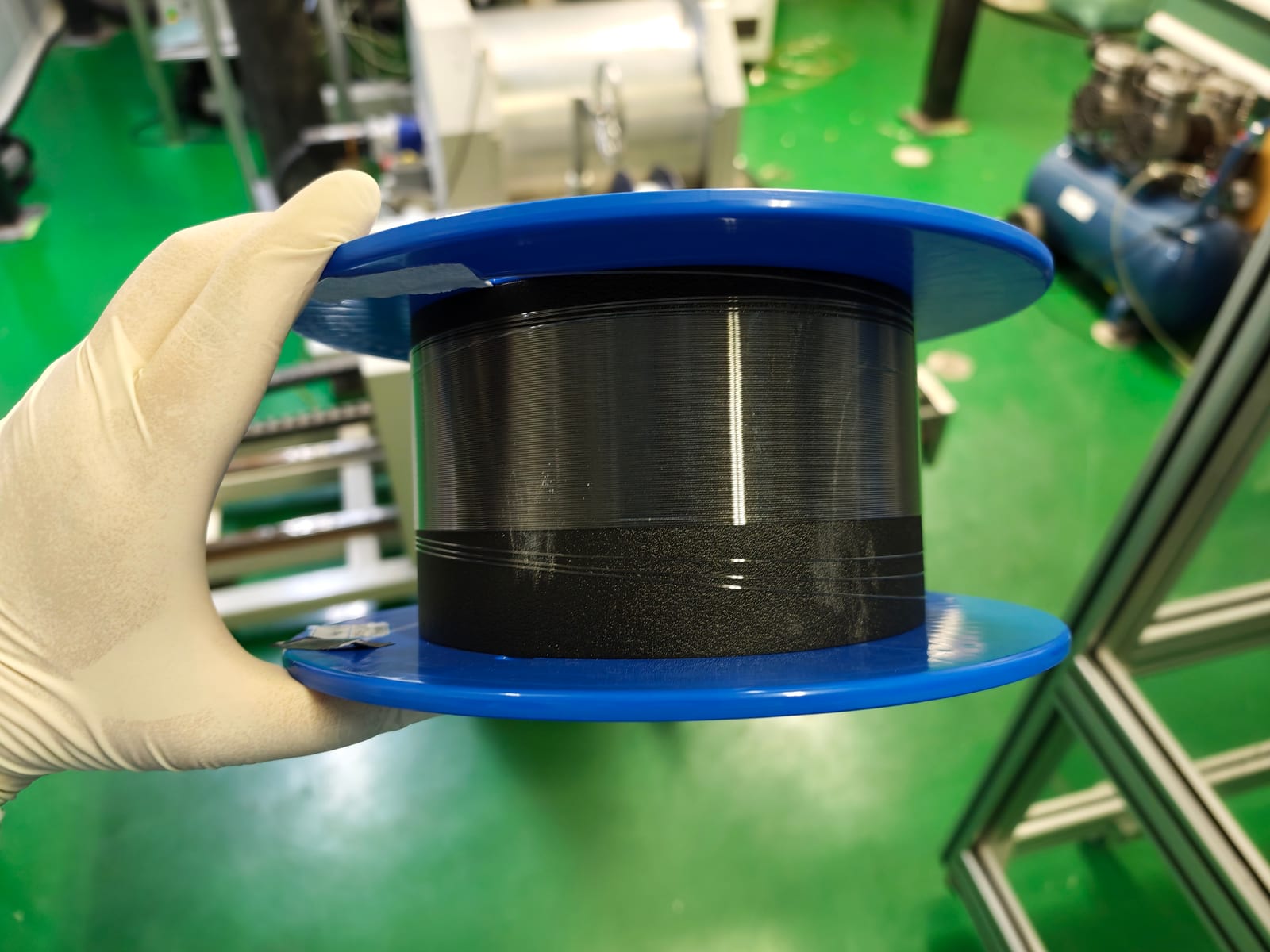
Figure Tellurite infrared anti-resonant hollow-core fiber
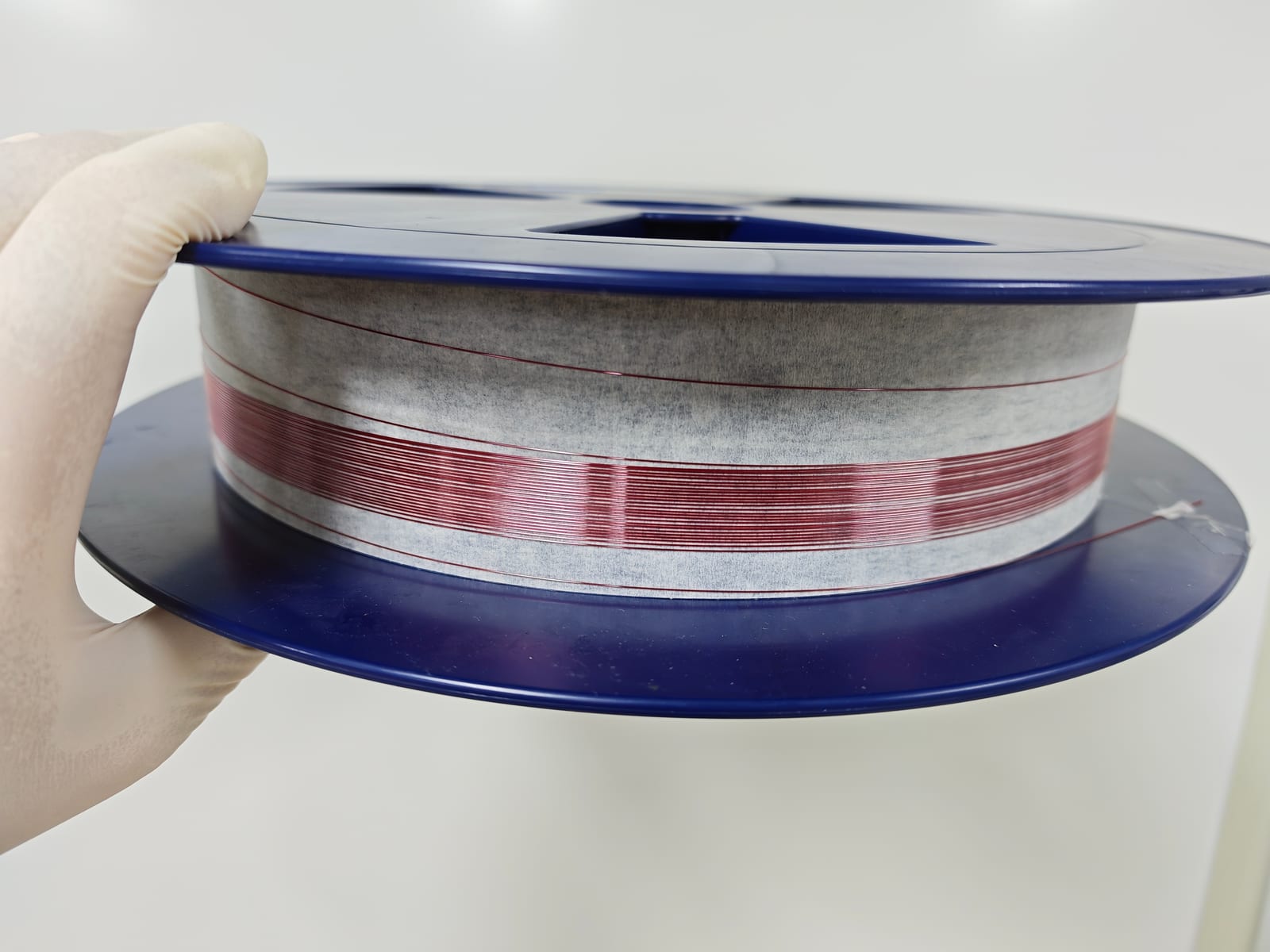
Figure Chalcogenide infrared anti-resonant hollow-core fiber
The related series of papers were published in journals including Light: Advanced Manufacturing, Ultrafast Science, Journal of Lightwave Technology, Optics Letters, Optics Express and Ceramics International.
The mid- to long-wave infrared band (3-15 μm) covers atmospheric transmission windows, strong water absorption bands and the concentration range of high-temperature thermal radiation, and is of great value for remote sensing, free-space laser communications, environmental monitoring, biomedicine and infrared optoelectronic countermeasures. Efficient transmission of mid- to long-wave infrared lasers has long been a bottleneck limiting development: conventional solid-core infrared glass fibers are constrained by intrinsic material properties, with drawbacks including high nonlinearity, low laser-induced damage thresholds and a narrow infrared transmission window. When transmitting high-power lasers, they are prone to pulse distortion, spectral broadening and other degradation, making high-power, high-fidelity flexible delivery difficult to achieve.
Infrared anti-resonant hollow-core fibers confine most of the laser light in an air core through the anti-resonance effect, offering inherent advantages such as low nonlinearity, low dispersion and a high damage threshold. They can suppress pulse distortion at its source and meet the demands of mid- to long-wave infrared laser transmission. However, the unusual temperature-viscosity behavior, surface tension and thermal expansion characteristics of infrared glasses pose major fabrication challenges, with difficult process control and hard-to-guarantee structural precision. Fiber loss from existing products in China and abroad remains high, far from meeting the requirements for efficient mid- to long-wave infrared laser power delivery.
Over several years, Guo Haitao's team achieved independent innovation across the entire chain, from material composition and structural design to fabrication processes and application validation, overcoming a series of key technical challenges.
01 Two new glass composition systems developed, breaking through the fiber-drawing bottleneck of infrared glass microstructured fibers
Infrared glass is the "cornerstone" for making infrared fibers, and its thermal and optical properties directly determine the final quality of the fiber. For years, the lack of high-performance infrared glass materials has been a core weakness limiting China's infrared fiber development.
The team independently developed two new material systems: TeO₂-BaF₂-La₂O₃-LaF₃ (TBLL) tellurite glass and Ga-As-Sb-S (GAGS) chalcogenide glass. Precise control of glass composition effectively improved the viscosity-temperature behavior, surface tension and thermal stability of the infrared glass materials, greatly enhancing structural controllability during fiber drawing and solving the material bottleneck of infrared glass microstructured fibers at the source.
02 New Fiber Structures Enable Low Loss, Large Mode Area and High Bending Resistance
The transmission performance of anti-resonant hollow-core fibers is determined by the microstructure of their cladding. The team proposed infrared AR-HCF structures including six-tube/seven-tube single-ring nodeless and five-tube nested nodeless designs, systematically revealing how fiber structural parameters govern confinement loss, bending loss and higher-order mode suppression.
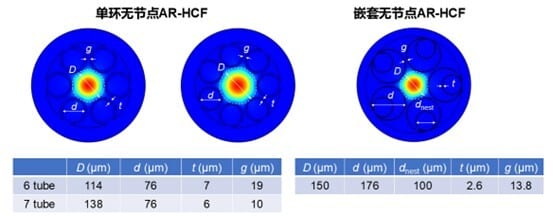
Figure: Design diagrams of infrared AR-HCF structures, including six-tube/seven-tube single-ring nodeless and five-tube nested nodeless configurations
By optimizing higher-order anti-resonant windows, the design greatly reduces fabrication difficulty while achieving low loss, large mode area, high beam quality and excellent bending resistance. The designed fiber transmission window covers 2–20μm, with theoretical loss as low as 0.001dB/m, additional bending loss below 0.05dB/m, and mode field area greater than 5000μm2, meeting the needs of diverse scenarios from precision medicine to infrared optoelectronic countermeasures.
03 Building a dedicated fiber-drawing dynamics model and pioneering differentiated fabrication processes, the team developed infrared AR-HCF with the lowest loss internationally
The steep viscosity-temperature curve of infrared glass, its low surface tension and high coefficient of thermal expansion are the key technical bottlenecks limiting AR-HCF fabrication. During drawing, even slight temperature fluctuations can trigger drastic changes in the glass's viscous flow state; deviations in pressure control accuracy can readily cause defects such as capillary deformation and core-cladding contact; and non-uniform contraction during cooling can disrupt the symmetry and forming accuracy of the anti-resonant structure, making the actual loss far higher than the theoretical loss.
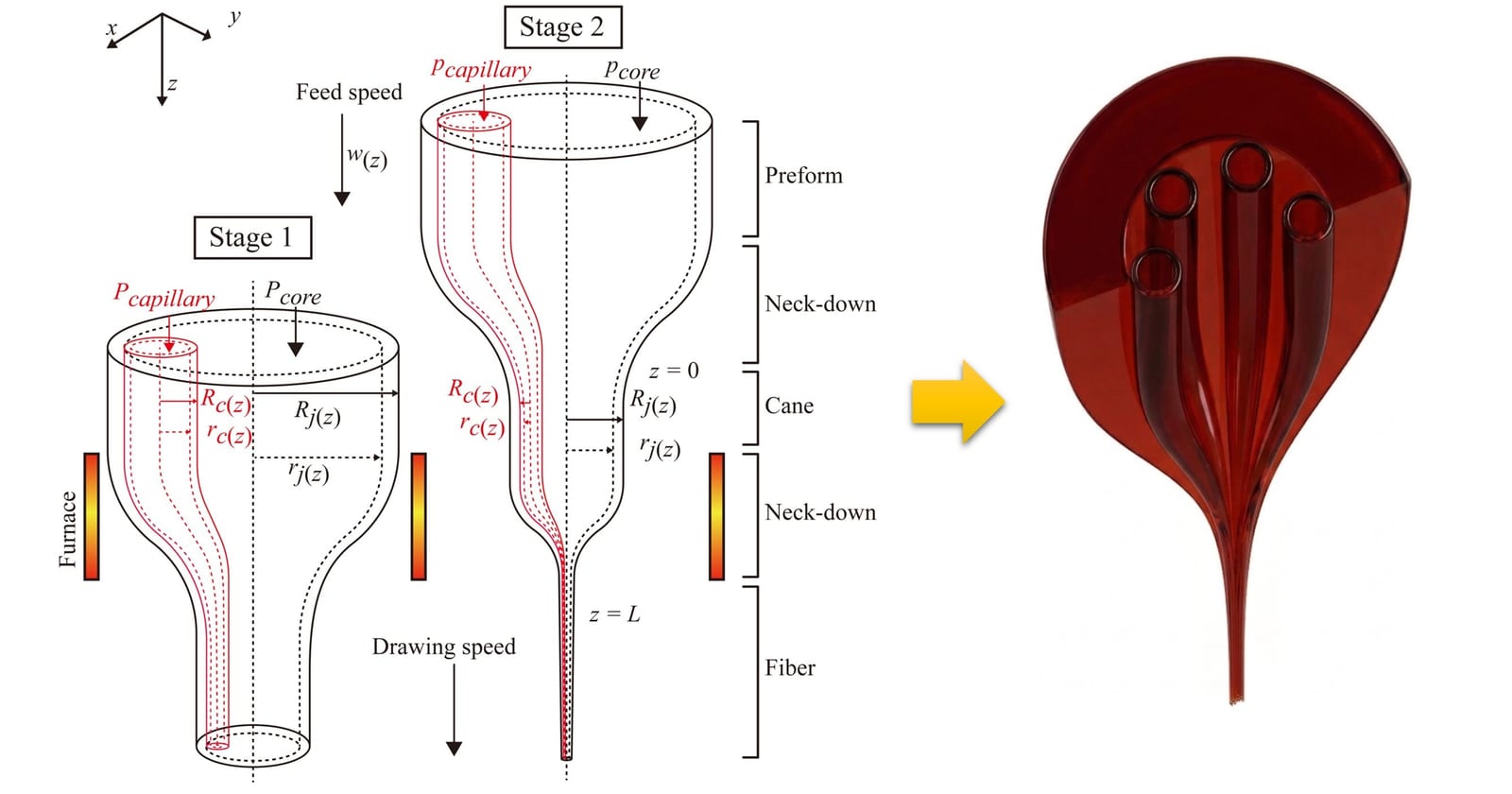
Figure: Fabrication technology for anti-resonant hollow-core infrared glass fiber guided by a fiber-drawing dynamics model
To address this, the team built a multiphysics-coupled fiber-drawing dynamics model that fully characterizes microstructure evolution in the neck-down region of the fiber preform and clarifies how drawing tension, temperature, gas pressure and speed affect fiber morphology. This breaks away from the traditional trial-and-error R&D approach, provides theoretical support for process optimization and structural stability, and enables precise control across the entire preform-to-fiber workflow.
On this basis, the team adopted differentiated fabrication processes to account for the differing thermal properties of chalcogenide and tellurite glasses: a "stack-and-draw twice" process for chalcogenide glass and a "stack-and-draw once" process for tellurite glass. Combined with full-process dynamic gas-pressure compensation technology, this successfully overcame technical challenges including the large variation in the viscosity-temperature coefficient of infrared glass, easy deformation of capillaries and contact between cladding structures.
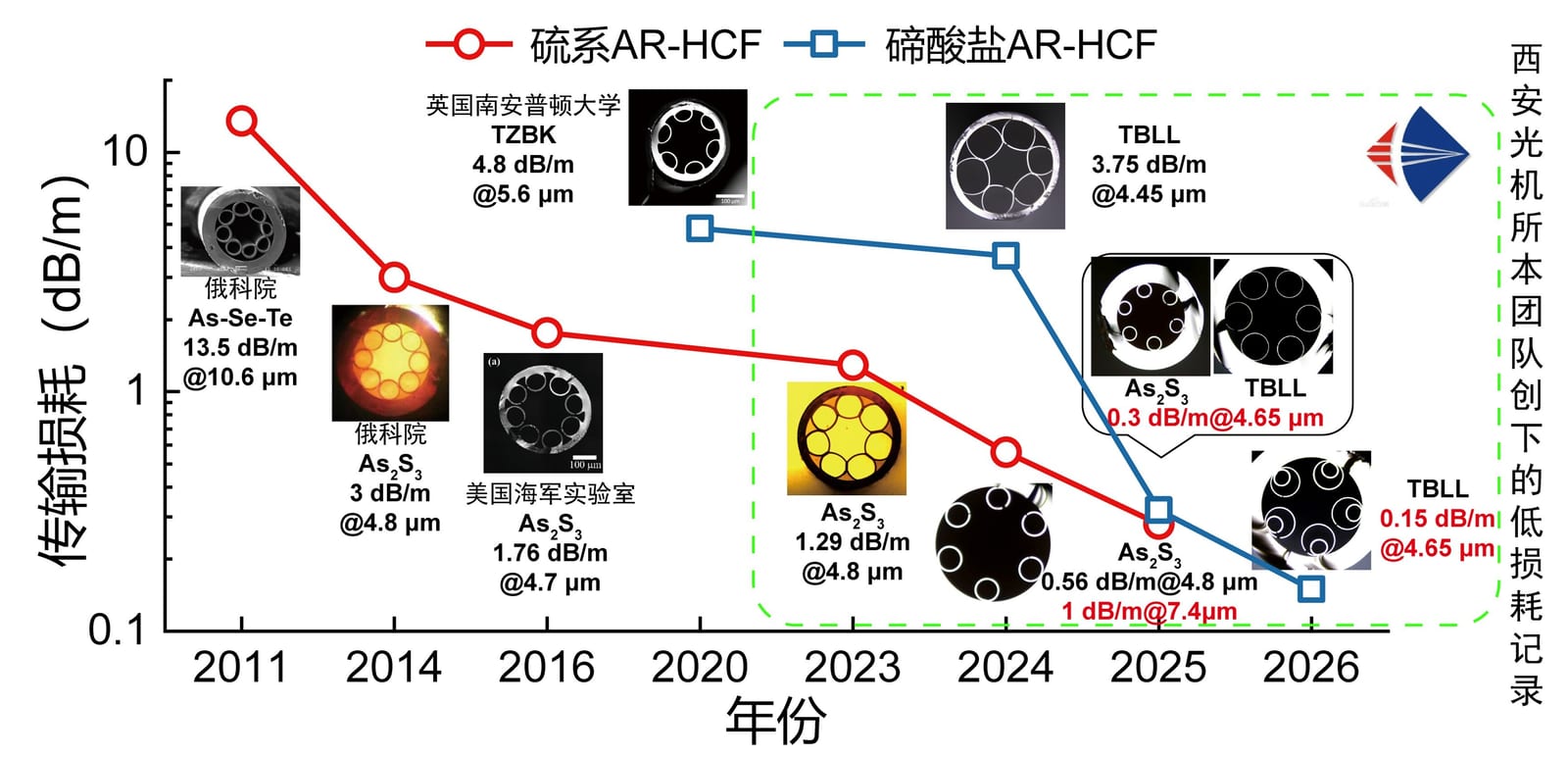
Figure: Xi'an Institute of Optics and Mechanics team sets new record in transmission loss for infrared anti-resonant hollow-core fiber
Building on these advances, the team developed infrared anti-resonant hollow-core fibers with the lowest loss among comparable products worldwide, reaching world-leading performance:
Chalcogenide AR-HCF achieved measured losses as low as 0.3dB/m and 1dB/m at 4μm and 7μm, respectively;
Tellurite AR-HCF achieved measured losses as low as 0.15dB/m and 2dB/m at 4μm and 7μm, respectively.
04 High-Quality Transmission of High-Power Mid-Infrared Femtosecond Pulses Validated
In collaboration with Researcher Fu Yuxi and the team of Professor Liang Houkun at Sichuan University, the team used the in-house developed fiber described above to achieve low-loss, high-fidelity transmission of tunable mid-infrared femtosecond pulses from 5 to 11 μm.
Experimental results show that the fiber can withstand peak powers above 16 MW and effectively suppress nonlinear effects. The pulses experience virtually no broadening during transmission, and the output beam quality is close to the diffraction limit, giving the fiber clear application advantages in ultrafast photonics, strong-field physics and other fields.
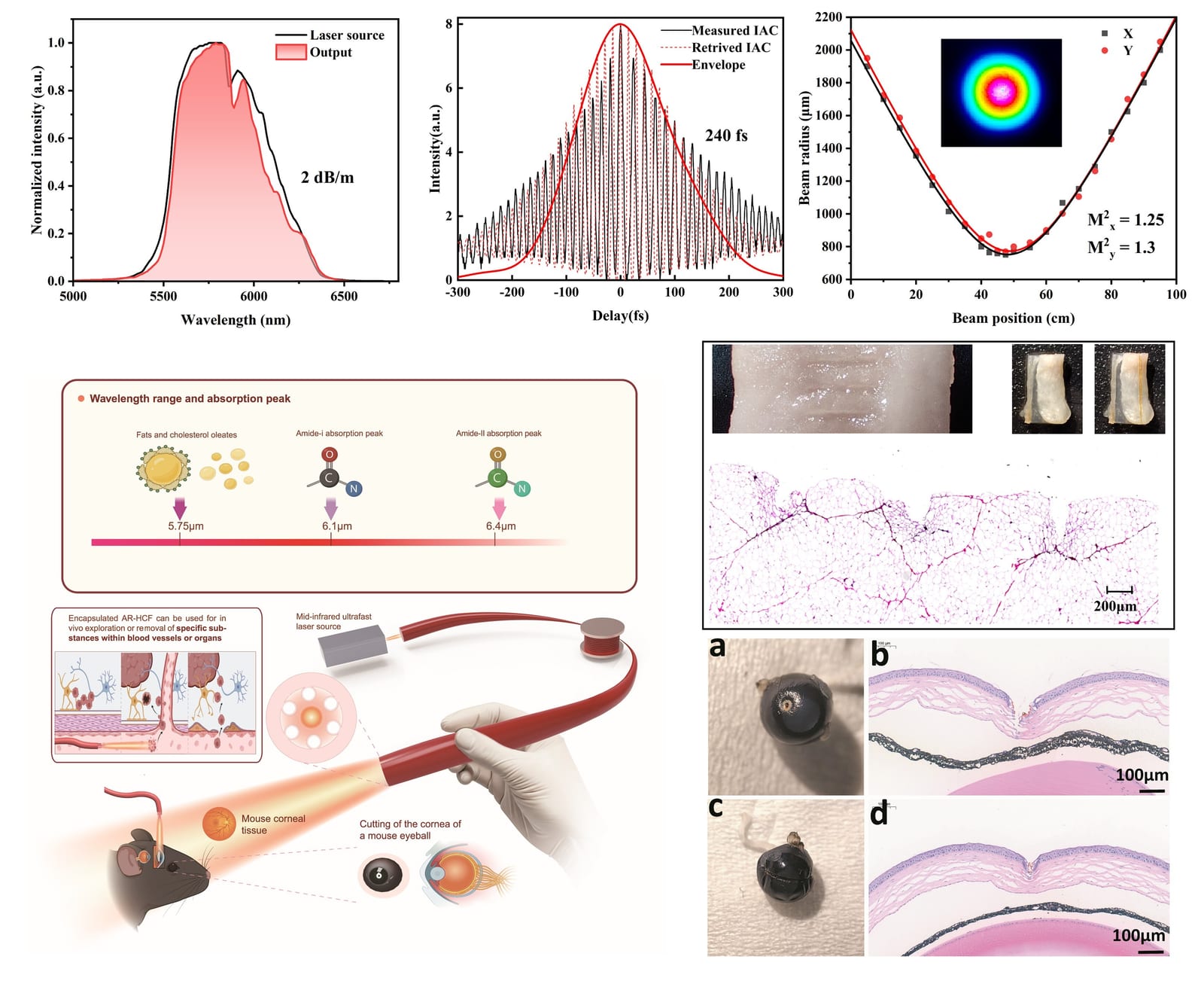
Figure: Transmission characteristics of high-power mid-infrared femtosecond lasers and minimally invasive tissue ablation
In biomedical applications, the team used the fiber to deliver 5.75 μm and 6.1 μm femtosecond lasers, successfully performing precise, minimally invasive ablation experiments on adipose tissue, atherosclerotic plaques and mouse corneas. Compared with conventional free-space delivery, fiber delivery lowered the laser ablation threshold by 40%-50%, produced cleaner cuts and caused minimal thermal damage. After coating and packaging, the fiber has a minimum bend radius of about 3 cm, offering a new flexible delivery solution for clinical scenarios such as vascular intervention and delicate ophthalmic surgery.
The above research was supported by a key project of the National Natural Science Foundation of China, the Shaanxi Province Distinguished Young Scholars Fund, and other programs.
Researcher Guo Haitao's team has long focused on high-performance mid-infrared fibers and lasers. The team has published more than 150 papers in leading optics and materials journals, obtained 14 authorized Chinese invention patents, and received honors including the Chinese Academy of Sciences "Innovation Cross-Team" award. Going forward, the team will continue to advance the engineering implementation of mid-infrared fiber and laser technology, with a focus on expanding its practical deployment and applications in spectroscopy, environmental monitoring, biomedicine, and other fields.
Source: Xi'an Institute of Optics and Fine Mechanics (XIOPM) · Research Progress · opt.cas.cn