Oxford University Uses Atomic Memory to Keep Distant Ions Entangled for About 10 Seconds
Atomic memory keeps distant ions entangled for about 10 seconds
Topics and contents
Topic
On this page
Researchers at the University of Oxford have kept remote memory qubits entangled for about 10 seconds in a two-node ion quantum network connected by optical fiber. Each node contains one strontium ion and one calcium ion. Photons emitted by the strontium ions establish remote entanglement through Bell-state measurement, and local operations then extend the entanglement to the calcium ions, creating three- or four-ion entangled states across the nodes.
Strium ions handle the long-distance link, while calcium ion storage extends the entanglement lifetime from the millisecond scale of network qubits to more than 10 seconds.
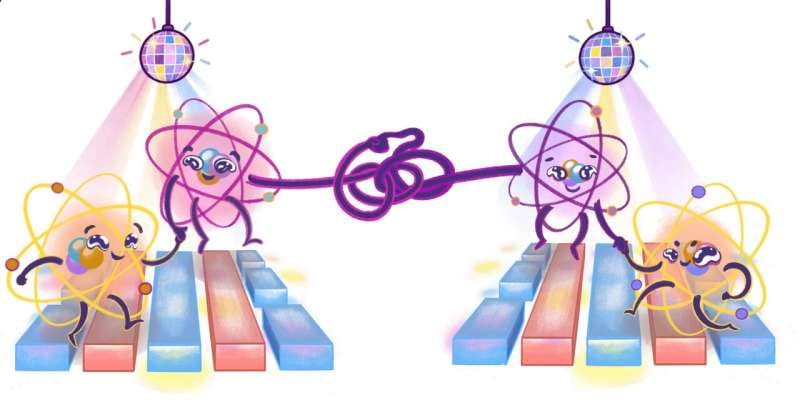
Quantum networks, systems that connect devices and allow them to exchange information encoded in the quantum states of particles, could enable more secure communications. To build these networks, physicists need to devise strategies that allow distant particles to share quantum states, preserving them long enough to perform calculations or enable communication between devices.
Researchers at the University of Oxford recently realized a quantum network with four qubits (i.e., units of quantum information) encoded in trapped ions distributed between two locations linked by optical fibers. This network, outlined in a paper published in Physical Review Letters, relied on electrically charged atoms held in place by electromagnetic fields, also known as trapped ions.
"The work grew out of our efforts to build a quantum network in which each node can do more than create an entangled link to another node," Dr. Gabriel Araneda, co-senior author of the paper, told Phys.org.
"A useful network also needs to process and store quantum information locally. Different atomic species can offer different advantages, so we wanted to combine them within the same network and investigate whether we could control entanglement between them, including when they are in separate nodes."
Connecting trapped atoms with light
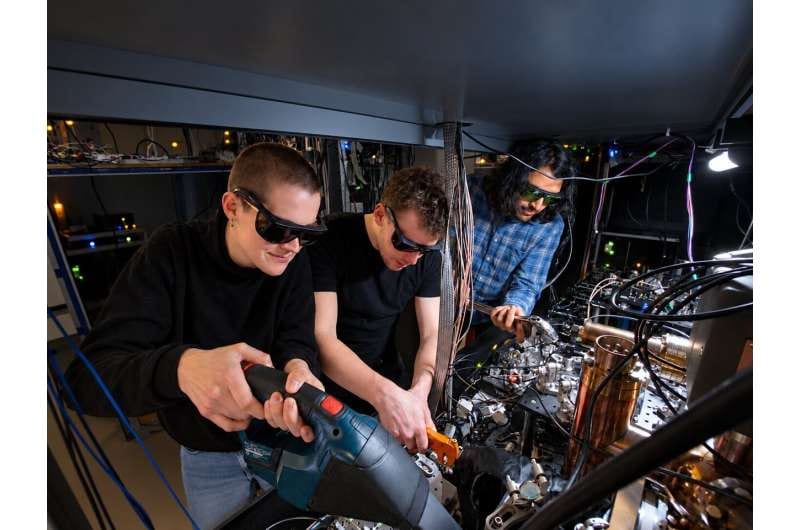
The main goal of the team's study was to combine operations performed on atoms at each node (i.e., a location containing qubits) in a network with connections between locations, to create a shared quantum state that involves several atoms. To achieve this, the researchers used two groups of trapped ions connected by optical fibers.
"Each node contains one strontium atomic ion and one calcium atomic ion," explained Dougal Main, first author of the paper. "We use the strontium ions to establish the link: each emits a photon, and the photons are brought together and measured at a central station."
The term "entanglement" means that particles share a quantum state that cannot be described as independent states for each particle. To establish entanglement between the two distant strontium ions in their network, Araneda and his colleagues performed a Bell-state measurement on the photons, or particles of light, emitted by the two ions. A particular pattern of photon detections signaled that the ions had become entangled.
"We then used operations within each node to extend that entanglement to the calcium ions," said Main. "In this way, we created entangled states involving three or four ions across the two nodes. To preserve entanglement for longer, we transferred it to calcium ions, whose chosen states are less sensitive to magnetic-field noise."
The researchers' approach combines operations on ions at two distinct locations in their network with a light-based connection. This allowed them to realize a shared entangled quantum state that involved up to four ions of two different elements (i.e., strontium and calcium), distributed across the two locations.
Informing the development of future quantum technologies
In the network realized by the researchers, strontium ions establish the connection between nodes, while the calcium ions enable the storage of quantum information. The researchers found that the entangled state between the remote memory qubits could be stored for approximately 10 seconds.
"We also showed that when the remote entanglement is stored in calcium ions, it can be preserved for more than 10 seconds—far longer than the millisecond timescales of the network qubits," said Araneda. "Entanglement is a key resource for quantum computing. Remote entanglement could allow separate quantum processors to work together as a distributed quantum computer."
This study could open new possibilities for the development of distributed quantum computing systems, where devices connected via entanglement work together to perform calculations. In addition, the team's approach could be used for measurements involving distant quantum sensors or comparisons between atomic clocks, which measure time using the frequencies of transitions between atomic energy levels.
"Our next steps are to build on these capabilities for more complex network protocols," added Araneda. "We are interested in how long-lived entanglement and local processing can support distributed quantum computing, including error correction, as well as remote sensing and clock comparisons, or secure quantum communications.
"More broadly, we want to develop network nodes that bring together different types of ions and make use of the strengths of each for the future of quantum technologies."
Written for you by our author Ingrid Fadelli, edited by Sadie Harley, and fact-checked and reviewed by Robert Egan—this article is the result of careful human work. We rely on readers like you to keep independent science journalism alive. If this reporting matters to you, please consider a donation (especially monthly). You'll get an ad-free account as a thank-you.
Publication details
D. Main et al., Multipartite Mixed-Species Entanglement over a Quantum Network, Physical Review Letters (2026). DOI: 10.1103/qpsf-nlp9.
Who's behind this story?

Ingrid Fadelli
Freelance journalist with BSc Psychology and MA International Journalism. Covers AI, robotics, neuroscience, and astrophysics since 2018. Full profile →

Sadie Harley
BSc Life Sciences & Ecology. Microbiology lab background with pharmaceutical news experience in oil, gas, and renewable industries. Full profile →

Robert Egan
Bachelor's in mathematical biology, Master's in creative writing. Well-traveled with unique perspectives on science and language. Full profile →
© 2026 Science X Network
Citation: Atomic memory keeps distant ions entangled for about 10 seconds (2026, October 21) retrieved 21 October 2026 from https://phys.org/news/2026-10-atomic-memory-distant-ions-entangled.html
This document is subject to copyright. Apart from any fair dealing for the purpose of private study or research, no part may be reproduced without the written permission. The content is provided for information purposes only.
Source: Phys.org Optics & Photonics · phys.org