Theoretical Breakthrough in Fourier Ptychographic Microscopy
Topics and contents
The State Key Laboratory of Ultrafast Optics Science and Technology has established a prior-free digital reconstruction theory in the field of FPM.
The original article provides specific data and details that help assess the actual progress in this direction.
Recently, the State Key Laboratory of Ultrafast Optics Science and Technology achieved a theoretical breakthrough in Fourier ptychographic microscopy (FPM), establishing a unified theoretical framework for prior-free digital refocusing and quantitatively predicting the depth-of-field extension limit of computational imaging systems. The results were published online in APL Photonics. The co-first authors are Zhou Yunhui, an intern at Xi'an Institute of Optics and Precision Mechanics (from Changchun University of Science and Technology), and Xu Jinghao, a doctoral student at Xi'an Institute of Optics and Precision Mechanics. Associate Researcher Pan An is the corresponding author.
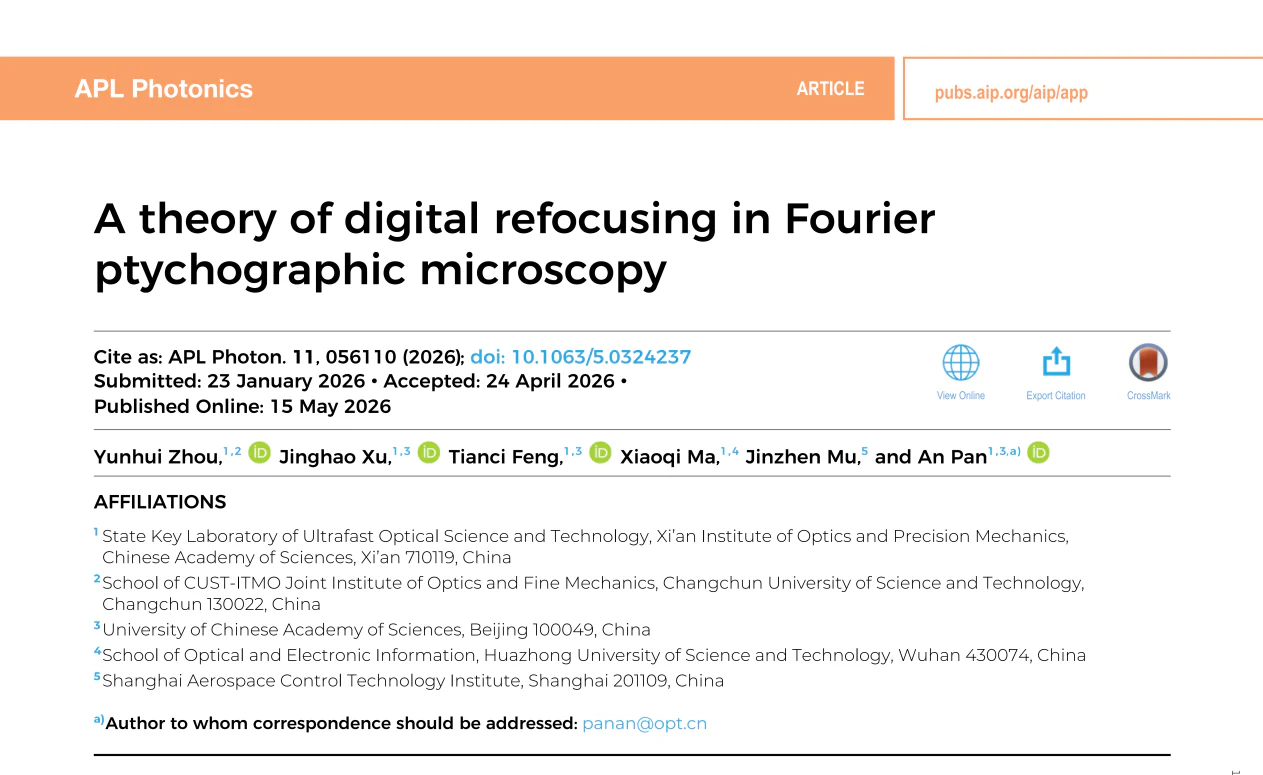
Figure: First page of the paper
Fourier ptychographic microscopy enables wide-field, high-resolution, label-free imaging and is widely used in cutting-edge biomedical fields such as digital pathology slide scanning and dynamic observation of living cells. However, the technique has long suffered from defocus sensitivity: an offset of just a few micrometers can cause reconstruction failure. Existing solutions either rely on prior defocus information or lack quantitative theoretical support, severely limiting the technology's path to industrial adoption.
To address this, the team combined theoretical derivation with experimental validation to build the first quantitative theory of digital refocusing covering multiple objectives, systematically clarifying the physical nature of prior-free depth-of-field extension. For the first time, the team decoupled hard physical-optics constraints from computational algorithm gains, derived an analytical model for the maximum tolerable defocus, and defined the physical limits of digital refocusing, providing precise theoretical guidelines for designing optical systems with different requirements.
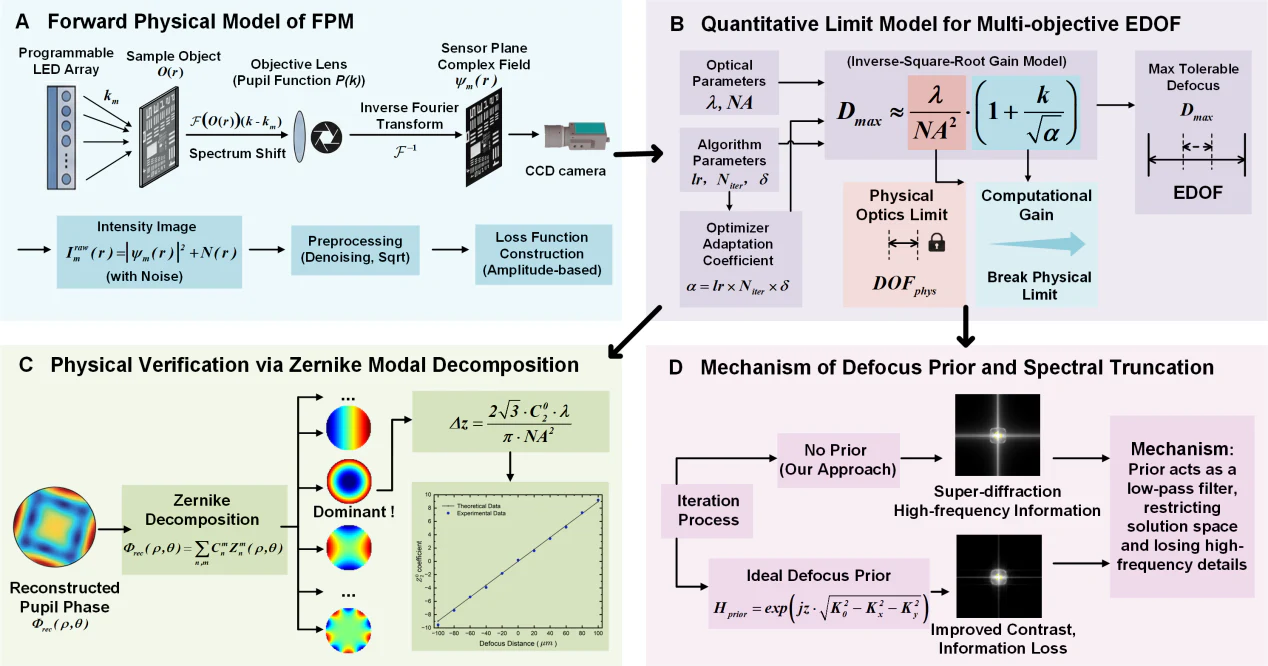
Figure: Analytical framework for prior-free depth-of-field extension (integrating four modules: forward physical model, quantitative limit model, Zernike validation, and prior mechanism)
To verify the accuracy of the theoretical model, the team conducted experiments using 4×, 10×, and 20× objective systems, with errors between the results and theoretical predictions all below 2%. Notably, the depth of field of the 20× high-NA objective was extended from 3.95 µm to 40 µm, a more than tenfold improvement.
In extreme defocus imaging experiments on human colorectal cancer pathology slides, the technique clearly recovered fine tissue morphology, demonstrating its practical value in biomedical applications.
|
NA |
|
Model Prediction |
Experimental Result |
Accuracy | |
|
4× |
0.1 |
63.2μm |
178.2μm |
180μm |
-1.0% |
|
10× |
0.25 |
10.1μm |
98.2μm |
100μm |
-1.8% |
|
20× |
0.4 |
3.95μm |
39.6μm |
40μm |
-1.0% |

Table: Model Predictions vs. Experimental Results
To further verify the physical authenticity of the reconstruction results, the team applied Zernike modal decomposition and found that the defocus term consistently dominated the reconstructed wavefront and maintained a strict linear relationship with the actual physical defocus, with back-calculation error below 1%, settling a long-standing academic dispute over "algorithmic artifacts vs. real physical aberrations."
The study also revealed the fundamental trade-off in prior fusion: while an ideal defocus prior improves visual contrast, it attenuates high-frequency information because geometric vignetting is not accounted for, sacrificing super-resolution detail; conversely, a purely data-driven, prior-free strategy preserves a wider band of high-frequency information and achieves higher-fidelity reconstruction.
Associate Researcher Pan An's team has long been engaged in computational optical imaging, Fourier ptychographic imaging, and AI + optics research. In recent years, the team has published a series of papers in journals such as Reports on Progress in Physics and Optica, and has led more than ten projects funded by the National Natural Science Foundation of China and the Shaanxi Provincial Key Research and Development Program. Looking ahead, the team will develop adaptive dynamic prior algorithms to advance computational microscopes with both ultra-wide depth of field and ultra-high resolution.
Source: Xi'an Institute of Optics and Fine Mechanics (XIOPM) · Research Progress · opt.cas.cn