Professor Zhang Xuping, Chairman of Hangzhou Faibo Optoelectronics, Named a 2026 Fellow of the Chinese Optical Society
Topics and contents
Professor Zhang Xuping, chairman of Hangzhou Faibo Optoelectronics Technology Co., Ltd., an incubated company of the Hangzhou Institute of Optics and Mechanics, has been named a 2026 Fellow of the Chinese Optical Society, with 7 science and technology professionals selected that year. Zhang is a level-two professor and doctoral supervisor at Nanjing University; the distributed optical fiber sensing technology he led has won a first prize in Jiangsu Province science and technology and a first prize in science and technology progress from the Ministry of Education, among other awards. Faibo focuses on the R&D and industrialization of distributed optical fiber sensing (DOFS) technology, and its products have been used for health monitoring in major national projects such as the South-to-North Water Diversion Project and support for the Beijing Winter Olympics.
On October 15, in accordance with the Regulations on Fellows of the Chinese Optical Society, seven scientists were selected as 2026 COS Fellows following expert review and public notice. Among them, Professor Zhang Xuping, chairman of Hangzhou Faibo Optoelectronics Technology Co., Ltd., an incubated company of the Hangzhou Institute of Optics and Mechanics, was selected.
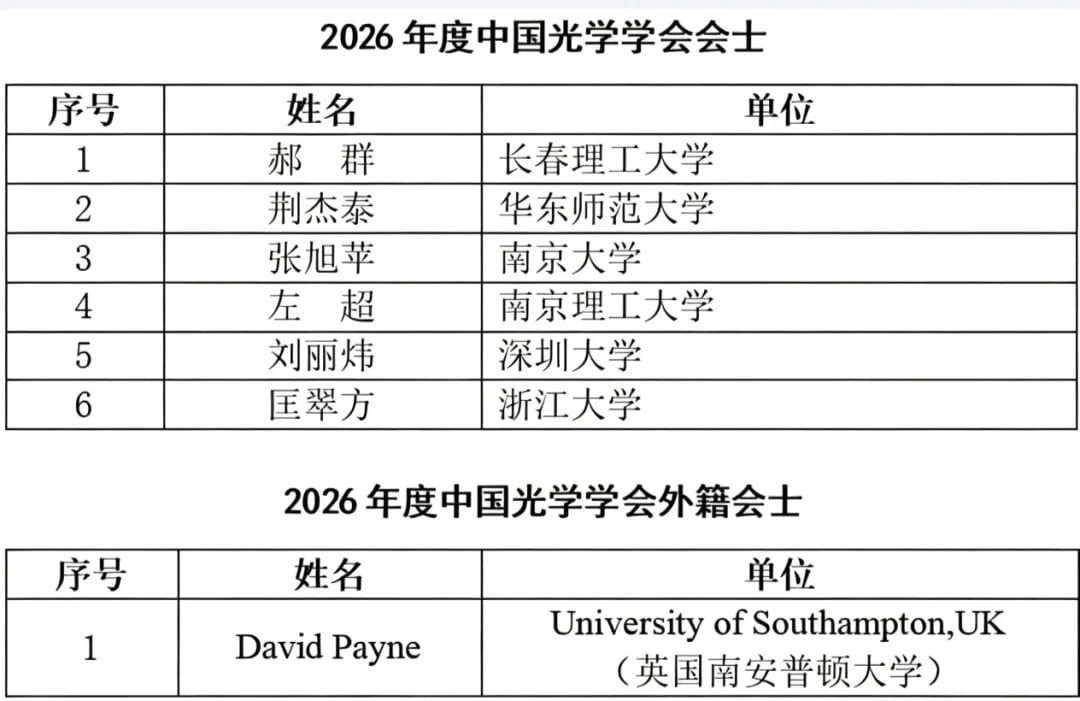
To recognize outstanding members for their exceptional contributions to the development of optics and optical engineering and to the work of the society, the Chinese Optical Society has established the COS Fellow system. The society has set up a Fellow Selection Committee composed of Fellows, which is responsible for the selection of Fellows. Candidates are nominated by two Fellows or by the Board of Directors, and the inaugural class of Fellows was recommended by the society's Board of Directors.
Zhang Xuping

A second-level professor and doctoral supervisor at Nanjing University, she serves as director of the Jiangsu Distributed Optical Fiber Sensing Technology and Network Engineering Research Center, deputy director of the Nanjing University Smart City Research Institute, chair of the Optical Fiber Intelligent Sensing Professional Committee, a recipient of the State Council special government allowance, and a national March 8 Red-Banner Pacesetter. As the first-ranked award recipient, her distributed optical fiber sensing technology has won more than ten honors, including the Jiangsu Provincial First Prize for Science and Technology, the Ministry of Education First Prize for Scientific and Technological Progress, and the Ministry of Education First Prize for Technological Invention.
Company Profile
Hangzhou Fa'aibo Optoelectronics Technology Co., Ltd.
Upholding the philosophy of technological innovation and serving the country through industry, the company has long been committed to the R&D, production and application of distributed optical fiber sensing (DOFS) technology and systems, providing specialized monitoring equipment and system solutions for safety and health monitoring of complex large-scale engineering structures. The company's core technologies originate from research achievements of Nanjing University, and it has a strong R&D team focused on technological innovation and industrialization in the DOFS field. The DOFS product series developed and produced by the team have passed testing by five authoritative institutions, including the Metrology Institute of the Ministry of Public Security, and have achieved pioneering application and promotion in major national projects such as the Belt and Road Initiative, the South-to-North Water Diversion Project, support for the Beijing Winter Olympics, construction of islands and reefs in the South China Sea, and new-concept technical equipment. They enable health monitoring of large facilities such as wind power systems, transmission lines, water pipelines, high-speed railways and expressways, large tunnels and bridges, and oil and gas pipelines, and are widely used for all-weather real-time monitoring and early warning of the safety and health status of large-scale infrastructure in sectors such as communications and power, transportation, coal, and national defense (including vibration, eavesdropping, cracking, and temperature changes).
Source: Hangzhou Institute of Optics and Fine Mechanics · Industry News · hiom.ac.cn