Shanghai Institute of Optics and Mechanics Advances Integrated Microcavity Optical Frequency Combs
Topics and contents
A team led by Peng Xie at the Shanghai Institute of Optics and Mechanics studied soliton generation and breather dynamics in microcavity optical frequency combs.
The original article provides specific data and details that help assess the actual progress in this direction
Ultra-Intense Laser Science Excellence Innovation Brief
(Issue 820)
September 7, 2026
SIMACH Makes Progress in Integrated Microcavity Optical Frequency Combs



Recently, a team led by Researcher Xie Peng of the Aerospace Laser Technology and Systems Department at the Shanghai Institute of Optics and Fine Mechanics, Chinese Academy of Sciences, conducted research on soliton excitation, breather dynamics control and frequency stabilization in microcavity optical frequency combs, making progress in three areas: bidirectional soliton generation, breather locking, and synchronization between different optical combs in a microcavity. The related results were published as “Counter-Propagating Solitons in the Mode-Splitting Microcavity" in ACS Photonics, selected as a cover paper; as “Backscattering-induced oscillated breathing soliton microcomb" in Optics Letters; and as “Cross-phase modulation radiation between soliton and four-wave mixing states" in Optics Letters.
By pumping at a pump mode subject to local dispersion perturbation, the research team achieved, for the first time, stable coexistence of bidirectional solitons in a mode-splitting microcavity. The experimental results are shown in Figure 1. Under appropriate detuning conditions, the counter-propagating solitons can reach equal power levels, enabling bidirectional soliton generation.
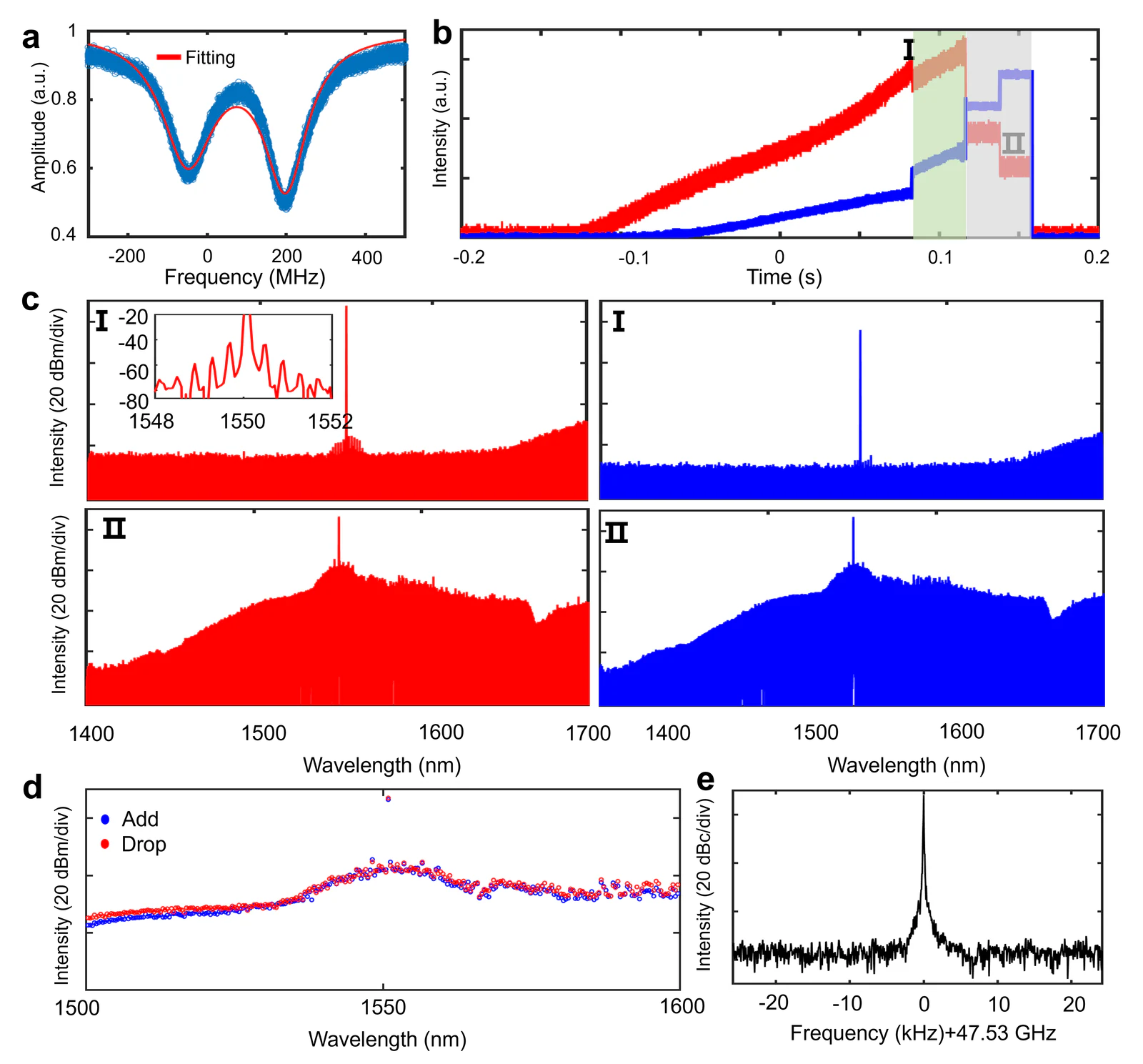
Figure1 Experimental results of bidirectional soliton generation. (a) Resonance peak transmission spectrum. (b) Wavelength evolution curves of forward-propagating light (red line) and reflected light (blue line). (c) Spectra in different states. Ⅰ, single-soliton microcomb spectrum; Ⅱ, soliton-state microcomb spectrum. (d) Comparison of comb-line power for the bidirectional soliton frequency comb. (e) Repetition rate of the generated solitons.
The research team demonstrated generation of a reflection-light-induced breather microcomb. Experimental results are shown in Figure2, where the breathing solitons exhibit periodic energy exchange between the forward and reflected light, with an oscillation period on the order of MHz. In the experiment, the breathing frequency can be continuously tuned by adjusting the pump laser frequency. By locking the oscillation frequency of the breathing solitons, the team reduced the repetition-rate fluctuation of the soliton microcomb from57.4 kHz to600 Hz over a600-second period. This work opens up new avenues for exploring soliton dynamics and provides a new method for locking the repetition rate of soliton microcombs.
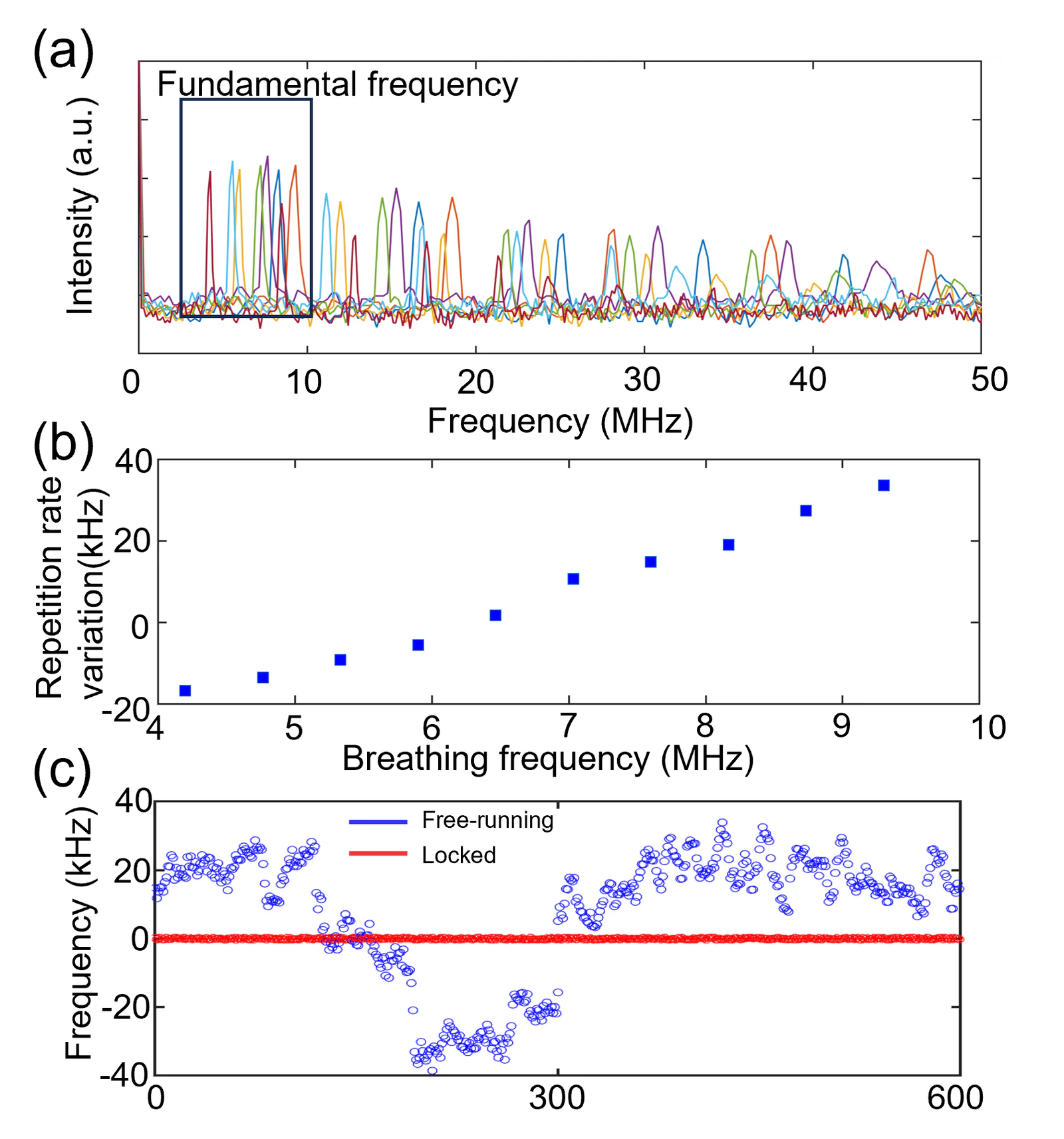
Figure2 Characterization of the reflection-light-induced breather microcomb. (a) Oscillation frequency of the breather microcomb. (b) Relationship between the breather oscillation frequency and the repetition rate. (c) Variation of the unlocked breather repetition-rate jitter (blue line) and the locked breather repetition rate (red line).
The research team explored nonlinear interactions between soliton states and four-wave-mixing states in microcavity optical frequency combs, achieving coexistence of soliton-state and four-wave-mixing-state microcombs. By optimizing the powers and detunings of the pump and probe light, phase matching between the soliton-state and four-wave-mixing-state sidebands was realized, and a cross-phase-modulation microcomb was successfully excited at the four-wave-mixing-state sidebands. Experimental results are shown in Figure3. This work provides a new approach to intrinsic synchronization between different microcomb states and opens a new route to synchronizing GHz-repetition-rate soliton-state microcombs with THz-repetition-rate four-wave-mixing states.
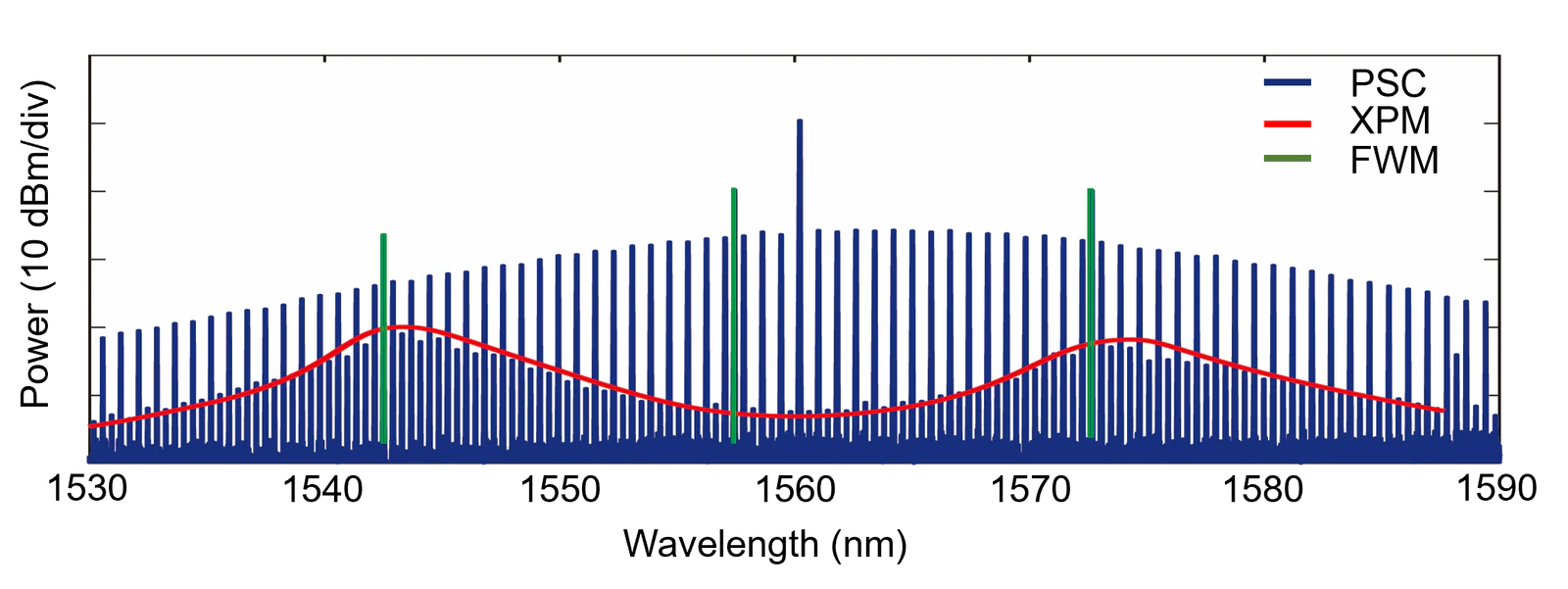
Figure3 Experimental results of cross-phase-modulation frequency comb generation. Blue line: soliton-state optical frequency comb; green line: four-wave-mixing-state optical frequency comb; red line: fitted cross-phase-modulation frequency comb envelope curve.
Source: Shanghai Institute of Optics and Fine Mechanics (SIOM) · Research Updates · siom.cas.cn