Xi'an Institute of Optics and Mechanics Research on Near-Infrared Optogenetic Pain Relief Draws Attention in Nature Photonics Commentary
中国科学院西安光机所近红外光遗传镇痛研究获Nature Photonics专题评论关注
Topics and contents
A team led by Researcher Wang Quan at the Biomedical Spectroscopy Laboratory of the Xi'an Institute of Optics and Mechanics, Chinese Academy of Sciences, has achieved wireless near-infrared optogenetic pain relief using upconversion nanoparticles. The research was recently highlighted in a dedicated commentary in Nature Photonics. Optogenetics received the Nobel Prize in Physiology or Medicine on October 5, 2026.
The original work applies upconversion nanoparticles to wireless near-infrared optogenetics, offering reference value for biophotonics applications
On October 5, 2026, optogenetics received the Nobel Prize in Physiology or Medicine for its foundational contributions to the precise control of neural activity, further underscoring the importance of optogenetic technology in modern neuroscience and biomedicine.
Recently, the near-infrared optogenetic analgesia research by a team led by Ph.D. student Guo Zebao, Associate Researcher Fan Qi, and Researcher Wang Quan of the Biomedical Spectroscopy Laboratory at the Xi'an Institute of Optics and Precision Mechanics (XIOPM), Chinese Academy of Sciences, was featured in a dedicated commentary in Nature Photonics.
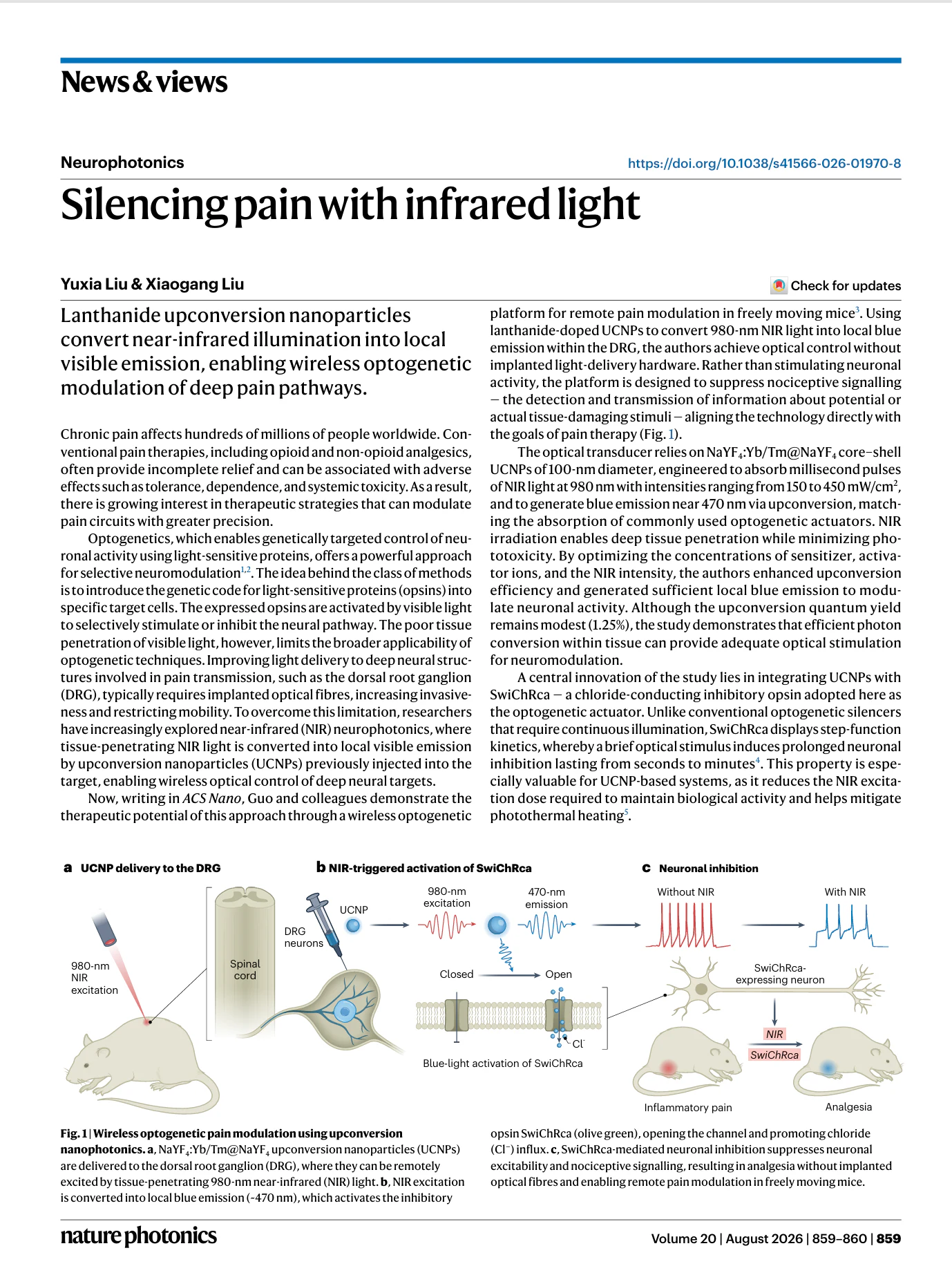
Researcher Wang Quan's team achieved wireless optogenetic analgesia mediated by upconversion nanoparticles, with the results published in ACS Nano in May 2026. In response, Nature Photonics invited Xiaogang Liu (刘小钢), a Fellow of the Singapore National Academy of Science and Distinguished Professor at the National University of Singapore, and colleagues to write a News & Views commentary titled "Silencing pain with infrared light."
Professor Xiaogang Liu provided an in-depth analysis of the study from the perspective of a "wireless optical interface for deep tissue." The commentary notes that a key feature of the study is the use of upconversion nanoparticles to build a "micro optical bridge" linking an external light source with deep neural tissue. Near-infrared light has good tissue penetration and can be delivered into tissue from outside the body; the upconversion nanoparticles can convert it into visible light recognized by photosensitive proteins, thereby activating the corresponding neural modulation mechanisms in the target region. This approach could reduce the reliance of conventional optogenetics on implanted optical fibers, allowing animals to receive light-based modulation while freely moving, and offers new ideas for wireless, non-invasive neural modulation.
The commentary also highlights the synergy between the upconversion nanoparticles and the inhibitory photosensitive protein SwiChRca. In simple terms, the nanoparticles "translate" near-infrared light into optical signals that nerve cells can recognize, while SwiChRca acts as a light-controlled "neural activity switch" that can sustain neural inhibition for a period after brief illumination. Combined, the two could deliver longer-lasting analgesia without prolonged continuous illumination, while reducing tissue heating that continuous exposure may cause. This design offers a new technical route for reducing light requirements and improving the practicality of wireless optogenetic modulation.
While affirming the potential of this technical approach for wireless deep neural modulation, the commentary also identifies several key issues for further development, including possible photothermal effects from 980 nm illumination, still-limited upconversion efficiency, and the lack of cell-type specificity in nanoparticles comparable to that of optogenetic proteins. The commentary therefore suggests exploring upconversion materials excited at 808 nm or in the second near-infrared window, improving upconversion efficiency through materials and photonic engineering, and developing molecular targeting strategies to enhance the localization specificity of nanoparticles.
In recent years, Researcher Wang Quan's team has conducted sustained research in brain-computer intelligence, computer vision, AI large models, and optical materials, achieving a series of important results published in NeuroImage, Pattern Recognition, CVPR, and others. This dedicated Nature Photonics commentary reflects the attention and recognition of international peers for our institute team's upconversion nanoparticle-mediated wireless optogenetic technology.
Attachment download:
Source: Xi'an Institute of Optics and Fine Mechanics (XIOPM) · Research Progress · opt.cas.cn