Mao Qian on Fragmentation of the Global Fiber Market and Chinese Companies' Overseas Transformation
Topics and contents
Topic
On this page
Mao Qian released the 2026 Global Optical Fiber and Cable Industry Development Report, stating that the global market is forming two fragmented systems led by the US and China, while Chinese companies' overseas expansion is shifting from absorbing excess capacity to exporting value. APC data show that Chinese companies' combined global share exceeded 45% in 2026, with North American prices at two to three times the global benchmark. The report forecasts that Chinese companies' share will exceed 50% by 2030, and warns of risks from key raw material supply and a supply-demand reversal after new capacity comes online.
The report places trade barriers, overseas capacity and customer lock-in within a single competitive framework, providing context for understanding how Chinese fiber companies are shifting from scale expansion to value export.
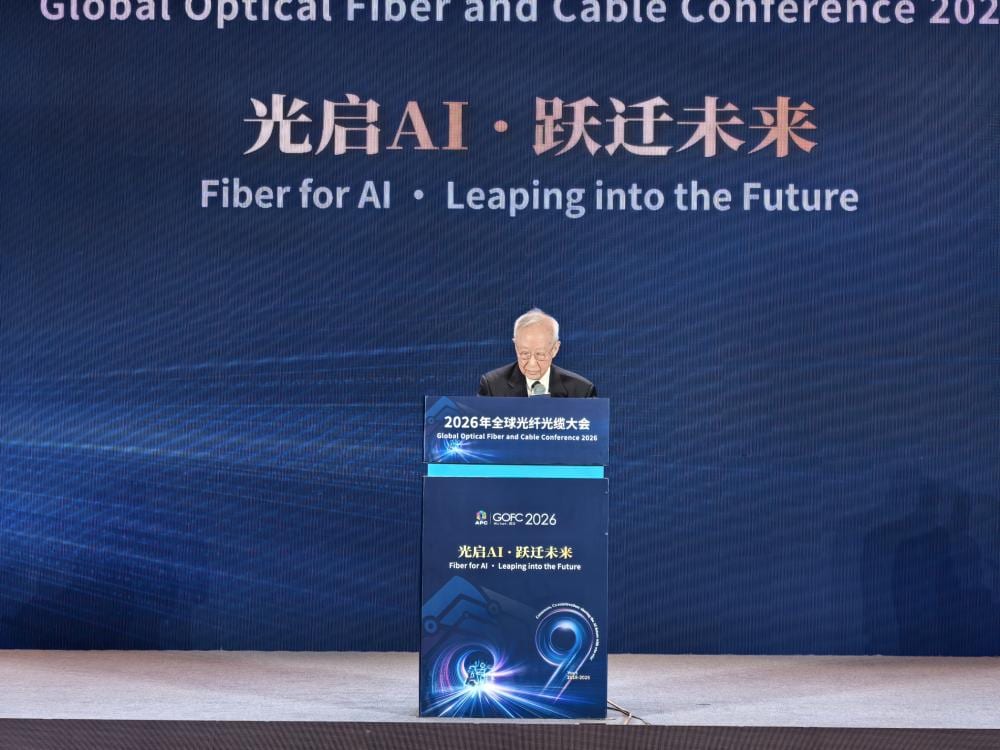
C114 News, October 19 afternoon (Jiang Junmu) - The 2026 Global Optical Fiber and Cable Conference opened today in Wuhan China Optics Valley. APC Conference Chairman, full member of the Communications Science and Technology Committee of MIIT, and Chairman of the Asia-Pacific Optical Communications Committee, Mao Qian, said while releasing the 2026 Global Optical Fiber and Cable Industry Development Report that the global optical fiber and cable market is forming two separate systems led by China and the United States. Chinese companies have built systematic advantages in scale, cost and delivery efficiency, but their soft power and degree of globalization are still catching up, and moving capacity overseas is an inevitable choice in response to trade barriers.
APC data show that among the global top 10 in 2026, Corning ranked first with a 22.95% share, followed by YOFC at 13.87%, with FiberHome, ZTT and Hengtong placing third to fifth respectively. Chinese companies together now hold more than 45% of the global market. The global market has split into two separate systems: North America excludes Chinese optical fiber companies because of relevant trade legislation and high tariffs, with prices two to three times the global benchmark. Mao Qian said bluntly that this split is the result of policy design and will not change in the short term.
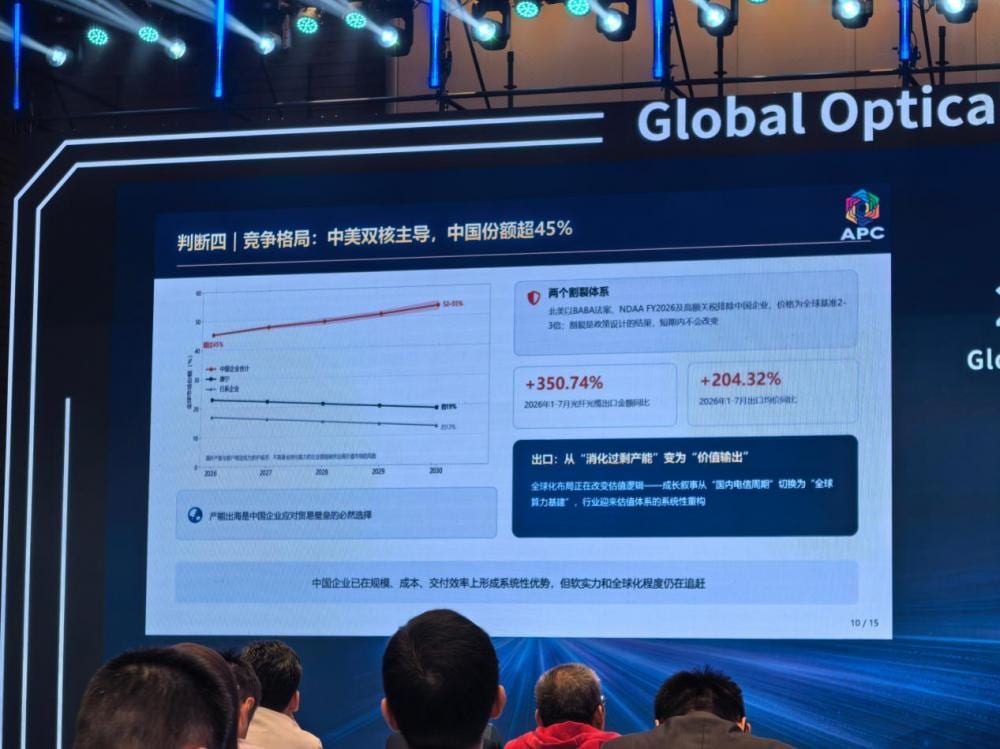
Chinese companies are responding by accelerating their global footprint. In trade terms, from January to July 2026, China's optical fiber and cable export value surged 350.74% year on year, while the average export price rose 204.32%. Mao Qian believes that exports have shifted from absorbing excess capacity to delivering value, and the global footprint is changing the valuation logic of Chinese optical fiber and cable companies. The growth trend is switching from domestic telecom cycles to global computing infrastructure, and the industry is entering a systemic breakthrough in its valuation framework.
The shift in the competitive landscape is not happening in isolation. Mao Qian views pricing, supply and demand, and competition along a single logical chain: decision-making power over demand is shifting from carriers to cloud providers, optical preform capacity expansion cycles create physical rigidity, the supply-demand gap feeds into prices, and shifts in product mix and higher added value are driving a historic price reset, moving the industry from price competition to value competition. From 2021 to 2026, major companies' profit growth was more than eight times their revenue growth, driven by higher prices and product mix upgrades, as the industry shifts from a scale-oriented to a profit-oriented model.
Beyond the competitive landscape, technology evolution is becoming the key variable separating leading companies. Mao Qian judges that four technology paths are advancing in parallel, with markedly different pacing: G654.E is in large-scale commercial use, with procurement by the three major carriers expected to reach 4 to 5 million fiber-km in 2027, up more than 30% year on year, and its share of core network fiber could exceed 50% by 2030; hollow-core fiber has entered early commercial deployment, with Microsoft deploying 15,000 km, YOFC winning the hollow-core cable project of China Telecom Guangdong, and FiberHome completing the country's first 400G-class provincial trunk hollow-core communications project, but prices remain as high as RMB 40,000 per fiber-km, and large-scale commercialization will take another two to three years; polarization-maintaining fiber is on the eve of a demand explosion and is the category with the most explosive characteristics in 2026, with volume production demand shifting from aerospace to the core supply chain of AI computing power, demand also set to grow markedly in 2027 while capacity still cannot guarantee supply; multi-core fiber remains at the technology validation stage, with ecosystem technology readiness and commercial adoption expected to take another three to five years. In October 2026, the APC Association developed the world's first international standard for hollow-core fiber, released during the conference, which will give a major boost to the development and application of hollow-core fiber.
Supply chain security, meanwhile, has escalated from a pricing issue to a strategic one. Mao Qian warned that supply constraints on key raw materials such as helium, high-purity quartz and germanium are structural rather than cyclical, price signals cannot effectively regulate supply, and the traditional highest-bidder-wins market mechanism may fail. The meaning of supply chain security is expanding from affordable prices to availability of supply. Optical fiber coatings are constrained by certification barriers, with certification cycles as long as 1.5 to 2 years. Phichem holds more than 60% of the domestic market, new capacity is expected to begin construction by the end of 2026, supply flexibility will remain limited in 2027, and the risk level is expected to rise from level 3 to level 4. Para-aramid fiber and polymer auxiliary materials are categories where risk is converging or stable: the localization rate of para-aramid fiber has reached 70%, leaving 30% of supply flexibility, while the localization rate of polymer auxiliary materials exceeds 90%, with many suppliers and ample capacity. These two categories are expected to maintain their current low risk level.
Looking ahead to 2027-2030, Mao Qian outlined a four-year industry picture: the supply-demand gap will widen to 150-200 million fiber-km in 2027 and narrow after new capacity comes online in 2028, but the timing for polarization-maintaining fiber and G657.A2 will slip beyond 2029. Chinese companies' global share is expected to exceed 50% by 2030, with demand growth increasingly concentrated in AI computing power and emerging markets. Global demand is projected at 680-720 million fiber-km in 2027, with North America rising to 160-170 million fiber-km and Scale-Up-driven deployments adding 10-15 million fiber-km. Global demand is forecast at 750-800 million fiber-km in 2028, reaching 850-950 million fiber-km in 2029-2030, with AI-related demand accounting for more than 50%. The core basis for the forecast is the steadily rising share of AI data centers in total demand; even if AI capital expenditure growth slows, absolute fiber demand will not fall back to 2024 levels.
On the supply side, global optical fiber preform capacity will edge up to 28,000-29,000 tonnes in 2027, with effective supply of 550-600 million fiber-km and the supply-demand gap widening to 150-200 million fiber-km. In 2028, preform capacity will reach 33,000-35,000 tonnes, with effective supply of 650-750 million fiber-km and the gap narrowing to 100-150 million fiber-km. However, the timing for polarization-maintaining fiber and G657.A2 may slip beyond 2029. Expansion of polarization-maintaining fiber is constrained by process know-how and preform quality, while G657.A2 production runs 10-15% slower than standard G652.D. These bottlenecks cannot be resolved through short-term capital expenditure.
On pricing, 2027 will see prices hold at high levels: average G652.D prices of RMB 100-110 per fiber-km, G657.A2 at RMB 220-250, G654.E at RMB 400-450, and hollow-core fiber gradually declining to RMB 30,000-35,000. Prices may retreat after new capacity is released in 2028, but polarization-maintaining fiber, G657.A2 and other products will show relatively strong price resilience, with prices entering a new equilibrium in 2029-2030.
In terms of competitive landscape, Chinese companies' global share is expected to rise from more than 45% to over 50% by 2030, while Corning's share falls to about 19% and Japanese manufacturers' to 13%. Overseas production capacity and customer lock-in are becoming the new moat, and companies without overseas capacity and customer ties risk being squeezed out of high-value markets.
Mao Qian specifically urged attention to the risk of a supply-demand reversal. After new capacity is released in a concentrated wave in 2027-2028, G652.D may experience a short-term, phased oversupply. However, categories such as G657.A2 used in data centers have relatively strong price resilience and a comparatively low risk of supply-demand reversal, thanks to technical barriers and inelastic demand. Attention is also needed on the high risk of helium and high-purity quartz sand rising to level 5 in 2027, as well as challenges from geopolitics, disconnects in procurement scale, and AI monetization.
From a global share of more than 45% to a push beyond 50% by 2030, and from absorbing capacity through exports to exporting value, the growth logic of Chinese optical fiber and cable companies is shifting from the domestic telecom cycle to global computing infrastructure. Mao Qian's report sketches a clear competitive picture: the China-U.S. bipolar split will not disappear in the short term, overseas capacity and customer lock-in are becoming the new moat, and technical barriers and supply chain resilience will determine who stays in high-value markets. For Chinese companies, going global is no longer optional but a must-answer question for countering trade barriers and reshaping valuation logic. The real test is whether, beyond scale advantages, they can turn standards, brands, localized delivery and supply chain security into the soft power of the next round of competition. 
Source: C114 Communications Network · Optical Communications · c114.com.cn