CAICT's Zhao Wenyu: NPO Commercial Deployment Imminent
中国信通院赵文玉:NPO商业部署在即,是当前AI算力基建优选方案
Topics and contents
Zhao Wenyu of the China Academy of Information and Communications Technology (CAICT) said at the CIOE forum that commercial NPO deployment is imminent and that it is the preferred solution for current AI computing infrastructure.
C114 News, September 16 — The 27th China International Optoelectronic Exposition (CIOE) was successfully held at the Shenzhen World Exhibition & Convention Center last week.
At the concurrent "AI Compute Cluster Optical Interconnect Technology Development Forum," Zhao Wenyu, deputy director of the Institute of Technology and Standards at the China Academy of Information and Communications Technology (CAICT), delivered a keynote speech. He provided an in-depth analysis of the optical interconnect industry's needs in the AI era, the evolving landscape of mainstream technology roadmaps, and standardization progress, making clear that pluggable optical modules, NPO, CPO and other technologies will coexist over the long term, and clarifying the industry's technology choices and development trajectory.
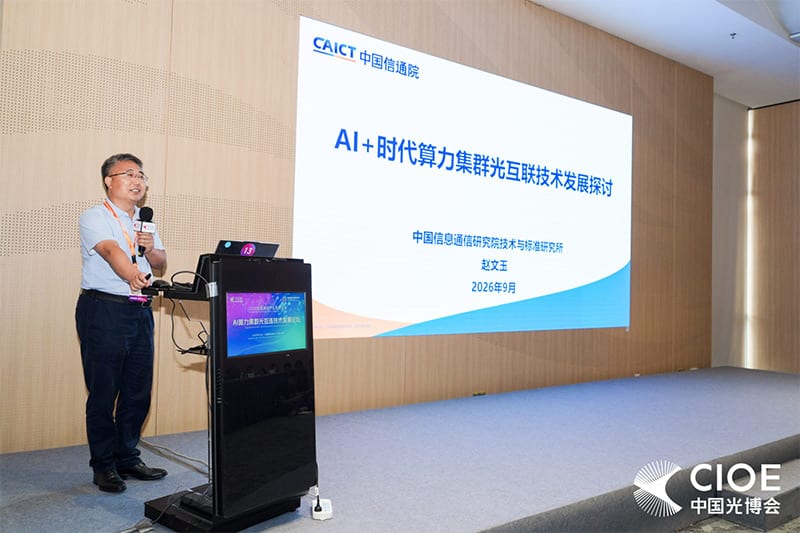
Zhao Wenyu said the global AI compute race has reached a white-hot stage. National strategies such as the U.S. Stargate initiative, Europe's Horizon program and China's integrated computing power network are being rolled out in rapid succession, comprehensively driving upgrades to computing infrastructure. As AI large-model training and inference place ever-higher demands on bandwidth, latency, jitter and reliability, traditional electrical interconnects can no longer meet the needs of ultra-large-scale compute clusters. The fundamental value of optical interconnects is increasingly evident, and industry attention and market enthusiasm have surged.
In intelligent computing scenarios, optical interconnect technology fully meets the networking needs of multiple compute tiers, forming four application dimensions — Scale-in, Scale-up, Scale-out and Scale-across — covering connectivity across chips, device clusters, super-nodes and cross-data-center scenarios. Meanwhile, the rapid expansion of the compute industry has tightened supply and demand along the optical module value chain, with the sector broadly facing resource contention. The optical interconnect industry as a whole has entered a period of rapid growth. In terms of speed iteration, 100G and 200G per-lane optical modules have achieved commercial scale, while 800G and 1.6T will become mainstream in the Ethernet market over the next few years. Standards bodies including IEEE, IPEC and CCSA are accelerating the rollout of relevant standards.
Regarding next-generation high-speed optical interconnect technology, Zhao Wenyu detailed the industrialization pace and competitive landscape of each technology roadmap. Single-lane 400G has become a key industry focus; building on mature iteration experience with 50G, 100G and 200G, it is expected to reach commercial scale in about two years and become widely adopted from 2028. On technical solutions, EML, thin-film lithium niobate and silicon photonics remain in fierce competition. The 2025–2026 period will focus mainly on technology validation, with the dominant roadmap to be determined later based on industrialization capability. In addition, low-power LPO optical modules have reached an initial scale of deployment, with 100G variants performing reliably and 200G gradually becoming feasible, while LRO solutions offer a better overall cost-performance ratio.
In the field of highly integrated optical engines, the XPO approach combines high bandwidth density with pluggability and easy maintenance, making it a highly competitive deployment path at this stage. Meanwhile, the industry's focus technologies — NPO, CPO and OIO — each have suited application scenarios and industrialization challenges. Among them, NPO's technology maturity and industry supply capability continue to improve, with commercial deployment imminent. It strikes an ideal balance among device integration, power consumption and operational convenience, while retaining the mature O&M systems of traditional pluggable equipment, making it a preferred solution for current AI compute infrastructure buildouts.
On the closely watched CPO technology, Zhao Wenyu noted that CPO offers higher optoelectronic integration and a higher performance ceiling, but faces issues such as difficult O&M, a closed ecosystem, and insufficient delivery stability. Industry yield, reliability, and large-scale delivery capabilities still need improvement. Overall, it is a longer-term advanced solution and is unlikely to replace existing technologies on a large scale in the short term. Based on scenario suitability, NPO and CPO will coexist over the long term rather than form a phased replacement relationship. NPO will achieve large-scale deployment first, with CPO gradually penetrating high-end scenarios later.
Zhao Wenyu stressed that the lack of standardization is the core bottleneck to the large-scale deployment of highly integrated optical interconnect technology. Currently, industry vendors differ in their solutions for connectors, optical modules, switch interface dimensions, electrical protocols, light source layouts, and O&M adaptation, resulting in insufficient interoperability that severely constrains large-scale industry development. To address these pain points, domestic standardization efforts have accelerated across the board. In May this year, leading internet companies took the lead in launching a 12.8T NPO standard project. Meanwhile, under the leadership of the CAICT, nearly 50 industry organizations jointly established an NPO standards working group, dedicated to developing a unified standard suited to China's industrial conditions and compatible with international systems, and to advancing coordinated industry development.
Looking ahead to the industry development cycle of the 15th Five-Year Plan period, Zhao Wenyu summarized the evolution of optical interconnect technologies. In the short term, high-speed pluggable optical modules will continue to dominate the market. As AI computing infrastructure build-out continues, the penetration of highly integrated optoelectronic technologies such as NPO and CPO will rise steadily, and the industry will see the coexistence and development of multiple technology routes. Going forward, the industry needs to leverage collaboration among industry, academia, research, and users to break down technical barriers and fragmented standards, build an open, unified, and mutually beneficial intelligent computing optical interconnect ecosystem, and underpin the sustained rapid growth of the AI industry with robust network infrastructure. 
Source: C114 Communications Network · Optical Communications · c114.com.cn