Huawei Teams Up with Xi'an Institute of Optics and Precision Mechanics on AI+Optics; Ascend 960 SuperPod Uses NPO
牵手西安光机所!华为在下怎样的一盘“光学大棋”?
Topics and contents
Huawei and the Xi'an Institute of Optics and Precision Mechanics have signed a strategic cooperation agreement, with AI+optics as a core focus. Huawei has pledged to prioritize computing resources and AI teams for the effort. Earlier, on September 17, Huawei unveiled the Ascend 960 superpod using near-package optics (NPO) at Huawei Connect 2026, employing 5,500 in-house Hi-ONE optical engines.
The original text places the industry-academia partnership alongside the NPO superpod, revealing Huawei's overall strategy in optical interconnect and AI optics
Recently, Huawei and the Xi'an Institute of Optics and Precision Mechanics (Xi'an Institute of Optics) signed a strategic cooperation agreement, with both sides designating "AI + optics" as the core direction. Huawei pledged to give "priority support" in computing resources and AI teams.
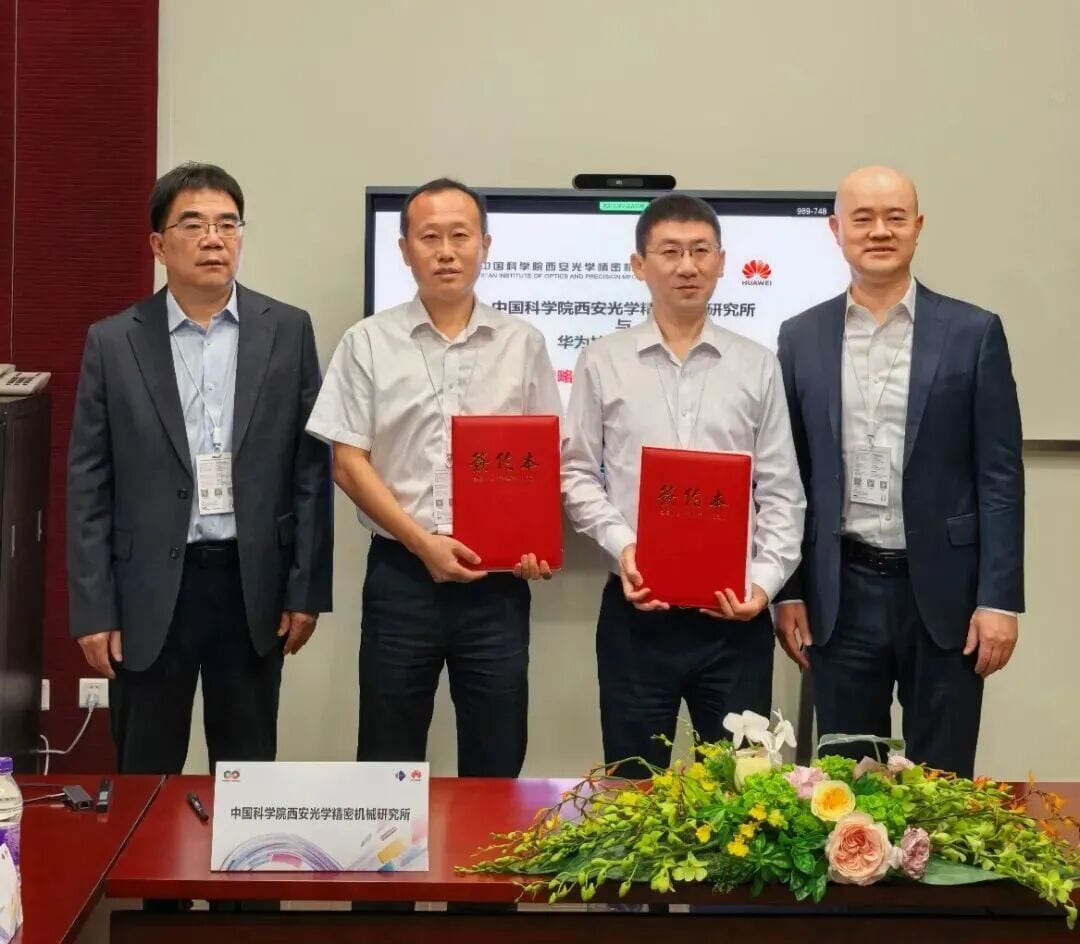
In fact, this is no ordinary industry-academia signing; it is a key leap in Huawei's optics strategy.
On September 17, Huawei unveiled Ascend 960, the world's first supernode using near-package optics (NPO), at Huawei Connect 2026. The solution replaces the 48,000 800G pluggable optical modules originally required with 5,500 in-house Hi-ONE optical engines. According to Huawei, system power consumption is reduced by more than 550 kW and system availability reaches 99.8%.
Huawei Vice Chairman and Rotating Chairman Tao Wang stated that, compared with co-packaged optics (CPO), which suffers from low yield and high maintenance costs, NPO strikes a better balance between maintainability and performance and is "currently the optimal solution."
The commercial significance of NPO extends far beyond an incremental improvement in a product parameter. It is reshaping the long-standing supply relationship between optical module makers and chip vendors. Under the traditional pluggable architecture, optical module vendors supply complete products, and equipment/system vendors procure them through standard interfaces.
NPO moves the optical engine closer to the chip. Although it is still supplied as a complete package by optical module vendors, the optical engine's design specifications are now being derived backward from the system architecture. Leading domestic vendors such as Innolight, Eoptolink and Accelink already have the capability to supply NPO optical engines, but who gains the first-mover advantage under Huawei's defined specification system will depend on who gets involved earlier in Huawei's technology definition process.
One of Huawei's response strategies is to advance standardization at the same time. In July, under the guidance of the Global Computing Consortium (GCC) and hosted by the Open AI Infra community (OAII community), Huawei joined forces with more than 20 industry chain partners, including China Mobile Research Institute, JD Cloud, Baidu and the China Electronics Standardization Institute, to launch the OPEN NPO project and release China's first NPO optical interconnect multi-source agreement.
Under the plan, the first version of the technical specification will be released in the third quarter of 2026, with large-scale commercial deployment promoted in the first half of 2027. Opening up the NPO interface standard means ceding some influence in the short term, but in the long run it helps lock the domestic optical module supply chain into a technology track defined with Huawei's involvement.
In a research report, Morgan Stanley sees the combination of Huawei's "Tao's Law" with technologies such as NPO and 3D folding as the underlying logic supporting exponential growth in the AI optical transceiver industry, forecasting that hardware integration will increase more than 100-fold by 2035.
Huawei's optical strategy also includes capital moves upstream into optical chips. Huawei's Hubble has invested in Mi'er Guang Semiconductor, which focuses on indium phosphide high-speed optical chips for 800G/1.6T optical module applications, aiming to fill a key gap in domestic high-speed optical chips. Hubble also holds a 4.04% stake in Vertilite, which is extending its VCSEL business from 3D sensing into high-speed optical communications.
The logic behind this layer of the strategy is clear: NPO scaling ultimately hinges on the capacity and yield of upstream optical chips. Whoever controls upstream optical chips controls how quickly the cost curve comes down.
TrendForce forecasts that the combined NPO and CPO market will leap from about $100 million in 2025 to more than $39 billion in 2030, with NPO accounting for most of the incremental growth from 2026 to 2028. In a market of this scale, Huawei needs not just suppliers, but technology partners capable of co-defining the specifications of the next-generation optical engine.
For the optics industry, Huawei's moves send a clear signal: the race for optical interconnect in AI compute infrastructure is pushing competition in the optical supply chain from the module level to the chip level and the standards level.
The commercial-scale deployment of NPO marks the starting point of this shift, while the inclusion of research institutes such as the Xi'an Institute of Optics and Precision Mechanics on Huawei's list of strategic partners shows that the decisive factors in this race are extending from manufacturing capability to fundamental research and technology-definition capability.
Source: OFweek Optics Network · News · optics.ofweek.com