Hyundai Mobis Sells Automotive Lighting Business for $443 Million as Chinese Carmers Bring Lighting In-House
全球车灯洗牌,中国车企爱做灯,韩国摩比斯把车灯业务卖了
Topics and contents
Topic
On this page
Hyundai Mobis has sold its automotive lighting business to France's OPmobility for an enterprise value of about $443 million, with the unit generating roughly €1.6 billion in revenue in 2025. Meanwhile, Xingyu has joined the global top ten in automotive lighting, while BYD, Leapmotor and Great Wall Motor are bringing lighting production into their own factories.
The automotive lighting industry is being reshuffled.
◎ On one end, Hyundai Mobis has sold its automotive lighting business to France's OPmobility for US$443 million.
◎ On the other, China's Xingyu has broken into the global top ten in automotive lighting, while BYD, Leapmotor and Great Wall Motor are bringing lighting in-house and making it themselves.
So where is the automotive lighting industry heading in the long run? Does the US$443 million deal mean traditional lighting is no longer worth much?
Part 1
China has won the complete-lamp game,yet Mobis sold out
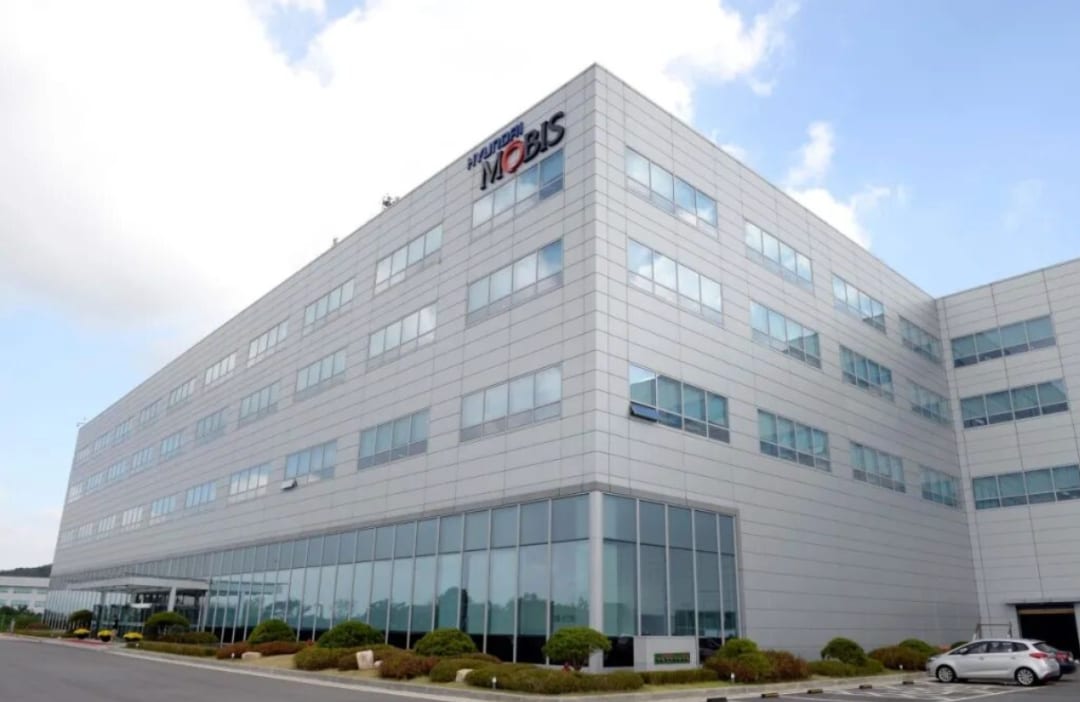
OPmobility's acquisition of Hyundai Mobis's lighting business carries an enterprise value of about US$443 million. The target already generated roughly €1.6 billion in revenue in 2025, with a positive operating margin. Yet the entire business was valued at only about €390 million, or 0.24 times the previous year's revenue.
A traditional lighting business with global plants, OEM customers and mature R&D is sizable, yet commands little capital value.
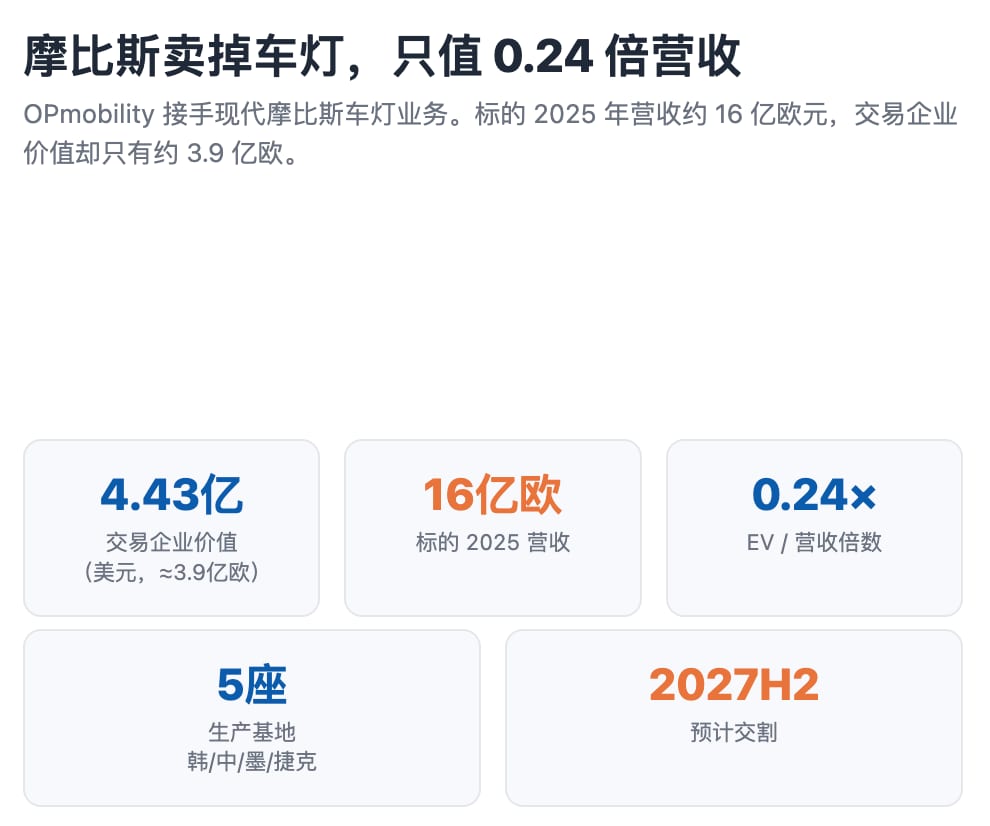
A revenue multiple alone does not make the asset cheap; full EBITDA, capital expenditure and debt details have not been disclosed. As lighting evolves from an illumination tool into an intelligent electronic system, the valuation logic for traditional complete-lamp makers is changing.
OPmobility wants the business to bind itself more tightly with Hyundai and Kia, integrating lighting and exterior trim into modules. Mobis sold it to free up capital and concentrate investment on electrification and automotive electronics.
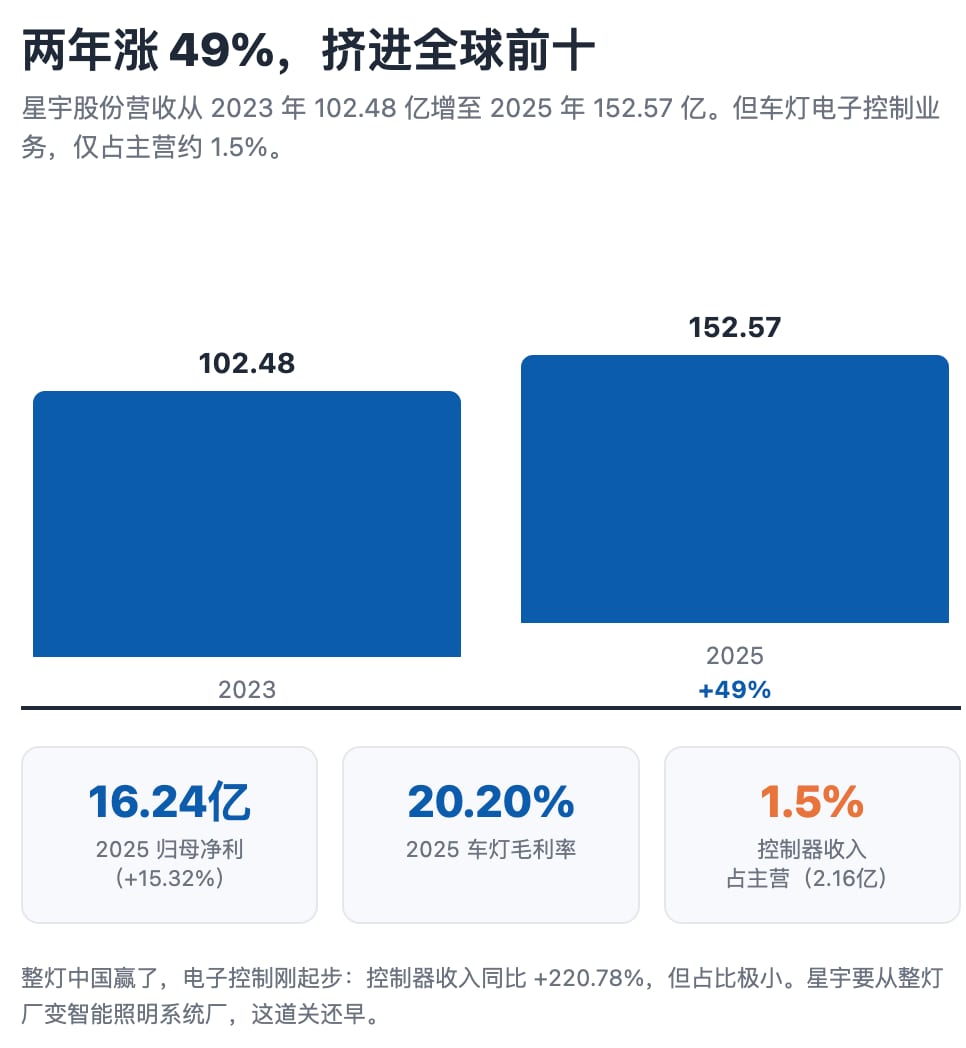
Xingyu is already a global top-ten lighting supplier. Its 2025 revenue reached RMB 15.257 billion, up 15.12% year on year, with net profit attributable to shareholders of RMB 1.624 billion, up 15.32%. From RMB 10.248 billion in 2023 to RMB 15.257 billion in 2025, cumulative growth over two years approached 49%.
Its customer base spans Volkswagen, Mercedes-Benz, BMW and Toyota, plus Chery, Geely, NIO, Li Auto, XPeng and Seres, without tying itself to any single automaker.
More striking is that automakers are entering the field themselves.
◎ BYD's FinDreams Vision focuses on automotive lighting R&D and manufacturing; when it was established in 2020, it was already developing more than 50 vehicle models and over 600 lighting products.
◎ Leapmotor's Huzhou super factory covers batteries, e-drives, domain controllers and lighting, with in-house development and manufacturing accounting for 65% of vehicle cost; lighting is a clearly defined in-house category.
◎ Great Wall Motor is building out complete lamps, optics modules and electronic controls through Mande Electronics. China's lighting sector is expanding, from specialist suppliers to automaker in-house systems.
Part 2
The chips are still in others' hands;localization is the next hurdle
The chips are still in others' hands: Xingyu's controllers account for just 1.5%
Break the lamp down into an electronic system and the contrast becomes clear.
Xingyu's 2025 lighting revenue was about RMB 14.362 billion, while controller revenue was only about RMB 216 million, up 220.78% year on year and accounting for roughly 1.5% of core revenue. Xingyu is pushing DLP, MicroLED and lighting controllers, but complete lamps still make up the bulk of revenue.
The lamps are made in China, but the MCUs running the control logic and the ICs driving them are mostly still imported.
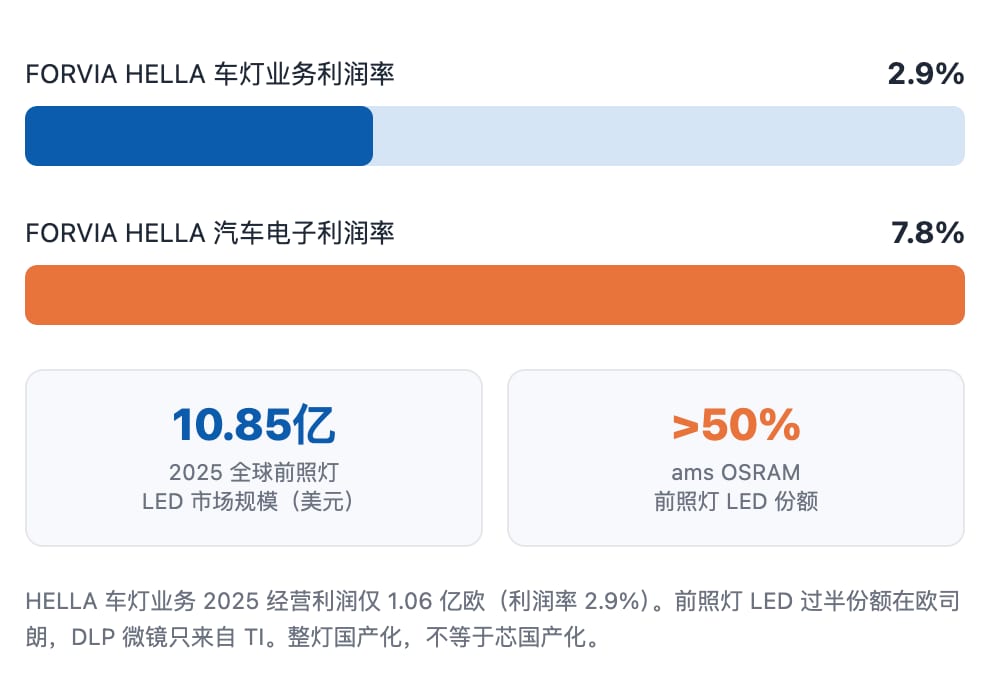
The light-source market is even more concentrated. According to TrendForce research in 2026, the global headlamp LED market was worth US$1.085 billion in 2025, with ams OSRAM holding more than 50% share.
In other words, no matter how many complete lamps Chinese makers build, orders for the most valuable light chip still land with OSRAM.
The headlamp of the NIO ET9 is a typical example: the complete lamp is system-integrated by Marelli, while the key pixel light source is ams OSRAM's EVIYOS HD25, with more than 25,000 independent pixels.
Chinese lighting makers can build the housings, but high-end light sources and drivers remain bottlenecked at upstream international suppliers.
ADB, MicroLED, DLP: the technology tier determines who captures the profit
Smart lighting falls into five tiers.
◎ Basic lighting uses LED light sources and lenses and is widely adopted.
◎ Adaptive lighting is matrix ADB, with automatic dimming to reduce glare, penetrating into more price segments.
◎ High-resolution lighting is HD-ADB and MicroLED, gradually expanding in high-end mass production.
◎ Digital projection is DLP and pixel projection, already in mass production but costly.
◎ Interactive lighting covers MiniLED, OLED and ISD light language, growing fast but constrained by regulations.
Two technology routes are worth comparing.
◎ ams OSRAM's EVIYOS HD25 uses 25,600 independently controlled pixels to shape the light pattern.
◎ Texas Instruments' DLP5531-Q1 modulates light with more than 1.3 million addressable micromirrors, supporting high-resolution road projection.
Pixel count alone cannot judge complete-lamp performance; light efficiency, thermal management and driving methods vary widely. But one thing is clear: these two core devices come from OSRAM and TI respectively, and neither is in the hands of Chinese lighting makers.
What truly builds barriers is ADB glare suppression, high-resolution beam control and long-term reliability, not how many LEDs are stacked.
A set of figures illustrates the operating pressure on complete-lamp makers. FORVIA HELLA's lighting sales were €3.7 billion in 2025, down 8.3% year on year, with operating profit of €106 million and an operating margin of just 2.9%. In the same year, its automotive electronics business posted a 7.8% operating margin. More technologically advanced complete lamps do not necessarily bring higher profits to lamp makers.
Complete-lamp makers must carry precision injection molding, optical development, electronic assembly, tooling, testing and validation, and factory depreciation, while some upstream light-source and chip companies can sell relatively standardized devices to multiple lamp makers.
So the two markets must be viewed separately.
◎ One is complete lamps: large in scale, but heavily affected by project development, manufacturing, customer bargaining power and capital expenditure.
◎ The other is light sources, driver ICs and electronic controls: smaller in scale, but with high technology concentration in some products.
Opportunities in China's lighting industry also fall into two categories:
◎ One is Xingyu and HASCO Vision Technology continuing to expand their global share in complete lamps,
◎ the other is domestic light sources, optical components, driver ICs and lighting controllers entering high-end supply chains.
What makes the automotive lighting industry most interesting is that it has both traditional component and modern automotive electronics dimensions.
◎ One end is tooling, injection molding, coating, assembly and project delivery,
◎ the other is semiconductor light sources, software, electronic control and high-resolution optics.
Hyundai Mobis selling its lighting business, OPmobility continuing to acquire, Xingyu chasing overseas customers, and BYD and Leapmotor raising their in-house ratios may look like opposite directions, but all reflect different corporate choices about industry division of labor and cost structure.
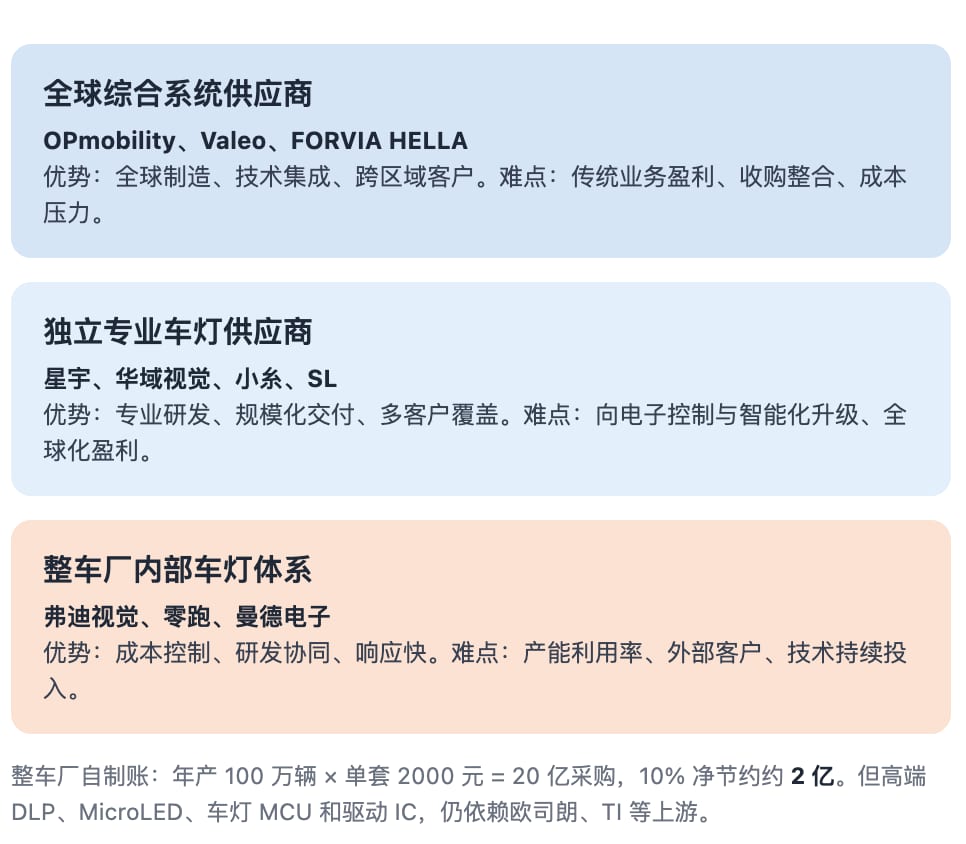
For Chinese suppliers, localization of complete lamps has already reached the global top ten; the next hurdle is localization of key components.
◎ Domestic and overseas project revenue and gross margins at Xingyu and HASCO Vision Technology will show whether globalization can truly make money.
◎ Complete-lamp capacity and external supply ratios at FinDreams Vision, Leapmotor and Mande will show how much of the independent Tier 1 market automaker in-house production is taking.
◎ Actual vehicle installation rates for ADB, HD-ADB, DLP and MicroLED will show whether technology upgrades can translate into market growth.
◎ What deserves the closest attention is whether domestic light sources, automotive lighting MCUs and driver ICs can win design wins in high-end projects. That step is the true watershed between localizing complete lamps and localizing key components.
Conclusion: the lamps are made in China
There are still opportunities in automotive lighting, but the room for different types of companies must be assessed separately. Traditional complete-lamp makers face installed-base competition and structural upgrading; the internationalization window is opening for Xingyu and HASCO Vision Technology; BYD and Leapmotor's in-house production will continue as part of vertical integration; and semiconductor and optical component companies are gaining new opportunities from the smart lighting upgrade.
Original title : Global automotive lighting reshuffle: Chinese automakers love making lamps, while Korea's Mobis sells its lighting business
Source: OFweek Optics Network · News · optics.ofweek.com