CAICT's Ao Li on Optical Communications Evolution Driven by AI Computing
Topics and contents
Ao Li, vice president of the China Academy of Information and Communications Technology (CAICT), said the optical communications industry is shifting from being driven by traditional telecom to being driven by AI computing, with next-generation communications networks and optical networks evolving in parallel. He noted that 1.6T is at the early commercialization stage globally, hollow-core fiber is already used for low-latency dedicated lines and cross-domain computing interconnects, and multi-core fiber is entering high-density data center cable scenarios. He expects optical circuit switching systems to form an optoelectronic hybrid architecture with electrical switching, while the relevant technology roadmaps continue to develop in parallel.
Comparing high-speed interconnects, hollow-core and multi-core fiber, and optical switching under AI computing demand provides context for understanding the engineering pace of each optical communications pathway.
C114 News, October 19 afternoon (Jiang Junmu) - The 2026 Global Optical Fiber and Cable Conference opened today in Wuhan, China Optics Valley. Ao Li, Vice President of the China Academy of Information and Communications Technology, said in a speech that the "six networks" proposed by the central authorities form the infrastructure system for economic and social development, with communications networks playing a key role both in maintaining existing communications and in enabling the development of other infrastructure. He estimated that the overall communications network ecosystem will be worth around 1 trillion yuan over the next five years, while the optical communications industry is shifting from traditional telecom-driven growth to AI intelligent-computing-driven growth, with the new-generation communications network and the new-generation optical communications network evolving in step.
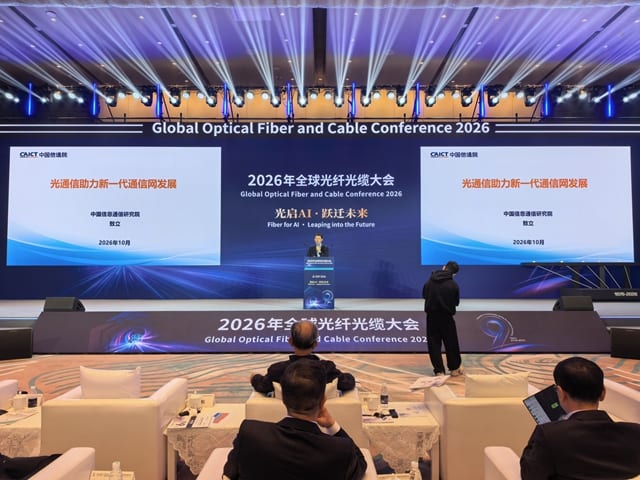
Ao Li summarized the changes in the new-generation communications network across several dimensions: communication targets are shifting from people to people, machines and things, and then to people, machines, things and intelligent agents; communication space is moving from two-dimensional terrestrial communications to integrated space-air-ground-sea communications; communication capabilities are evolving from speed and latency toward determinism and high reliability; and the relationship between communications and computing is moving from pure communications toward integrated communications and computing. In his view, these changes are not simple technology upgrades but a shift in the entire communications paradigm. As the underlying support, optical communications must adapt in step to the new targets, new spaces and new capability requirements.
Changing Communications Paradigm: From Transmitting Data to Transmitting Semantics, and from Public Communications to the Computing Power Bus
Traditional communications rely on layered architectures and standard protocols, with coding, error correction and transmission at their core; in essence, they carry information. Ao Li noted that three rapid shifts deserve attention. First, the move from transmitting data to transmitting semantics: voice communication is the form closest to the original state of information, and future communication paradigms will shift from conventional bit transmission to semantic transmission. Second, quantum communication has progressed from theory to practice, and quantum secure communications have now entered the deployment stage. Third, the configuration, policy and operation of future communications networks will change substantially.
The "genes" of communications are also changing. Ao Li explained that communications networks used to prioritize the transmission of public communications, with the core goal of reliably moving bits from one point to another. In the future, there will also be a computer bus that prioritizes storage and computing. In computing architectures, storage, computing and communications are inherently interdependent; a bottleneck in any one link exposes the system's weakest point. This is why future computing power will depend on high-bandwidth transmission to safeguard computational efficiency. The third gene is the persistent priority of industrial control. In the future, communications must not only enter factories and workshops, but also ensure high reliability and determinism for control networks. The coexistence of these three genes means that a communications network is no longer just about "delivering the signal"; it must simultaneously meet requirements for bandwidth, latency, determinism and reliability across different scenarios.
The convergence of AI and communications is another important direction. AI has a major impact on telecom networks. In the future, network operations and maintenance can reduce time-consuming and repetitive work, enable more precise network management, and support online dynamic energy saving, resource allocation, policy deployment, and communication performance visualization, as well as real-time monitoring, prediction, and adjustment of channel conditions on the wireless side, improving efficiency across the board. Operators already have many successful cases in this area, from base station energy saving to wireless optimization, and from fault handling to operations assistants, with AI playing an increasingly significant role.
Spatial expansion is also accelerating. Ao Li noted that traditional satellite communications relied on transparent forwarding, but now base stations are heading into space, where high- and low-latitude coordination and laser communications will play important roles. Optical communications will also extend to aerial, low-altitude and maritime links, and even onto vehicles; in the future, optical Ethernet could upend in-vehicle architectures. At the micro level, the trend toward optical interconnects is clear, and optical networks will converge with industrial control networks and the Internet of Vehicles, continuing to expand into environments such as extreme polar cold, underground mines and underwater settings.
In addition, the number of agents has nearly reached, and will soon exceed, the total human population. Interactions among agents, between agents and humans, with large models and with external tools all require communications support, while agent discovery, parsing and trusted communications still face many gaps in standards. A deeper impact lies in business models: the Internet has long monetized traffic, but agents could reshape the entire operating model and value system, and the citation rate of large models is becoming a new entry point for business models. Security is also being redefined - attack targets have shifted from networks and content to corpora and models. Once a corpus is poisoned, it will affect human cognition; using AI to attack AI boosts attack efficiency exponentially, and defense systems must move from patching to an intrinsic security architecture.
The expansion of agents is bringing a fundamental change in communication targets. Ao Li said the number of agents has nearly reached, or will soon exceed, the total human population. There are interaction processes between agents and agents, agents and humans, agents and large models, and agents and externally invoked tools. Going forward, the industry still faces many standards issues spanning agent discovery, parsing and trusted communications. Agents will also bring major changes to the Internet model: traffic used to be monetized, but in the future agents could change operating models, pricing systems and value systems, and the citation rate of large models will become an important commercial entry point.
The security paradigm is being redefined. Attack targets have shifted from networks and content to corpora and models. Once a corpus is poisoned, it will affect human cognition; using AI to attack AI boosts attack efficiency exponentially, and defense systems must move from patching to an intrinsic security architecture.
Coordination among the three new networks is also worth watching. Ao Li cited NVIDIA's saying that "the end of computing power is electricity," and said the CAICT estimates that electricity currently accounts for more than 50% of the cost of generating each Token. In future large-model business models, efficiency and economics will be crucial. Whether through hardware and chip iteration or large-model algorithm tuning, the essential goal is to use less electricity; locating computing power in places with cheap electricity, such as Inner Mongolia, can also lower Token costs. Coordination among communications networks, computing power networks and power grids is not just a concept, but a real constraint on the economics of computing power.
Changes in the optical communications industry: AI intelligent computing takes the lead, hollow-core fiber and multi-core fiber step into the spotlight
Discussing next-generation optical communication networks, Ao Li said plainly that the future of optical communications can only be driven by computing and AI. Demand from public communications for optical transmission density is not yet clear, and the main driver of future growth will be interconnection among AI computing centers. Overseas Scale-Across has reached a certain stage, and 1.6T is in the early phase of commercial deployment worldwide; in China, 800G adoption for AI computing center interconnection lags slightly in user scale, but industry players including Huawei and ZTE are already piloting and commercializing 1.6T-related products. The warm-up for 448G solutions in 2026 is building technical reserves for the subsequent breakthrough to 3.2T, with optical modules, DSP chips and other components preparing for high-bandwidth, high-speed transmission.
The fiber access market is in relatively better shape, as the global FTTH market is still in a new early-stage cycle overall. Large-scale deployment in China has entered a stable phase, but FTTH in Europe, the US, the Middle East, Africa and other countries and regions is moving from planning to implementation. Global FTTH scale is expected to grow gradually, and the future goal of Chinese optical fiber and cable companies is to expand overseas. Notably, FTTR, a concept that was dismissed when it first emerged, has now been accepted and begun to be deployed by many overseas operators. As a new expansion direction, PON technology will also move into vehicles and factories.
Hollow-core fiber was a focal point of discussion at the conference. Ao Li said that, in terms of technological innovation and industry, Chinese companies continue to iterate on hollow-core fiber performance and have carried out actual deployments, making China's hollow-core fiber industry a leading force globally. Hollow-core fiber is currently used mainly in low-latency intelligent private lines and cross-domain computing power interconnection scenarios. Sources revealed that financial institutions in Hong Kong are looking to deploy services using the low-latency properties of hollow-core fiber, although engineering challenges remain that require continued industry practice. Multi-core fiber was first deployed in submarine cables and is now entering high-density optical cable scenarios inside data centers. CCSA has released the first standard, and ITU is also advancing related standardization. Facing industrialization challenges, he suggested advancing through a model of "standards first, ecosystem co-building."
In optical interconnection, the technology iterates roughly every two to three years, from 400G to 800G and then to 1.6T. The CPO and LPO paths are not entirely the same. NVIDIA, Microsoft and others have begun using CPO at scale, and the market is gradually gaining volume, while China leans more toward LPO. In 2026, all technical approaches remain in parallel and have yet to converge. All-optical switching will be deployed at scale in computing centers first. Ao Li judged that, due to power consumption and cost factors, OCS systems will form an optoelectronic hybrid architecture with electrical switching. Google has been the first to commercialize OCS for the outer electrical switching network, and the future market capacity will be in the billions. Chinese companies are pursuing comprehensive independent breakthroughs, and many have already released related products.
In autonomous networks, Chinese operators are moving from L3 to implementation in high-value L4 scenarios, and all three major operators have announced results. However, reliability and hallucination issues of large models in network applications persist, and the lack of a cross-vendor semantic foundation remains a major challenge for AI to deeply empower communication networks. Integrated sensing and communication gives optical fiber another role: optical fiber sensing networks offer full-domain perception capabilities. ITU and CCSA are advancing standardization in parallel, and extensive exploration and practice have already taken place in scenarios such as earthquake monitoring and oil and gas pipeline monitoring.
From the migration of communication paradigms to the iteration of the optical communications industry, Ao Li's assessment follows a clear thread: AI is not only incremental demand but also a variable that reshapes the logic of communication networks and the optical communications industry. As communication targets expand from people to intelligent agents, as computing power interconnection replaces traditional telecom as the main driver of optical transmission, and as hollow-core fiber, multi-core fiber, CPO and OCS move from concept to engineering, the optical communications industry faces not a simple cyclical fluctuation but a realignment of technology roadmaps and the industrial ecosystem. Whoever gets the pace of standards, engineering and industrialization right in this realignment will take the initiative in the next round of optical communications competition.

Source: C114 Communications Network · Optical Communications · c114.com.cn