SIOM Achieves Fully Optical Arbitrary Control of Chirality and Ellipticity in Solid-State High-Harmonic Generation
上海光机所在量子几何调控高次谐波偏振方面取得重要进展
Topics and contents
A team from the State Key Laboratory of Ultra-Intense Laser Science and Technology at the Shanghai Institute of Optics and Fine Mechanics (SIOM) has achieved, for the first time, fully optical arbitrary control of chirality and ellipticity in solid-state high-harmonic generation through dynamical symmetry engineering and quantum geometric phase manipulation.
The original work presents an all-optical method for controlling the polarization of solid-state high harmonics, relevant to attosecond circularly polarized light sources
Shanghai Institute of Optics and Mechanics Achieves Major Advance in Quantum Geometry Control of High-Harmonic Polarization
Recently, a research team from the State Key Laboratory of Ultra-intense Laser Science and Technology at the Shanghai Institute of Optics and Fine Mechanics, Chinese Academy of Sciences, made a major breakthrough in strong-field quantum geometry and polarization control. Through dynamical symmetry engineering and quantum geometric phase manipulation, the team achieved, for the first time, fully optical arbitrary control of the chirality and ellipticity of solid-state high harmonics (Figure1). The results, published inPhysical Review Lettersunder the title “Chiral high-harmonic generation via subcycle symmetry engineering”, were featured on thePRLwebsite homepage as a highlight and also covered in a special report by the American Physical Society'sAPS Physics(Figure2).
Polarization control typically relies on passive optical elements such as birefringent waveplates, but their operating spectral range is limited by the material's transparency window, and their tuning speed is constrained by mechanical rotation. High-harmonic generation (HHG) can produce short-wavelength coherent light, but its polarization state is restricted by angular momentum conservation and material symmetry. Breaking through material and symmetry limits to enable fast, flexible control of the polarization state of short-wavelength light sources is therefore a key issue in strong-field light physics.
The core innovation of this work lies in actively manipulating quantum geometry with the light field to control high-harmonic polarization. The team used a phase-lockedω–2ωtwo-color field and, by adjusting the relative phase and intensity ratio, broke the combined time-reversal and half-cycle-translation symmetry of the driving field. This controls the quantum geometric phase in the electron dynamics, generating polarization components that are symmetry-forbidden under normal conditions and enabling continuous tuning of harmonic ellipticity and chirality.
Experimentally, the team validated the universality of the scheme in representative materials including the topological insulatorBi2Se3, theRashbasemiconductorBiTeI, and the layered semiconductorGaSe. By adjusting the relative phase of the two-color field, the harmonic polarization state can be continuously switched among right-handed circular, linear, and left-handed circular polarization, achieving ultrafast polarization control on a femtosecond scale. The method can also be extended to multiple harmonic orders and is expected to cover shorter wavelength ranges from the vacuum ultraviolet to the extreme ultraviolet, offering a new means of polarization control in spectral regions that conventional waveplates cannot reach.
The research team has long focused on solid-state high-harmonic generation driven by strong-field light waves and on ultrafast dynamics, carrying out a series of studies on high-harmonic generation from topological surface states[Nat. Phys. 17, 311 (2021)], nonadiabatic quantum geometric evolution[Phys. Rev. Lett. 133, 243801 (2024)], and ultrafast light-wave electronics in two-dimensional materials[Phys. Rev. B 112, 174306 (2025)]. This study further extends the application of dynamical symmetry and quantum geometry to nonlinear optical polarization control. The American Physical Society'sPhysicsmagazine published a special report titled “Tuning Light Polarization with Quantum Geometry”, noting that the method differs from conventional birefringent polarization techniques and could be used for chiral molecular spectroscopy and ultrafast optical information storage based on the polarization degree of freedom.
This work was supported by the National Natural Science Foundation of China, the Youth Innovation Promotion Association of the Chinese Academy of Sciences, and the CAS Youth Team Program for Basic Research in Stable Support Fields, among others.
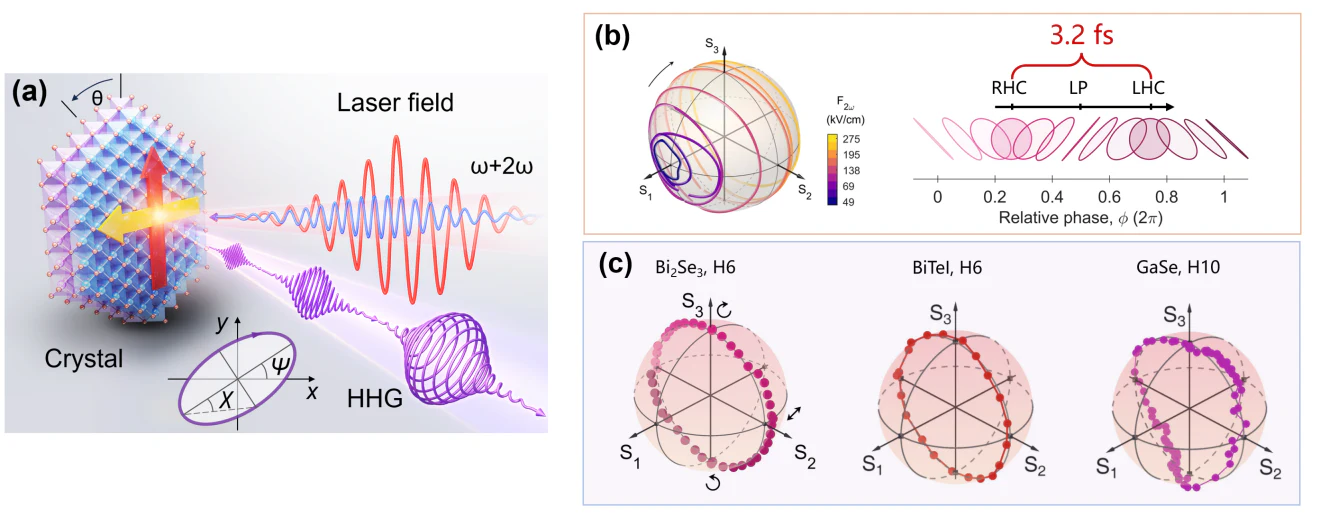
Figure 1: Principle and experimental results of high-harmonic polarization and chirality control driven by a two-color field
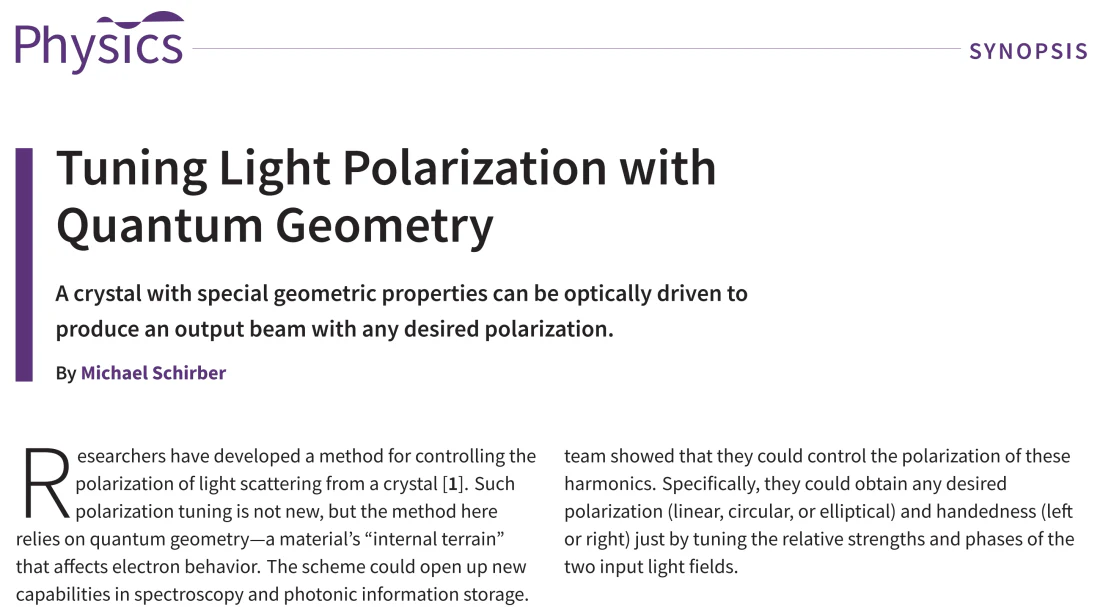
Figure 2: Special coverage of this work by Physics, published by the American Physical Society
Source: Shanghai Institute of Optics and Fine Mechanics (SIOM) · Research Updates · siom.cas.cn