Xi'an Institute of Optics and Mechanics Makes Progress in High-Repetition-Rate, High-Energy Ultrafast Thin-Disk Lasers
中国科学院西安光机所在高重频大能量超快薄片激光器方面取得新进展
Topics and contents
A team led by Fu Yuxi and Cao Huabao at the Xi'an Institute of Optics and Mechanics has made new progress in high-repetition-rate, high-energy ultrafast thin-disk lasers.
The source article provides specific data and details that help assess actual progress in this direction
Recently, a team led by researchers Fu Yuxi, Cao Huabao, and Liu Keyang at the State Key Laboratory of Ultrafast Laser Science and Technology reported new progress in high-repetition-rate, high-energy ultrafast thin-disk lasers, with the results published in Optics Letters.
High-repetition-rate, high-energy picosecond thin-disk lasers can generate few-cycle mid-infrared femtosecond light through frequency conversion. Known in the community as "third-generation" femtosecond laser technology, they are key drivers for high-performance attosecond light sources. Currently, commercial Yb:YAG thin-disk lasers all use heat-sink-based indirect cooling. The core process — bonding the thin-disk crystal to the heat sink — is technically demanding and has a high barrier to entry, long constraining the independent development of China's high-end ultrafast laser equipment.
To address this challenge, the team adopted an innovative direct liquid-cooling approach using hundred-micrometer-scale Yb:YAG thin-disk crystals, breaking through the process bottlenecks of high-power, high-energy thin-disk laser heads and mastering the full chain of core proprietary processes.
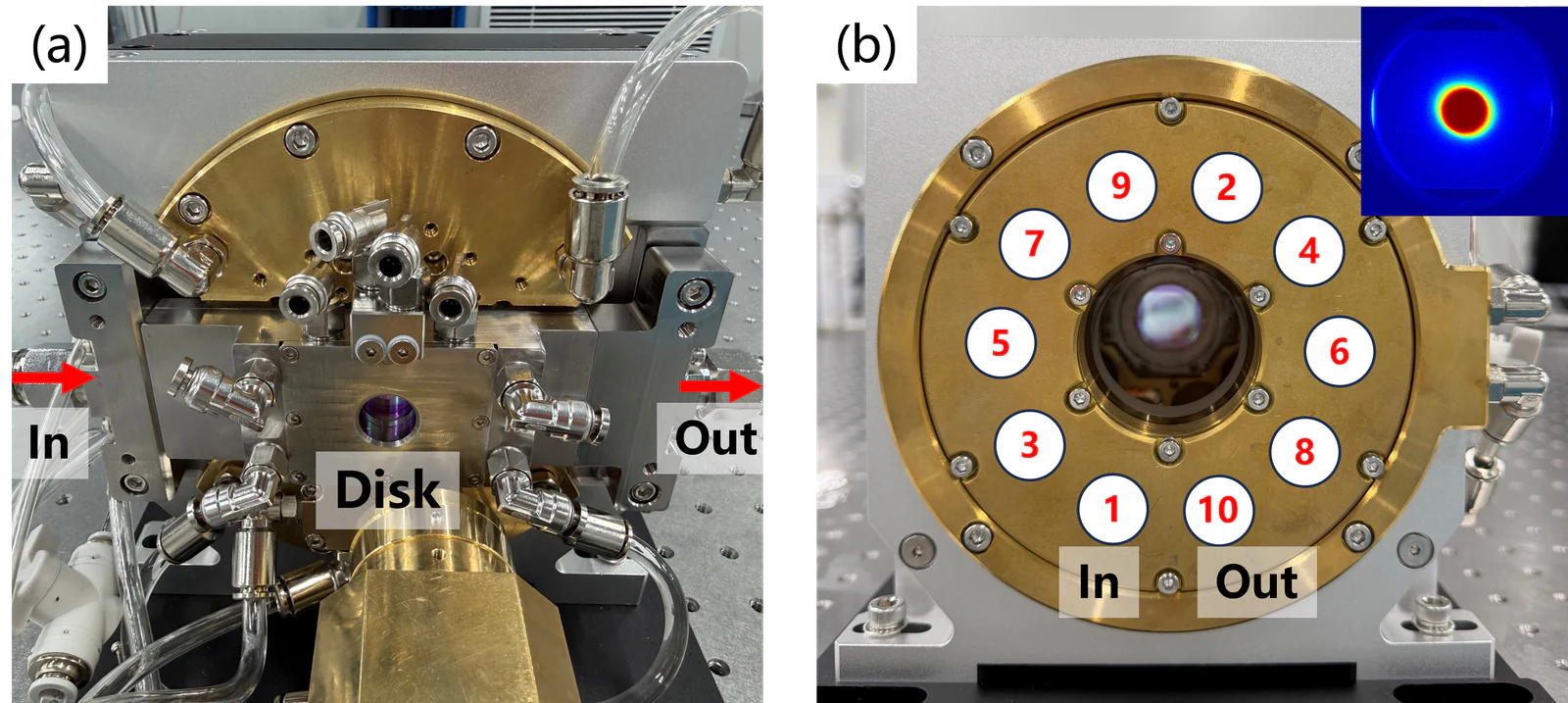
Figure: Photos of key core components: (a) thin-disk laser head and (b) pump module
In the laser head design, the team integrated multiple thin disks into a single head and improved heat extraction by increasing the number of coolant channels and the coolant flow rate. The beam passes through the gain medium, reducing beam distortion caused by thermal deformation of the material, while flexible mounting greatly relieves deformation from thermal expansion, reliably ensuring high beam quality output. A multi-pass pump structure was also used to fully absorb the diode pump laser, enabling a compact thin-disk laser head design.
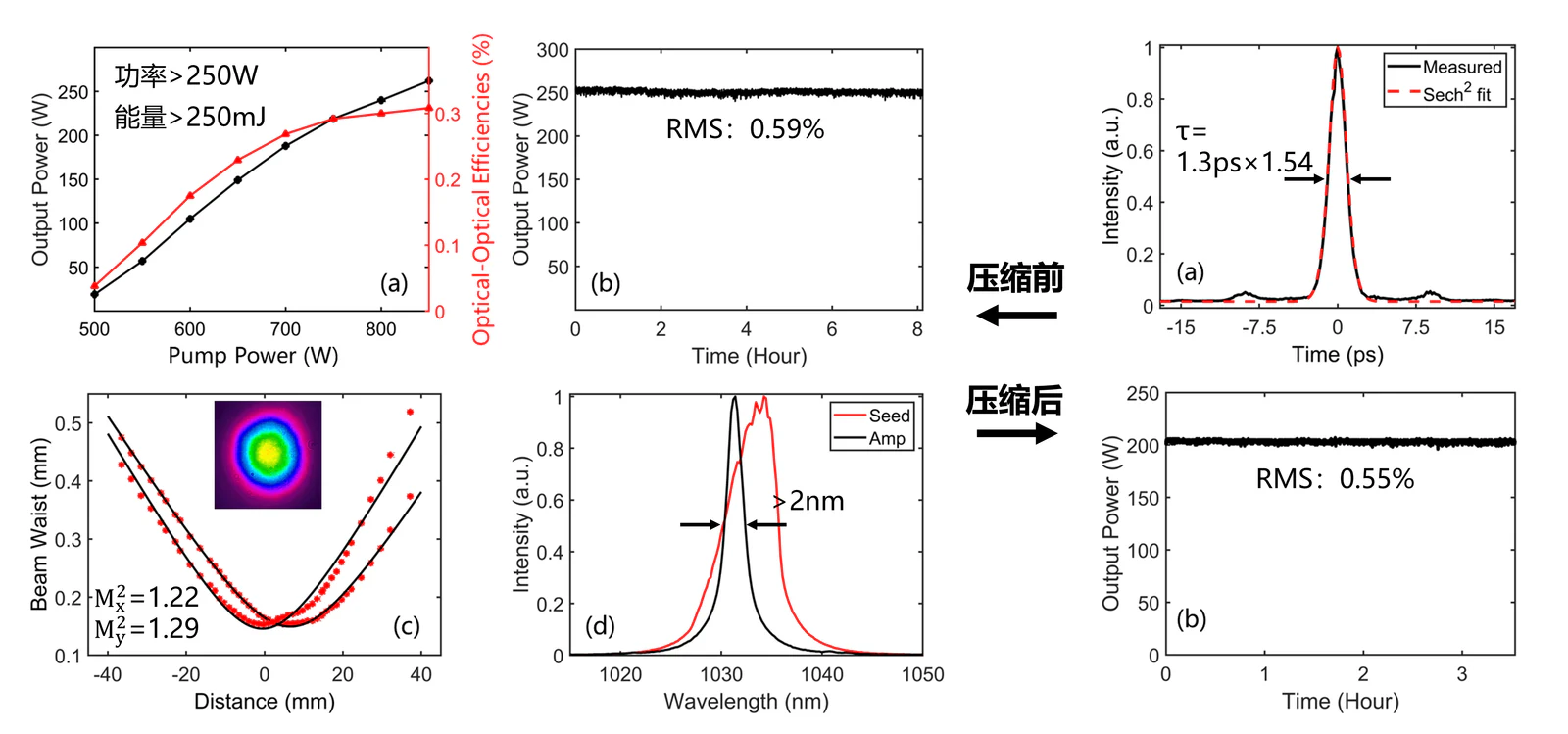
Figure: Performance testing of the high-repetition-rate, high-energy picosecond thin-disk laser
Using a chirped pulse amplification (CPA) architecture, the team built a single-head ring regenerative amplifier based on an in-house developed directly liquid-cooled Yb:YAG thin-disk laser head. It delivers picosecond pulses at a 1 kHz repetition rate, with average power >200 W and pulse energy >200 mJ, matching the specifications of TRUMPF's Dira-200. This is the highest energy achieved internationally at kHz repetition rates using a directly liquid-cooled Yb:YAG thin-disk laser head.
Liu Keyang explained: "Commercial products use 'indirect cooling,' in which the thin-disk crystal is 'welded' onto a heat sink, placing extremely high demands on the 'welding' process. Our approach lets the coolant flow rapidly and stably in direct contact with the crystal surface, carrying away the generated heat. This improves cooling efficiency without compromising beam quality, while keeping the system compact, and the achieved specifications match comparable international products."
This result offers a new technological pathway for China's independent and controllable development of high-end ultrafast laser equipment, and will provide solid technical support for the construction of major national science and technology infrastructure facilities.
Source: Xi'an Institute of Optics and Fine Mechanics (XIOPM) · Research Progress · opt.cas.cn