SIOM Makes Progress in High-Repetition-Rate, High-Power Ultrafast Lasers
Topics and contents
SIOM has made progress in research on high-repetition-rate, high-power ultrafast lasers.
The source provides specific data and details that help assess actual progress in this direction
Excellent Innovation Brief on Ultra-Intense Laser Science
(Issue 808)
July 31, 2026
Shanghai Institute of Optics and Fine Mechanics Reports Progress in High-Repetition-Rate, High-Power Ultrafast Lasers
Recently, a research team from the State Key Laboratory of Ultra-Intense Laser Science and Technology at the Shanghai Institute of Optics and Fine Mechanics, Chinese Academy of Sciences, made progress in high-repetition-rate, high-power ultrafast lasers. The related results, titled "High-power Innoslab amplifier with a multi-segmented composite Yb:YAG crystal", were published in High Power Laser Science and Engineering.
High-repetition-rate, high-power ultrafast lasers are an important direction in the current development of laser technology worldwide, with broad application prospects in advanced manufacturing, strong-field physics, high-harmonic generation, precision measurement, and semiconductor processing. As laser output power continues to rise, the thermal load on the gain crystal inside the laser amplifier increases rapidly. In conventional uniformly doped Yb:YAG crystals, large temperature gradients and thermal stresses limit performance, reducing amplification efficiency and beam quality while increasing the risk of thermal damage or even thermal fracture of the crystal.
This study proposes and demonstrates a high-power Innoslab ultrafast laser based on a multi-segment composite-doped Yb:YAG crystal structure. Experimental comparisons were conducted between a conventional uniformly doped 2% Yb:YAG crystal and a newly designed 2%+3%+2% multi-segment composite-doped Yb:YAG crystal. Unlike the conventional crystal, the multi-segment composite-doped crystal increases the doping concentration in the middle region, allowing the pump beam to be absorbed more uniformly along the propagation direction. This effectively reduces the temperature gradient inside the crystal, laying the foundation for high output power. The structure of the high-power Innoslab laser amplifier is shown below.
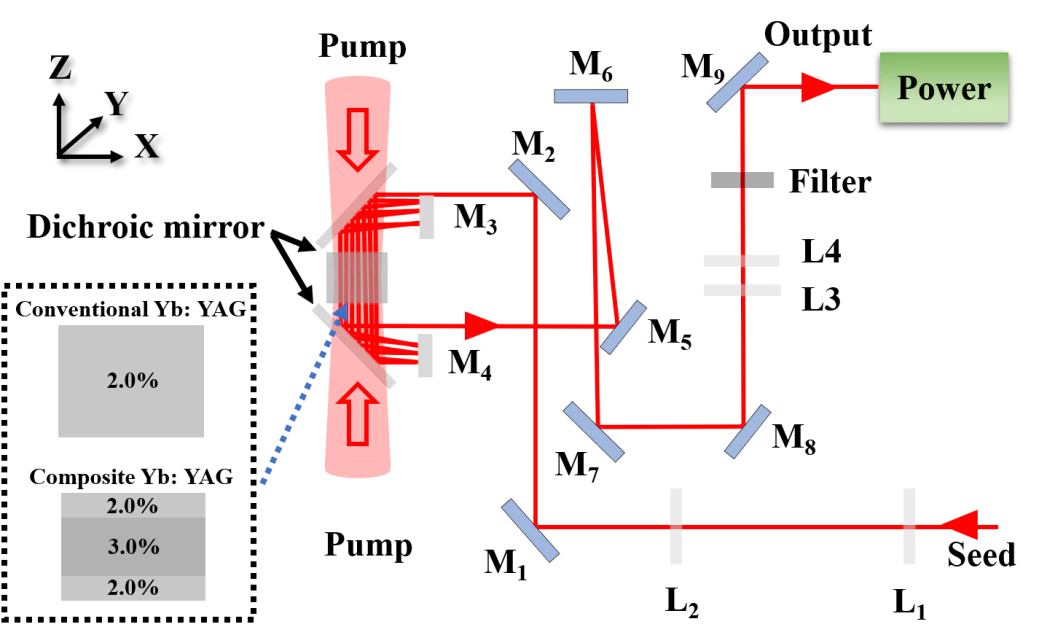
Figure 1 Innoslab laser amplifier structure and schematic of the multi-segment composite-doped Yb:YAG crystal
Experimental results show that with a pump power of 630W and a seed injection of 20W, the conventional uniformly doped crystal produced an output power of 211W, while the multi-segment composite-doped crystal further increased the output power to 245W, raising the optical-to-optical conversion efficiency from 33.4% to 38.9%. Meanwhile, the small-signal gain increased from 1.9 to 3.4, enabling high amplified output even with low-power seed light and fully demonstrating the advantages of the multi-segment composite-doped crystal. Thanks to the more uniform temperature field inside the crystal, the high-power Innoslab laser based on the multi-segment composite-doped crystal achieves excellent beam quality of M²=1.21×1.25, along with good long-term stability: output power stability over 1 hour of continuous operation is 0.11% (RMS), and pointing stability over 30 minutes is 7.33μrad and 7.76μrad in the X and Y directions, respectively. Compared with conventional uniformly doped Yb:YAG crystals, the multi-segment composite-doped crystal shows clear advantages in output power, amplification efficiency, beam quality and stability. In the future, this technology is expected to be extended to ultrafast laser systems with higher average power, providing efficient and reliable laser sources for advanced scientific research and applications.
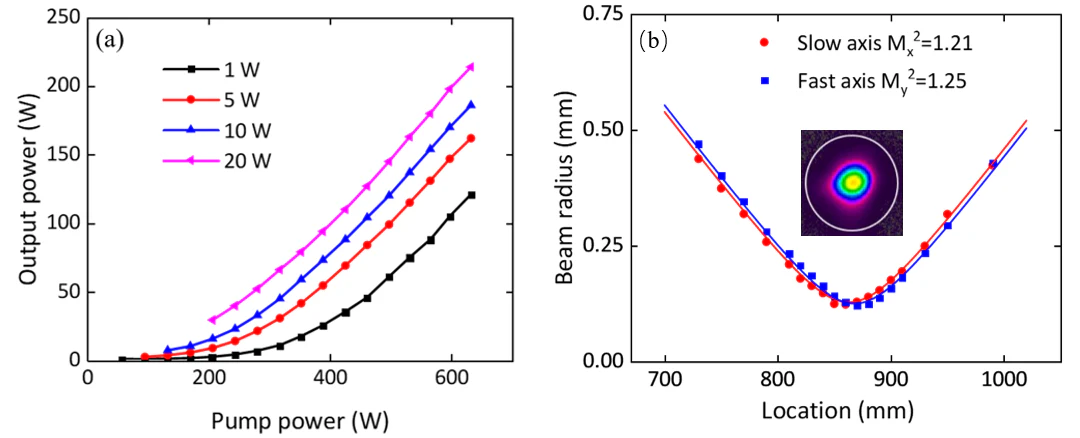
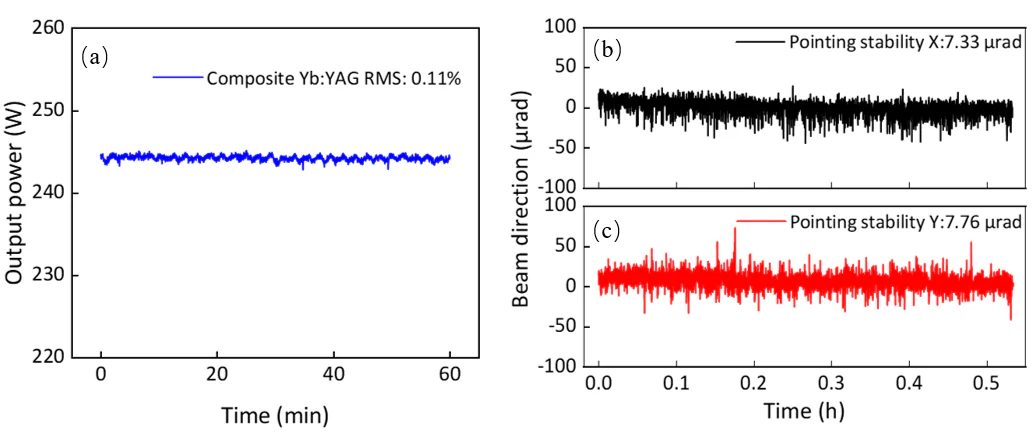
Figure 2 Output performance and stability of the high-power Innoslab laser
Source: Shanghai Institute of Optics and Fine Mechanics (SIOM) · Research Updates · siom.cas.cn