Changchun Institute of Optics and Mechanics MTC-Designed Quantum Cascade Laser Achieves 1.2 µm Ultrabroad Lasing Spectrum at Room Temperature
Topics and contents
A team led by researcher Meng Bo at the Changchun Institute of Optics and Mechanics published a paper in Light: Science & Applications proposing a multistate-to-continuum (MTC) active-region design based on diagonal transitions, and used MOCVD to grow a mid-infrared quantum cascade laser with a single active region and an ultrabroad gain spectrum.
The diagonal-transition design from multiple states to continuum states lets several transition channels contribute gain simultaneously. The original text gives lasing spectral widths of 1.2 µm at room temperature and 1.93 µm at 80 K, directly relevant to applications such as mid-infrared frequency combs.
Changchun Optics Institute Achieves New Breakthrough in Broadband Mid-Infrared Quantum Cascade Lasers
Published: 2026-04-16
Recently, a team led by Researcher Meng Bo at the Changchun Institute of Optics, Fine Mechanics and Physics, Chinese Academy of Sciences, published a research paper in Light: Science & Applications titled "Ultra-broadband single-stack mid-infrared semiconductor lasers grown by MOCVD." The team proposed a novel active-region design for mid-infrared single-core quantum cascade lasers (MTC design), achieving quantum cascade lasers with ultra-broad gain spectra and ultra-broad room-temperature lasing spectra, making them key devices for cutting-edge applications such as widely tunable mid-infrared laser sources, ultrashort pulse generation, and mid-infrared optical frequency combs.
Limited by the design complexity of active-region band engineering, the electroluminescence spectral full width at half maximum (FWHM) of current long-wave infrared single-active-region quantum cascade lasers is generally below 600 cm-1 (the achievable spectral width falls far short of 1 μm), severely constraining their application potential in scenarios such as broadband spectral control and precision measurement.
Diagonal Multi-State-to-Continuum Design
The research team proposed a multi-state-to-continuum (MTC) active-region design scheme based on diagonal transitions, with the structure built using a strain-compensated material system. After optimization, two injector energy levels (4 and 6) form strong coupling with the upper laser level 5 of the active region. Electrons can undergo diagonal transitions from the three upper laser levels (4-6) to the lower laser levels (1-3), with multiple transition channels contributing gain simultaneously, significantly broadening the gain bandwidth of the active region.
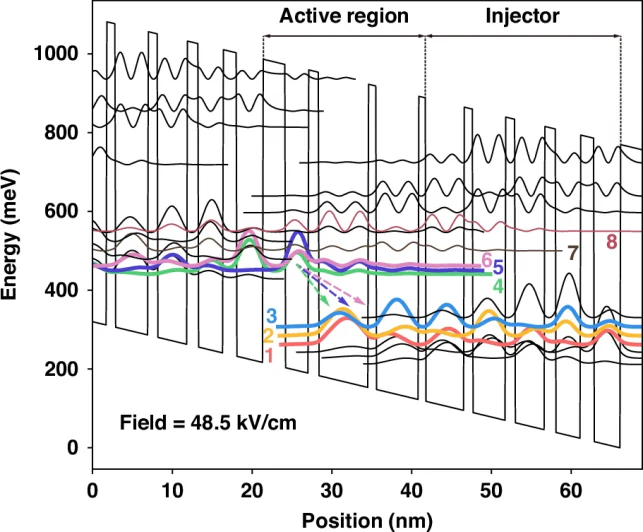
Energy band diagram of the ultrabroadband MTC-designed quantum cascade laser
Ultrabroad electroluminescence spectrum
In the experiments, epitaxial growth was carried out using metal-organic chemical vapor deposition (MOCVD), and quantum cascade laser devices with mesa and Fabry-Perot (FP) structures were fabricated separately. Under pulsed conditions, the electroluminescence (EL) spectra of the mesa-structure device were measured over a bias range of 11 V to 16 V. At 298 K and a bias voltage of 11 V, the EL spectrum reached a maximum full width at half maximum of 75.6 meV, the broadest EL width reported to date in the long-wave infrared band.
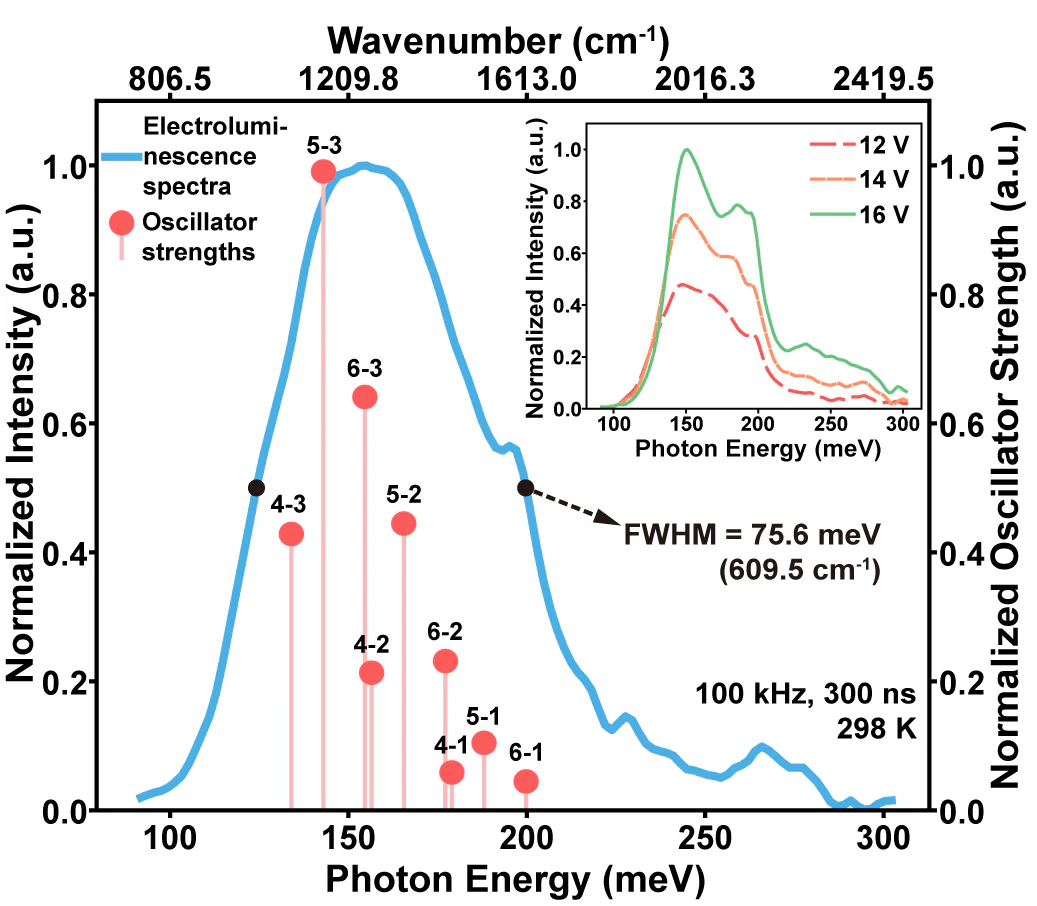
Comparison of oscillator strength and electroluminescence (EL) spectrum of the ultrabroadband MTC-designed quantum cascade laser
Ultrabroad laser spectrum
The device's laser spectral characteristics at different injection currents within its current dynamic range are as follows: near the threshold current, the device exhibits a narrowband laser spectrum with a center wavelength of 8.8 µm. As the injection current increases to 2.5 A, the spectral width gradually broadens with rising current while the center wavelength red-shifts, eventually reaching 9.2 µm. As the current is further increased to the rollover current, the laser spectral width continues to broaden to 1.2 µm and the center wavelength blue-shifts, stabilizing at 8.0 µm. The 1.2 µm spectral width represents the broadest laser spectrum achieved at room temperature by a quantum cascade laser with a single active region at comparable wavelengths. The same device achieved a laser spectral width of 1.93 μm at 80 K.
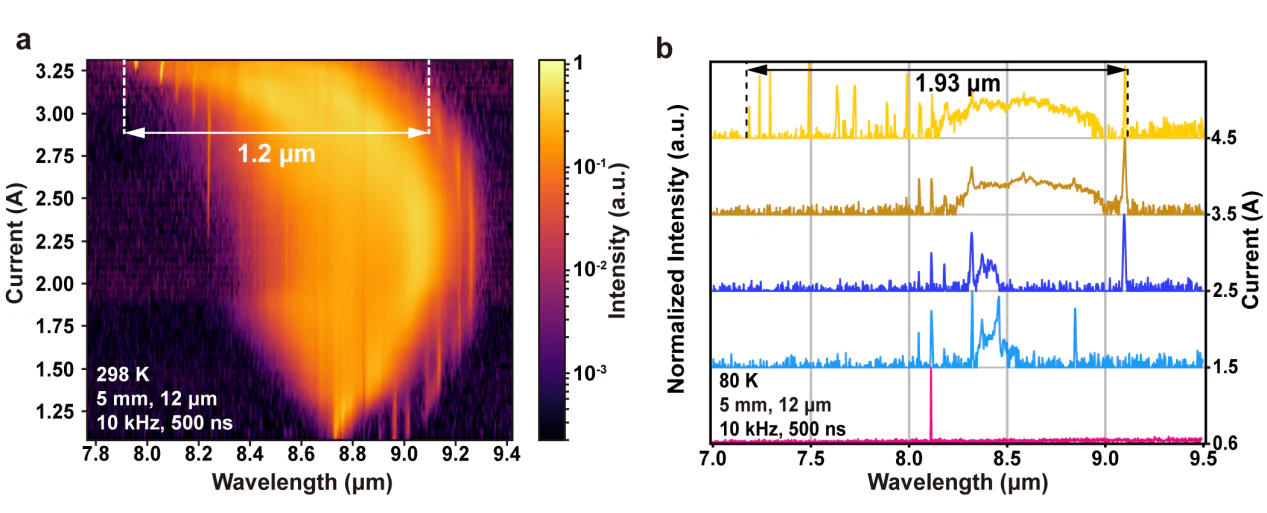
Ultra-broadband MTC-designed quantum cascade laserspectra at room and low temperatures
Technical innovation enables multidimensional applications
The work overcomes the key limitation of spectral bandwidth in single-active-region QCLs, opening a new route to integrated, high-efficiency light sources for mid-infrared frequency combs, high-precision broadband spectroscopic sensing, imaging and free-space communications.
This research was supported by the National Natural Science Foundation of China, the Jilin Province Science and Technology Development Plan, and other projects. Researcher Meng Bo of Changchun Institute of Optics, Fine Mechanics and Physics (CIOMP) is the corresponding author; Liu Peng, a doctoral student at CIOMP, is the first author; and Professor Wang Qijie of Nanyang Technological University and others provided important assistance to this work.
Original paper: https://doi.org/10.1038/s41377-026-02268-8
Source: Changchun Institute of Optics, Fine Mechanics and Physics (CIOMP) · Research Progress · ciomp.cas.cn