SIOM Achieves High-Power Few-Cycle Pulse Compression with Dispersion-Engineered Multi-Pass Cell
上海光机所在高功率少周期超快激光研究方面取得进展
Topics and contents
A team from the State Key Laboratory of Ultra-Intense Laser Science and Technology at the Shanghai Institute of Optics and Fine Mechanics (SIOM) has achieved few-cycle nonlinear pulse compression in a dispersion-engineered folded multi-pass cell, producing high-power few-cycle ultrafast laser pulses. The results were published in Optics Letters.
The original article presents a multi-pass cell compression scheme for few-cycle pulses, offering useful reference for high-power ultrafast lasers
Shanghai Institute of Optics and Mechanics Reports Progress in High-Power Few-Cycle Ultrafast Lasers
Recently, a research team from the State Key Laboratory of Ultra-Intense Laser Science and Technology at the Shanghai Institute of Optics and Fine Mechanics, Chinese Academy of Sciences, made progress in high-power few-cycle ultrafast lasers. The results were published in Optics Letters under the title "Few-cycle nonlinear pulse compression in a dispersion-engineered folded multi-pass cell".
High-power few-cycle ultrafast lasers are the core light sources driving high-harmonic generation, isolated attosecond pulse production, and extreme-ultraviolet and X-ray radiation, with important application prospects in frontier fields such as ultrafast science, precision measurement, and advanced imaging. To improve signal-to-noise ratio and photon flux, the driving source must combine few-cycle pulse duration with high average power. Although high-power Yb-doped lasers can deliver average powers on the order of hundreds of watts, their limited gain bandwidth typically restricts output pulse durations to hundreds of femtoseconds or picoseconds, making it difficult to directly meet few-cycle requirements. Nonlinear pulse compression based on self-phase modulation (SPM), particularly the multi-pass cell (MPC) scheme, has become a key approach to breaking the pulse-duration limit, thanks to its high transmission efficiency, excellent beam quality, and good energy scalability. However, once the spectral broadening is sufficient to support a transform-limited pulse duration below 30 femtoseconds, dispersion rapidly stretches the pulse and reduces peak power, suppressing further spectral broadening and producing a saturation effect that makes few-cycle nonlinear pulse compression difficult to achieve.
To address this challenge, the study proposes and demonstrates a nonlinear pulse compression device based on a dispersion-engineered folded MPC (dispersion-engineered folded MPC). The device folds the beam path through multiple reflections from additional plane mirrors, giving a compact structure with a footprint of only 0.55 m × 0.15 m. Notably, the team replaced one of the plane mirrors with a commercial chirped mirror, with specifications precisely selected using a 3D simulation model, enabling accurate dispersion management without relying on highly customized components. In this folded MPC, the influence of dispersion on pulse evolution during nonlinear propagation is essentially eliminated, the pulse duration remains stable, and SPM-dominated spectral broadening continues, effectively overcoming the saturation effect and laying the foundation for few-cycle pulse compression. The dispersion-engineered folded MPC device and its equivalent optical path are shown below.
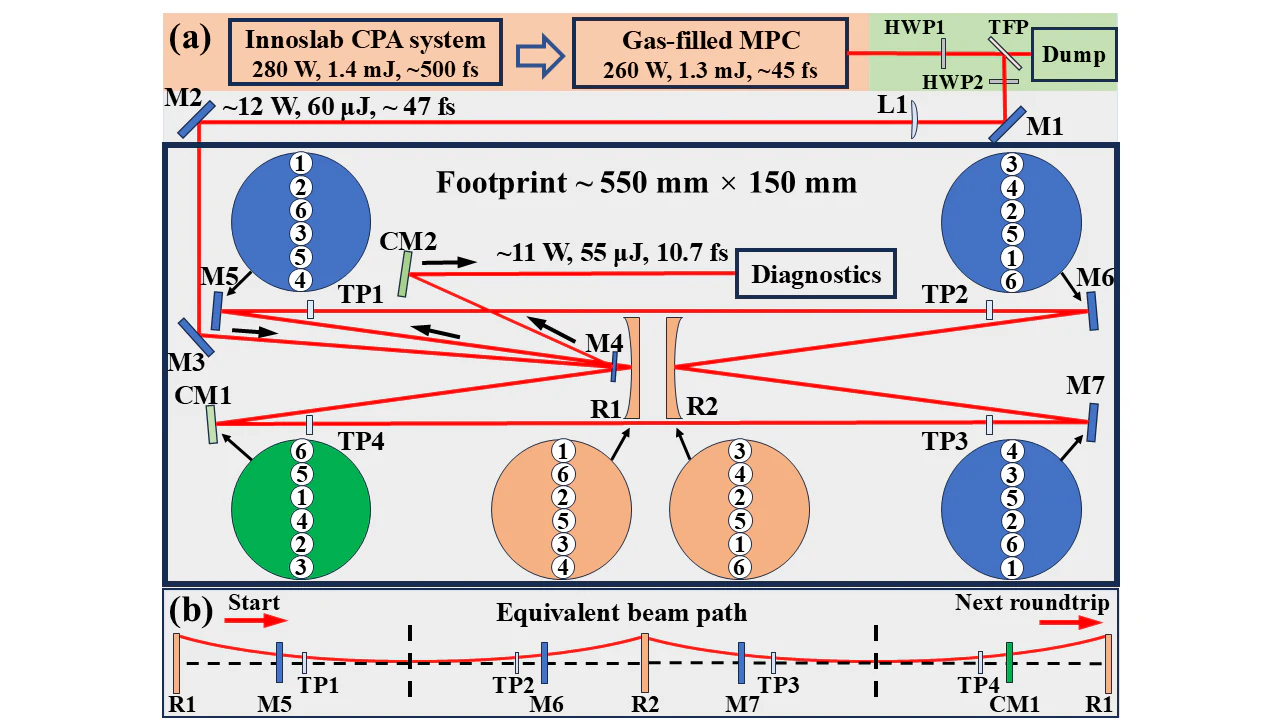
Figure 1: Schematic of the dispersion-engineered folded MPC device (a) and its equivalent optical path (b)
After spectral broadening in the dispersion-engineered folded MPC, compensation with just a single chirped mirror compressed the output pulse duration from 47 femtoseconds to 10.7 femtoseconds, a compression ratio of 4.4 times, with transmission efficiency above 90% and excellent beam quality maintained (M²≈1.3). To further reveal the role of dispersion engineering in the nonlinear process, the team also replaced the chirped mirror with a standard ultrafast plane mirror and compared experimental and simulation results with and without dispersion engineering at different numbers of round trips, as shown in Figure 2. Numerical simulations solved the nonlinear Schrödinger equation (NLSE) using the split-step Fourier method; experiment and simulation agreed closely in both spectral broadening and pulse evolution, validating the reliability of the model for designing dispersion-engineered MPCs. The comparison shows that in an MPC without dispersion engineering, spectral broadening clearly saturates in the second half of the process, and the Fourier transform-limited (FTL) pulse duration essentially stops changing. With dispersion engineering, however, the spectrum continues to broaden substantially, and the FTL pulse duration keeps shortening with increasing round trips, ultimately reaching the few-cycle regime. The difference stems from the pulse evolution: without dispersion management, the pulse rapidly stretches beyond 200 femtoseconds, severely weakening SPM efficiency; with the dispersion-engineered design, pulse propagation remains stable and the SPM effect stays effective, breaking through the saturation limit. This dispersion-engineered folded MPC also offers structural advantages for energy scaling and is expected to become an important technical route for high-power few-cycle ultrafast laser sources, further advancing fields such as attosecond science and extreme-ultraviolet light sources.
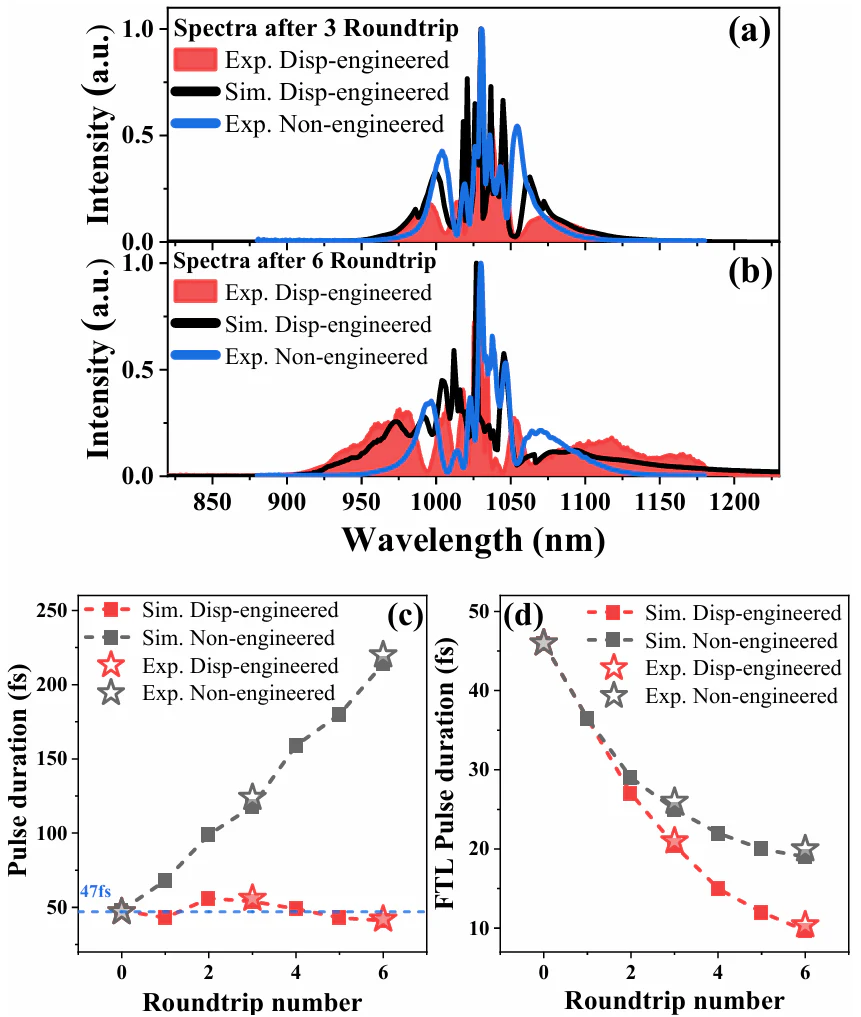
Figure 2 Experimental and simulated results of spectral broadening and pulse evolution at different pass numbers in a dispersion-engineered folded MPC
Source: Shanghai Institute of Optics and Fine Mechanics (SIOM) · Research Updates · siom.cas.cn