SIOM proposes programming coherent and quantum light sources with free-electron wave packets
上海光机所在自由电子激光和量子光源研究中取得重要进展
Topics and contents
Researcher Tian Ye and Academician Li Ruxin's team at the Shanghai Institute of Optics and Fine Mechanics (SIOM), together with Researcher Pan Yiming of ShanghaiTech University and others, have proposed a new mechanism that uses the quadratic phase accumulated during the propagation of free-electron quantum wave packets to simultaneously achieve selectable high-harmonic bunching and synthesis of non-classical quantum light sources, linking quantum state control, high-harmonic radiation and quantum light synthesis.
The original work proposes a unified framework for free-electron lasers and quantum light sources, offering useful insights for novel light source research
Shanghai Institute of Optics and Mechanics Reports Major Advances in Free-Electron Lasers and Quantum Light Sources
Recently, a team led by researcher Tian Ye and Academician Li Ruxin from the State Key Laboratory of Ultra-Intense Laser Science and Technology at the Shanghai Institute of Optics and Fine Mechanics, Chinese Academy of Sciences, together with researcher Pan Yiming of ShanghaiTech University, proposed a new mechanism: using the quadratic phase accumulated by a free-electron quantum wavepacket as it propagates in space, they simultaneously achieved selective high-harmonic bunching and the synthesis of nonclassical quantum light sources, establishing a new conceptual framework linking quantum state control, high-harmonic radiation and quantum light synthesis. The results were published in Physical Review Letters as “Programming Coherent and Quantum Light with a Free-Electron Wavepacket.”
Free-electron lasers are the primary source of high-brightness, short-wavelength coherent radiation, while quantum light sources are a key resource for quantum information processing. Achieving flexible, programmable control of a light source's spectrum and quantum state while maintaining high coherence has long been a scientific goal at the intersection of advanced light sources and quantum technology. Conventional advanced free-electron laser schemes, such as high-gain harmonic generation (HGHG) and echo-enabled harmonic generation (EEHG), rely on “layer-by-layer shaping” of the electron beam, externally controlling it stage by stage through cascaded modulators and magnetic compression sections; the systems are complex and susceptible to collective instabilities. Quantum free-electron lasers purify the spectrum via the quantum recoil effect, but impose extremely stringent requirements on beam quality—electrons must have very small energy spread, low emittance and high energy stability—to enter the quantum regime dominated by single-photon recoil. Is it possible to break free of both the “external shaping” and “extreme quality” constraints, and let the electrons' own quantum evolution do the job?
The team drew inspiration from the classical optical Talbot effect: a periodic optical field, as it propagates freely, “self-replicates” at specific distances due to coherent interference among its components. They found that a free-electron quantum wavepacket undergoes a corresponding quantum Talbot evolution—after modulation by an optical field, the electron's different energy components accumulate different phases in vacuum and coherently recombine at specific distances, causing the probability density to spontaneously form periodic, dense structures. This is essentially a “self-bunching” effect: unlike the statistical bunching of large numbers of electrons in conventional free-electron lasers, the bunching here arises from quantum interference within a single electron wavepacket, extending the concept of bunching from classical beams to the level of single-electron quantum wavepackets.
Based on this effect, the team realized two output channels. The first is selective high-harmonic radiation: at specific fractional Talbot distances (such as 7.96 mm), the electron density self-organizes into a high-contrast ultrafast density comb, selectively enhancing the 30th, 60th and 90th harmonics while naturally suppressing the others, with no need for external seed light or filters. The second is nonclassical quantum light synthesis: the modulated electrons interact with a quantum microcavity, and by measuring the change in electron energy, the quadratic phase preprogrammed in the wavepacket is “transferred” to the optical field, generating nonclassical photon states such as multi-component Schrödinger cat states. The scheme is highly robust against perturbations such as phase noise and finite sideband bandwidth, and continuous tuning from harmonic selection to quantum cat-state control requires adjusting only one parameter—the electron's free propagation distance.
This work redefines the meaning of free-electron bunching at the quantum wavepacket level and introduces a new paradigm in which bunching is generated and controlled by single-electron quantum interference. For free-electron lasers, it avoids the reliance of conventional HGHG/EEHG schemes on multistage modulators and demonstrates the possibility of intrinsic harmonic selection using vacuum drift alone; for quantum light sources, it bypasses the dependence on material nonlinearity or probabilistic methods, offering a new precompilation approach for deterministic, programmable quantum light synthesis. This expands the role of free electrons from a traditional ‘radiation source’ to a programmable carrier of quantum states, opening theoretical space for future electron-photon hybrid quantum control.
Zhu Songyu, a 2025 joint PhD student at the Shanghai Institute of Optics and Fine Mechanics, Chinese Academy of Sciences, and ShanghaiTech University, is the first author, and Associate Researcher Zeng Yushan is the co-corresponding author. This work was supported by the NSFC Distinguished Innovation Group (formerly the Basic Science Center Program), the Young Scientists Fund A, and the Shanghai Basic Research Special Zone Program.
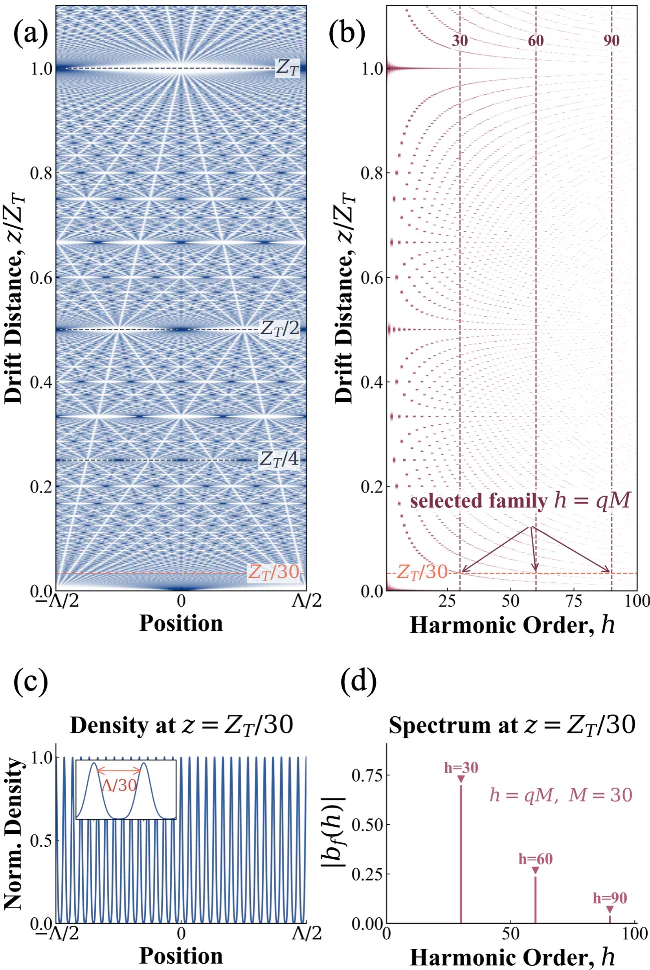
Talbot Self-Bunching and Harmonic Selectivity of Free-Electron Wavepackets
Source: Shanghai Institute of Optics and Fine Mechanics (SIOM) · Research Updates · siom.cas.cn