RUNTO on Why Laser Projector Competition Is Moving from Whole Units to Light Sources
Topics and contents
RUNTO believes the accelerating adoption of tri-color lasers is pushing the focus of laser projector competition from whole units down to light source components. It forecasts global laser projector shipments of 2.405 million units in 2026, with tri-color laser penetration reaching 75% in the Chinese market. HiSilicon recently released five lasers covering discrete single-color and multi-channel integrated solutions, and light source integration is affecting optical engine size, thermal management and overall design flexibility.
Placing tri-color laser penetration and integrated light source solutions within the same design chain shows how light source selection affects projector optical engine size, thermal management and product definition.
This article is about 3,400 words long and should take about 15 minutes to read in full. We suggest following and saving it first, or reading it section by section.
At present, technological change across the global display industry continues to accelerate, with large screens, ultra-high definition and immersive interaction now the core themes of market development. The projector industry is undergoing a corresponding systemic overhaul of its technology and application scenarios.
Within this shift, laser display is gradually emerging as the preferred solution for large-format displays, thanks to its outstanding overall competitiveness in brightness, color, lifespan and cross-scenario adaptability.
Inside the laser projector market, the rapid adoption of tri-color laser is shifting control of image quality from color wheels and phosphor materials toward the laser source. The value of the light-source device continues to grow, and its performance, level of integration and supply capability have become the core variables that determine the upper limit of image quality and the freedom available in whole-unit design.
Laser projection is the only segment growing against the trend in the overall market
According to RUNTO data, global projector shipments totaled 19.206 million units in 2025, down 4.8% year on year, and are forecast to fall further to 17.38 million units for the full year 2026.
However, laser projection has charted a growth path independent of the broader market. Global laser projector shipments surpassed the one million unit mark in 2021, reaching 1.168 million units. In 2024, they topped two million units for the first time, with both domestic and overseas markets each exceeding one million units. Shipments rose against the trend to 2.308 million units in 2025, up 3.7%. RUNTO forecasts that the global market will grow a further 4.2% in 2026, to 2.405 million units.
Global Laser Projector Market Shipments, 2020-2026
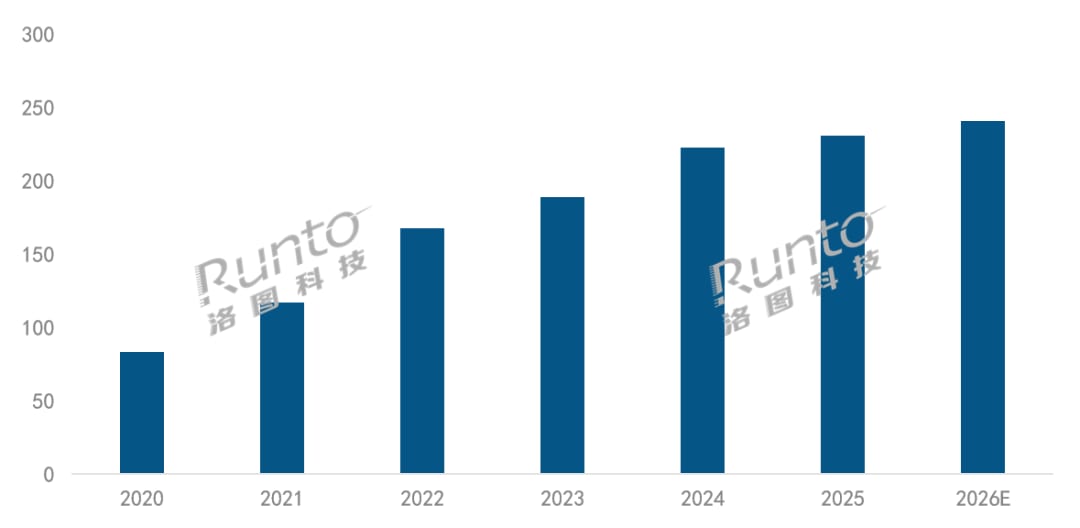
Source: RUNTO. Unit: 10,000 units
Scenarios: Steady Growth in Homes, Major Expansion in Commercial Settings
RUNTO divides the laser projection market by scenario into two main categories: home and commercial. The commercial market includes engineering, business, education and cinema applications.
Home laser projectors currently account for the majority of the market. Over the past two years, mainstream brands have concentrated their R&D resources, expanded their product portfolios and increased channel investment, bringing the home viewing experience closer to projection-grade cinema quality and extending use scenarios from the living room to bedrooms and outdoors. In terms of scale, global home laser projector shipments were still below 1 million units in 2023, rose to 1.506 million units in 2025, and are expected to exceed 1.6 million units in 2026, accounting for about 67% of the overall laser projector market.
The commercial market has contracted somewhat under the influence of the macro environment, with shipments falling from 919,000 units in 2023 to 802,000 units in 2025, and 2026 is expected to remain flat. Although volume performance has been unremarkable, results in scenario-based applications have been notable. Engineering projection is the industry's value stronghold, with demand remaining firm; in addition, laser projection is extending from traditional large conferences and auditoriums into emerging fields such as cultural tourism night tours, immersive exhibitions, digital exhibition halls, and outdoor landmark projection.
Global penetration of RGB laser is expected to reach 50%, with the Chinese market at 75%
In terms of light source structure, RGB laser has become the mainstream solution in the laser industry, thanks to advantages such as a wide color gamut and pure, saturated colors. In 2022, RGB laser penetration in the global laser projection market was only 8.4%; it rose to 37.0% in 2025 and reached 45.7% in Q2 2026, with the full-year share expected to approach half.
The Chinese market has shown even greater momentum, with this share rising from 17.7% in 2022 to 62.2% in 2025, and it is expected to reach 75% in 2026.
2024-2026Q2 RGB laser penetration in the global laser projection market
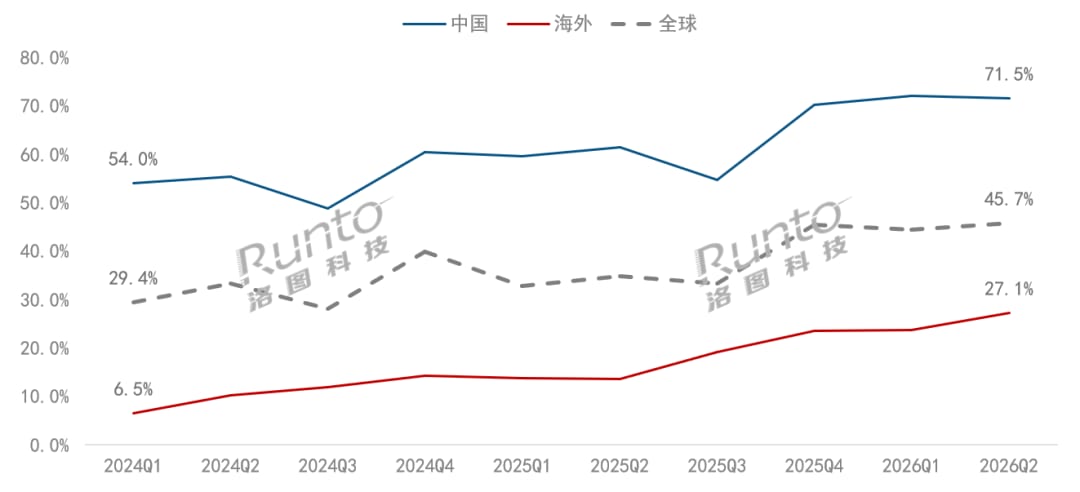
Source: RUNTO, unit: %
Home Laser Projectors Become More Affordable at an Accelerating Pace
According to RUNTO data, in the first half of 2026, laser products priced below 3,500 yuan accounted for 43.7% of unit sales in China's online market, up 12.7 percentage points from the same period in 2025.
As laser shifts from a premium label to a standard feature of mid-to-high-end models, the performance ceiling of the light source itself begins to determine the image quality ceiling of the entire projector. Industry attention and competitive focus have accordingly extended from the complete unit to the light source level.
Home, Engineering, and Stage Applications Put the Light Source Center Stage
The core demands of home use are larger images and higher brightness. In the first half of 2026, 4K UHD models accounted for 71.8% of shipments in China's home laser projector market, up 2.5 percentage points year on year. The brightness mix shifted upward as well, with products above 3,500 lumens gaining 1.6 percentage points year on year to reach 9.7%. Larger images and higher brightness translate directly into requirements for high power density, compact size, and wide color gamut in the light source.
Commercial engineering applications prioritize stable operation over long hours at high brightness. Cultural tourism night tours and digital exhibition halls are currently the most certain growth segments. Data show that China's immersive performance box office grew from about 1.82 billion yuan in 2024 to about 2.5 billion yuan in 2025, an increase of 37.4%. Products deployed in these settings often run continuously for hours, placing higher demands on the color consistency and thermal reliability of the light source. Integrated, modular high-power light sources have therefore become the core choice for engineering optical engines.
The core requirements of professional stage and performance settings center on high brightness and high-power monochromatic output. This approach, in which blue laser light excites a fluorescent color wheel to generate red and green light, is common in large-scale stage productions. The more channels and the higher the module luminous flux, the higher the brightness ceiling.
These three application scenarios push the light source to a position that determines the product's performance ceiling, across three dimensions: color gamut and size, brightness and stability, and high-power monochromatic output.
Light source supply is shifting from discrete monochromatic devices to highly integrated modules,
Optomechanical design is being restructured accordingly
The upstream supply landscape is being reshaped
In the past, projection light sources were dominated by discrete monochrome laser diode devices, with separate red, green and blue emitters. Beam combining, light shaping and thermal management were all designed in-house by optical engine makers. The optical path was therefore long, overall unit size remained high, and batch-to-batch consistency was hard to guarantee.
Today, the industry's supply is gradually shifting toward multi-channel, high-power, miniaturized integrated modules. There are two main approaches. One integrates red, green, and blue into a single module, delivering all three colors from one device. The other performs multi-channel integration at a single wavelength, boosting module luminous flux through multiple blue channels.
HiSilicon's breakthroughs in lasers
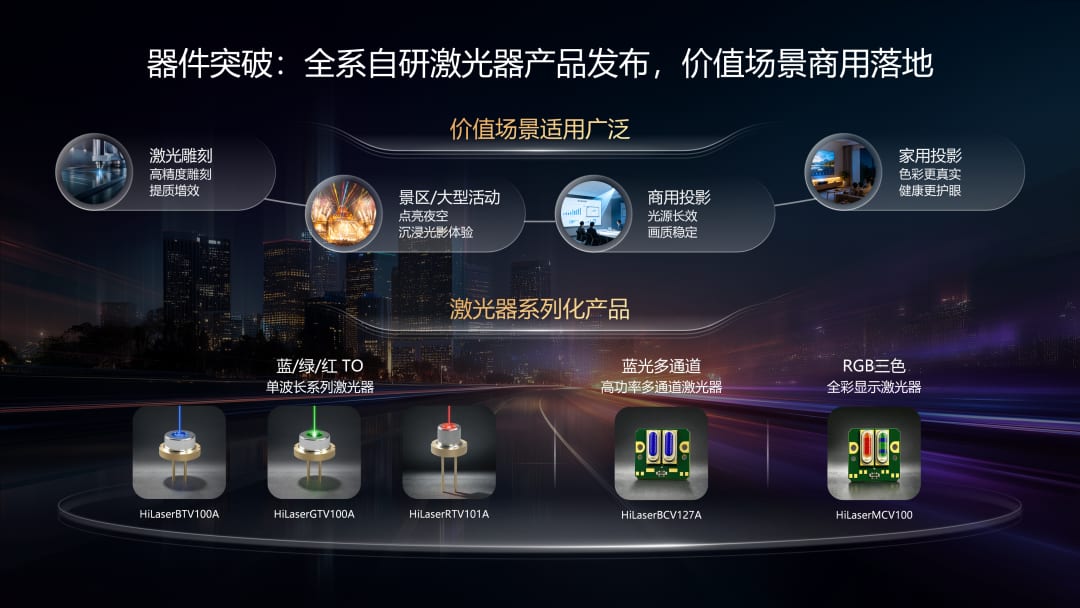
Recently, Shanghai HiSilicon released five lasers at once, a concentrated expression of the above trend. The products span two series. The HiLaser TO series comprises single-die monochrome lasers in three models: red RTV101A, green GTV100A, and blue BTV100A, with center wavelengths of 638nm, 520nm, and 455nm, and typical output powers of 1W, 1.5W, and 6W, respectively. The three single-die lasers can be combined into an RGB light source module, sharing the characteristics of extremely high brightness, exceptional directionality, pure color, and high reliability.
The HiLaser CompLas series comprises multi-channel high-power lasers. The MCV100 integrates red, green, and blue light sources into a single device. Multi-wavelength beam combining and optimized optical path design suppress speckle and improve color transitions, delivering cleaner, finer image quality. Color gamut coverage reaches up to 110% BT.2020, meeting the wide-gamut requirements of premium viewing. The BCV127A is a 14-channel high-power collimated blue laser with high output power and excellent electro-optical conversion efficiency. It sustains stable operation under heavy loads over extended periods, making it suitable for professional high-power applications such as engineering projection and large-scale stage lighting.
Leveraging two major product series, HiSilicon has built a complete laser matrix covering red, green and blue, supporting both single discrete chips and multi-channel integration, suitable for diverse power scenarios such as laser display, home lighting and professional lighting.
The direct benefit of this shift in supply format is a smaller optical-mechanical footprint and better use of space. The less space the light source occupies and the more concentrated and controllable its heat generation, the greater the freedom system makers have in thermal management, optical path and industrial design, and the shorter the product development cycle becomes.
More importantly, the light source is shifting from a replaceable purchased component to a core part that determines the optomechanical architecture. Light source selection is no longer merely the final step in system design; it may become the first. The laser product matrix represented by HiSilicon Shanghai products, covering both single-emitter and multi-channel configurations, will give system makers more options for moving light source selection forward and defining products.
This one-step shift could change not just the design process of a single product, but the collaboration model of the entire supply chain. First, the relationship between system makers and light source suppliers will move from shelf-style price comparison and procurement to deep collaboration around product definition, including joint customization. Second, the light source will move from an ordinary cost item to a core investment that determines the performance ceiling of the system. Third, system makers will focus their attention down to the core component level, and the market will place growing importance on diversified light source supply capabilities.
RUNTO believes that the rollout of HiSilicon Shanghai's laser matrix will foster cooperative, symbiotic relationships among system, module and other manufacturers, ultimately enriching light source supply in laser projection and professional lighting.
Furthermore, competition in laser display is shifting from a comparison of system specifications to a contest of end-to-end capabilities
Looking further out over the medium to long term, the global laser projection growth curve is still trending upward. RUNTO forecasts optimistically that global laser projection shipments could exceed 3.5 million units in 2028. This means laser projection has grown from a premium category into a mainstream major track at the million-unit scale.
The direct result of scale expansion is a rapid increase in participants and product supply. Once brightness, resolution and tri-color lasers all become core requirements, the room for differentiation in system specification sheets will shrink sharply. The core logic of industry competition will then evolve: upstream players will compete on the hardware limits of components, while downstream players will compete on end-user experience.
From the upstream perspective, lasers are the foundation of image quality and product form. Their power, integration solutions, and stable supply capacity determine the hardware ceiling a product can reach, and they are also a prerequisite for brands to achieve differentiated designs and expand into diverse home and engineering scenarios.
From the downstream perspective, user demand for ultra-high image quality will continue to deepen. Rapidly emerging on-device AI is accelerating improvements in image quality experiences. Lightweight intelligence, powered by lightweight on-device computing, uses local perception and device-cloud collaboration to enable environmental awareness, adaptive picture tuning, and natural interaction, turning hardware performance into a stable, comfortable immersive viewing experience. This will become a core way for end products to optimize the user experience.
Original title : RUNTO: The focus of the laser projection display industry is shifting from complete units to light sources
Source: OFweek Laser Network · News · laser.ofweek.com