Laser-Induced Lattice Reveals One-Dimensional Discrete Optical Solitons in Tunable Rubidium Vapor
Laser-made lattice reveals discrete light solitons in tunable atomic vapor
Topics and contents
Topic
On this page
A joint team from the Institute of Physics in Zagreb and PMF has experimentally observed one-dimensional discrete solitons for the first time in an optically induced photonic lattice in warm rubidium vapor. At a probe laser power of about 6 mW, nonlinear self-focusing counteracts discrete diffraction, and the beam maintains an almost invariant transverse profile as it propagates. The study was published in Laser & Photonics Reviews; a model incorporating the full atomic hyperfine structure agrees with the experiment, and the lattice can be tuned via the coupling beam frequency and intensity.
By comparing a laser-written tunable lattice with an atomic response model, this experiment provides a concrete case for understanding how discrete diffraction and nonlinear self-focusing balance each other.
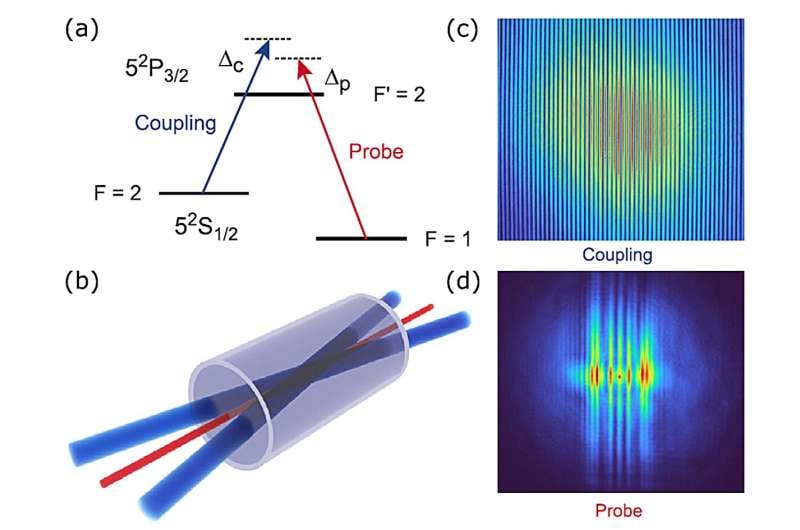
Scientists from the Quantum Technologies Group at the Institute of Physics Zagreb, in collaboration with a colleague from the Physics Department at the Faculty of Science (PMF), have experimentally demonstrated for the first time the existence of discrete one-dimensional (1D) solitons in an optically induced photonic lattice in warm rubidium vapor.
The work was published in Laser & Photonics Reviews.
These results open new possibilities for research in nonlinear optics, photonic lattice physics and complex quantum systems.
Balancing diffraction with self-focusing
Photonic lattices are periodic structures through which light propagates in a way analogous to the motion of electrons in crystals. Conventional implementations of such lattices, for example in semiconductors, lithium niobate, glass or optical waveguides, generally have fixed properties. In this work, the researchers used warm rubidium vapor as a dynamic and tunable medium in which the lattice is created by laser light.
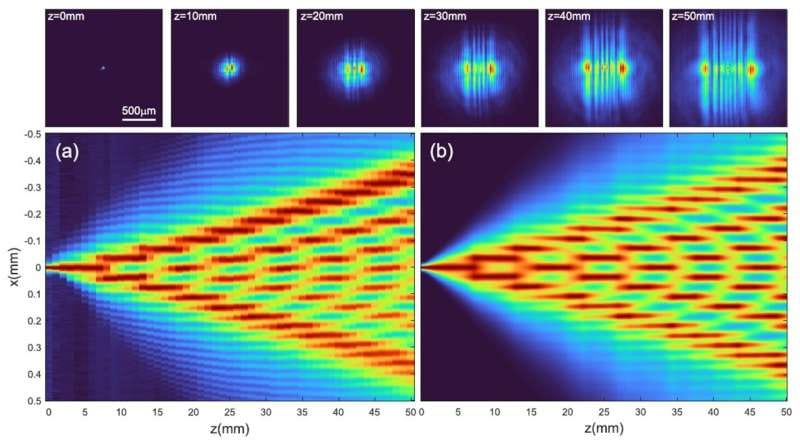
Two coupling laser beams intersect at a small angle inside a glass cell containing rubidium vapor, producing an interference pattern that spatially modulates the refractive index of the vapor. An additional probe laser beam, focused onto a single lattice site, then propagates through the lattice. At low intensity, the beam gradually spreads to neighboring sites. This phenomenon is known as discrete diffraction: because of the medium's periodic structure, light propagation differs from diffraction in a homogeneous medium.
As the probe-beam intensity increases, the response of the atomic vapor becomes nonlinear, and the beam begins to self-focus. At sufficiently high power, this effect can counterbalance discrete diffraction. The researchers thus observed a discrete soliton—a localized beam of light whose transverse profile remains nearly unchanged as it propagates through the medium. In the experiment, the soliton formed at a probe-laser power of approximately 6 mW.
Modeling the atomic response
The physical mechanism relies on the interaction of rubidium atoms with two laser fields in a configuration known as the Λ-scheme, which involves three atomic energy levels. An important role is played by electromagnetically induced transparency under conditions of large detuning from single-photon resonance.
To explain the observed phenomena, the authors developed a theoretical model that couples the paraxial wave equation, which describes laser-beam propagation, with optical Bloch equations describing the response of rubidium atoms. The model includes the full hyperfine structure of the atom, and the good agreement between experimental and numerical results confirms the importance of this approach for describing nonlinear light propagation.
A tunable platform for quantum optics
The particular significance of this experimental platform lies in the unique properties and flexibility of atomic vapor compared with solid-state materials. The properties of the optical lattice can be tuned by changing the frequencies and intensities of the coupling beams, as well as other experimental parameters. Because it allows coherent control of optical gain and loss, warm atomic vapor provides a highly tunable environment for studying non-Hermitian nonlinear dynamics, parity-time (PT) symmetry, dissipative solitons and quantum fluids of light.
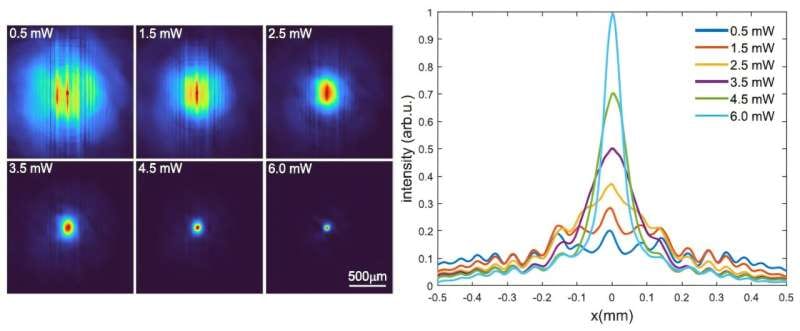
The results contribute to a better understanding of nonlinear light propagation in tunable photonic structures. In the longer term, they may also be relevant to the development of new approaches in quantum optics and atomic technologies, for example in research on quantum memories, atomic clocks and chip-scale devices.
More information
Vjekoslav Vulić et al., Observation of Discrete 1D Solitons in an Optically Induced Lattice in Rubidium Atomic Vapor, Laser & Photonics Reviews (2026). DOI: 10.1002/lpor.71994
Who's behind this story?

Swati Mestri
Swati Mestri holds a bachelor's degree in Electronics Engineering and has worked as a content editor since 2019. She has experience editing research documents across technology, health care, and materials science, and has a particular interest in technology and space. Full profile →

Robert Egan
Bachelor's in mathematical biology, Master's in creative writing. Well-traveled with unique perspectives on science and language. Full profile →
Citation: Laser-made lattice reveals discrete light solitons in tunable atomic vapor (2026, October 21) retrieved 21 October 2026 from https://phys.org/news/2026-10-laser-lattice-reveals-discrete-solitons.html
This document is subject to copyright. Apart from any fair dealing for the purpose of private study or research, no part may be reproduced without the written permission. The content is provided for information purposes only.
Source: Phys.org Optics & Photonics · phys.org