Mao Qian on Fiber Demand Shifting to Cloud Providers and Physical Supply Constraints
Topics and contents
Topic
On this page
Mao Qian noted that control over fiber demand has shifted from carriers to cloud providers, and preform expansion cycles make supply-demand gaps difficult to ease quickly through pricing. A report he released estimates that global optical fiber and cable demand will reach about 630 million fiber-km in 2026, while effective supply will be only 480 million to 520 million fiber-km, leaving a gap of about 110 million to 150 million fiber-km. Preform plant construction takes 18 to 24 months, and product mix shifts combined with supply constraints are pushing the industry from price competition toward value competition.
Linking cloud provider demand with preform capacity expansion cycles explains why structural shortages can persist even when nominal capacity is ample, providing a framework for comparing different fiber categories.
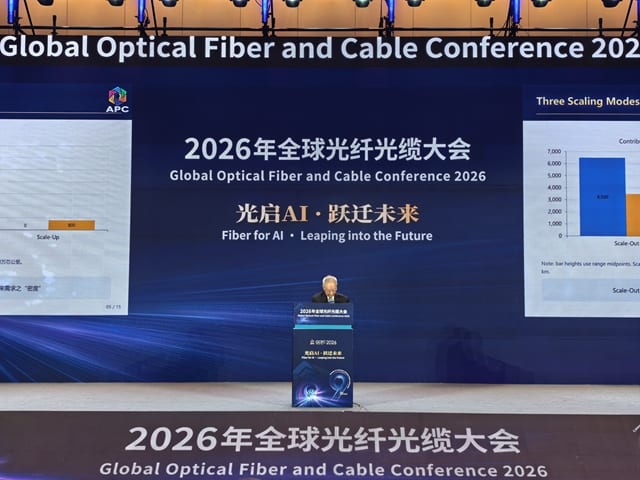
C114 News, October 19 afternoon (Jiang Junmu) - The 2026 Global Optical Fiber and Cable Conference opened today in Wuhan, China Optics Valley. APC Conference Chairman, full member of the Communications Science and Technology Committee of the Ministry of Industry and Information Technology, and Chairman of the Asia-Pacific Optical Communications Committee, Mao Qian, said while releasing the 2026 Global Optical Fiber and Cable Industry Development Report that over the past 20 years the optical fiber and cable industry's fortunes have followed the capital expenditure cycles of telecom operators exactly. From 2019 to 2023 it went through its longest adjustment, with centralized procurement prices falling from more than 60 yuan per fiber-km to less than 20 yuan, and the industry even coined the phrase "optical fiber is cheaper than noodles." But in 2026 this logic chain has been completely broken: optical fiber is gradually becoming the bottleneck component in the delivery of computing infrastructure, pricing power is shifting systematically from buyers to sellers, and the industry is moving from low-price involution to a return to value. He summarized this change in eight characters: out of the trough, priced by computing power.
First, on the demand side, the decision-making power over optical fiber demand has shifted from telecom operators to cloud providers, changing from plan-driven to competition-driven, with lower volatility and a rising rigidity index. The deeper implication of this shift is that traditional telecom demand is driven by operators' coverage strategies, procurement plans are predictable, and KPIs center on coverage rates; AI computing demand, by contrast, is driven by cloud providers' strategic deployment plans, an arms race among tech giants, with construction schedules determined by GPU supply, power supply and land availability, and fiber prices having no decisive impact on construction decisions. This means that even if AI capital expenditure growth gradually slows after 2028, the absolute level of optical fiber demand will not return to pre-2024 levels, because AI data centers' share of total demand has risen systematically. Data confirms this judgment: total global optical fiber and cable demand in 2026 is about 630 million fiber-km, up about 10% year on year; in North America, AI data centers' share of optical fiber demand has jumped from less than 30% in 2025 to more than 70%.
Why do AI data centers consume optical fiber at a higher density than traditional data centers? Mao Qian outlined a triple overlapping mechanism. First, a fundamental change in network architecture: traditional data centers use three-tier aggregation, with fiber connections growing linearly with servers, while AI data centers have fully shifted to full-mesh architectures, with high-frequency, low-latency communication between GPUs, causing fiber connection counts to rise sharply. Second, connection counts grow with the square of the GPU count; N GPUs theoretically require N times one-half of N minus one connection paths, so moving from 10,000 to 100,000 GPUs could multiply fiber usage by dozens of times, and NVIDIA Blackwell GPU nodes require 16 times as much fiber as traditional cloud switches. Third, optical module speed iterations deliver a dual amplification of both volume and price: 400G uses 4 to 8 per port, 800G needs 8 to 16, and 1.6T rises to more than 16; optical module shipment growth combined with higher per-port density creates a cumulative effect.
North American demand is driven in different ways. According to the analysis, Scale-Up is currently the main driver, accounting for about 60 to 70 million fiber-km in North America in 2026 and contributing the vast majority of current North American AI fiber demand, with an expected additional 30 to 40 million fiber-km in 2027; Scale-Across has high per-link value and uses G654.E ultra-low-loss fiber, at about 0.8 to 1.2 million fiber-km in North America, with limited volume but the strongest profit resilience; Scale-Out starts in 2027 and grows fastest, at an expected 6 to 10 million fiber-km in North America, potentially falling to 3 to 6 million fiber-km if OIO technology is delayed. The three will ramp up in sequence, supporting continued growth in North American fiber demand. "In one sentence: Scale-Up determines the quantity of demand, Scale-Across determines the quality of demand, and Scale-Out determines the density of future demand."
Demand is so strong, yet supply cannot keep up. Mao Qian judged that the physical rigidity created by the preform capacity expansion cycle determines that the global optical fiber market will remain supply-tight through 2026 to 2027, and this constraint cannot be quickly eased through prices because production line construction cycles are rigid. The industry's core bottleneck is the optical fiber preform; preforms account for about 71% of fiber production costs, and a 3,500-ton preform plant requires an investment of about 4 billion yuan and a construction period of 18 to 24 months. In 2026, leading global preform makers are generally running at full capacity, with China's effective preform capacity utilization at 84.3% and Corning's North American plant above 95%. Global nominal supply is 995 million fiber-km, far exceeding demand of 630 million fiber-km, but nominal supply does not equal effective supply. Some capacity cannot meet AI data center demand for G657.A2, G654.E and polarization-maintaining fiber; trade barriers isolate some capacity from the North American market; and the preform bottleneck limits the release of fiber-drawing capacity. Overall estimates put effective supply at only 480 to 520 million fiber-km, leaving a supply-demand gap of about 110 to 150 million fiber-km.
The essence of this gap is structural mismatch. Global demand for G657.A2 fiber in 2026 is about 370 million fiber-km, while effective capacity is only 200 to 210 million fiber-km, a gap rate as high as 46%; the polarization-maintaining fiber gap is about eightfold. The North American market is particularly acute: North America's nominal local capacity is about 135 million fiber-km, with actual deliverable volume of 120 to 130 million fiber-km. Corning's new plant will ramp up no earlier than the end of 2027, Prysmian's first project from its acquisition of US capacity comes on line in 2028, and Fujikura will only contribute supply in 2028, so North American local fiber capacity will see almost no increase in 2026 to 2027. Although overseas giants' total expansion investment exceeds 10 billion US dollars and domestic companies are also expanding intensively, the 18 to 24 month expansion cycle means global preform capacity is expected to grow by about 10,000 to 15,000 tons in 2027 to 2028, with large-scale capacity coming online only from the end of 2027 to 2028. The supply shortage in 2027 therefore still cannot improve significantly.
The supply-demand gap inevitably feeds through to prices. Mao Qian noted that three layers of drivers - product mix shift, supply-demand gap premiums, and higher cost value-added - are combining to push fiber prices through a historic reset, moving the industry from price competition to value competition. Bare G652.D fiber in China climbed from 32.25 yuan per kilometer in January to 95.78 yuan in June, an increase of about 197%; G657.A2 rose about 161% and G654.E about 126%. G657.A2 prices in North America reached 21 to 25 US dollars per fiber-kilometer, 2 to 3 times the global benchmark. The first driver is the product mix shift: the market is moving away from predominantly purchasing G652.D toward data center fibers such as G657.A2 and G654.E, with entirely different costs and pricing. The second is the supply-demand gap premium: the G657.A2 shortage rate is 46%, and the gap for polarization-maintaining fiber is even wider, driving price increases far beyond those of ordinary products. The third is higher value-added in cable and connectivity solutions: the average unit price of optical cable is typically 2 to 3 times that of bare fiber, and bare fiber price increases are being passed through to costs and connectivity solutions, shifting value along the chain from selling fiber to selling cable plus connectivity solutions.
The earnings recovery data is even more telling. From 2021 to 2026, sales revenue at major global companies rose from 66.55 billion yuan to 78.29 billion yuan, a compound annual growth rate of about 3.3%; net profit grew from 5.53 billion yuan to 12.62 billion yuan, a compound annual growth rate of about 27.5%; and net profit margin on sales improved from 8.31% to 23.79%, with profit growing more than 8 times as fast as revenue. Mao Qian said this shows the industry's growth momentum comes from price increases and product mix upgrades. The industry has moved from price competition to value competition, and from a scale-driven to a profit-driven approach.
From "fiber cheaper than noodles" to a bottleneck component of computing infrastructure, the optical fiber and cable industry has undergone a revaluation of its status in just a few years. Mao Qian's assessment is a reminder to the industry that this upswing is not a simple cyclical rebound, but the result of simultaneous shifts in demand drivers, supply constraints and pricing logic. As fiber evolves from supporting material for telecom networks to a critical delivery link in computing infrastructure, the question the industry must answer is no longer just how to expand capacity and raise prices, but how to preserve value amid structural mismatches and stay rational in the face of physical rigidity. After emerging from the downturn, whether computing pricing can translate into the ability to weather cycles is the real test of this industrial leap.

Source: C114 Communications Network · Optical Communications · c114.com.cn